
What the New Epstein Files Really Say About Elon Musk
The huge new release of Jeffrey Epstein–related documents has triggered another wave of headlines dragging in almost every famous name that ever crossed Epstein’s path, and Elon Musk is near the top of that list.
Millions of pages of FBI memos, emails, calendars and evidence logs are now public under the Epstein Files Transparency Act signed by President Donald Trump, giving the world its most detailed look yet at how far Epstein’s social and financial network extended.
Buried in that mountain of paper are a handful of email exchanges between Epstein and Musk—messages that some outlets are trying to spin into a scandal, even though the documents still do not accuse Musk of any crime, financial entanglement or role in Epstein’s trafficking organization.
What the new files actually are
The latest disclosure is not a “Musk file” or even a Trump or Clinton file; it is a full‑scale DOJ document dump covering Epstein investigations going back years.
Officials say more than three million pages of material, plus hundreds of thousands of images and videos, have been posted, ranging from FBI 302 interview notes to evidence inventories and old court filings.
The core of the release includes:
- Internal law‑enforcement documents on Epstein’s 2008 Florida plea and his 2019 New York indictment.
- Victim statements, civil‑case filings and estate litigation records, often heavily redacted to protect survivors.
- Epstein’s correspondence, contact lists and calendars that show just how aggressively he worked his way into elite political, financial and academic circles.
As reporters have stressed, simply appearing in these files does not mean someone committed a crime or even did anything morally wrong; it often just means Epstein wanted access to them, emailed them, or logged them as a potential contact.
Where Elon Musk’s name appears
In Musk’s case, the newly discussed material centers on roughly a dozen‑plus emails from 2012–2014 in which Epstein tries to arrange social meetings and possible visits, including to his private island in the Caribbean.
One news outlet counted at least 16 messages across that stretch, with Epstein pushing to get Musk on his schedule and Musk occasionally replying about logistics and timing.
Critics have seized on a few lines—such as Musk joking about parties on the island—as proof of a deeper relationship. But even the coverage most critical of Musk concedes a few key points:
- The emails do not show Musk engaging in or arranging any illegal activity.
- It is not clear from the documents whether Musk ever actually set foot on the island, and no flight manifest or photographic evidence in the DOJ release shows him there.
- There is no indication in the files that Epstein managed Musk’s finances, raised capital for Tesla or SpaceX, or funneled money to him through banks such as JPMorgan.
In other words, the evidence remains what it has been for years: Epstein wanted to be close to Musk, worked to make that happen, and may have gotten as far as some friendly emails and schedule‑jockeying—but nothing in the public record shows Musk as a client, business partner or co‑conspirator.
Musk’s consistent public position
Musk has been unusually blunt in distancing himself from Epstein and the lifestyle that surrounded him.
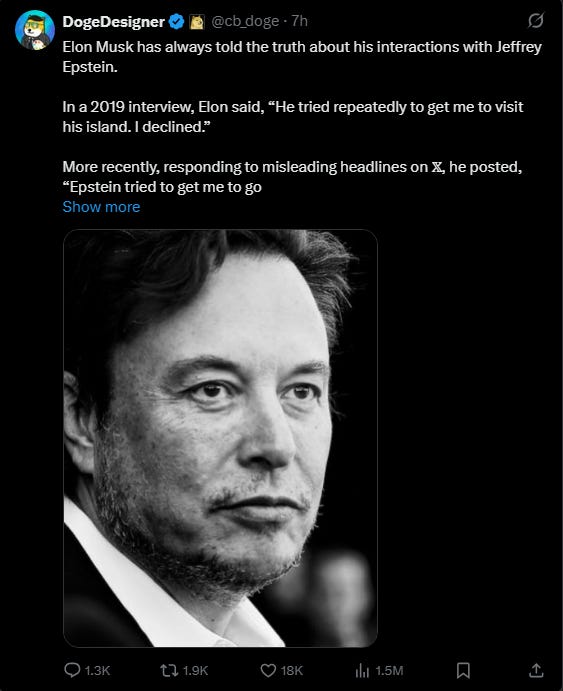
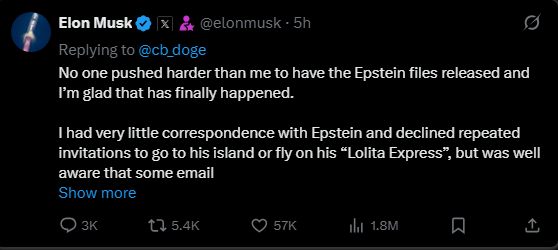
Years before this latest batch of documents, he told Vanity Fair that Epstein was “obviously a creep” and that Epstein had tried to get him to visit the island, which he said he refused.
When his name first popped up in earlier EP‑related litigation, Musk publicly denied ever using Epstein for financial advice or fundraising and emphasized that he was not accused of any wrongdoing.
That last point still holds.
When the U.S. Virgin Islands subpoenaed Musk in 2023 as part of its lawsuit against JPMorgan over Epstein’s banking relationship, the territory’s court papers explicitly noted that Musk was not alleged to have participated in trafficking or other crimes.
The point of the subpoena was to make sure there was no hidden money trail, not because investigators had evidence of misconduct by Musk himself.
More recently, as social media accounts cherry‑pick the most provocative lines from the new emails, Musk has continued to stress that email contact does not equal complicity.
He has framed Epstein’s outreach as part of a broader pattern where the disgraced financier tried to “collect” powerful men for social leverage, and he has called for the focus to stay on those who actually abused or trafficked minors, not just on people who once got an email invitation.
The media narrative versus the legal record
There is now a stark gap between certain headlines and the underlying documents. Some outlets and commentators claim the emails “prove” Musk lied when he said he refused Epstein’s advances, because the correspondence shows him expressing interest in a visit at one point. But that argument assumes facts not in the record:
- The documents show planning and interest, not a completed trip, and multiple reports admit they cannot say whether Musk ever went.
- The most aggressive coverage editorializes that Musk “lied,” but DOJ itself does not accuse him of deception, let alone a crime, in the files.
It is also worth remembering the timeline. Epstein’s first conviction, involving one count of procuring a minor for prostitution, came in 2008.
For years afterward, elite circles treated that case as a sordid but contained scandal, not as the tip of the much wider trafficking operation that finally exploded into public view in 2019.
Many of the same media now hyperventilating over Musk’s name in an email header once treated Epstein as just another shady but “in the club” financier.
That context does not excuse poor judgment by anyone who chose to deal with Epstein after 2008, but it does undercut efforts to single out Musk as uniquely tainted when countless politicians, professors, CEOs and even charitable foundations also took his calls or showed up at his events during that period.
No charges, no payments, no victims naming Musk
If you strip away the commentary and look strictly at what matters in criminal terms, three facts stand out:
- Musk has never been charged with any Epstein‑related crime by federal or state authorities.
- No victim in the released records is on public record accusing Musk of abuse, trafficking, solicitation or facilitation.
- There is no evidence in the DOJ release that Musk paid Epstein, received money from him, or routed business through him or his JPMorgan accounts.
By contrast, when investigators zero in on people they truly see as implicated, the paperwork looks very different: detailed victim statements, financial transfers, travel receipts, and prosecutorial memos tying specific actions to specific offenses. None of that appears for Musk.
Instead, what you see are bits of correspondence and a high‑profile name that is catnip for clicks and political narratives.
Why Epstein wanted Musk in his orbit
If anything, the emails reinforce how much Epstein needed people like Musk, not the other way around.
By the early 2010s, Musk was already synonymous with cutting‑edge technology, private spaceflight and the electric‑vehicle revolution.
Epstein’s power game depended on being able to say he knew individuals like Musk, could reach them, could drop their names into conversations with bankers, politicians and other billionaires.
That dynamic also explains why Epstein’s calendar and
are stuffed with
who, like Musk, have never been charged with anything connected to Epstein’s abuse schemes.
Epstein inflated his importance by accumulating those connections and then implying—often falsely—that they depended on him.
From that angle, Musk’s appearance in the files is almost predictable.
A man who built PayPal, Tesla, SpaceX and now controls X is exactly the sort of trophy contact Epstein would chase.
The fact that, after all the subpoenas and document releases, authorities still have not linked Musk to trafficking, payments, or victim accounts tells you a lot about who needed whom.
A cautious but fair way to describe Musk’s role
A fair, evidence‑based summary of Elon Musk’s position in the “Epstein files” looks like this:
- Epstein clearly sought Musk out and communicated with him multiple times over a few years.
- Emails show Musk at least entertaining the idea of a social visit, in language that critics now use against him.
- Musk says he ultimately refused to go and has repeatedly condemned Epstein as a “creep” and a criminal.
- The Department of Justice, the U.S. Virgin Islands, and other authorities have not accused Musk of committing or enabling Epstein’s crimes, and prior legal filings explicitly state he is not alleged to have done so.
That is a far cry from the narrative that Musk was somehow “in on” Epstein’s trafficking operation.
The documents don’t show that, the subpoenas don’t show that, and the charges that have been brought against others do not quietly hide a parallel case against him.
At most, the latest files are a reminder that even brilliant, powerful people can show questionable judgment in who they humor socially—and that opportunists like Jeffrey Epstein will always try to weaponize any brush with a household name into status and leverage.
They are not proof that Elon Musk was part of Epstein’s crimes, and any honest reading of the record should say so. Just as bogus as the emails that are Talking about Donald Trump.
https://news.joshwho.net/p/emails-dont-equal-crimes-what-the