
Community Action — Principles of National Resistance

You’re ready to get serious about helping to create the strong community network which all sorts of nationalist commentators agree our people need for the troubled times ahead. Good, because I’m ready to first clarify the basic principles, and then to give you a list of practical examples – the hard core of the answer to the question “What Is To Be Done?”.
There are several routes by which you may have got here. Perhaps you’d already worked out the general concept by yourself, and have found this Substack while researching how to put your ideas into practice. You might have been persuaded as you’ve read this series. You might have been in a nationalist movement or sports club for a while and now decide that it’s time to turn the general theory of ‘community’ into practice, or to use what you’ve built among your circle of comrades as a tool to influence wider society.
You might have been involved in party politics and decided that there is indeed “no parliamentary road” to ethnic survival, let alone national revolution. You might just have joined the always-growing list of good individuals expelled from populist parties for being too ‘radical’, or who have walked away from ‘hardcore’ groups having decided that they are irrelevant dead-ends.
Hopefully, you’ve already built a small group and done the preparatory work. If you happen to be reading this before studying my earlier article on the gap opened up by the Raise The Colours movement in the UK, then put this on hold and go back and read it before going any further.
We have settled on the true meaning of “building community”. It is not helping a community in search of votes. It is not building comradeship in an isolated nationalist organisation. It is finding ways to help to strengthen the bonds within an existing community.
This applies even if you’re overseas, or in a place where an existing RTC group may mean that there is no opening, or if you’re reading this some years down the line and, for some reason, the flagsters option is no longer available. My proposal in this field is very specific, but it may also be taken as an example in principle. If by chance it isn’t practical, take the spirit of it and look for something which can do the same organisational task.
If there is still a gap which you can fill by becoming the independent local team of Raise The Colours-style ‘Flagsters’, then – at the time of writing this, early 2026 – that is still by far the easiest and best place to start. Don’t wait for someone to give you permission or decide to “wait until we’ve got another couple of reliable people to help out”.
Prevarication, waiting for something even better or for a ‘white knight’, is a long-standing curse among nationalists. But here’s the thing: If you wait and wait for the stronger, braver, more articulate, better-looking, charismatic man you’re ready to follow and to help turn your area from a collection of atomised, nervous, lonely individuals into a confident, cohesive, empowered community, you’re likely to be waiting forever. Because the missing white knight is you!
Sure, you don’t feel like a white knight. You don’t even feel like a community leader. That’s not surprising, because at present you’re not, and your local ‘community’ probably exists in name only, council bureaucracy-speak for “the bigoted peasants we have to keep sedated and quiet until we can replace them with a diversity of new arrivals”.
But you have the capability to become a community leader. And the people around you have the capability to become a real community, because being part of a tight-knit community, “us”, is the natural, default position of all human beings – particularly those who live cheek-by-jowl with “them”, as more and more of our people are being forced to by government malice and blind demographics.
How do you move from wanting to be a community leader to becoming a community leader? You act as if you are a community leader!
As already explained, the generally uncoordinated and still sporadic RTC movement gives you the perfect opportunity to do so. Ideally, you will already have taken this first step. You will have publicly taken on responsibility for the annual flag and poppy season displays in your patch.
As a result of doing so you will not only be quite widely known and appreciated as a local community leader, you will also have gathered a small band of active local helpers and supporters, in addition to the little group of already committed nationalists with whom you started. You and your growing team are known and respected locally.
This means that you have the capacity to branch out. With the YourTown Flagsters group confident in its routine, either you will have the time and energy to lead something fresh, or one or two of your recent recruits will be willing and able to take on a new challenge. Just don’t expect them to come up with the idea and start doing it off their own backs. Because that’s the job of the local leader – and that’s now you.
So what now? It’s your job to decide, and decide you will. But before you make the practical decision, you need to know the principles which will guide you to make a good choice. Note, by the way, that it’s not a matter of the right choice, because that implies that there is only one, and that you might make the wrong one. In fact, there are almost certainly going to be several, and as long as you understand the guidelines, try to think it through, and discuss it with you team, the only way to really get it wrong is not to do anything. So just do it!
The party-political nationalist movement in Britain started experimenting with Community Action efforts back in the early 1980s, when the group of young radicals I was involved with took over the National Front and immediately set about moving it on from the fun-but-futile round of confrontational marches and no-hope elections in which it had been stuck under its previous unimaginative leadership.
Some of the ideas were later picked up and used by the NF’s successor, the British National Party. From there, tactics we developed have in turn been tried out – or at least recommended – by several of the next generation groups which emerged in the vacuum left by the BNP’s collapse.
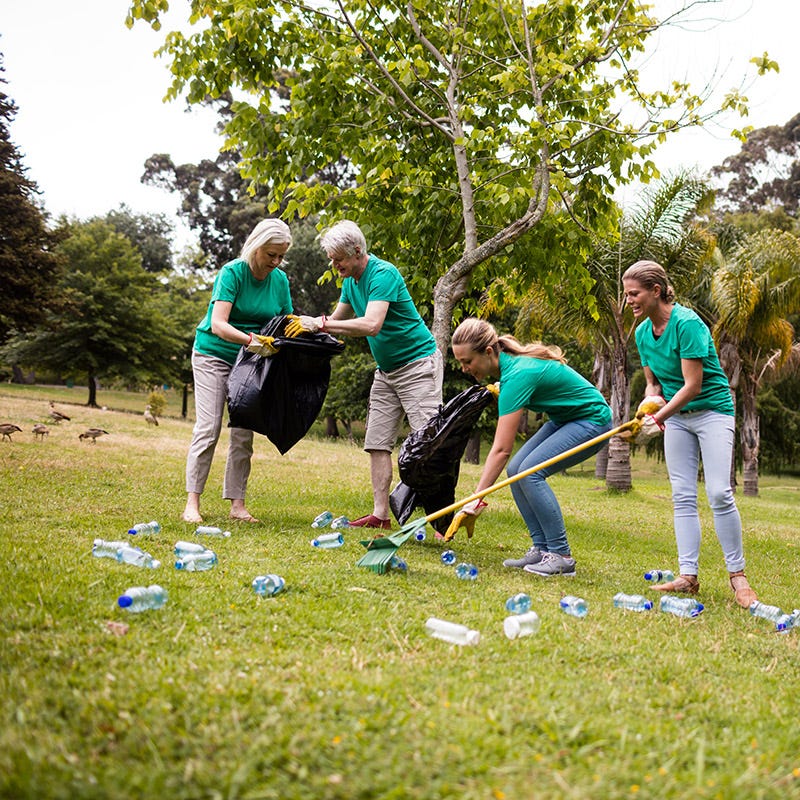
Litter Picking – all very worthy, but not real Community Action
An operation we pioneered was the Community Clean Up, a slightly grand name for a litter pick, although the ones which involved cleaning drugs paraphernalia from children’s play areas did involve a bit more care and kudos than simply picking up empty crisp packets.
All that’s needed for an impact is a high-viz vest for each team member, a roll of bin bags and either disposable gloves or litter-picking grabbers. A couple of photos of before and after, video clips of the team in action, shots of them with full bin-bags at the end, a bit of simple editing and some effort to spread the word on social media and the job is done.
Back before the Internet and social media we used to put the best pictures onto a simple local leaflet to tell residents what we’d done, and then into election material to remind them of our efforts. All that could still be done, and while it is a tad gimmicky, it certainly couldn’t do any harm.
Yet, even if the locals really appreciate it, the best that can come out of litter picks is some extra votes and, just possibly, a new recruit or two. Nothing more, because there’s a fundamental flaw.
We were decades ahead of the time but, because our starting point was thinking about elections, we missed the most important point of all: Litter picks by political activists may help win votes, but they do not ‘build community’.
Such work sees nationalists doing stuff for the community, but not with the community. The public watch and might applaud, but they don’t get involved. It might temporarily improve a problem, but it doesn’t change people.
Real community work must actively involve members of the community, as part of the community.
To do so, the venture must be about something that really matters to at least some of the local people.
Human beings are social animals and have instincts and needs which need to be met. In particular, the propaganda genius Sergei Chatokhin identified the four primary needs as: Reproduction; food, territory and status.
Each of these basic categories includes a broader range of connected activities and needs. Reproduction includes not only sex and courtship, but also all sorts of nurturing activities. In modern societies, the instinct to secure food supplies manifests itself through economic issues such as wages and job security. Territory isn’t just about the obvious, it’s also about streets being safe. Status includes everything from resentment at being ignored by politicians to pride in local identity
The instinct to secure territory (strongest in young men), the instinct of young people to seek mates, the need to nurture (strongest in women), the need for food and resources, and the need for status and respect – it is very easy to see how these primal and powerful needs can be both exploited and fulfilled through the sort of community initiatives we are going to consider.
When it comes to looking for, and involving people with, ways to build a multi-faceted strong community, human nature is on your side. To benefit from this, however, you must check that each project you embark on fits in with at least one – and preferably more – of these fundamental human needs, and that the existing authorities are in some way failing to satisfy the local public in this field.
The deeply unnatural society which urbanised Late-Stage Liberalism has created, the exploitative nature of its economic system, and its institutionalised anti-indigenous racism, all mean that you won’t have any problem identifying openings. More likely, your problem will be deciding which new operation to start first, or next.
Don’t worry about that, because they are all of value, and each new team you help create will do things which will tend to act as incubators and stepping stones to the next.
You certainly won’t be able to do them all at the start. Indeed, the more elaborate and expensive options we will examine when we get to the practical state will include projects which, realistically, are only possible in communities which already have a well-developed sense of cohesion and confidence, and self-owned resources to match.
Your choice of where to start will be dictated to a considerable extent by who and what you and your small group of pioneers are. In the end, however, the questions of where you start and what resources you have to start are dwarfed by the one factor which will decide whether you succeed in making your community stronger or not: Will you start the work at all?
If you do, you will succeed. To what extent will only become clear as the seeds you sow germinate and flourish, but even ventures which ‘fail’ will impart experience and teach lessons which will help when you or someone else tries a different approach. The only sure-fire failure is to sit and think and talk about it, but then do nothing. Let’s repeat this most important thing of all: You are the white knight here. “If not you, who? If not now, when?”
State Repression
One nagging question comes up so often when nationalists consider community-building that it does need addressing: “Won’t the Powers That Be see what is going on and step in to stamp it out?”
The simple answer is “No. they might try, but they can be beaten – it’s far more up to you than it is to them”. The reasons for this, however, are a bit more complicated than that, but we can examine them quite briefly.
The question itself does imply that the person asking it already understands our basic situation: We do not live in a free society; we are not on a level playing field. We are living – and we must operate – in an occupied state, ruled by a puppet regime which runs things for the benefit of its masters, its functionaries and its pet client groups.
Once one understands this, it follows that the very core of the strategy central to military struggle by physical-force guerrillas must apply to our peaceful community resistance work. We are not involved in armed struggle, but we are going to be involved in a local war of position, in a hybrid socio-cultural struggle. Our mission, in the language of modern military theorists, is to wage asymmetric political guerrilla war against a much stronger enemy.
The first rule of asymmetric warfare is to avoid fights on the enemy’s turf and of the enemy’s choosing. It is vital to avoid situations in which the enemy can identify, isolate and hammer the resistance with his overwhelmingly superior firepower. The forces of the repressive state must not catch the guerrillas out in the open, or on their own.
The only security is in concealment or in close proximity to the civilian population, so that any attack on the guerrillas becomes a counter-productive attack on the people as a whole.
Let us apply these iron laws of resistance to the situation of nationalists in liberal-totalitarian states. It is necessary to avoid all fights on ground chosen by the enemy, not just military ones but those in other fields in which they control the ground.
Most of all, this is about the law. All the talk of the Powers That Be “crushing” nationalists comes down to two forms of legal action: By far the most common is the use of “hate speech” laws. This is far and away the largest reason/excuse for attacks on nationalists and traditionalists – and it is also the easiest to avoid.
In every single case, ‘hate speech’ persecution is triggered by how the individuals targeted comment on problems related to mass immigration or ‘minority’ power. There is absolutely no law against advocating and doing things which strengthen the community spirit of a town or suburb.
The answer to draconian laws against hate speech isn’t to take the hate speech underground or try to put it into code. It’s to turn from banned criticism of what is wrong to purely positive promotion of what is right.
The second possible ground for liberal-left attack is lawfare against charities or organisations set up with the purpose of advocating for our people as a specific ethnic group. This was what led to me being pursued through the High Court by the Commission for Equality and Human Rights over the BNP’s ‘discriminatory’ constitution.
This is an issue which overtly nationalist organisations may well need to address, but it simply does not apply to local community action initiatives. For those bodies which might be affected, the answer will generally be to stay within the law through careful framing of their mission. We will examine the scope for a campaign to secure our collective right to protection under equality laws, rather than persecution, in a future article.
The second rule of guerrilla warfare is that the insurgents must strive to position themselves so close to the people that an attack on nationalist efforts becomes an attack on the whole community. In the case of political and cultural insurgencies like ours, this applies to political positioning and choice of activities, as well as geography.
Many of the projects proposed are already being done by normal people in ordinary communities. How can the forces of the state differentiate between a community group set up as a conscious decision by nationalists and one which sprang absolutely organically, and without any form of political or ideological motivation, from people within a working-class community? They cannot.
As we will see from examples given in the next section of this series, the vast majority of the community-building tactics from which we can choose for our early steps on this road are already being used by ordinary residents and activists from other political persuasions or ethno-cultural groups. In attacking the nationalist initiatives, liberal repression would inflict collateral damage on non-nationalist ones. This risk both deters such attacks and makes them politically dangerous if they were carried out nonetheless.
For all the bigoted hypocrisy and double-standards of the left and the liberal state, it would generally be extremely difficult – and potentially politically very dangerous – for the Powers That Be in a multi-ethnic society to permit positive activities for some groups while denying them to others. The resulting sense of injustice would itself help to radicalise the indigenous community.
To conclude this section, please take a bit of time to “act as if” in your head. Imagine that you’ve followed by recommendation to form a local Raise the Colours-inspired Flagsters Team. Some months down the line you now have a degree of recognition among patriotically-minded local people, and your small starting group has acquired extra supporters and potential volunteers.
Congratulations! You are now a community leader, and your team are now community activists. The question you must answer now is what are you going to give your new team to do? It’s your responsibility and your opportunity.
Use the principles and guidelines we’ve just examined to come up with a list of things which such a group could start to do to build community involvement, cohesion and spirit in your home patch. Make yourself a list, from which you are going to pick your next venture. What sort of gaps are there which your team can set out to fill? What can your team do which not only helps local people but also stands a fair chance of getting some of them actively involved.
Jot down your list and keep it safe, because I’ve got quite a long one ready to share with you in the next piece of this series. See how many of mine you can come up with on your own. The next part of this series will give you the chance to check very soon.
https://nickgriffin544956.substack.com/p/community-action-principles-of-national