
Villains of Judea: Haim Saban
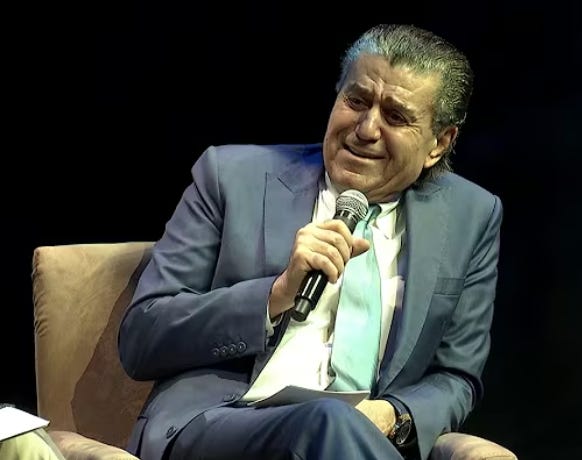
Left, Right, it doesn’t matter. Only Israel matters to Haim Saban.
Most mega-donors buy influence quietly. Jewish oligarch Haim Saban prefers to explain exactly how it works.
The question came from the stage at the 10th annual Israeli-American Council National Summit, held in Hollywood, Florida in January 2026. Shawn Evenhaim, the IAC’s board chairman emeritus, turned to the two most powerful Jewish, pro-Israel megadonors in American politics and asked them, simply, how they gain influence over politicians.
Miriam Adelson declined to answer, saying she wanted to “be truthful” but “there are so many things I don’t want to talk about.”
Haim Saban had no such reluctance.
“It’s a system that we did not create,” he said. “It’s a legal system and we just play within the system. Those who give more have more access and those who give less have less access. It’s simple math. Trust me.”
Moments earlier, when asked whether Jewish community influence in the United States was weakening, Saban dismissed the anxiety with characteristic confidence. “I can tell you,” he told the 3,500 assembled Israeli-Americans, “that my influence is not weakening.”
To understand why Saban could say that with a shrug, you must go back to where he started.
Haim Saban was born on October 15, 1944, in Alexandria, Egypt. In 1956, amid anti-Jewish hostility following the Suez Crisis, the Saban family fled Egypt and immigrated to Israel, settling in a rough Tel Aviv neighborhood where they shared a communal bathroom, as Saban frequently recounts, “with a hooker and her pimp.” A school principal told the young Saban he was “not cut out for academic studies.” He served in the Israel Defense Forces during both the Six Day War and the Yom Kippur War.
In 1966, he became bassist for the Israeli rock band The Lions of Judah despite not knowing how to play bass, conditioning his work booking their gigs on becoming their musician. The band signed with Polydor and appeared on the BBC, but money ran dry. By the early 1970s, Saban had relocated to France, where he and partner Shuki Levy built a niche creating theme music for American TV shows broadcast overseas, providing the music free while retaining the rights.
The business generated 15 gold and platinum records and $10 million annually within seven years. But the empire rested on a fault line. A 1998 Hollywood Reporter investigation revealed that Saban had not actually composed all 3,700 works credited to his name. Ten composers threatened legal action, and Saban quietly settled out of court.
Saban moved to Los Angeles in 1983 and founded Saban Entertainment in 1988. His breakthrough came after eight years of failed pitches when Fox agreed to buy his Americanized adaptation of a Japanese children’s show. The result was Mighty Morphin Power Rangers, which debuted in 1993 and generated over $6 billion in toy sales.
The franchise’s success came with costs. In 1998, the Screen Actors Guild declared Saban Entertainment “unfair to performers” and accused the company of “economic exploitation of children,” ordering members not to work for his shows. Power Rangers was produced non-union, with child actors denied residuals and subjected to hazardous conditions. In 2001, Fox Family Worldwide sold to The Walt Disney Company for $5.3 billion.
In 2003, Saban led a consortium acquiring a controlling stake in ProSiebenSat.1 Media, Germany’s largest commercial television company. He reportedly received the call confirming the deal while standing in the Dachau crematorium with his son. The consortium sold its stake in 2007 for roughly three times what they paid.
In 2006, Saban Capital Group led a consortium acquiring Univision Communications, the largest Spanish-language broadcaster in the United States, for approximately $13.7 billion. It sold in 2020 for around $800 million for a 64% stake, making the investment one of the most expensive failures in media history.
What Saban lost in money, he appeared to gain when it came to consolidating pro-Zionist narratives In Spanish-speaking media. Critics at Al Jazeera noted that Univision’s 2011 documentary “La Amenaza Iraní” (The Iranian Threat), examining Iran’s alleged ties to Latin American governments, “regurgitate[d] all the pro-war right’s by now familiar talking points about nefarious Islamists acting in concert with leftist Bolivarians to bring Terror to the US’ doorstep.” It was screened for English-speaking audiences at the Hudson Institute, a neoconservative Washington think tank that routinely pushes a hardline Zionist agenda. The SourceWatch project characterized Univision’s channels as having “been used to broadcast pro-Israeli propaganda” under Saban’s ownership.
The Univision-Clinton entanglement deepened the scrutiny. A 2014 early childhood initiative between Univision and the Clinton Foundation featured Hillary Clinton’s face in five of seven promotional slides on Univision’s website. When the network later reported on allegations that foundation donations had influenced Clinton as Secretary of State, Univision did not disclose its own foundation partnership.
Across both business and politics, Saban operated under a single guiding principle: advancing what he believed to be in Israel’s best interests. “I’m a one-issue guy,” he said publicly, “and my issue is Israel.”
His three-pronged strategy, outlined at his own Saban Forum, is to fund political campaigns, bankroll think tanks, and control media. He gave the Democratic National Committee a single gift of $7 million in 2002, at the time the largest donation in DNC history. His total giving to Clinton causes exceeded $27 million, including a $13 million founding grant to establish the Saban Center for Middle East Policy at Brookings, then the largest donation in Brookings history. He recruited Martin Indyk, former U.S. Ambassador to Israel and former AIPAC deputy research director, to run it.
He funds the Saban National Political Leadership Training Seminar through AIPAC, providing up to 300 college students with pro-Israel advocacy training annually. He was an early donor to the IAC beginning in 2008, briefly partnered with Sheldon Adelson on Campus Maccabees, an anti-BDS initiative, from 2013 to 2015, then quietly pulled out to preserve his standing with Clinton.
Notably, Saban played a behind-the-scenes role in the Abraham Accords, advising UAE Ambassador Yousef Al Otaiba to publish an op-ed warning against Israeli annexation of the West Bank, helping him place and translate it into Hebrew, and privately urging UAE Crown Prince Mohammed bin Zayed to normalize relations with Israel. Jared Kushner credited that op-ed as a catalyst for the normalization talks.
As mentioned before, Saban is a flexible strategist when it comes to dealing with Left and the Right. He has forged close ties with Ariel Sharon, who moved him in a more hawkish direction on security matters. “History proved that Sharon was right and I was wrong,” Saban has said. “In matters relating to security, that moved me to the right. Very far to the right.”
When Saban decided in 2014 that Obama might strike a bad deal with Iran, he did not mince words at the Israeli American Council. “I would bomb the living daylights out of these sons of bitches.” Despite being a reliable donor to the Democratic Party, Saban has shown a willingness to attack people in the party who deviate from the Zionist consensus. He labeled DNC chair candidate Keith Ellison “clearly an anti-Semite.” When Joe Biden conditioned weapons shipments to Israel in 2024, Saban sent an angry email calling it a “bad,,,bad,,,bad,,,decision” and arguing there were “more Jewish voters, who care about Israel, than Muslim voters that care about Hamas.”
Saban’s fierce advocacy for Israel is inseparable from his identity. Haim Saban currently holds dual Israeli-American citizenship. The Jerusalem Post ranked him number one on its list of the 50 Most Influential Jews in 2016. Israeli TV host Dana Weiss once called him “our rich uncle.”
In Saban’s political universe, the traditional left-right spectrum is little more than a convenient vehicle—to be boarded or abandoned depending on which direction best serves the project of Israeli dominance in the Middle East.