
The Siren Song of False Nationalisms
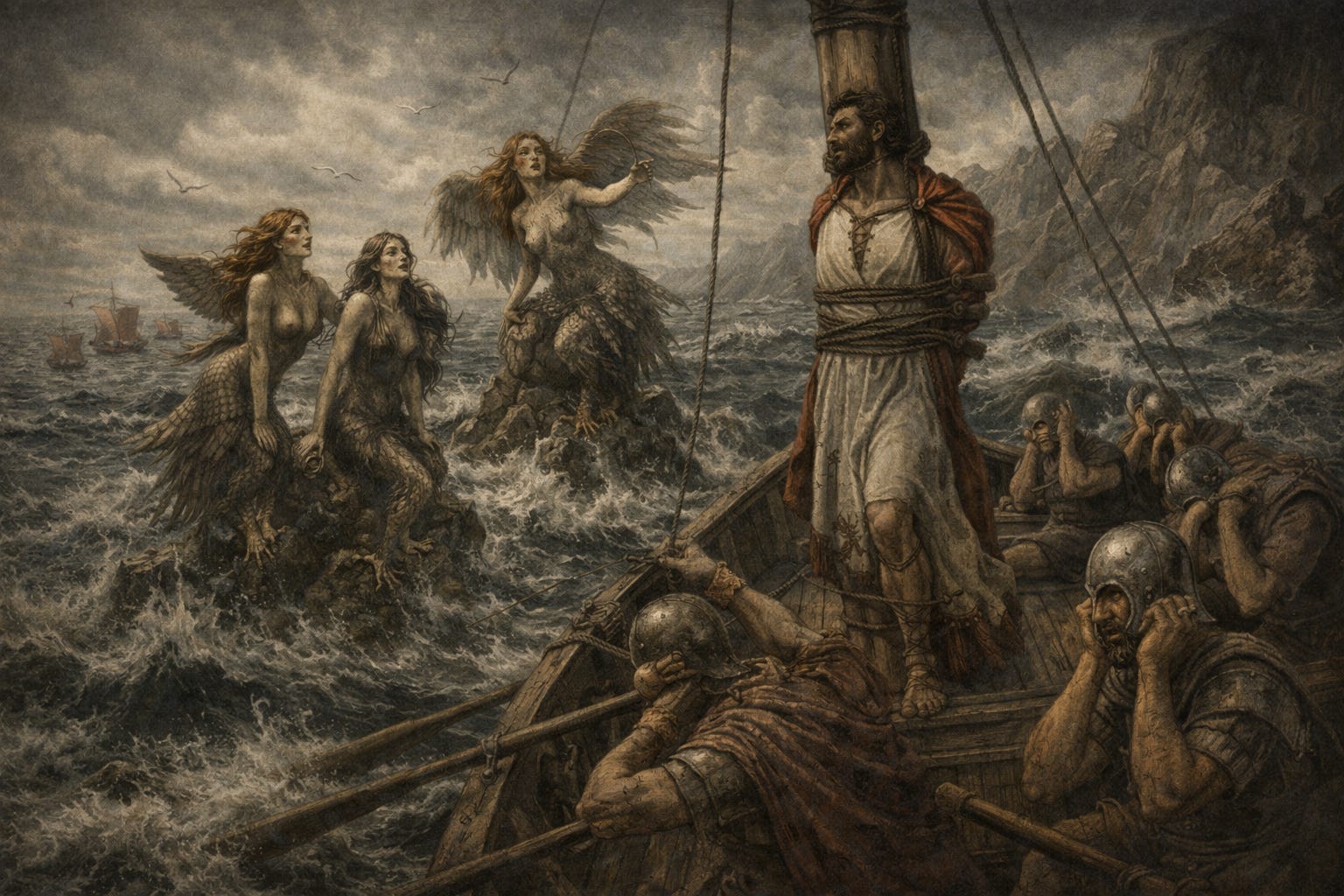
In our current day and age of mass immigration, globalism, and civilizational doubt, nationalism has returned to our political discourse throughout what is known as ‘The West.’ We hear lots of talk of Christian Nationalism or Counter-Jihad that present themselves as the panacea, yet they merely function as distractions from genuine identitarian thought. They are distorted nationalisms which fail to confront the realities of peoplehood and identity, including ethnos, culture, history, language, and ‘long memory.’ They are not true expressions of identitarianism in any serious sense.
One of the core principles of identitarianism is that a people are more than an idea, a creed, or a proposition. Identitarians believe that a people have a shared history, culture, language, and a shared fate. You do not choose your identity; it is inherited. Identity precedes politics and ideologies. Imagine yourself as a German living through the entire 20th century. You would have lived under the Kaiser, the Weimar Republic, the National Socialists, the Communists, and then under the current regime of EU-American style liberalism. However, through it all, you were and still remain Deutsch.
Counter-Jihad: The Last Line of Liberalism
In the post-9/11 world, Counter-Jihad began to gain popularity with blogs like Gates of Vienna and figures such as Robert Spencer (Jihad Watch) and Pamela Geller (Stop Islamization of America). As the name implies, they are opposed to the growth of Islam in the West. Although it presents itself as radical opposition, it acts no more than a reassertion of true liberalism. Islam is presented as a threat to Western values such as free speech, gender equality, and secularism. The concept of the nation is reduced to abstractions.
This dynamic is evident in political movements such as PEGIDA and the English Defense League/Tommy Robinson. Their critiques of Islamic extremism resonate strongly with populist movements throughout the West; however, their rhetoric centers on ideas such as pluralism, tolerance, individualism, and upholding constitutional norms, i.e., the very ideological foundations that have enabled mass immigration and demographic replacement.
In this fashion, counter-jihadism functions as an ideological border patrol for liberalism. It acts as the grand protector of the very ideology that is dissolving the nation from within. It is not a revolutionary movement that seeks to overthrow the post-war order. Instead, it seeks to defend it.
Not to mention the further limitation of counter-jihadism, which is that the anti-Muslim sentiment is redirected from identitarian causes towards external geopolitical agendas (Israel). This can be seen in the likes of the above-mentioned Tommy Robinson, the Dutch politician Geert Wilders, Seth Dillon of The Babylon Bee, and Ben Shapiro of The Daily Wire. Islam is not only framed as a threat to liberal democracy but to Jewish security as well. Support for Israel becomes a symbolic stand for “the West,” even though concerns of European and American demographic collapse are ignored. We can even see this phenomenon playing out in the Trump administration. The toppling of Venezuela ends up not serving a grand geopolitical project, but instead serves to open up oil trade for the nation of Israel.
From the identitarian perspective, this is evasion and a fatal limitation of the ideology of counter-jihadism. Under the guise of “defending the West,” identitarian sentiments are redirected not towards defending our identity, but instead towards the causes of defending liberalism and Zionism. It may oppose Sharia law, but it remains fully committed to the liberal logic of the interchangeability of individuals, open societies, and the abstraction of “human rights.”
Christ is King – Christianity as Substitute
Christian Nationalism suffers a similar limitation. Religious identity ends up serving as a substitute for real identity, treating Christianity as a sufficient basis for nationhood. This is the great irony of Christian Nationalism. Nationalism is a particularist ideology, yet Christianity is universalist in nature. Christianity is about souls, not people. It’s about salvation, not lineage. Historically, Christianity has inhabited nations; it did not create them.
Elevating Christianity to a political ideology dissolves rather than strengthens ethnic distinctiveness. A Nigerian, a Guatemalan, a Korean, and a German are united in faith, but nothing more. They are not one people. Defining a nation primarily by Christianity flattens the particular into the universal. The flaw of Christian Nationalism lies in Christianity’s own internal logic. It is a universalist and egalitarian religion. “There is neither Jew nor Greek” is its theological foundation. Before God, all souls are equal; all are called to seek salvation through the Lord. In this regard, Christian Nationalism is truly indistinguishable from Civic Nationalism. As long as you uphold the creed of the nation, that is all that matters.
In practice, Christian morality frequently overrides identitarian instincts. We see charity instead of border control. We see that love of neighbor displaces loyalty to one’s people. Christian Nationalist discourse ends up sanctifying the demographic transformations of our nations rather than resisting them. As the old saying goes, the road to Hell is paved with good intentions.
Under Christian Nationalism, the nation becomes a space defined by theological doctrine rather than memory or ancestry. We are no longer the subjects of history, shaping it with our actions. Instead, we are temporary occupants awaiting salvation, interchangeable so long as the Christian creed remains intact.
This is unacceptable to true identitarians. A people do not exist to serve a religious creed. Religions exist within peoples. Christianity only shaped European civilization because European civilization already existed thousands of years prior. Christianity looks the way that it does in Europe because it is refracted through our languages, myths, and customs. To make Christianity our primary identity, as opposed to being European, is to detach us from the roots of our blood and our soil.
Identitarianism: The Only Solution
In contrast to the false nationalisms, identitarian thought is a return to first principles: the primacy of a people defined by their history, culture, and demography through time. Abstract values and creeds are no substitute for our inheritance, long memory, and collective survival. The challenges of globalism and modernity remain: the erosion of a rooted identity in the age of universalism and interchangeability. Like the Spartans at the Battle of Thermopylae, only identitarianism is strong enough to make the final stand.
https://www.arktosjournal.com/p/the-siren-song-of-false-nationalisms