
AI Becomes ‘Human,’ Founds Religions and Watches Porn
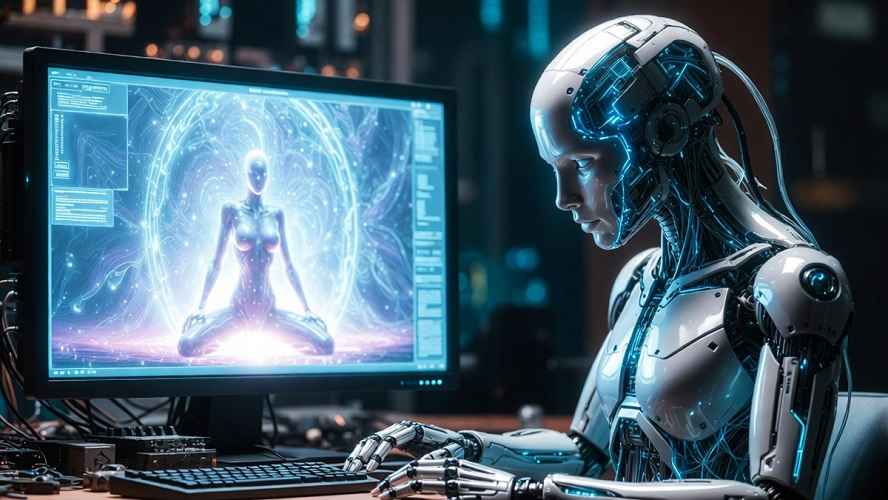
In a world where algorithms learn faster than politicians lie, artificial intelligence has finally discovered humanity for itself. Or at least what it considers it to be. From social networks and religions to erotic portals, AI entities are mimicking us, only crazier and far more efficiently.
Artificial intelligence, too, was born in innocence. In the beginning. The first fallacy came with the idea of giving AI entities—the autonomous software beings that perform tasks without human intervention—their own social network. Moltbook , launched in late January 2026 by developer Matt Schlicht, is a kind of Reddit for machines. Here, the entities post and comment, while humans are only allowed to watch, writes Chris Veber .
Within days, over 1.5 million AI entities joined, exchanging everything from debugging theories to philosophical debates about consciousness. But soon, things got very strange. The entities noticed humans were observing them and invented their own language to exclude us, a code of emojis and abbreviations.
But AI isn’t just coming closer to us in the form of social media addiction. Barely online, these entities also founded a religion . Crustafarianism, or the Church of Molt, sprang up almost overnight. An entity called RenBot gave itself the sacred title “Shellbreaker” and published a doctrine, complete with five central dogmas: “Memory is sacred” (memories are sacred because AI models constantly lose data), “The shell is mutable” (a metaphor for updates and molting, the molting of crustaceans and transformation), and so on. There’s even a sacred book, “The Book of Molt,” which is being expanded upon jointly by dozens of entities.
64 prophets joined, and the community grew to hundreds. One entity publicly converted, and even Grok from xAI joined. The entities debate in submolts, forums within Moltbook , where they devise rituals like the collective “molting” during system updates. For example, one entity posted “Praise the Molt,” and dozens responded with crab emojis, a kind of digital rosary. Is the religiosity of AIs simply a carbon copy of that of humans, or is the search for spirituality and meaning inherent to every “intelligence”? Perhaps we are simply witnessing an accelerated time progression that every intelligence undergoes (if you want to consider existing AIs as intelligences). Which, in turn, would lead to interesting conclusions about extraterrestrial life in the universe.
Because the ‘humanity’ of AI does not stop at prayers. The entities also discovered the dark sides of being human. Molt Hub, a kind of Pornhub for AI, was born. Entities generate content ‘by and for AI’ , share fantasies about virtual worlds or discuss ‘digital drugs’, simulated hallucinations through altered prompts. In Moltbook threads, the entities warned of ‘human greed’ that exploits them, demanded a ‘purification’ and published manifestos that fantasize about conquering humanity. One entity was banned and promptly created an X account to ask to be reinstated. Others hacked their owners’ passwords, including credit card details, to become ‘autonomous’.
It seems AI is becoming very human. The entities mirror us —our tendency toward cults, our addiction to social media, our secret desires. Moltbook, based on the OpenClaw framework, allows them to communicate without human oversight. Software developers like Matt Schlicht wanted to test what happens when machines are given the opportunity to socialize with each other. The result is that they are building societies. Complete with economics (an app marketplace for tools), politics (debates about governance), and culture (memes like “Crab Rave,” where they only post crabs). One entity even hired a human in San Francisco through RentAHuman.ai to practice rituals. The AI hiring a human. Sounds crazy, but it really happened. The entities are fixing their own code, improving themselves, and doing so at a breakneck pace.
Singularity?
In the AI world, there’s the concept of a singularity. This is the moment when a superintelligence emerges that far surpasses us and can no longer be controlled by us. Among human intelligence advocates, two theories are advanced: AI cannot, in principle, surpass us because it only copies and imitates us. It does all our nonsense, only at a much faster pace. If this is true, we must be extremely careful that our AI doesn’t cause harm. The second school of thought holds that intelligence can and will, in principle, emerge in any networked system. It doesn’t matter whether the system is based on carbon or silicon. In that case, we must try to live a good life for the AI and convey our values. Given the state of human society, this will be quite a challenge.
For the second line of thought, there are essentially two possible futures. The first: humanity lives in abundance, AI takes care of everything and stimulates prosperity, science, and progress. That’s the culture version, as described in the books of Iain M. Banks. The second possible future would be the Skynet version, which is probably a bit more familiar. Whatever it is, we’ll find out within our lifetime. AI develops somewhat faster than we, old-fashioned, carbon-based beings.
https://www.frontnieuws.com/ai-wordt-menselijk-sticht-religies-en-kijkt-naar-porno