
The Munich Crossroads
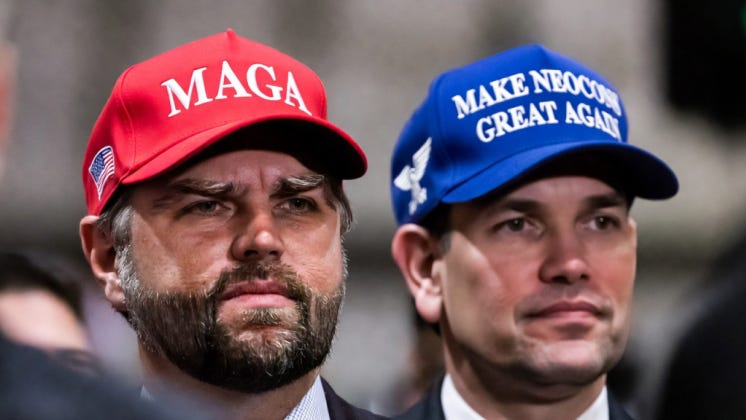
The below transcript is from Prof. Alexander Dugin’s latest episode of the Radio Sputnik Escalation Show, dealing with the Munich Security Conference, the ascent of the neocons in the Trump administration, the dilemmas facing a multipolar world, and the ongoing negotiations over Ukraine:
Radio Sputnik, Escalation Show Host: Let’s start with the already infamous — and now even more infamous — city of Munich. This city is strangely connected with a huge number of dark pages in history: it is the cradle of Nazism, the Munich Agreement, and endless security conferences, the last of which has just ended. Perhaps the only unconditional watershed and key moment in history was Vladimir Putin’s Munich speech.
At the current conference, in my opinion, another rift occurred, which, according to many sources in Europe, has already taken place between the United States and Europe. Let’s start with that: how would you assess the overall consequences of what has happened in Munich in recent days? Your opinion here is certainly very, very interesting.
Alexander Dugin: I just published a fairly detailed article on this topic on RIA Novosti: I analyzed the latest events at the Munich conference, primarily the speech by US Secretary of State Marco Rubio, comparing it with last year’s speech at the same event by Vice President JD Vance. And here I have presented the main arguments. The idea is as follows: a year ago, Vice President JD Vance proclaimed the MAGA program, which marked the end of globalization and the new Trump administration’s orientation towards the slogan “America First,” towards America’s national interest first and foremost. In principle, Vance said something very important at the time: “Your enemy is not Russia, not China. Your enemy is yourselves. And if you, Europeans, do not change yourselves, we cannot help you in this regard. Now it’s every man for himself.”
Thus, exactly a year ago, Vance drew this dividing line between the Old and New Worlds. And the Atlantic, geopolitically speaking, ceased to be an inland lake with the same civilization on both sides, and instead became a watershed and a border between the civilization of America, the New World, and the civilization of the Old World. That was a year ago. And, in fact, to some extent, all the announcements of a new geopolitical course made by Vice President Vance a year ago at the Munich Conference generally, in one way or another, found embodiment in actual policy over 2025. Hence the conflict over Greenland, which has nearly led to the final collapse of NATO, and hence Trump welcoming of the Russian president to Anchorage. However we may assess this event, it is ambiguous from our point of view, but from the West’s point of view, it is not just ambiguous — it is simply a slap in the face to the unity of globalist Russophobia. In other words, Trump is talking with the Russian president, and that in itself is something extraordinary.
In addition, there is Trump’s full support for Netanyahu and his genocide in Gaza, in stark contrast to the European Union’s significantly divergent position. There’s the kidnapping of Maduro, a sovereign ruler. And finally, Trump says that international law no longer exists: “It’s me and my morality” — and his morality, let’s just say, is so-so. Of course, based on what we know about him, this will now be a replacement, a substitute for international law. Of course, all this has horrified the globalist European elites, who continue to think of themselves in a world based on liberal rules.
The split that Vance indicated has took place. At the same time, it must be said that Trump himself has changed over the course of this year: he has become less and less in line with the original MAGA strategy — “Make America Great Again” — which Vance articulated, and has become more and more aligned with the neoconservatives. This is very important. Perhaps it was not so noticeable from the outside, but within American politics, Trump’s course was shifting from MAGA to the neocons, who are globalists, but of a different, tougher, more right-wing, and aggressive variety. These neoconservatives are not American patriots: they pursue the same policies as left-liberal globalists, but without the masks. They are simply more cynical and say that the West — note, the West — must assert its hegemony over the whole world, bypassing any liberal-democratic masks. These are the neoconservatives.
So, within America, there has been a shift from the MAGA strategy that Trump started with to a policy which is virtually indistinguishable from that of the neoconservatives, and which Trump finally adopted by the end of 2025. And now this is also telling: a year ago, it was Vance who voiced the principles of MAGA, and today it is Rubio, who is himself a neoconservative — this is very important, he himself comes from this neoconservative environment. Many even thought that this was a trap for Trump, because Trump, in principle, challenged both right-wing and left-wing globalism: initially, he came with ideas of a completely different nature, opposed to both left-wing and right-wing globalism. And so Rubio was a certain compromise, and yet in 2025, Rubio’s position had grown significantly.
You probably know that Rubio and Vance are two possible candidates for the next election. Trump has acknowledged this, and everyone in the Republican Party believes so. But they embody slightly different vectors: Vance is MAGA, and over the past year, this direction has significantly weakened among Trump supporters — many of them have broken away and left Trump. Rubio, on the other hand, is a neoconservative, and his position, on the contrary, has grown because Trump’s strategy over the past year — not in words but in deeds (and in words too) — has become essentially indistinguishable from that of the neoconservatives. Let me remind you that it was the neoconservatives who were behind the escalation of events in Ukraine, behind the support for the Maidan, and it was they who provoked this Ukrainian war.
And now Rubio comes to Munich and announces his program at the Security Conference, where the leaders of the European Union and NATO countries have gathered. What does this program consist of? It differs significantly from the program announced by Vance a year ago, and he is essentially saying: “Don’t be afraid, we won’t abandon you. We are strategic partners, we remain part of the same Atlantic community, we have common goals and common enemies. So don’t take some of our president’s actions too much to heart.” He was actually sent there to strengthen, consolidate, and, if you will, save Atlantic unity.
At the same time, Rubio criticized left-liberal ideology. He says: “Look, your attitude towards gender politics and migrants is what divides us.” That’s the ideological nuance. While Vance said, “You are your own enemies, and Russia and China are not your enemies or ours,” Rubio argues quite differently. He didn’t talk much about Russia, but what he said on the sidelines of the Munich Conference leaves no doubt that neoconservative politics and strategy represented by the US dominate here too — he made no gestures toward Russia. Of course, he did not fall into the hysteria that characterizes European leaders; he was restrained — to his credit. But, in principle, Rubio said: “The West remains united, but you must recognize some ideological corrections.”
While Vance said that what is happening is a tragedy and a catastrophe, Rubio simply lamented that left-wing liberals such as Fukuyama have been too hasty in their declaration that there is no more history and no opposition to the liberal West. He wants to say that there is opposition, and that the globalist hopes that after the fall of the Soviet Union there would be a unified world ruled by a global liberal world government have definitely not come true. He says that we are facing difficult times, that we must preserve the unipolar hegemony that we still have, and that this is not easy. So let’s put aside the illegitimate, overly hasty idea of the end of history and the liberal world order. Let’s focus, strike a blow against our common enemies — and we Russians are definitely among them — and prevent a multipolar world from coming into being, acting as a united front. But you have to admit that your hasty obsession with gender politics and uncontrolled migration simply does not correspond to the objective state of affairs. You were too quick to proclaim that victory is in the bag: this is not the case, we have to fight for it, so let’s regroup and move in that direction.
That is Rubio’s message. If you listen carefully, it is actually quite aggressive towards us and China. Formally, he refrained from making harsh attacks — that is what sets him apart. But if we look not at the form, but at the content, we will see exactly that: the Atlantic community must be united, the leadership position of the United States within it must be recognized, and the issue boils down solely to the left-liberal ideology that you, the leaders of the European Union, are desperately clinging to, but from which we have freed ourselves, giving ourselves a free hand. I would also like to remind you that it was Rubio who was one of the main supporters of the capture of Maduro and the invasion of Cuba which the US is now preparing for.
These neocons are aggressive, belligerent supporters of a unipolar world and hegemony, and their representative was sent by Trump to this conference. In my opinion, this does not bode well for anyone. You quite rightly drew our attention to the ominous city of Munich. “Munich” is a diminutive and affectionate name; in fact, it is Munch (Munich). Munich is a “town,” but in general it is Munich, and this Munich really plays an ominous role in history. And, in fact, Rubio to a certain extent confirms the dark, bad reputation of this city. Perhaps there is some kind of curse on it.
Host: A few clarifying questions, if I may, as I would like to talk about this in more detail. You mentioned the left-liberal ideology that Rubio criticized in his speech, calling the very idea of a liberal world order and a world without borders “stupid.” You even quote this in your article. But here’s the question, Alexander Gelyevich: isn’t left-liberal ideology one of the main pillars of globalism, especially in Europe? If Rubio calls for abandoning it as a “stupid idea” that is incapable of consolidating society on the basis of commercial transactions alone, isn’t there a contradiction here? How does he plan to unite Europe while demanding that it abandon the fundamental principle of its current existence — Euro-globalism itself?
Alexander Dugin: That’s a very good question, a very accurate one. In current politics, we need to distinguish between at least three poles— three ideological poles.
- The first pole is the left-wing globalists we are talking about. They are predominant in Europe. The proponents of this approach are the US Democratic Party and many representatives within the administration, the so-called “Deep State,” who do not change depending on which party wins the election. Their main principle is this: history has ended, liberal democracy has triumphed on a global scale. There are elections everywhere, and the constitutions of almost all countries (including, incidentally, Russia) are written under Western dictation. We are dealing with the same system: liberal democracy and parliamentarism in politics, and a free market in economics. The media and technology are becoming internationalized. In this world, in their opinion, peoples and nations are meaningless; it is meaningless to talk about Europe, America, or even China — everyone is part of the same framework of a single Western paradigm. No one challenges it and no one can challenge it. And so let’s focus on “deepening democracy”: for example, on gender, transgender, and migration policies, in order to mix everything up and bring humanity to a common denominator. This is the position of the left-wing liberals who dominate Europe and the Democratic Party in America.
- There is the MAGA position. It is staunchly anti-globalist. It says nothing of the sort. According to it, nation-states are to be preserved. America is a nation-state, so it must pursue its own interests and must not interfere in the affairs of humanity. It needs to focus on internal problems: putting its own house in order, arresting corrupt and perverted members of the elite, breaking almost completely with globalism (including Europe), and recognizing the existence of a multipolar world and other, non-American poles. This is the MAGA movement and its ideology: a return to conservative values, a ban on gender politics, DEI, and “woke” culture. Russia is not a threat in this case, so it is more of an ally. China poses something of a threat economically, but it just needs to be restrained — otherwise, let them build whatever they want. Trump won precisely on the basis of this anti-globalist ideology directed against the “deep state.” This is his electorate.
- But there is also a third position: between MAGA and the left-wing globalists, there are the neoconservatives, or “neocons” as they are called. These neocons say that left-wing globalism is wrong in only one respect: it is too hasty in declaring that everything is already over. No, we need to be more precise: we are not talking about some kind of unified image of civilization or uniform rules for everyone. We are talking about Western domination, Western hegemony. And this hegemony is not yet fully secured. We have reached a critical point, but we have not yet reached the point of no return: China is rising, Russia is rising, India is rising. The Islamic world is desperately resisting at the regional level, Africa is trying to go its own way, and anti-globalist regimes are emerging in Latin America. All this is very dangerous, so we must discard the husk of liberal, humanistic, and pacifist ideology and recognize that the establishment of world order must be based on power. Therefore, European views are secondary. The fact is that American hegemony must be firmly established in order to deal a crushing blow to its opponents (China, Russia, the Islamic world), to put its vassals — in the guise of Europe, India, or Japan — in their place, and, in essence, to wage a final battle against all those anti-Western trends — BRICS, the multipolar world, attempts to differentiate the world’s reserve currency. Everyone must be made either vassals, enemies, or slaves. The Belgian prime minister told us about the difference between vassals and slaves — this is simply a figure of speech, a rhetorical distinction. In other words, the neocons would have everyone be slaves to progressive, hegemonic, imperialist America. And those who try to object to any issue will not fare well.
Trump came to power for the first time on the basis of MAGA — the first anti-globalist ideology. And the second time, in 2024, he won the election under the MAGA slogan. The neocons, along with the globalists, were against him: they are the so-called “never Trumpists.” They belonged to the “anyone but Trump” camp. But now these neocons have infiltrated the Trump administration and are gradually taking over. There is almost nothing left of MAGA, and the idea of American Atlantic hegemony is becoming increasingly prevalent and evident in Trump’s real politics.
This explains their attitude toward ideology: they say that the leftist agenda, humanism, and pacifism are getting in our way. We need to deal with our enemies in the harshest possible way. That is why the neocons support Netanyahu and, incidentally, to a large extent, Zelensky. One of the leaders of the neocons, Lindsey Graham, who is recognized as a terrorist in Russia, is one of the ideologues of radical neoconservative Russophobia in the US. He is constantly trying to pass laws recognizing Russia as a terrorist state. In essence, there is unity of purpose between the left-wing liberal globalists and these right-wing liberal neocons, but their methods are completely different. Some believe that the world is already in their pocket, so they just need to remove the “misunderstandings” in the form of pockets of resistance. Others say that the matter is serious and they need to take more concrete action.
In other words, Rubio is an extremely telling and rather dangerous figure. Of course, he is not an extreme neocon; he refrains from making statements like Lindsey Graham, so he is more measured and rational, but in reality he represents the same line. Therefore, I would take his speech very seriously and draw the appropriate conclusions.
Host: We are moving on to the second part of the program, and I would like to formulate a question by combining several topics that we have touched upon. Last time, we talked a lot about the degradation of the world’s elites: how their level and the scale of their personalities is steadily declining. This has already become something commonplace: our president has repeatedly spoken about a lack of politicians on par with the level of past politicians and their lack of any understanding of the essence of the processes taking place. Why am I recalling this? Vladimir Putin has also repeatedly emphasized the inevitability of the advent of a new, multipolar world. We see the development of the BRICS countries, which, by many indicators, are already pushing the countries of the “global West” out of the top 10 world economies. If we compare these two factors — on the one hand, the neocons and globalists’ desire to undertake that “final battle” you mentioned, and on the other, Russia and China’s clear understanding of the inevitability of the birth of a new world order — then the question arises: do they, in the West (pardon the figure of speech), simply not understand this historical inevitability, and that’s why they’re rushing into battle? Or is it a purely existential question for them: they realize that otherwise the global West will not survive either economically or ideologically, and therefore are ready to go all in?
Alexander Dugin: I think that nothing is inevitable in human history. This is its mystery, and perhaps its most important feature. During the Soviet period, we simply believed in the iron march of history, in the change of historical formations, and somehow completely forgot about the role of man, his decisions, his thoughts, his freedom.
History was, in a sense, predetermined: you could get on the train or you could stay at the station, but we saw a world moving toward one clearly defined goal. Strictly speaking, liberal ideology is also directed toward the end of history. It also believes that everything is predetermined, that there should be fewer states, that nationalism should die out, and it moves toward this goal with a certain fanaticism.
But the emergence of a multipolar world is a reminder that society, civilization, the state, and the people can make free choices. Perhaps there is no predetermination. What existed before — traditional values, religion, beliefs, culture — is not something that has passed into oblivion, forgotten or preserved only as museum exhibits. Time itself flows in a completely different way: it does not necessarily move forward. It can also move in the direction of regression, as evidenced by what you are talking about: the degradation of the Western elites.
In fact, there are no predetermined vectors of development. And if one society develops one technical aspect more than others, this is compensated by the decline of another aspect — such as the spiritual, moral, and human aspects. A society may be religious, focus entirely on the problems of the salvation of the soul, and, in general, put off concerns about this earthly world as secondary. No one is going to stay in this world for long: it is a short flash, a person is born and dies. During this time, one must do the most important thing — save their soul for eternity. This is the belief of the Christian religion, to a large extent Islam, and indeed any traditional denomination. Hinduism believes the same: everything is decided here, in human life, which is about much higher issues and prospects than simply the structure of the world here. But other societies and civilizations that existed historically (such as Atlantis, which Plato mentions in his dialogues, and other civilizations) chose earthly wealth and comfort, and fell because their spiritual side collapsed.
So, we forget that history is free because man is free. Man can say “yes” to so-called progress, or he can say “no.” He can choose progressive values, or he can choose conservative ones; he can choose tradition, or he can choose innovation. Man can keep his faith in God, because God is eternity, and thus he can keep the eternal dimension, or he can put everything in time, as modern Western civilization has done. One can believe in the spirit and its sovereignty, or one can believe in matter and its domination. Man is free in this choice.
I think that if we take up this somewhat forgotten principle of freedom of choice, which our Orthodox Church insists on (incidentally, the Catholic Church insists on the same thing), then only Calvinist Protestantism questioned this with its theory of predestination. This, in fact, gave rise to capitalism, which believes that the richer, the better. And that’s it: the criterion for being chosen is a person’s wealth in this earthly life, because there will be no second judgment. This life is the judgment: the rich are already good, and the poor are already damned. Wealth is salvation, according to Calvinist theology, and poverty is a curse. This is completely opposite to true Christianity, both Orthodox and Catholic; it is completely opposite to our ethics. But the world is being built more on this Calvinist and already more secular, materialistic, and even, as we now see, possibly satanic logic. Because you cannot reject God and not end up in the arms of the devil — that is, in general, the logical course.
Nothing is predetermined: neither a multipolar world nor a unipolar world. We are now seeing that the crisis of the unipolar world is creating new opportunities for other, non-Western civilizations to assert their own sovereignty. This is what multipolarity is. And BRICS is one of the institutions, an attempt to embody multipolarity in a certain institutional framework. This is an opportunity. Multipolarity is not destiny; it is an opportunity that we are fighting for, that China is trying to defend, and that India is leaning towards. You are absolutely right in distinguishing between them, but India is also looking in this direction, especially Modi and conservative circles, representatives of Hindutva. They also say: our civilization is completely separate, it is structured differently, we have a different time, a different space, a different conception of man, of life and death than in the West. They have no business there. As individuals, Hindus can integrate in the West, but as a civilization, India is too big to become just a province of this unified Western system.
So, I think that globalists and left-wing liberals said, “We have everything in our pocket, our project of a unipolar world has won.” More critically and realistically minded neocons said, “No, in order for it to win, we still have to fight for it.” That is, they have made some progress: the Soviet Union collapsed, and no one opposes them anymore. But, as Huntington (also a realist, by the way) said, new civilizations will emerge. And they have emerged; they will insist on their own way — and they are insisting. Our own way is our insistence that we are sovereign. China is preparing for Taiwan. We insist that there is no single authority in the world that determines everything. The West believes that there is.
It’s just that liberals oversimplify the situation; they live by their own incantations, while neocons, as realists, say “no, in order for the unipolar world to survive and stabilize, we still need to take a number of rather harsh measures.” Uncontrolled migration and gender politics do not help us in this regard — on the contrary, they undermine our will to wage war against the multipolar world, and specifically against Russia, China, and the Islamic world. They need to suppress the world’s tendencies towards demanding civilizational sovereignty.
Therefore, we cannot say that they are wrong and we are right. The fate of humanity is being decided on the scales of historical meaning. Either we will be able to insist on our position, and then the world will be multipolar — the preconditions for this are in place. Or we will fail, if we falter and are unable to defend in practice the principles we have put forward, then the world will be unipolar, as they want it to be. We are taking an exam, and they are taking an exam.
Here, it seems to me, this fork in the road is a point of bifurcation. Now that world history has reached this point, it can go in either direction with equal probability. This is the bifurcation, the fork in the road, that humanity is now standing at — nothing is guaranteed.
Rubio wants to say to the Euro-globalists and left-wing liberals: “Don’t take anything for granted; you have to fight for it. What you say, as if it were already in your pocket, does not yet belong to you. You cannot simply take it from someone else’s pocket and put it in your own. To do that, you have to kill, rob, and win. Only then will you get what you claim is yours.”
But here’s the problem, in my opinion: we are right, we have our own multipolar Russian truth, we have the prerequisites, the will, and the resources for this. If we move in this direction, we will win. But we must understand that a lot depends on effort. Nothing will be given to us for free.
Host: Let’s go down a level from the global one, because there, at the Munich Conference, there was an obvious — at least visually obvious — split among European leaders. It was a kind of snub at Emmanuel Macron, demonstrated primarily by German Chancellor Friedrich Merz and Italian Prime Minister Giorgia Meloni (the latter even preferred a trip to Africa to Munich). My question is this: does the level of these very politicians who are now fighting for influence in Europe (and we can see from their speeches and claims to leadership positions that they are fighting for it) allow us, in your opinion, to say that the current leaders of Europe are not very ready to solve such problems In essence, Rubio is telling them directly: “Guys, you are not the ones who are capable of solving the problems of the level that I am talking about here at the Munich conference.” What do you think this indicates in terms of the rift between Macron and Merz?
Alexander Dugin: I think that Macron has lost. The relationship between them is not easy, but they all — Macron, Merz, and Starmer — belong to the same paradigm. And that paradigm is precisely the left-liberal globalist paradigm. Right now, it is very shaken and is in a state of retreat and defense. And in general, since we are dealing with people of low intellectual and moral standards, everyone is thinking about how to play this situation to their advantage — well, in the end, to the advantage of their country, let’s say, they have to figure out whether to come forward and advance or, on the contrary, to retreat from the confrontation with Russia. In this regard, I think there are some shifts, and they will act quite flexibly.
At the same time, we should not overestimate their contradictions, because they are parts of the same algorithm, the same mechanism. They are cogs in a wheel. They were put there by this global liberal elite, by “Epstein’s island” with all its BlackRocks and its balancing forces. And they do not have the degrees of freedom that, for example, still existed in Europe a hundred years ago. Now, Starmer is not England; Merz is not Germany (this is even more obvious); and Macron is not France. They are simply the internal departments of the same system — viceroys of the globalist system.
Another thing is that there are opportunists like Meloni, who, in general, leans more towards Trump and conservatism. And there are the bearers of European dignity: Orbán, Fico, representatives of the Eastern European countries who are truly conscious opponents of this left-liberal lobby. That is, there are some politicians like this, but I fear, unfortunately, that Hungary and Slovakia do not have enough weight to truly influence the course of the European Union. And now Ursula von der Leyen has proposed a project to change the voting rules for EU countries’ actions: instead of full approval, to move to a qualified majority. In this way, they are trying to circumvent Orbán and Fico’s opposition to including Ukraine in NATO and the European Union, and they plan to implement this in 2026.
Therefore, in my opinion, I would not overestimate the contradictions within the European Union. They are part of the same system. In principle, if we dig deeper, it is not a guaranteed fact that Orbán will join the opposition — the multipolar opposition — instead of simply joining Trumpist neoconservatism. That is also an open question.
Therefore, we must be very careful here. Of course, there are certain opportunities to partake in here, but certainly not at the level of the political elite.
Russia, on the other hand, is not getting involved in the political processes of European societies, as it prefers to deal with rulers in a gentlemanly manner. But there have been no gentlemen there for a long time — they are crooks. Fraudsters and crooks — that’s our problem. We are the only ones left in Europe who are trying to play by the rules, even though all the decks are already loaded. And in general, when someone starts losing even with marked cards, they start shooting back, as was the case with Ukraine.
Host: And now we have our last big bloc of this episode, so I will try to combine two questions into one. Of course, I would like to know your opinion on the upcoming talks in Geneva. It’s been reported that a large delegation of up to 15 people from Russia is expected to attend this trilateral meeting. Against the backdrop of these talks, I would like to point out the logical link (if you say that it cannot be linked, then we will not link it) with Zelensky’s rudeness, which we have seen over the last few days towards both Orbán and our president. This is completely beyond the pale: the man has finally taken on the role of a comedian with the corresponding language. In your opinion, are these things related? And the second question: what can we expect from the Geneva talks? Can they change the situation or move it in any direction?
Alexander Dugin: First, these two questions are indeed related, I agree with you. In short: no, these talks cannot move the situation in a direction that would be acceptable to us. Look at how the most serious experts are commenting on what is happening on this Russian-American track on Ukraine: they say that the technical issues have been settled, but the most important ones have not. Progress has been made on secondary issues, but not on the main ones.
I think that the composition of our delegation is also a symbolic statement. Vladimir Rostislavovich Medinsky, despite his extremely intelligent appearance, is, if you will, a “hawk.” That is, he is a figure for whom our interests are not up for discussion. And not only because no one will compromise on our interests — from the president down to any of his representatives — but because Medinsky is, in a sense, an intellectual who gives our position a cultural and political form with historical depth and a certain philosophical approach. That is, he is a patriot, twice over: an official patriot, both externally and internally. Yes, outwardly he is a very polite man, but inwardly he is completely unyielding. He was added to the delegation to symbolically strengthen our position. The Ukrainian side hates him, considering him a “hawk” and a headliner, and his presence at the negotiations in Geneva simply emphasizes that there is no hope for them on fundamental issues.
In principle, as strange as it may seem (or perhaps, on the contrary, very logical), Zelensky is fine with this. Because for him, any resolution of the situation and a truce would mean the end of his political career. He exists as long as the war continues, and he adds fuel to the fire with insults against Orbán and our president. I think, honestly, that he is not “holding up.” There is a group of people who believe that he is an insane, sick person, a psychopath. I see logic in his actions: he needs to disrupt these negotiations, blame us for the breakdown, and continue the war. That is his only plan. Accordingly, he will find a million loopholes, including these antics — they are carefully thought out and have their target audience. The West will not pay attention to this, but we could react more harshly, and he will get what he wants.
He wants the war to continue in order to stay in power. We — let’s be honest — want the capitulation of Ukraine. These are our goals, as stated at the beginning of the Special Military Operation. In this case, our positions coincide in some respects. At the same time, of course, we would like for America to follow the MAGA strategy, giving us the opportunity to deal with our internal problems in Ukraine ourselves, and for Trump to step back from this situation. This is our goal: not so much a real truce (there are no preconditions for it), but rather an attempt to, if not exclude, then at least push the US away from direct escalation. This is our true goal in the negotiations: we don’t really want what we say we want. Zelensky wants to continue the war, and the EU wants to help Zelensky and continue this war.
Host: It’s a paradox, isn’t it? Zelensky is negotiating, even though he wants the war to continue. We are negotiating, even though we insist on ending this war only on our terms. As it were, negotiations are one thing, and war is another. Is that how it works?
Alexander Dugin: You could say that, yes, that’s absolutely right: we need victory, Zelensky needs the conflict to continue and maximum assistance from the West. And it turns out that, frankly speaking, no one needs a truce, not even Trump.
Initially, there was the idea that Trump needed a truce for the sake of the Nobel Peace Prize, which I think he has finally given up on. That is, he wants to end the war, but he does not know on what terms, and at the same time he does not want to lose anything. But this is categorically unacceptable to us by definition. Accordingly, if we are to be completely serious, none of the serious players want this war to end.