
The Age of the Caesars is Coming
The late season of democracy approaches its reckoning.
The modern West speaks constantly of democracy, procedure, and shared values, yet beneath the language of committees and conferences a different mood gathers strength. Institutions persist, elections continue, parliaments debate, and courts issue opinions, yet public trust thins year after year. Citizens sense the drift. They observe a managerial class that governs through regulation and moral instruction while daily life grows harder, borders blur, and social cohesion weakens. A civilization that once projected certainty now projects anxiety. It celebrates transparency while power moves into opaque networks of finance, technology, and bureaucracy. It proclaims autonomy while dependence deepens through debt, surveillance, and global supply chains. In such climates, history moves along familiar lines. Republics, when fatigued, generate figures who promise decisions in place of discussions. The age of the Caesars, which Oswald Spengler predicted in The Decline of the West, emerges when procedure loses authority and power seeks a single face, when legality remains yet vitality drains from its forms.
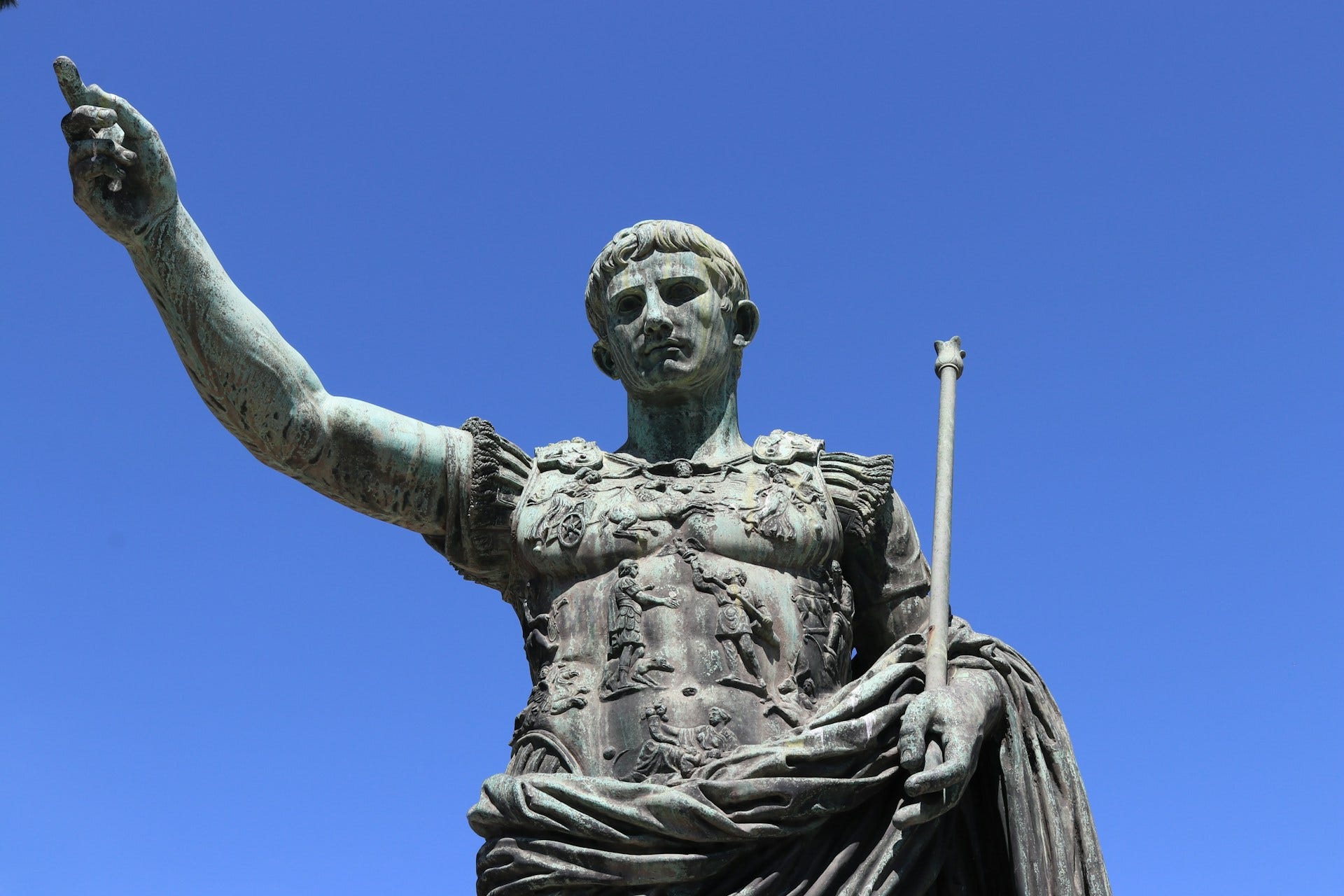
Classical Rome offers the pattern in stern clarity. The late Republic preserved its offices, its Senate, its rituals of legality. Speeches rang out in the Forum, alliances shifted, reforms were proposed and blocked. Yet behind the facade stood exhausted institutions, oligarchic rivalry, and a population that desired order more than theory. Wealth concentrated in few hands, armies grew loyal to commanders rather than to the state, and political life hardened into spectacle. Julius Caesar created nothing new in essence; he embodied the direction already inscribed in the age. The structure of republican governance had hollowed long before his march. Authority migrated from law to personality, from abstract rule to embodied will. The form remained republican for a time, yet the substance moved towards monarchy. The transformation appeared gradual until it became irreversible, and only later did generations recognize that a threshold had been crossed.
The contemporary West stands at a comparable threshold. Its ruling circles uphold a universal creed of liberalism, human rights, and global integration, presenting it as the culmination of history. Yet beneath this creed, the social foundations disintegrate. Economic disparity widens, cultural consensus breaks apart, and national sovereignty yields to supranational frameworks and financial imperatives. Leaders speak of “resilience” and “diversity,” while many citizens experience dislocation and loss of ethnic continuity. Political debate hardens into ritualized outrage, amplified by digital platforms that reward extremity and spectacle. Elections change personnel while policy direction often continues along established tracks shaped by markets and administrative elites. In such conditions, frustration seeks a decisive will. A public that feels unheard gravitates towards figures who promise to cut through stagnation and to restore coherence to a world perceived as drifting.
The multipolar world intensifies this dynamic. Power no longer concentrates in a single Atlantic sphere. China asserts technological and industrial mastery through centralized planning and disciplined state direction. Russia reasserts sovereignty through military resolve and strategic patience. India advances as a civilizational state with ambitions extending beyond regional confines. In each case, authority crystallizes around strong executives who embody national purpose. These polities operate within formal constitutional frameworks, yet decision flows from concentrated centers. The contrast with Western fragmentation sharpens perception. Citizens in Western Europe and America observe states that act with unity and speed, and they ask whether diffuse parliamentary systems can sustain comparable resolve in an age of civilizational competition.
Donald Trump appeared within this atmosphere as a symptom and a signal. His ascent marked a revolt against managerial consensus and a permanent bureaucracy. He spoke in blunt cadences, dismissed established etiquette, and claimed to represent the forgotten citizen. Many supporters imagined in him a decisive ruler who would sweep aside inertia. Critics perceived disorder and high risk. Both responses exaggerated his stature. Trump functioned as a harbinger rather than as a Caesar. He revealed the depth of alienation within American society and exposed the rift between the governing elites and broad strata of the population. Yet he governed within the same constitutional frame, constrained by courts, Congress, media pressure, and internal division. His presidency illuminated the crisis; it did not consummate the transformation towards concentrated sovereignty.
A true Caesar arises when institutions fail to command obedience even in appearance and when legality survives mainly as a ceremony. In Roman history, the crossing of the Rubicon symbolized the moment when personal command superseded senatorial authority. In modern systems, equivalents emerge through prolonged emergencies, executive expansions, and security crises that normalize extraordinary powers. Financial turmoil, pandemics, energy shortages, and geopolitical conflicts generate climates in which populations accept intensified control in exchange for stability. Decadence signifies exhaustion of form rather than mere moral decline. When a political order loses creative energy, it consolidates authority to preserve coherence. Concentrated leadership becomes the instrument through which a civilization attempts to arrest dissolution.
Western Europe displays parallel tendencies. Supranational governance diffuses responsibility across commissions, councils, and courts whose decisions shape national life in decisive ways. Voters cast ballots, yet strategic directions regarding migration, fiscal discipline, and foreign alignment often remain steady across electoral cycles. Public discourse oscillates between technocratic reassurance and moral exhortation. Economic stagnation and demographic contraction generate unease. As geopolitical competition intensifies between continental powers, the demand for leaders capable of unified action strengthens. Executives expand prerogatives in the name of security and stability. The language of rights persists, though the practice of rule centralizes. The soil prepares itself for figures who embody authority beyond party negotiation.
The age of the Caesars does not require the formal abolition of democratic structures. It preserves elections, parliaments, and courts as a visible structure while shifting decisive power towards individuals whose personal authority transcends factions. Digital media accelerate this process by creating direct bonds between the leader and the masses, bypassing intermediary institutions. Continuous crisis conditions justify expanded executive discretion. Citizens accustomed to volatility may welcome swift command over prolonged deliberations. Gradually, emergency becomes custom, and concentration of power appears natural. History teaches that societies accept such transitions when they associate them with protection, dignity, and renewed purpose.
In the wider multipolar order, the struggle between economics and politics sharpens. Financial networks, global corporations, and technological conglomerates exercise influence across borders, shaping narratives and policies through capital and information. Yet sovereign states reassert primacy through industrial policy, strategic alliances, and military power. Politics seeks to reclaim dominance from markets. The contest unfolds across trade corridors, energy routes, digital infrastructures, and cultural spheres. Within this contest, leaders who can integrate economic power into national strategy gain stature. Caesarism thus grows from democratic soil while drawing sustenance from deeper layers of tradition and collective will.
The current decadent West stands at a crossroads shaped by these forces. Its liberal creed proclaims universality, yet its political psychology signals transition. Trump served as a warning flare, an announcement that consensus had become brittle and that the search for a commanding authority had begun. Future figures may advance further along this path, embodying a stronger synthesis of will and structure. Whether such leadership yields renewal or rigid domination depends upon character and circumstance. The age of the Caesars is coming because the preconditions for Caesarism have matured: institutional fatigue, civilizational competition, economic centralization, and a yearning for decisions. Republics rarely collapse through a single dramatic rupture. They evolve into new configurations that express the inner rhythm of their culture. The West approaches such a transformation, and history watches for the figure who will give it form.
https://www.eurosiberia.net/p/the-age-of-the-caesars-is-coming