
Identitarian Reflections on Heavy Metal (Part 2)
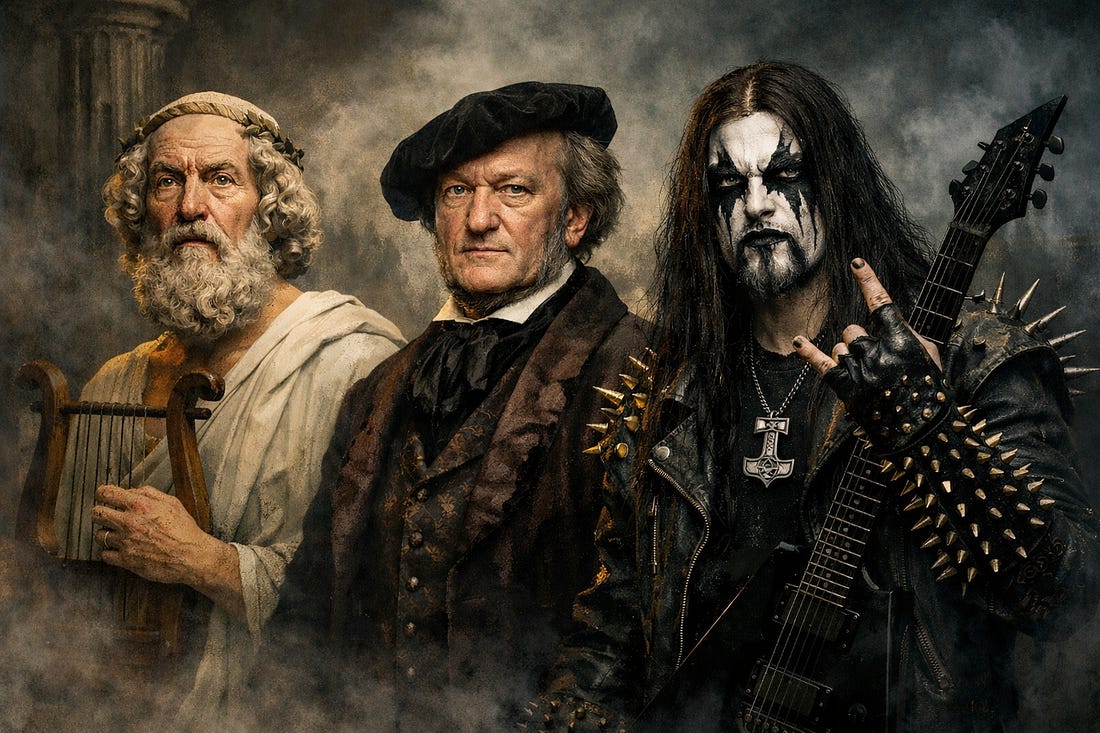
Heavy metal and the styles that grew out of its trunk are characterised by an underlying rootedness in their cultural and natural surroundings. Metal is a rebellious form of art, yet it harkens back to our old traditions. It is also deeply immersed in history and myth, and often consults the wisdom of the past. These are some of the traits of the mighty sound of thunder and steel that we have reflected upon in the first part of our musings on the genre, and in the second part we will observe its mythopoetic abilities, ethnopluralist aspects, and archeofuturistic nature, which can, at times, also be deeply reactionary.
The Mythopoetics of Metal
From Homer to Tolkien, metal acts are as often inspired by epic literature and storytelling as they are by myths, history, and folklore. The subcreation of J. R. R. Tolkien remains particularly influential. Many bands borrow themes from his legendarium. A good example would be German power metal champions Blind Guardian, who have an entire concept album, Nightfall in Middle-earth (1998), dedicated to The Silmarillion, or the Finnish power/melodic death metal group Battlelore, whose entire discography focuses on Tolkien’s literary legacy.
However, while such bands engage with Middle-earth in an expected way, black metal outfits sometimes invert Tolkien’s subcreation, just as they invert crosses, for they are more attracted to the antagonistic, dark, and malicious forces of Tolkien’s universe. Hence, we get band names such as Gorgoroth or Burzum, the first being a plain in Mordor, and the second meaning “darkness” in the Black Speech, which is also found in the inscription on the Ring. Varg Vikernes, who would later write favourably of Tolkien’s mythology in general, was initially most captivated by Sauron’s servants and marauding Orcs:
“To me the “dark forces” attacking Gondor were like the Vikings attacking Charlemagne’s Christian France, the “dark forces” attacking Rohan were like the Vikings attacking the Christian England. And I may add; the Vikings eventually lost their war as well, just like Sauron and the orcs did – and I didn’t mind supporting the loosing part.”1
Since Tolkien was a devout Roman Catholic, it was perhaps expected that some black metal artists would be more intrigued by his villains who represent his notions of evil, often reflecting broader Christian ethics – Sauron and Morgoth being fallen angelic beings, similar to Lucifer.
However, Tolkien’s work also mirrors general themes and virtues found in our myths and legends, and there is no lack of black and other metal acts that adopt Elvish and other motifs from Middle-earth, and engage with philosophical and aesthetical concepts of his universe. Even so, while some artists focus on already existing literary, historical, or mythical narratives, others try their mettle in their own mythopoetic endeavours. They unleash their imagination to construct original subcreations, which serve as training grounds for their lyrical abilities and ideas.
A major example of such mythopoetic world-building would be the renowned Norwegian black metal group Immortal. Rather than taking the road of Satanism or paganism, they envisioned their own fantasy realm, Blashyrkh, a kingdom of snow and ice where formidable mountains surge toward the dark winter sky—a place of grim, brutal atmosphere.
One of the founding members and former frontman of the band, Abbath, described the concept thus: “It is our work, fantasy work. It is like our Mordor.”2 And the other founding member, Demonaz Doom Occulta, who now remains the sole member of Immortal, defined the motivations behind his artistic urges in a very rooted manner:
“My inspiration to start Immortal came from the environment that I grew up in. The cold winter, the dark woods, the mighty mountains and glaciers. I wanted something unique to bind the lyrics and music together. I created Blashyrkh, meaning ‘The realm of all darkness and cold.’”
Similar illustrative language appears in his explanation of why he chose black metal as the vehicle for his creative powers:
“I am devoted to the early days of black metal. Late nights in the woods, embracing darkness, breathing fire, obsessed by the winter moon. It is what keeps my spirit alive. This has inspired me to write riffs, lyrics and music and made the foundation to all our music.”3
Both quotes reflect the nature of the Immortal’s subcreation, which is rooted in the cold, snowy scenery of their homeland, just as different parts of Middle-earth can mirror the English countryside, the climate of north-western Europe, and the European natural and cultural atmosphere in general.
Another band that engages in mythopoetics is the standard-bearer of Finnish folk metal, Ensiferum. Many of their songs relate to Norse mythology, Nordic heritage, and the Finnish national epic myth, The Kalevala. They also produced a metal version of the poem Pohjola, written by the Finnish poet Yrjö Koskinen during the era of Romantic nationalism and the national idea. As stated by the band’s bass player and main lyricist, Sami Hinkka: “National Romantic is really something that fits Ensiferum’s theme.”4 With their 2020 album Thalassic, they added motifs from Greek mythology to their war chest, while their latest album, Winter Storm (2024), is a purely mythopoetic concept that grew out of Hinkka’s idea to write a fantasy novel, which was channelled into his lyrics. It is a concept album revolving around an epic tale of war, rebellion, and magic, set in a fantasy land of snow and ice. Whether through mythopoetic efforts or by relying on the vast repository of national and civilisational legacy, Ensiferum deals with familiar topics of battles, heroism, nature, and myths. Like so many other bands, they are firmly rooted in Finnish, Nordic, and European cultural ground.
Lying on the ground
As battle rages on
Warm blood covers
The cold land of our fathersDon’t cry for me my son
Because I’m not the only one
Where I go you can’t follow
This journey I will make all aloneI’ve bled so many times for this land
But this wound will claim my life
Death commandsLet not my people
Live under oppression
And remember the darker the night
The more beautiful is morning’s light(Ensiferum- “Last Breath”)
The Spirit of the Place
Metal is at once a civilisational and yet quite ethnopluralistic phenomenon. Standing on the shoulders of its pioneers, it extends across borders, regions, and countries. Just like many other artistic and subcultural movements, it manifests itself on a civilisational scale. Nonetheless, whilst holding fast beneath the sonic standards of their respective subgenres, numerous artists evolve their distinctive sound, poetry, and imagery, which reflect their native cultures and regions.
This approach is most visible in folk metal but can also be observed in other branches of the mighty metal oak. The collective soul of European peoples manifests itself in various cultural and artistic forms that reflect their immediate surroundings and distinct local mores, as well as their common biocultural roots. In this context, metal can be viewed as yet another medium of such expressions that become alive with the incorporation of folkish ingredients, whether through traditional instruments and folklore, or through artistic inspiration that comes from local flora and fauna, national history, and culture. All of this can be reflected in the lyrics, band logos, artwork, and the overall atmosphere of the music.
Since we have already observed how native elements influence the heavy music of our Nordic and Germanic European kinsmen, let us now move toward the eastern parts of our common homeland. Eastern Europe has a strong black and folk metal scene. While we can notice some cross-cultural references within the framework of our civilisation, the majority of bands celebrate their specific ethnocultural roots by diving deep into the world of Slavonic legends, tales, and pantheons.
Much like their northern and western counterparts, Slavic folk and pagan metal bands combine folk instruments, such as flutes, fiddles, and gusli, with fast-paced drum beats and powerful guitar riffs in a truly archeofuturistic fashion. The voices accompanying the music sing mostly in native tongues, and female vocalists are perhaps a bit more common, although not due to some feminist “gender quota” policies. Songs range from traditional folk compositions and haunting ballads to standard hard-hitting, aggressive hymns of raw passion.
Fatherland – tragedies
Tragedies written in snow
Fatherland – poetry
Poetry written in blood
Fatherland – lonely nights
Of coldness, of autumn, of rain
Fatherland – razor blades
Of winter, of smoke and the pain(Temnozor – “Fatherland”)
The ethnopluralist sentiment is further strengthened by lyrical themes. While some bands, such as Graveland from Poland, are more keen to explore Norse mythology, there is no shortage of artists who prioritise the old Slavic deities like Perun, Veles, Svarog, Svantevid, Mokosh, and other ancient gods. As in the Northern and Western countries, the presence of nature and the spirit of the place is strongly felt in Eastern European metal activities as well. The ambience created by Russian and Ukrainian heathen acts, such as Temnozor, Arkona, Grai, Nokturnal Mortum, Kroda, and Drudkh, evokes the cyclical order of nature — the long freezing winters and twilight forests, as well as the blossoming meadows of early spring, and vast summer fields under blue skies.
The great outdoors of the European East, rich with majestic mountain ranges that pierce the skies, crystal clear lakes, old forests bursting with wildlife, and never-ending fields, is only surpassed in its variety by the creative capacities of the Slavic imagination. Among many bands that add to the authenticity of Slavonic metal, we should perhaps also mention Polish outfit Percival Schuttenbach, who mixes metal with folklore and folk songs, and the very catchy and melodic band Kalevala from Russia, which merges Slavic with Ugro-Finnic folkish traditions. The neighbouring Baltic countries have a strong traditional metal scene as well, where such bands as Skyforger from Latvia carry on the ancient banners of their own specific national culture and folkish beliefs by means of folk metal.
Across the narrow channel that separates mainland Europe and the British Isles, another ethnopluralist segment of the genre evolved under the influence of Gaelic melodies and Celtic legends. By manifesting their ancestry and culture through art, bands like Cruachan, Primordial, and Waylander continue the tradition of Celtic bards with modern means. Epic narratives of Irish history, folk tales, and myths, coupled with heavy guitars, hard drums, and traditional instruments, transport us back to the misty days of druids and imprint local specifics on a civilisational artistic phenomenon.
Drift back to an era now gone
Kindred spirits fought to overcome
Druids held sway over kings
And the thrill of the hunt prevailed
People were one with the land
And harmony reignet in the cycle of life
I too am of the earth
Celtic fire burns in my veins
I too am a warrior born
I fight the pain and misery
My spirit forever flys free(Waylander – “Once Upon an Era”)
Rhapsodes, Romantics and Rock ‘n’ Roll
The roots of heavy metal extend beyond rock music and run much deeper. Many artists regularly cite classical composers as influences alongside the pioneers of the genre. Mozart, Bach, Wagner, and Beethoven had almost as much of an impact on metal as Deep Purple, Led Zeppelin, or Black Sabbath.
There is something distinctly Wagnerian in the grandeur of heavy metal, and as music journalist Malcolm Dome remarked in the documentary Metal: A Headbanger’s Journey, it would not be surprising if Richard Wagner or Ludwig van Beethoven would have become metal musicians had they been born in the modern era: “I still believe that if Richard Wagner were around today, he’d probably be in Deep Purple. Beethoven probably would’ve been happy to have been in Led Zeppelin.” Music producer Robert Ezrin, who described the genre as “dark, powerful, and heavy, like Wagner”, agreed with him, stating that “the classical roots of heavy metal are fairly obvious.”5
Such views are only reaffirmed by the musicians themselves. Master of metal strings Yngwie Malmsteen is known for blending heavy guitars with classical music influences, translating its techniques to electric guitar playing, thus popularising what has become known as neoclassical metal. He was quite clear on who chiefly inspired him:
“My classical influence is 100 per cent from Johann Sebastian Bach, Antonio Vivaldi, Nicolai Paganini, Tchaikovsky, Mozart and so on. My classical influence does not come from other guitar players; let’s make that perfectly clear.”6
Additionally, metal artists are not only influenced by the musical elements of classical compositions, but often share a fascination with similar themes to those explored by the composers, and derive their artistic creations from the same deep wells of European history and imagination. On this point, the connection with Wagner becomes the most evident. Just like the old maestros, the modern bards in jeans and leather are mystified by the world of myths, sagas, and heroic yet often tragic tales of vanished times. In the same spirit, they too strive for excellence and evoke deep emotions through their art.
Malmsteen’s fellow Swede, Quorthon, was also strongly influenced by classical masterpieces. When asked what his inspiration was behind more epic sound, the greater symbolic significance of motifs, and lengthier tracks on his album Blood, Fire Death (1988), he replied:
“Probably from reading biographies on masters like Wagner and Beethoven and their works. I began to listen to classical music shortly after forming Bathory, and from 1985-1986 it was all I would listen to. I had been playing various types of rock in various constellations since 1975, so picking up Wagner, Beethoven, Haydn and others really broadened my musical awareness extensively. The motif signature naturally comes from the world of opera.”7
Metal often operates within the realm of the irrational. It transcends the provinces of rational individual as the Romantics did: not in the sense of acting contrary to common sense, but by focusing on passion, emotions, intuition, and imagination, rather than staying within the limits of pure, cold reason. Formulated thus, many things, including our musical tastes, can be considered irrational.
Delving deep into this realm, various subgenres reach into the deepest caverns of our souls and awaken the mysterious yearnings that reside there. Metal can overwhelm us not only with emotions of joy or strange sadness that is at once mournful and beautiful, but with a peculiar yearning for the harsher yet nobler past as well. The feeling of nostalgia for times and places that we never saw or visited runs through the melodies and beckons us to return to where we have never been. Suddenly, we feel the longing for the days when our values were not yet corrupted by modern materialism, consumerism, and calculating rationalism that scolds personal integrity and honour.
Whereas metal is a modern musical form, it has deep roots, and, as we know, deep roots are not reached by the frost. While some bands integrate folk instruments, others add orchestral elements to their songs. Metal is an amalgamation of several traditions: the grandeur and precision of classical music; the epic storytelling of ancient bards, skalds, and rhapsodes; the fervour of Romantic irrationalism; traditional folk melodies and folklore; and, of course, its closest relative, the rock ‘n’ roll revolution of the 20th century.
Archeofuturism Personified
By combining traditional narratives and forms with modern means of artistic expression enabled by technological progress, heavy metal can be seen as a cultural manifestation of Archeofuturism. This idea, coined and articulated by Guillaume Faye, represents a synthesis of archaic values and traditions with modern technology. As Faye explained, the foundation of this synthesis is a “philosophical alliance between the Apollonian and the Dionysian.” He believed that futurism and archaism are not necessarily opposed, but that both share Apollonian and Dionysian aspects:
“The futurist pole is Apollonian in its sovereign and rational plan to shape the world, and Dionysian in its aesthetic and romantic mobilisation of pure energy. Archaism is telluric in it appeal to timeless forces and conformity to the archè, but it is also Apollonian, for it is founded on wisdom and the endurance of human order.”8
Faye’s principle deals chiefly with philosophical considerations, but when applied to the realm of cultural and artistic expression, we could argue that metal also possesses both Apollonian and Dionysian attributes. Its technical precision and orderly yet innovative spirit are clearly Apollonian and futuristic. At the same time, its dynamism, which harvests pure creative energy, and its passion for myth and the days of yore are very much Dionysian, while its romantic immersion in tradition and the stories of the ancestors reflect the archaic sensibilities that hide in the deep places of our being.
Once, skalds recited the poems of heroic deeds and struggles of gods and men in the wooden halls brightened by the flickering flames. Today, illuminated by stage lights, modern poets often sing, scream, and growl about the same heroes, gods and epic deeds, accompanied by electric strings and thunderous drums. Amon Amarth recounts the old sagas, and Manowar sings of the champions from The Iliad. The great tales of our civilisation live on, regenerated and reborn through modern means of culture and art.
Becoming One’s Own Hero
As our brief journey through the lands and regions of metal nears its end, let us once more return to the archetypes of warriors and rebels. Heavy metal tells us that there is something more to life than just endless consumerism and shallow materialism. In its essence, metal is very much aristocratic in its rejection of mediocrity and the false morals of feminised society. It encourages the cultivation of heroic mindset in a modern context and aims to reinvigourate the virtues of manliness by calling upon us to stand erect in the midst of the morally bankrupt world.
Since the heroes of old have passed and live on only in our collective memory, we must set the task upon ourselves to become our own heroes. This principle was best described by Eric Adams, the frontman of Manowar, when he talked about the meaning behind the mysterious, Conan-like, bulked up, sword-wielding figure that appears on their album artworks:
“We have always felt that everyone has always needed a hero in their life. That hero could be you in the mirror. That is why the album cover has this warrior/hero-like image with no face. Because it could be anyone. We have always believed that heavy metal was about power and might and steel and just a strong feel to a song. That is why we have always had that in our songs. You can’t get any more powerful than steel. It goes well with the heavy metal genre.”9
Bold attitudes of self-confidence and triumphant struggles radiate through Manowar’s anthems. Their discography is packed with grand narratives from mythology and history. Upon listening to their songs, we encounter heroes and gods of the ancient Greeks and Scandinavian Vikings, freedom fighters of the Scottish clans and Howardian barbarians. They also inspire brotherhood and masculinity with their odes to the heavy metal lifestyle. Their music beckons us to free ourselves from the chains of mediocrity and find the hero within. Whereas G. K. Chesterton once remarked, “Fairy tales do not give the child his first idea of bogey … What the fairy tale provides for him is a St. George to kill the dragon,”10 Manowar and other epic metal acts prompt us that, once we become men, we find the strength to confront the hideous serpents in St. George’s or Sigurd’s manner.
The gods made heavy metal
And they saw that it was good
They said to play it louder than hell
We promised that we would(Manowar – “The Gods Made Heavy Metal”)
British heavy metal veterans Iron Maiden are another outfit that regularly dives into the stuff of myth and history. Their broad repertoire often references topics of European historical and cultural legacy. They sing of battles and conquests, from Viking invasions of Britain to British pilots battling the German aircraft among the clouds. They invoke the words of Shakespeare’s Marc Antony and explore the literary world, from Arthurian legends to modern dystopian novels. Whether it is ancient history shrouded in mystery or futuristic conceptions of man and technology, Iron Maiden tackles a range of subjects, demonstrating great mettle in both songwriting and storytelling, which are the hallmarks of the genre.
Wake alone in the hills
With the wind in your face
It feels good to be proud
And be free and a race
That is part of a clan
And to live on highlands
And the air that you breathe
So pure and so clean
When alone on the hills
With the wind in your hair
With a longing to feel
Just to be free
Is it right to believe
In the need to be free
It’s a time when you die
And without asking why
Can’t you see what they do
They are grinding us down
They are taking our land
That belongs to the clans
Not alone with a dream
Just a want to be free
With a need to belong
I am the clansman(Iron Maiden – “The Clansman”)
The Deep Waters of Metal
Across the spectre of different styles, themes of history, origins, myths, and nature are expressed in various ways, reminding us that metal is a river of many streams. Some join it from the mountain springs, running fast from great heights, while others flow slowly into its current from the dark sources beneath the earth. Some are clear, others murky.
As an art form, the genre flows from simple yet powerful motifs to more complex subjects that can be ambiguous and leave room for interpretation. Metal can be a vessel for simply voicing one’s beliefs or contemplating deeper subjects that recurrently encompass matters of history, war, ancestry, tradition, and the issues of human nature.
Therefore, we must be careful—just as some tunes can reinvigourate us and lift us up, others can drag us down into the darkness of nihilism through sinister aesthetics of death and suffering. Hence, when we step into the wilderness of metal, wander in its woods, and hike its peaks, we would do well to remember Nietzsche´s warning that if we gaze too long into the abyss, the abyss also gazes into us.
Nevertheless, heavy metal can be recognised, with all of its tributaries and subgenres, as an overwhelmingly uplifting force in an age of moral bankruptcy that hides beneath the generic progressive slogans of the entertainment industry and the commercial culture that, for all of its neon signs and promises, only impoverishes our souls and diminishes our existence to mere economic units of flesh and blood.
The Reactionary Revolt
Furthermore, despite of its rebellious attitude – or perhaps precisely because of it – metal can be seen as a fundamentally reactionary force, but not in a way that would be incompatible with its defiant nature or archeofuturistic aspects. It was already remarked in the first part of our reflections that metal rebellion is very conservative and even identitarian beneath the surface. Through the promotion of manly and traditional virtues, the heavy metal revolt against the modern society can be posited not as a cry of progressivism, but as a revolt against its consequences, which caused general effeminisation of society.
Moreover, the rejection of Christianity, which is central to many black metal or folk and pagan metal acts, is deeply reactionary: it rebels against the Church not with arguments of rationalism or progressivism, but by appealing to the ancient pagan past and belief-systems that exsisted before the arrival of Christ’s teachings on European shores. The Church is not attacked as a backward or outdated institution, but as an alien intruder imposing a new religion on the native peoples and cultures of the Old world. Thus, the Church itself becomes an agent of progress – of change brought by spiritually alien forces. We may agree with such positions or not, but the fact remains that they come from a very reactionary point of view, one which bids us to look back into the past, not only in terms of decades, but hundreds and even thousands of years.
This reactionarism is mostly subconscious, and organically evolves within the genre in a similar fashion as its identitarian, conservative, or archeofuturistic components. For the most part, bands will dismiss and avoid such connotations by claiming to be non-political or non-partisan. Regardless, these aspects of the genre remain under the surface in its very nucleus and ethos.
On the other hand, some acts of particular subgenres can be openly progressive and very left-leaning. But we can also point out that, as far as political extremes are concerned, there exists a thriving NSBM (National Socialist Black Metal) movement within the wider black metal scene, and that metal was very influental on RAC (Rock Against Communism) scene. As a matter of fact, one of the leading figures of the nationalist skinhead movement, Ian Stuard Donaldson, frontman of Skrewdriver, did covers of Black Sabbath and Judas Priest, and said in one of his later interviews that Manowar was his favourite band.11 Numerous RAC skinhead bands likewise adopted very metallic sounds, to the point that their music is rather “metal” than “rock” against communism. One such example is the well established U.S. band Bound For Glory.
Notwithstanding the radical ideologies and subcultures within which the genre has found its place on both ends, the fact remains that, in its essence as a cultural and aesthetical phenomenon, metal is very much aristocratic, identity-based in the old-fashioned sense of the term (meaning one’s folk and land), deeply conservative in a way that reflects the true meaning of the word, and, above all, inherently sympathetic to tradition.
Identitariansm and Heavy Metal
We are all aware of the memes that inaugurate conservatism as the new punk rock. Once the leftist counter-culture became the establishment, the right wing slowly took on the role of the new rebel on the block, thus, in the metapolitical sense, adopting the rebellious spirit of punk rock. Now, while admitting that it makes for a pretty good meme, let us propose a slightly different formulation.
While seeking as many cultural means as possible in the metapolitical quest for the regeneration of our authentic civilisational values—which is crucial for any meaningful European renaissance—we may entertain a new kind of meme: identitarianism is the new heavy metal.
For the identitarian right is at once rebellious and traditional, modern in form and archaic in spirit. It rejects the rigid conformity of liberal society while admiring old mythic narratives and wishing for the return of everlasting masculine and feminine virtues, each within their respective sexes. It also prepares and plans for the future by consulting the wisdom of the past.
Therefore, identitarianism may find a kindred spirit in the ethos of metal. From an identitarian perspective that genuinely cherishes the ever-changing cultural forms of authentic European expressions, it would neither be necessary nor desirable to approach heavy metal strictly from an ideological or political angle. To measure any form of art solely by such standards only diminishes it. And with metal, it would also be unnecessary. Instead of trying to reinterpret it through strictly ideological lenses, it is enough to simply approach it with a clear gaze and an open mind, and unveil that which is already before us: a musical form and a modern cultural phenomenon that is the most recent transmitter of essentially European traditions and passions.
1 Varg Vikernes, “A Burzum Story: Part I – The Origin and Meaning,” Burzum.org, https://burzum.org/eng/library/a_burzum_story01.shtml
2 “Immortal: Interview,” Chronicles of Chaos (heavy metal webzine), May 19, 1999, http://www.chroniclesofchaos.com/articles.aspx?id=1-223
3 “Immortal Vocalist/Guitarist Demonaz – I Am Devoted to the Early Days of Black Metal,” BraveWords, July 6, 2018, https://bravewords.com/news/immortal-vocalist-guitarist-demonaz-i-am-devoted-to-the-early-days-of-black-metal
4 “Interview with Sami Hinkka of Ensiferum, Part One,” The Norse Mythology Blog, July 31, 2013, https://www.norsemyth.org/2013/07/interview-with-sami-hinkka-of-ensiferum.html
5 Metal: A Headbanger’s Journey (documentary film), directed by Sam Dunn, Scot McFadyen & Jessica Joy Wise, 2005, YouTube.
6 “Yngwie Malmsteen: What I Did Was I Took the Entire Guitar Playing Technique…,” MusicRadar, https://www.musicradar.com/news/yngwie-malmsteen-classical-guitar-interview.
7 “Interview: Quorthon,” Death Metal and Black Metal Interviews, Dark Legions Archive, https://www.anus.com/metal/about/interviews/quorthon/
8 Guillaume Faye, Archeofuturism (London: Arktos, 2010), p. 73.
9 “CoC Interviews Manowar,” Chronicles of Chaos (metal webzine), http://www.chroniclesofchaos.com/articles.aspx?id=1-87
10 G. K. Chesterton, Tremendous Trifles (Project Gutenberg eBook ), https://www.gutenberg.org/files/8092/8092h/8092h.htm
11 “Ian Stuart Interview,” originally published in Last Chance (England, 1991–1992), https://archive.org/stream/PDF-biblioteket/InterviewsWithIanStuart_djvu.txt
https://www.arktosjournal.com/p/identitarian-reflections-on-heavy-9a2