
Francisco Franco’s Anti-Zionist Gift
“This is not self-defence…it is the extermination of a defenceless people.”
With those words on September 8, 2025, Spanish Prime Minister Pedro Sanchez became one of the most senior European leaders to formally accuse Israel of committing genocide in Gaza. He announced a sweeping package of nine measures including a total arms embargo formalizing restrictions in place since October 2023, a ban on ships carrying fuel for Israel’s military from docking at Spanish ports, closure of Spanish airspace to aircraft transporting defense material to Israel, and an entry ban on individuals “directly involved in genocide, human rights violations, and war crimes,” potentially including Benjamin Netanyahu and members of his government.
Spain’s parliament formally ratified the arms embargo into law by a vote of 178 to 169 on October 8, 2025. Madrid canceled a €285 million contract with Israeli weapons manufacturer Rafael for SPIKE LR2 anti-tank missile launchers in June 2025. When Israel’s foreign minister accused Sanchez of antisemitism, Spain recalled its ambassador from Tel Aviv for consultations.
Sanchez even called for Israel’s exclusion from international sporting events, asking “Why was Russia expelled after invading Ukraine, yet Israel faces no expulsion after invading Gaza?” He expressed “deep admiration” for the massive pro-Palestinian protests that forced organizers to cut short the final stage of the Vuelta a Espana cycling race, praising “a Spanish society that mobilizes against injustice and defends its ideas peacefully.”
To observers unfamiliar with Spanish history, Sanchez’s actions might appear as the idiosyncratic politics of a progressive government. They are not. The Spanish prime minister acts within a deep-rooted civilizational and political trajectory spanning centuries, which reached its most impactful modern expression through an unlikely individual.
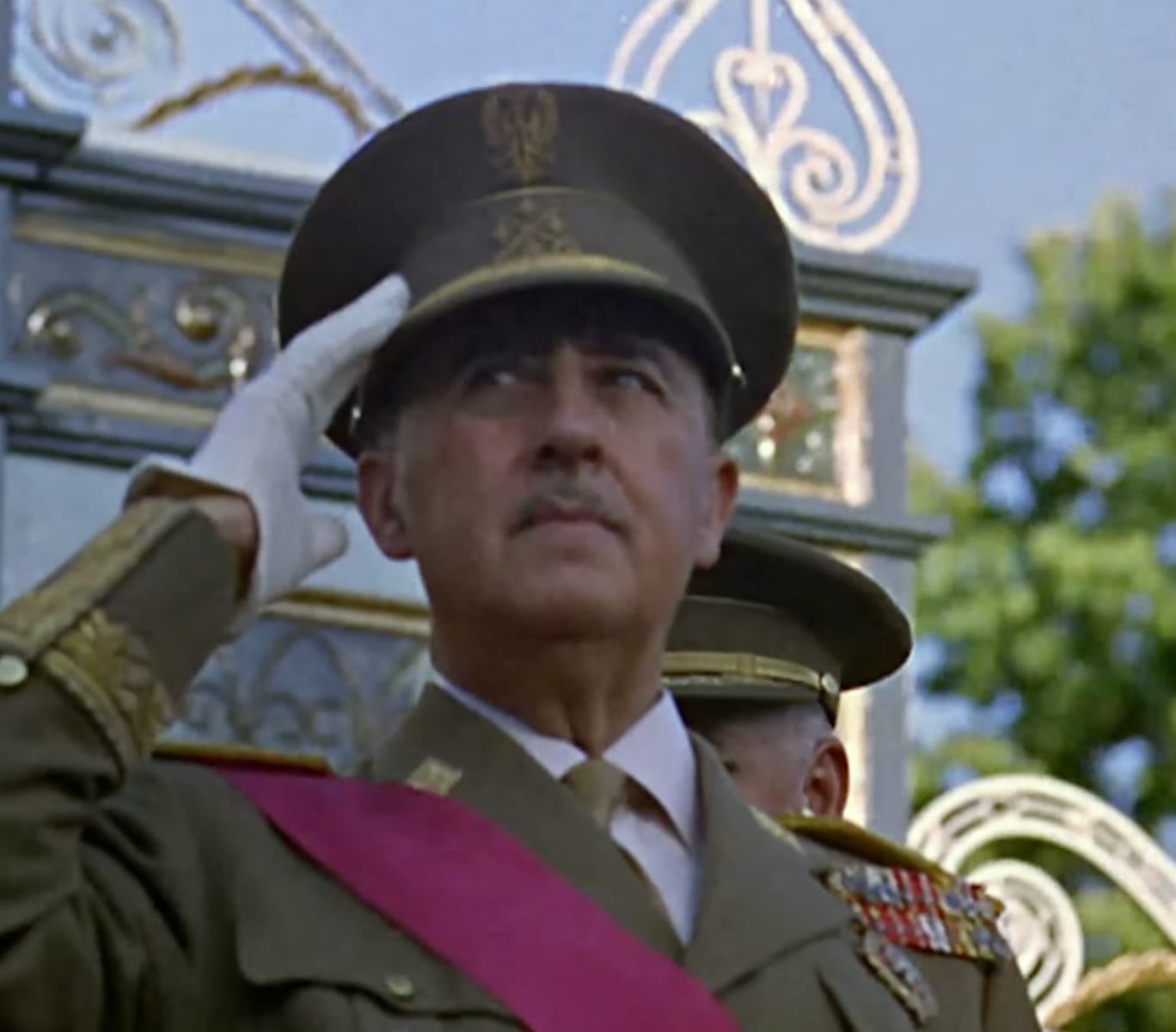
That individual was none other than Francisco Franco himself. Whatever one thinks of the Spanish leader, he maintained an unwavering refusal to recognize the Zionist entity throughout his entire rule, a stance so firm that Spain would not establish relations with Israel until 1986, more than a decade after Franco’s death.
Franco’s government rejected the State of Israel from its creation in 1948. In 1949, shortly after Israel’s founding, Franco reportedly offered to establish diplomatic relations with the new state, but Israeli Prime Minister David Ben-Gurion rejected the overture because of Spain’s close wartime ties with National Socialist Germany, according to the Center for Israel Education. Israel then voted against lifting UN sanctions on Spain in the United Nations General Assembly due to the Francoist regime’s sympathy and material support for the Axis Powers, according to Jewish Currents. This rebuff pushed Franco to align definitively with the Arab bloc.
Franco did far more than merely withhold recognition. The Franco government cultivated strong ties with Arab nations including Egypt, Iraq, and Libya as part of its strategy to break Spain’s postwar international isolation, according to the Palestine Land Society’s research. The Palestine Liberation Organization maintained an informal representative office in Madrid since 1972 under the Franco regime.
Spain consistently voted in the PLO’s favor at the United Nations. During the October 1973 Yom Kippur War, Franco took the significant step of preventing the United States from using its military bases on Spanish soil to resupply Israel with armaments. On November 22, 1974, Spain voted in favor of UN General Assembly Resolutions 3236 and 3237, which recognized the Palestinian people’s right to self-determination and granted the PLO observer status. The first post-Franco government, headed by Adolfo Suárez, declared that it would not recognize Israel unless it withdrew from the West Bank and allowed the creation of a Palestinian state.
Franco’s pro-Arab orientation was driven by pragmatic calculations as much as ideology. After World War II, Franco’s Spain was condemned and excluded from the United Nations due to its association with Nazi Germany and Fascist Italy. Unable to join Western European institutions, Franco pursued what scholars call “substitution policies,” cultivating ties with Latin America and the Arab world to escape diplomatic isolation.
He built close relationships with monarchies in Jordan, Saudi Arabia, Egypt, Iraq, Libya, and Morocco. Appealing to historical, cultural, and political ties, Franco endeavored to act as a self-appointed protector of Arab interests and to portray Spain as an essential bridge between Europe and the Arab countries. After Spain gained UN membership in 1955 with Cold War dynamics shifting in its favor, Madrid continued to reject several Israeli offers to establish diplomatic relations and instead deepened its Arab alliances.
Several factors reinforced this alignment. Spain lacked colonial ambitions in the Middle East, unlike Britain and France, making it a more acceptable Western partner for Arab governments. The cornerstone of Arab-Spanish friendship was the non-recognition of Israel. As Spanish foreign minister Fernando María Castiella stated, “The fact that we do not have diplomatic relations with Israel works in our favor with regard to the Arabs.”
Franco’s death in 1975 did not immediately change Spain’s stance. The transitional government of Adolfo Suárez maintained the policy of nonrecognition, fearing backlash from the Arab world. Suárez declared that Spain would not recognize Israel unless it withdrew from the West Bank and allowed the creation of a Palestinian state. On September 13, 1979, Suárez became the first Western European leader to officially receive PLO Chairman Yasser Arafat, prompting strong protests from Spain’s Jewish community. The PLO had maintained an informal representative office in Madrid since 1972 under Franco, and this office continued operating under the new democratic government.
It was only after Spain joined NATO and sought accession to the European Economic Community that Prime Minister Felipe González moved to establish diplomatic relations with Israel. The coordinated Israeli diplomatic effort linking Spain’s EEC admittance with the normalization of ties was the main driving force for this shift. As Spanish Foreign Minister Francisco Fernández Ordóñez admitted in an interview with Diario 16 in March 1986, “Once inside the EEC, it was untenable not to maintain diplomatic relations with Israel.” On January 17, 1986, Spain became the last Western European nation aside from the Vatican to formally recognize Israel, with González and Israeli Foreign Minister Shimon Peres meeting at the Dutch government’s state guest house in The Hague. Spain simultaneously issued a declaration, the Hague Declaration, reiterating its “non-recognition of any measures aimed at annexing Arab territories occupied since 1967, or at unilaterally altering the nature or status of the city of Jerusalem.”
Even after recognition, Spain maintained its distinctive posture. Under Prime Minister José Luis Rodríguez Zapatero from 2004 to 2011, relations cooled again. In 2006, Zapatero gave a speech in which he criticized Israel harshly, then accepted a keffiyeh from members of the audience and had his photograph taken wearing it. Zapatero drew criticism for his lack of restraint when attacking Israeli policy, continuing Spain’s reputation as the least Israel-friendly EU state. In September 2010, during a high-level meeting between Spain and the Palestinian National Authority, Spain upgraded the Palestinian diplomatic representation from a General Delegation to a full Diplomatic Mission with ambassadorial status.
The October 7, 2023 Hamas attack on Israel and the subsequent Israeli military campaign in Gaza triggered a dramatic rupture that brought Spain’s historical orientation roaring back to the surface.
Sanchez was among the first EU leaders to sharply criticize Israel’s conduct. During a joint visit to the Rafah border crossing with Belgian Prime Minister Alexander De Croo on November 24, 2023, he denounced “the indiscriminate killing of innocent civilians, including thousands of boys and girls” as “completely unacceptable” and called for a permanent humanitarian ceasefire.
On May 28, 2024, Spain alongside Ireland and Norway formally recognized the State of Palestine, making it among the first major Western European nations to do so. Sánchez called recognition “a matter of historical justice” and “the only way to move towards a Palestinian state living side by side with the State of Israel in peace and security.” On June 6, 2024, Spain announced it would join South Africa’s genocide case against Israel at the International Court of Justice. Spain formally filed its Declaration of Intervention on June 28, 2024, becoming the first European country to do so. Sanchez declared “There should be no doubt that Spain will remain on the right side of history.”
In January 2026, Sánchez declined Trump’s invitation to join the U.S.-led “Board of Peace” for Gaza, stating “The future of Palestine as a whole should be settled by Palestinians.” Spain’s defiance reached its zenith on February 28, 2026 when the United States and Israel launched “Operation Epic Fury,” an act of war against Iran. Sánchez condemned the strikes as an “unjustified, dangerous military intervention outside international law,” calling it a war “started without the authorization of the United States Congress or the United Nations Security Council.”
The Spanish government barred the U.S. from using the Rota and Morón de la Frontera air bases in southern Spain for operations against Iran. Defense Minister Margarita Robles declared “no assistance of any kind, absolutely none” had been provided, stating that the U.S. and Israel were acting “unilaterally without the support of an international resolution,” Flight tracking platforms recorded at least 15 U.S. military aircraft departing the two Andalusian bases for Ramstein, Germany, in the hours after the announcement,.
In a televised address on March 4, 2026, Sánchez warned Trump was playing “Russian roulette with the destiny of millions” and declared “We are not going to be complicit in something that is harmful to the world and contrary to our values and interests simply to avoid reprisals from someone.”
Sánchez’s defiance places him in a longer Spanish tradition that transcends conventional political categories. Admirers of Franco on the right tend to celebrate his authoritarian anti-communism while conveniently overlooking his administration’s consistent hostility toward Zionism and its sympathies for the Arab and Palestinian cause — a dimension of his reign that complicates tidy ideological sorting. That contradiction points to something important: serious opposition to Zionist power has never belonged exclusively to any one political camp.
The historical record, from Franco’s Spain to its socialist successors, reveals this to be not a partisan position but a civilizational one, and a stark reminder of how inadequate our current left-right labels truly are.
https://www.josealnino.org/p/francisco-francos-anti-zionist-gift