
The Extent of the Iranian Retaliatory Strikes in the Gulf Region

In recent days, ‘Planet Labs’ said they’d delay publishing of satellite data by 14 days. This has been understood as a cover for the extent to which US facilities across the Gulf have been hit by Iranian strikes. Commentators, specifically Alon Mizrahi have argued that the strikes on US and Israeli infrastructure since this war started are unprecedented. Most of the news is coming in piecemeal, so I wanted to get together a document showing what key infrastructure exists across the Gulf, and what has been hit so far. This is an extensive piece of work, so I’ve leveraged Deep Research to put this together. What follows is the full report which has been edited extensively for readability.
The MEAD Alliance and the Counter-Sensor Architecture
The operational viability of the U.S. military presence in the Gulf, and its ability to defend Israeli and Gulf interests, relies upon a deeply interconnected, multi-billion-dollar web of early-warning radars, satellite communications (SATCOM), and interceptor batteries. The Middle East Air Defense (MEAD) Alliance, covertly negotiated in Sharm El-Sheikh and publicly acknowledged in 2022, sought to synchronize these sensors.14
At the heart of this defensive shield are highly specialized radar installations. The AN/TPY-2 radar, an X-band surveillance array manufactured by Raytheon and costing approximately $500 million per unit, serves as the central nervous system for the Terminal High Altitude Area Defense (THAAD) system.5 These massive, trailer-mounted systems scan the horizon to acquire ballistic targets, calculate interception vectors, and guide kinetic kill vehicles.5 U.S. and allied forces deployed AN/TPY-2 radars across the Arabian Peninsula, with confirmed sites at Prince Sultan Air Base (Saudi Arabia), Al Ruwais and Al Sader (UAE), and Muwaffaq Salti Air Base (Jordan).5
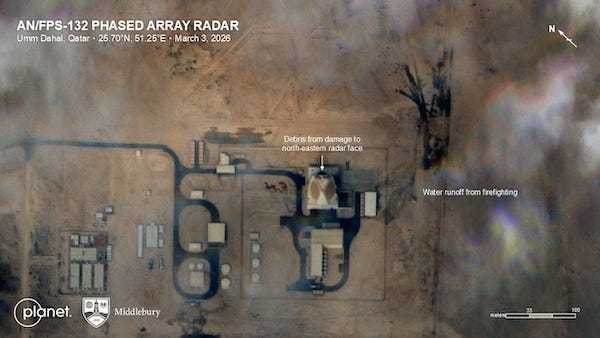
Complementing the THAAD network is the AN/FPS-132 (Block 5) phased array early-warning radar located at Umm Dahal, near the Al Udeid Air Base in Qatar.37 Valued at $1.1 billion, this gigantic static structure features multiple radar faces providing 360-degree coverage.36 With a detection range of approximately 4,800 kilometers, the AN/FPS-132 acts as the primary over-the-horizon eye for the U.S. Space Force, capable of tracking ballistic missile launches deep within Iranian territory from the moment of ignition.38
Furthermore, bases like NSA Bahrain and Al Dhafra Air Base house large spherical radomes containing strategic satellite communications terminals, essential for the secure transmission of targeting data between the CAOC in Qatar, naval strike groups, and interception batteries.36
The Iranian Retaliatory Campaign: Kinetic Reality and Damage Dossier
Following the devastating U.S. and Israeli airstrikes on February 28, 2026, which decimated Iran’s political leadership and degraded its domestic air defenses, the Iranian military and the Islamic Revolutionary Guard Corps (IRGC) executed Operation True Promise IV.4 This retaliation represented a paradigm shift in Middle Eastern warfare. Recognizing its conventional military inferiority, Iran deployed an asymmetric, cost-imposition strategy utilizing massed volleys of loitering munitions (suicide drones), cruise missiles, and ballistic missiles.11
Between February 28 and March 11, the IRGC launched over 3,000 projectiles, systematically targeting the U.S. military footprint, the MEAD Alliance sensor network, and the critical economic infrastructure of the Gulf states.3 Al Jazeera English, Reuters, and real-time OSINT analysts on X.com documented a campaign that unfolded in distinct, escalating phases.
The Strategic Counter-Sensor Offensive (February 28 – March 2)
Iranian military planners understood that attempting to overwhelm the U.S. and Israeli missile defense shields through sheer volume alone would result in unacceptable attrition of their own missile stockpiles. Consequently, the initial wave of the campaign was a dedicated counter-sensor offensive aimed at blinding the MEAD Alliance and degrading CENTCOM’s early-warning architecture.5 By destroying the “eyes” of the defense network, subsequent waves of cheaper drones could penetrate Gulf airspace with greater lethality.46
The precision of this counter-sensor campaign was startling. On the opening day of the conflict, an Iranian ballistic missile successfully struck the $1.1 billion AN/FPS-132 early-warning radar facility in Umm Dahal, Qatar. Satellite imagery verified by Planet Labs and the Middlebury Institute of International Studies confirmed a direct collision on the northern face of the radar array—the specific sector oriented toward Iran.5 This strike severely compromised the U.S. Space Force’s ability to monitor deep inland launches from the Islamic Republic.37
Simultaneously, Iran targeted the highly sensitive AN/TPY-2 radar systems that guide the THAAD interceptors. At the Muwaffaq Salti Air Base in Jordan, satellite imagery captured on March 2 revealed two large blast craters, each roughly four meters across, amidst the debris of a completely destroyed $500 million AN/TPY-2 radar unit.5 Similar strikes targeted THAAD radar shelters and support infrastructure at the Prince Sultan Air Base in Saudi Arabia and military installations near Al Ruwais and Al Sader in the UAE, resulting in visible charring and structural damage.5
OSINTtechnical@Osinttechnical
Footage of an Iranian attack drone slamming into the headquarters of the US Navy’s 5th Fleet at Naval Support Activity (NSA) Bahrain moments ago.
7:51 AM · Feb 28, 2026 · 2.78M Views
164 Replies · 958 Reposts · 5.12K Likes
The communications backbone was also severed. At NSA Bahrain, a kamikaze drone struck a large spherical radome, destroying vital satellite communications (SATCOM) terminals used by the U.S. Fifth Fleet to coordinate regional maritime defense.36 In Kuwait, reports indicated that at least six SATCOM radomes were destroyed at Camp Arifjan.48
Kinetic Impacts on U.S. Military and Diplomatic Installations
With the regional sensor network degraded, Iranian projectiles began impacting high-value military and diplomatic targets across the Gulf, inflicting casualties and structural devastation.
The most severe loss of American life occurred in Kuwait. On March 1, an Iranian missile bypassed defenses and struck a makeshift tactical operations center located within a civilian port facility in Kuwait. The massive blast killed six U.S. Army Reserve soldiers and left 38 other service members hospitalized with severe traumatic brain injuries, burns, and shrapnel wounds.9 Further attacks in Kuwait saw an Iranian drone strike the garrison at Camp Buehring, while the U.S. Embassy in Kuwait City was likely hit by a missile on March 2, prompting the State Department to order its indefinite closure.24 Satellite imagery from Planet Labs further confirmed extensive damage to more than a dozen structures, aircraft shelters, and runway approaches at the Ali Al Salem Air Base.48
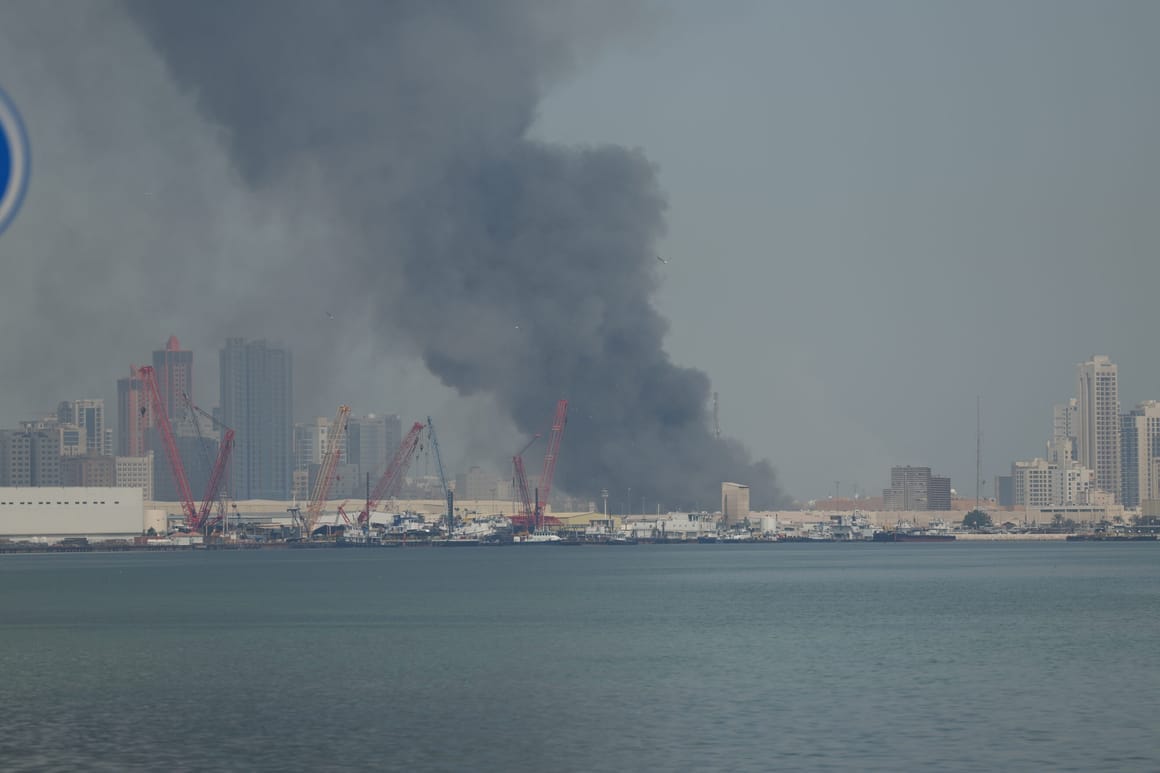
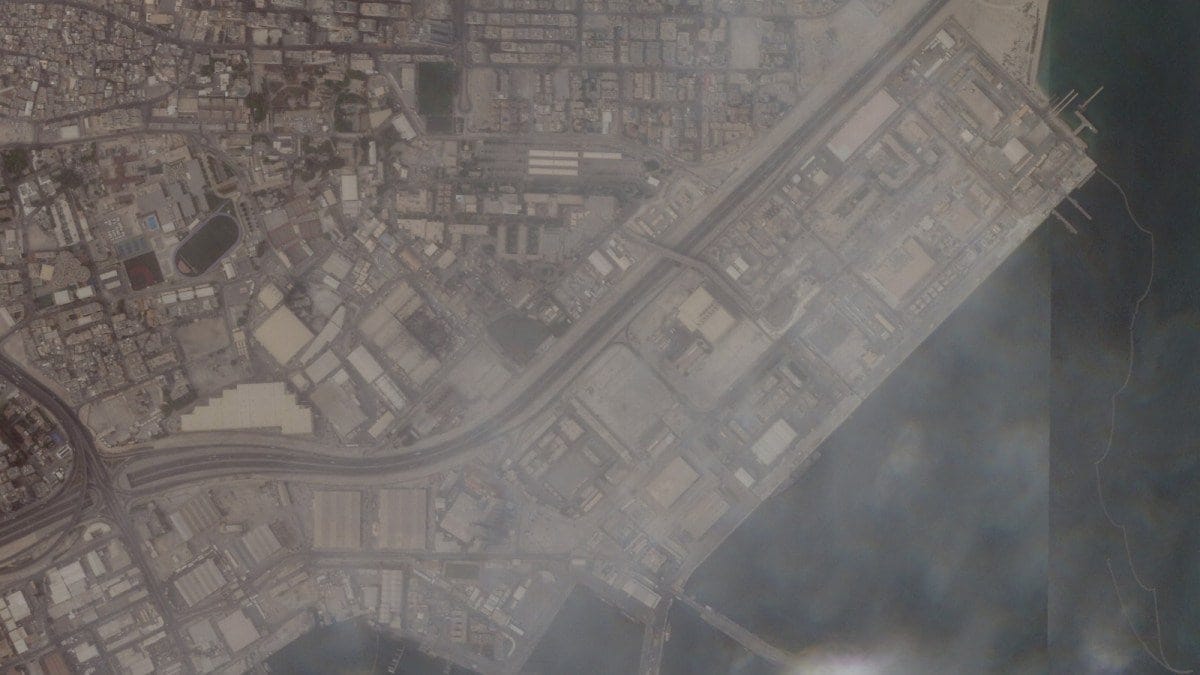
In Bahrain, the assault on the U.S. naval presence yielded fatal consequences. At approximately 2:00 AM on March 2, an Iranian missile directly struck the Mina Salman Port, adjacent to the Fifth Fleet headquarters. The kinetic impact and subsequent interception debris killed one shipyard worker and severely injured two others.19 The Pentagon later confirmed that two U.S. Department of Defense employees were wounded during the barrages on Manama.19
Diplomatic compounds were not spared. In Saudi Arabia, two Iranian drones successfully penetrated the airspace over the highly fortified Diplomatic Quarter in Riyadh on March 3, striking the U.S. Embassy compound and causing a localized fire and structural damage.8 A separate drone attack targeted a CIA station within the city.32 In the UAE, a drone strike hit the vicinity of the U.S. Consulate in Dubai, igniting a fire and forcing operational suspensions.8
OSINTdefender@sentdefender
Smoke rises as a fire appears to be burning on the roof of one of the entrance buildings that are part of the U.S. Consulate in Dubai.
2:35 PM · Mar 3, 2026 · 104K Views
18 Replies · 84 Reposts · 680 Likes
The conflict also bled heavily into Iraq, where Iranian-aligned Shiite militias joined the offensive. Militants launched repeated drone and rocket barrages against the Ain Al Asad Air Base and the Erbil Air Base, targeting housing units and runways.23 On March 10, a drone strike directly hit the Baghdad Diplomatic Support Center, a major U.S. facility, further destabilizing the American footprint in the Levant.35
The Shattering of the Gulf Oasis: Civilian and Economic Infrastructure
A defining characteristic of Iran’s strategy was the deliberate expansion of targeting to include the civilian and economic lifeblood of the Gulf monarchies.10 By striking luxury hotels, international airports, and vital energy refineries, Tehran sought to fracture the carefully curated image of the GCC as a safe haven for global capital, thereby pressuring the Arab states to demand a cessation of U.S. and Israeli hostilities.10
The United Arab Emirates bore the overwhelming brunt of this attritional warfare. Between February 28 and March 10, the UAE Ministry of Defense reported detecting an astounding 1,475 drones, 262 ballistic missiles, and numerous cruise missiles launched toward its territory.40 While Emirati F-16s, Mirage 2000s, and ground-based interceptors achieved an impressive interception rate, the sheer volume of the swarm attacks ensured that dozens of projectiles breached the shield.31
The visual impact was devastating for Dubai’s reputation. Intercepted drone debris and direct strikes sparked localized fires at the iconic Burj Al Arab hotel and luxury residential towers in the Palm Jumeirah and Dubai Marina districts.55 Dubai International Airport—the world’s busiest for international travel—and Zayed International Airport in Abu Dhabi suffered direct hits and debris impacts. Four aviation workers were injured in Dubai, and one individual was killed at the Abu Dhabi facility, leading to mass flight cancellations and the suspension of operations by major carriers like Emirates and Air France.57 Across the UAE, the collateral damage from interceptions and direct strikes resulted in the deaths of six civilians—primarily expatriate workers from Pakistan, Nepal, India, and Bangladesh—and injuries to 122 others.29
Iran also executed precision strikes against the core energy infrastructure that sustains the global economy. In Saudi Arabia, Iranian drones repeatedly targeted the massive Ras Tanura oil refinery. Debris from intercepted drones sparked fires that forced Saudi Aramco to temporarily shut down 550,000 barrels per day of processing capacity.9 The Shaybah oil field, which produces roughly 1 million barrels daily, and the Berri oil field faced sustained, multi-wave drone attacks.9
The economic assault on Qatar was equally severe. Iranian drones struck QatarEnergy’s facilities at the Ras Laffan and Mesaieed Industrial Cities.26 The strikes forced a complete halt to Qatari liquefied natural gas (LNG) production, abruptly removing approximately one-fifth of the world’s LNG export capacity from the global market and triggering panic in European energy sectors.6 In Bahrain, a drone attack on March 9 ignited a massive fire at the Bapco petroleum refinery on Sitra Island. The resulting conflagration injured 32 citizens, including four serious cases, and prompted the state-owned energy company to declare force majeure on all group operations.19
Perhaps most alarming was the exposure of the Gulf’s fundamental existential vulnerabilities. On March 8, an Iranian drone struck a critical water desalination plant in Bahrain.19 Furthermore, fragments from intercepted missiles struck a university building in Muharraq, injuring three people, and damaged residential housing and shopping districts in Manama.56 In Kuwait, drone strikes targeted fuel storage tanks at the Kuwait International Airport and engulfed the Public Institution for Social Security building in flames.56
Maritime Strangulation: The Blockade of the Strait of Hormuz
Parallel to the aerial bombardment, Iran executed a highly effective maritime strangulation campaign, effectively blockading the Strait of Hormuz and weaponizing global supply chains.6 On February 28, the IRGC declared the 33-kilometer-wide chokepoint a closed military zone, threatening to “set fire to any vessel attempting to pass”.6
This threat was not idle. The maritime offensive targeted vessels traversing the Gulf and the strategic logistical ports meant to support the U.S. Navy. On March 2, the American-flagged chemical and oil products tanker MT Stena Imperative was struck by multiple Iranian projectiles while berthed at the Mina Salman Port in Bahrain, sparking a major onboard fire that required emergency suppression.19 Concurrently, an oil tanker flying the Marshall Islands flag was attacked by an explosive drone boat approximately 50 nautical miles off the coast of Muscat, Oman. The explosion breached the main engine room, resulting in a severe fire and the death of one crew member.33 On March 4, a Bahamas-flagged crude tanker suffered a massive explosion while anchored southeast of Kuwait, marking a significant geographic expansion of the maritime threat.30
To enforce the blockade, the IRGC Navy deployed numerous minelayers into the Strait of Hormuz. By March 10, CENTCOM reported that U.S. naval and air forces had engaged and destroyed 16 Iranian minelaying vessels.65 Furthermore, Iran subjected the entire Persian Gulf and Gulf of Oman to severe GPS/GNSS jamming and electronic spoofing. Maritime intelligence agencies recorded over 1,735 severe interference events affecting 655 cargo-carrying ships in the first week alone, rendering electronic navigation near-impossible and drastically increasing the risk of collateral damage.66
Recognizing that the U.S. military relies on bypass hubs to circumvent the Strait of Hormuz, Iran directly attacked Oman’s commercial infrastructure. The Port of Duqm, vital for U.S. logistical roll-on/roll-off operations, was repeatedly targeted by drones. Strikes hit mobile housing units, injuring a foreign worker, and successfully impacted fuel storage tanks, causing contained damage to the strategic dry-dock facility.26 In the UAE, the Jebel Ali Port, the linchpin of regional maritime commerce, suffered fires resulting from intercepted missile debris, while operations at Kuwait’s Shuaiba port were completely suspended.26
The compounding effect of kinetic threats, naval mines, and electronic warfare caused commercial transit through the Strait of Hormuz to collapse to near zero.6 Major global ocean carriers—including Maersk, MSC, Hapag-Lloyd, CMA CGM, and COSCO—suspended all transits, trapping over 150 loaded tankers outside the gulf.68 The global insurance market reacted instantly; War Risk and Protection and Indemnity (P&I) insurance were broadly withdrawn for the Persian Gulf, rendering maritime commerce economically untenable.6
The Stress Test of the MEAD Alliance
The joint defense framework established by the United States, Israel, and the GCC—formalized faced its first existential, real-world test.14 From a purely tactical perspective, the integrated air defense network demonstrated significant capability. The UAE, which bore the brunt of the Iranian swarm tactics, reported interception rates hovering between 92 and 94 percent for incoming ballistic missiles and drones.54 The integration of early warning data via CENTCOM’s CAOC at Al Udeid proved functionally capable of tracking and assigning mass launches.27
However, the strategic viability of this defense model was revealed to be fundamentally flawed due to an unsustainable asymmetric cost-exchange ratio. Iran’s True Promise IV campaign relied heavily on the mass deployment of Shahed-136, Shahed-107, and jet-powered Shahed-238 loitering munitions.11 These systems are manufactured at an estimated cost of $20,000 to $50,000 per unit.31 In stark contrast, defending against these saturation waves forced the U.S. and GCC militaries to expend premium interceptors. A single Patriot PAC-3 interceptor costs approximately $4 to $5 million, while a THAAD interceptor costs upwards of $15 million.31
Within the first 100 hours of the conflict, the financial burden of munitions replacement for the United States alone exceeded $3.1 billion.71 The rapid and alarming depletion of interceptor stockpiles prompted the UAE and Qatar to issue urgent requests to Washington for emergency replenishments.54 This dynamic highlights a critical capability gap: the United States and its regional partners currently lack the deep magazines of cheap interceptor drones or directed-energy weapons necessary to sustain defense against prolonged attritional warfare.11
Furthermore, the fog of war in a highly saturated drone environment led to severe operational friction and catastrophic failures in situational awareness. The sheer density of targets over Kuwait caused a tragic breakdown in air defense coordination, resulting in Kuwaiti air defenses mistakenly identifying friendly aircraft as hostile. This friendly fire incident led to the downing of three U.S. Air Force F-15E Strike Eagles, a catastrophic error that cost the U.S. military an estimated $282 million in hardware and undoubtedly fractured operational trust within the coalition.11
The Shattering of the Gulf’s Economic Model
For decades, the Gulf monarchies have predicated their transition away from hydrocarbon dependency on maintaining an image as an “oasis of stability” in a perpetually volatile region.10 Cities like Dubai, Abu Dhabi, and Doha have successfully attracted trillions of dollars in foreign direct investment, global tourism, and highly skilled expatriate labor by implicitly guaranteeing absolute physical security.52
The visual reality of the March 2026 war—plumes of black smoke rising from the Jebel Ali Port, fires near the Burj Al Arab, and explosions disrupting the world’s busiest international airport—has deeply punctured this vital narrative.10 The deaths of foreign workers in Dubai, Bahrain, and Oman forcefully communicated to the global market that the GCC is no longer immune to the kinetic realities of its neighborhood.29 Furthermore, the Iranian strikes on the Bahraini water desalination plant exposed a terrifying existential vulnerability; without uninterrupted desalination and energy services, the hyper-modern, arid Gulf capitals simply cannot sustain their populations.10
This sudden vulnerability is forcing a profound diplomatic recalibration across the GCC. Prior to the conflict, Gulf leaders, including those from Saudi Arabia, Qatar, and Oman, had engaged in extensive diplomacy with Tehran and explicitly warned the Trump administration against initiating a war, fearing precisely the blowback that occurred.73 Despite hosting U.S. military assets and investing hundreds of billions in American defense technology, the Gulf states found that the U.S. security umbrella was incapable of providing hermetic protection against massed Iranian retaliation.9
Consequently, the utility of hosting U.S. forces is undergoing intense domestic and elite scrutiny. States that had meticulously cultivated backchannels with Iran and attempted to act as neutral mediators—specifically Oman and Qatar—found their sovereign territory attacked regardless of their diplomatic posturing, effectively killing near-term off-ramps.7 As Qatari officials noted, Doha cannot function as a credible diplomatic mediator while its energy infrastructure and military bases are actively under bombardment.75 The realization that U.S. bases serve as magnets for destruction, rather than purely as deterrents, is likely to stall further integration under the Abraham Accords and the MEAD Alliance.73
Global Supply Chain Paralysis and Macroeconomic Shock
The kinetic operations in the Persian Gulf instantly metamorphosed into a severe global macroeconomic crisis. The de facto closure of the Strait of Hormuz effectively severed the primary transit artery for approximately 20 percent of the world’s daily seaborne oil supply and a massive fraction of its liquefied natural gas.6
The financial markets reacted with immediate panic. The international benchmark Brent crude surged by nearly 65 percent, peaking at nearly $120 a barrel, sparking fears of a resurgence in global inflation.77 The severity of the disruption forced the International Energy Agency (IEA) to announce an unprecedented intervention: the release of 400 million barrels of emergency oil reserves, primarily drawn from the U.S. Strategic Petroleum Reserve, representing the depletion of roughly one-third of the globe’s emergency stockpiles in a desperate bid to stabilize energy prices.79
Beyond the energy sector, the conflict triggered a systemic logistics failure. With the Persian Gulf quarantined by the withdrawal of War Risk insurance and the physical threat of Iranian minelayers and anti-ship missiles, maritime commerce ground to a halt.6 The forced rerouting of major ocean carriers around the Cape of Good Hope added 10 to 20 days to Asia-Europe transit times, drastically spiking freight costs and delaying the delivery of critical industrial commodities such as aluminum, fertilizer, and cement.68
Simultaneously, the targeting of Gulf airports crippled the air freight industry. Major logistics providers, including FedEx, UPS, and Cargolux, suspended regional operations, while airlines canceled passenger and cargo flights to Dubai, Abu Dhabi, and Doha.69 This dual-domain paralysis of both ocean and air freight threatens to disrupt global manufacturing, retail, and construction supply chains long after the cessation of active military hostilities.80
The eruption of the 2026 Iran War, initiated by the U.S.-Israeli Operation Epic Fury and answered by Iran’s Operation True Promise IV, has fundamentally rewritten the security geometry of the Middle East. By systematically targeting the critical infrastructure of the United States and the Gulf Cooperation Council, Iran demonstrated both the capability and the strategic resolve to hold the region’s economic and military lifeblood hostage.
The deliberate destruction of high-value American early-warning radars, including the AN/TPY-2 in Jordan and the AN/FPS-132 in Qatar, highlighted a highly effective Iranian counter-sensor doctrine designed to blind the multi-billion-dollar MEAD network. While U.S. and allied interceptors performed admirably on a tactical level, the conflict exposed the unsustainable economic reality of utilizing multi-million-dollar missiles to defeat massed swarms of inexpensive loitering munitions.
The resulting kinetic damage to commercial ports in Dubai and Oman, energy refineries in Saudi Arabia and Qatar, and life-sustaining desalination plants in Bahrain has shattered the illusion of Gulf invulnerability. As the de facto closure of the Strait of Hormuz continues to inflict severe macroeconomic pain on global energy and shipping markets, the United States faces a precarious future in the region. Washington must now navigate the monumental task of rebuilding degraded surveillance infrastructure, addressing critical gaps in asymmetric air defense capacity, and managing a deeply fractured alliance network where host nations are increasingly questioning whether the American security umbrella is worth the devastating cost of Iranian retaliation.
https://philharper.substack.com/p/the-extent-of-the-iranian-retaliatory