
The Devil’s Share
On the Decline of Germany and the West
In my mind’s eye, present-day Germany resembles a large steamship that still appears to be sailing but has just run out of fuel. When the passengers realize what is happening, there will be anarchy aboard.
This mental image is also a metaphor for the Western world. The ugly scenes already unfolding in our major cities are only the beginning of greater upheavals. While I cannot predict the future, I cannot see how the catastrophe can be averted. The reason that our current trajectory seems hopeless dates back to an ideological problem that Germany has cultivated since 1945: guilt-based self-negation. Over the last 80 years, Germans’ natural self-identity, pride, and willingness to defend their country and culture have been suppressed.
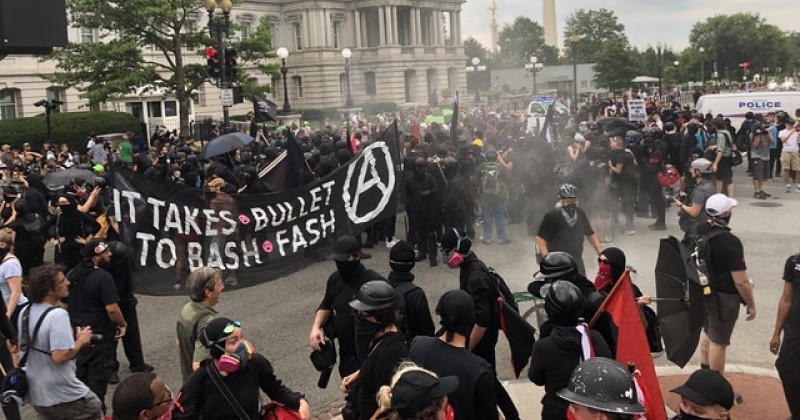
This suppression has spread and infected others. Not just in Germany but also in Sweden, France, Great Britain, and the United States, public spaces have become staging grounds for terrorist and anti-state brutality, the violence of rival gangs and ethnic groups, and the recklessness of left-wing mobs that fight any opponent of immigration. For the left, immigration is no longer a political question but a crusade for its secular religion of victimhood and salvation. This is where the extreme polarization and fanatical radicalism of the “fight against the right” comes from. As Chronicles Editor Paul Gottfried wrote in his 2021 book Antifascism: The Course of a Crusade, Germany today exemplifies “the elevation of antifascism to a state philosophy and program of mass reeducation”—with mass immigration as its most well-known consequence.
Germany’s asylum system and its anti-fascist activism have combined as part of a state-funded industry in which more and more refugees are dependent on asylum seekers’ benefits while municipal budgets collapse under the burden of welfare spending. Germany’s 2026 federal budget of €525 billion (around $625 billion) includes €180 billion in new debt. Public-sector spending makes up around 50 percent of Germany’s GDP, which means rich sinecures are up for grabs. But while Germany’s economic output is falling—a thousand industrial jobs are lost every month—asylum applications remain at high annual levels: over 106,000 by November 2025, plus 100,000 visas for family reunification. And NGOs and the German media want to ensure that the country continues on its current course.
German politicians, meanwhile, attack “the right wing” as the country’s main problem even as they drive the country headlong into a brick wall. The right-wing populist party Alternative for Germany (AfD) has not yet been banned, but it is being denounced, paralyzed, and attacked in every conceivable way. In contrast, Antifa Ost, the notorious “Hammer Gang” of Antifa radicals that has attempted to murder German right-wingers with hammers, is regarded with public goodwill. The group has been branded a terrorist organization by the Trump administration for its attacks on cars, private homes, and members of Parliament, and it is probably only a matter of time before the first deaths occur.
At the end of November, an anti-fascist street mob tried to prevent the founding of the new AfD youth organization Generation Germany in the city of Giessen. At least 25,000 demonstrators engaged in sometimes violent clashes with 6,000 police officers from all over Germany. Taxpayers finance both sides of these street battles. And things are even more absurd in the Bundestag. Chancellor Friedrich Merz of the Christian Democratic Union (CDU) has only two items on his agenda: to ostracize the AfD and to avoid upsetting his left-wing Vice Chancellor Lars Klingbeil of the Social Democratic Party (SPD), who was himself a member of Antifa as a young man.
Once a pompous-sounding conservative, Merz has broken all his electoral promises in his desperate attempts to placate the SPD and keep his coalition afloat. His constant contradictions are a symptom of his self-imposed dilemma. The SPD, in turn, feels emboldened by Merz’s weakness and has become increasingly radical. Among its demands is that Merz maintain the “firewall” against the AfD. When a CDU Bundestag motion to limit migration won a majority thanks to AfD votes early last year, a left-wing street mob of SPD supporters occupied CDU party headquarters. After that, Merz fell into line.
The AfD is a parliamentary pariah. The other parties refuse to let their members perform basic parliamentary functions such as chairing meetings or heading committees. One assumes the intention is to ban the AfD or to find a pretext to suspend upcoming elections. It seems unlikely the AfD will ever be permitted to govern. Even AfD’s leader, Alice Weidel, is said to be very skeptical regarding her party’s future.
The same game is being played against right-wing populist parties in Paris, London, Vienna, Stockholm, Bucharest, and The Hague, albeit under different circumstances. President Donald Trump, too, faces ideologically motivated obstruction within the U.S. Congress and judicial system.

This situation brings us to a sobering assessment: A decisive battle for the future of the West is being fought right now, both behind the scenes and on the streets. The violent Antifa mob is just one of many players in this game. Its advocacy for Muslim refugees (who comprise 76 percent of Germany’s immigrant population) coincides strikingly with the Islam-friendly attitude of European elites. Fighting Islamic Sharia law, femicide, and gender segregation will be just as much a part of the battle for the future as cracking down on the terrorism, knife crime, and protection rackets that come with immigrant gangs.
Added to this chaos is the widespread refusal to acknowledge the immigration crisis that is happening right before everyone’s eyes, which the writer Frank Böckelmann has identified as a “denied state of emergency.” The new German citizens are up-front about their will to power, the absolute claims of their religion, and their fantasies of annihilating nonbelievers, but they are not taken seriously.
In his 1933 book The Hour of Decision, Oswald Spengler attested to the same ignorance among his contemporary elites and foresaw the rise of non-Western powers. In the book’s last chapter, Spengler painted a bleak picture of the future of white peoples. He predicted both continued class struggle and a “race war,” in which the colored peoples of the world would rise up against the whites. There would be an intertwining of class and race warfare, with whites using people of color to fight against other whites. Spengler saw a historical precedent in the 18th century: “In 1775 the English enlisted Native Americans to attack, burn, and scalp the American republicans.” His conclusion was that
the white ruling nations have abdicated from their former rank. They negotiate today where yesterday they would have commanded, and tomorrow they will have to flatter if they are even to negotiate. They have lost the feeling of the self-evidence of their power and are not even aware that they have lost it.
In Berlin next year, Die Linke (“The Left Party”), which openly collaborates with Islamist forces, could win control over the city council. If that happens, ethnic Germans will find it harder to obtain government-subsidized housing, among other benefits. The betrayal of their own compatriots by these ideologues should serve as a warning to other countries.
Mass immigration, anti-colonialism, wokeness, and climate change are justified with abstract and collective accusations of guilt, which Germans are already well accustomed to, having been heaped with guilt and shame over the Holocaust. Unlike the sins of the World War II era, these are not a matter of concrete, indisputable deeds but rather what is called “metaphysical guilt” in the philosophical tradition. Unlike criminal, political, or moral guilt (according to Karl Jaspers’ definitions), metaphysical guilt is a guilt before God that is negotiated in prayer, and should be anything but a subject of politics.
The civil-religious equivalent of this metaphysical guilt does not require God, nor does it know of forgiveness, since it is a secular “political religion,” as Eric Voegelin called it. Metaphysical guilt consists in large part of a sum of individual actions that are not crimes in themselves. The same applies to alleged man-made climate change. This alienated action, to use Marx’s term, strangely enough makes the guilt not lighter but heavier. It corresponds with the burden that Hannah Arendt—sometimes critically, sometimes affirmatively—described as “absolute” guilt.
In August 1946, Arendt wrote to Jaspers, her doctoral supervisor,
This [German] guilt … transcends and shatters all legal systems.… Just as inhuman as this guilt is the innocence of the victims. As innocent as they all were together in front of the gas oven (… because no crime can deserve such a punishment), people are not innocent at all. With a guilt that goes beyond crime and an innocence that goes beyond goodness or virtue, there is nothing that can be done in human-political terms.
And yet absolute guilt became the basis for a fusion of politics and morality.
After 1945, there were initially two positions on absolute guilt, and the tension between them runs through the entire history of the Federal Republic. One position, which Hermann Broch advocated in his correspondence with Volkmar von Zühlsdorff, sought to bring people “and by no means only Germans” back “onto the path of increasing humanization.”
“I am convinced that the practical solution will come from Germany, because that is where the guilt was most pronounced and because that is where the mystical connection between guilt and atonement is most evident,” Broch wrote in August 1945. “What happened in Germany can happen anywhere, but because it happened first in Germany, the transformation of the world must begin in Germany.”
The other position amounted to a response to German guilt through state policy. Here, within the scope of German possibilities and interests, a process of reappraisal and reparation was set in motion that was certainly not perfect but was fundamentally new and comprehensive. This position shaped the executive branch from the term of the first federal chancellor, Konrad Adenauer, until the end of Helmut Kohl’s government in 1998. Broch’s position, on the other hand, ultimately led to a betrayal of national interests in favor of a vague globalist ethic. By accepting the idea of collective guilt, Germany became the producer of a seductive political drug: global secular moralism, which offered socialism a chance at transformation and survival after the end of the Cold War.
After 1998, the executive branch under the new Left-Green government also brought about the paradigm shift in government that had already become apparent in culture and the media around 1960 with the participation of the Frankfurt School, which had returned to Germany in the early 1950s. Since then, there have been not one but two constitutions in Germany: the written constitution of the Grundgesetz (“Basic Law”) of 1949 and the “lived” one of unconditional morality, which today finds its equally unconditional expression in violent anti-fascism.
The AfD, which the other parties notoriously accuse of being anti-constitutional, stands on the ground of the Basic Law insofar as it obviously seeks electoral success rather than a coup d’état. However, it is an opponent of the “lived” constitution of unconditional, universal ethical morality and thus of anti-fascism, which grotesquely equates the AfD with the Nazi Party. Through a gradual, “value-oriented” reinterpretation of the Basic Law, the AfD could become the enemy of this new version—but that does not yet make it the enemy of the Basic Law of 1949.
When Europe’s ruling powers pledge to “save democracy,” they are actually trying to unconstitutionally sideline the AfD, as was the case in 2020 in Thuringia, when the election of a minister-president with votes from the AfD was reversed at the behest of Chancellor Angela Merkel. Even Merz said in 2018 that he deems the German right-wingers to be of “the same evil” as National Socialism. This demagogic short-circuit, which Merz’s Christian Democrats have also adopted, allows the ruling elite to go so far as to employ violence in the fight against the AfD.
There was an important intermediate step on the way from the idea of absolute or metaphysical guilt to a “negative identity” (in Theodor Adorno’s phrase) of the German people. This was the equally metaphysical concept of the “singularity” of the Holocaust, which was finally established in the Historikerstreit (“historians’ dispute”) of 1986–1987. One problem with this idea of singularity is that it devalues all culture that “did not help” in opposing the Holocaust, as the mantra of the 1990s went. Obviously, nothing helped in preventing the Holocaust, and so redress seemed to require no less than the reversal of the entirety of European culture, including Christianity. This abyss in the philosophy of history naturally also changed the German raison d’être.
The best example of this mentality can be found in the writings of the novelist Günter Grass, who rejected German reunification, calling the division of Germany atonement for Auschwitz and thereby implicitly turning reunification into undeserved amnesty.
On Feb. 20, 2016, dozens of local Berlin celebrities lauded Merkel’s 2015 decision to open the border to more than a million migrants. They bought a half-page advertisement in the daily newspaper Welt with a headline that translates to “We Can Do It!” Their over-the-top tribute made it seem like it was Merkel had just defeated Hitler. One could sense the enormous relief of the signatories at finally being able to say goodbye to the idea of the German “perpetrator nation.” But the destruction of the German welfare state through mass immigration involving millions of people demonstrates the hubris of that very project.
Hitler nevertheless remained, paradoxically, more powerful than ever. What to do? “Killing Nazis isn’t hard, with hammer, sickle, and rifle,” read one of the banners in Giessen. Incidentally, “Kill Nazis” is a legally permissible slogan, but “Germany awake” is strictly forbidden, because that slogan can also be found in a Nazi party song from 1920. Thought crimes like these, when expressed by locals, are often prosecuted more stringently than even the most serious violent crimes committed by immigrants.
Spengler’s interaction of class struggle and “racial struggle” is playing out as a grim spectacle of revenge, performed by the purified Germans “after Auschwitz” against their allegedly stubbornly Nazi fellow citizens. The simultaneous economic collapse, public debt, and breakdown of infrastructure, the welfare state, and public safety seem to point to the third downfall of the German nation-state after 1918 and 1945.
Revenge in this context is not a simple quid pro quo. The philosopher Peter Furth in 1990 provided a model for “optimistic tragedy” that gives meaning to Germany’s sacrifice from an anti-fascist perspective. The idea of the optimistic tragedy comes from Vsevolod Vishnevsky’s 1932 play of the same name and is, of course, a contradiction in terms, attributing a positive message to great misfortune. In Furth’s repurposing of the idea, he asks, “Wouldn’t it serve global catharsis if guilty Germany sacrificed itself?”
The world would be well advised to heed the warning of the Swiss philosopher Denis de Rougemont in his 1944 book The Devil’s Chance: “Here lies the new tragedy: we have foreseen everything against a future Hitler, nothing against his absence, which is nevertheless certain. And this is the Devil’s opportunity for tomorrow.” He goes on to say, “The theological naiveté of our century is one of the most considerable advantages of the new barbarism.”
https://chroniclesmagazine.org/correspondence/the-devils-share