
Where Empire Meets the Abyss
One ought never to seek anything rationally graspable in the feverish utterances that presently issue from Donald Trump; for they resemble less the speech of a statesman than the half-coherent incantations of one who has lingered too long at the edge of a horizon where meaning itself thins into a pale, phosphorescent mist. Over the weekend, if one may still trust the mundane sequence of days, he cast forth his appeals to a circle of nations, imploring them to aid the United States in forcing open the Strait of Hormuz, that narrow and ancient passage whose significance vibrates like a hidden nerve beneath the visible skin of commerce and empire. The replies came back as refusals, blunt and unaccommodating. Europe asserted its own line, stepping back from Washington’s demand and signaling a growing distance from its supposed overlord. Yet, with a curious reflex common to those who sense the collapse of their own narratives, Trump recast his plea as a test, a deliberate probing of loyalties, as though he had merely extended tendrils into the dark to measure the response of unseen entities. The United States, he insisted, stands in radiant self-sufficiency. It requires nothing. And still, he pronounced judgment upon NATO—an edifice long assumed to possess a certain structural permanence—declaring its refusal a grave error. The words carried the cadence of a threat, though one distorted by the peculiar warping of intention into incoherence. From the babble, however, one perception emerges with dreadful clarity: Trump’s ire has fixed itself upon Europe, as though some slumbering antagonism has stirred beneath the sediment of diplomatic habit.
The subjective core, that seething reservoir of will and resentment, exerts its pressure upon events. Trump reveals himself as vindictive, a figure who acknowledges ever fewer limits, as though the boundaries that once circumscribed action had dissolved under the corrosive influence of his own Being-in-the-world. Here Heidegger’s language intrudes with uncanny precision: Dasein, that exposed clearing in which Being discloses itself, drifts when severed from authentic grounding into a condition of erratic projection, where the world appears as a shifting field of arbitrary possibilities. A man who proclaims he may do as he pleases with an island state such as Cuba, who idly muses about bombing Iran’s Kharg Island “just for fun,” inhabits a realm in which possibility and actuality bleed into one another like indistinct shapes glimpsed through a veil of cosmic vapor. Such a figure would not hesitate to cast indignities upon allied nations, should the opportunity arise, for in his horizon the Other appears as a disposable configuration within an increasingly constricted field of concern. Whether this will occur in the immediate future remains obscured, like cyclopean forms lurking just beyond the threshold of perception.
At this juncture, one is reminded of those fragmentary dialogues preserved in certain disreputable Arkham archives, where witnesses, having glimpsed the underlying structure of events, struggled to give voice to what pressed upon their minds:
“I tell you, Carter, there is a rhythm beneath it, a cadence older than policy. The words are wrong… they crawl, they coil… and still something speaks through them.”
“Through them?” Carter’s reply came strained, as though each syllable cost him dearly. “You speak as if he were a conduit, an aperture.”
“An aperture, yes, an opening through which something expresses itself. These threats, these reversals, they lack the texture of intention. They resemble… emanations.”
Carter’s breath caught, a faint tremor passing through him. “Then the figure we see is merely the surface, an agitation above a deeper sea?”
“Precisely. And that sea is vast, Carter, vast beyond any chart. Once one has heard its murmur, the world never regains its former solidity.”
Meanwhile, Trump descends, step by step, into a mire that appears less political than cosmically determined in its density. The swift and glorious victory he had envisioned in Iran recedes like a mirage glimpsed across an alien desert, dissolving upon approach into formless distortion. Each day of continued bombardment deepens the losses borne by his Arab partners in the Persian Gulf, losses that accumulate with a dreadful inevitability, as though dictated by forces that regard such designs with utter indifference. The global economy trembles, its intricate lattice of dependencies vibrating under strain, evoking those immense and vertiginous structures described in forbidden texts, non-Euclidean architectures whose scale dwarfs human comprehension, whose foundations rest upon principles no mind can fully apprehend. Yet, in a manner at once chilling and entirely predictable, such consequences appear to weigh little upon him. More troubling still is the agitation within the MAGA base: a restless stirring born of mounting war costs and the relentless ascent of fuel prices. What once appeared as a unified body now begins to fissure, like a once-solid edifice whose hidden supports have long since decayed.
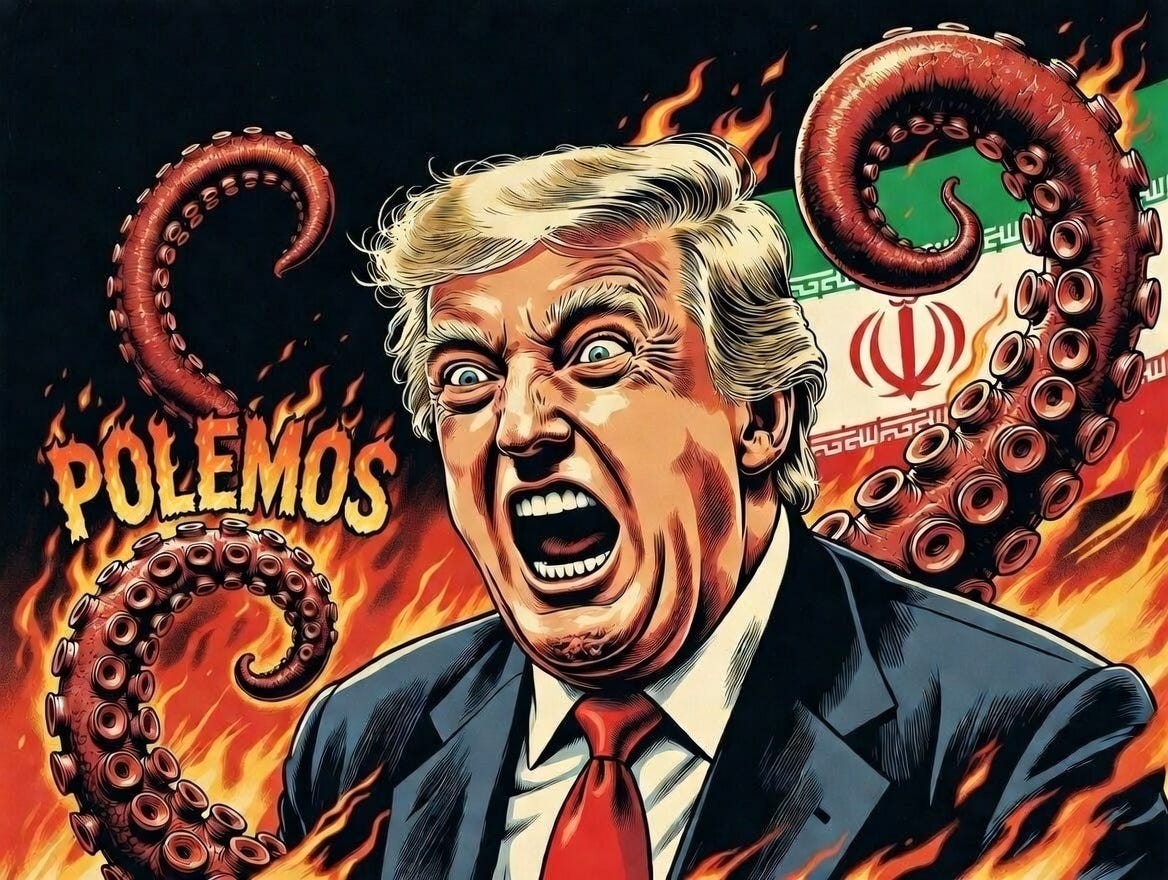
The war in Iran itself reveals an even more disquieting dimension. For Heidegger, conflict—polemos—is a primordial strife through which a world comes into unconcealment. Here, the war ceases to be merely strategic or economic; it becomes a site where Being itself discloses its inner tension. Nations and leaders appear as Dasein collectively thrown into a historical situation, bound by that uncanny “thrownness” which situates existence within conditions never chosen. Yet what unfolds in this conflict bears the mark of a deeper forgetfulness, a Seinsvergessenheit so profound that all participants move within a closed circuit of calculation, domination, and technical manipulation. In this oblivion, the question of Being recedes into darkness, and action becomes ever more frenzied, ever more detached from any authentic grounding. The escalation thus assumes an almost ritualistic quality, as though each act of force were an offering to an unseen order whose logic exceeds human comprehension, drawing all participants further into its inexorable unfolding.
The resignation of Trump’s counterterrorism chief, Joseph Kent, emerges as a signal—subtle, yet laden with significance—like the first faint tremor preceding a tectonic rupture. For the American establishment, that diffuse and shadowed constellation of power, tolerates incoherence only so long as it is accompanied by results. The babbler may babble, provided he delivers. When delivery falters, and when his performances render the nation absurd before the gaze of the world, the tolerance evaporates with alarming speed. Then the atmosphere thickens, charged with a tension that resists articulation, as though unseen presences had drawn nearer.
In response, Trump appears to reach instinctively for escalation, as though greater intensity might dispel the encroaching void. He seeks to turn the tide through renewed conflict, to impose direction upon a reality that increasingly resists his projections. Yet the effort yields little. Success remains elusive, retreating ever further into an immeasurable distance. One is reminded of those doomed figures who, having glimpsed the deeper structure of existence, persist in their attempts to assert mastery, only to discover that the universe does not yield, that it remains vast, indifferent, and fundamentally alien to human desire. In such a context, the present course of events acquires an ominous cast. For when action continues in defiance of its own futility, when escalation replaces understanding, the consequences unfold with a severity that surpasses all prior imagining. And thus, what now appears as mere failure may yet reveal itself, in time, as the threshold of something far more profound and far more terrible.
https://www.eurosiberia.net/p/the-lovecraftian-trump-iran-clash