
Conservatism Died Because It Failed and Became Purposeless

Conserving Liberalism Is a Fool’s Errand.
In my recent article on why “How One Dress Is a Political Act,” I noted that the claim pushed by many, particularly in the mass-appeal podcasting space, that the “Left-Right Distinction is no longer real” is facile. Left and Right are spirits. Entropy versus order, equality versus excellence, progress versus tradition. The left is the side of entropy incarnate; it is a teeming horde that aims to destroy every unchosen bond in the name of liberation. The right is the side of three things: order, tradition, and natural hierarchy. That distinction remains.
What is true, however, is that nominally “conservative” parties and figures are decidedly not creatures of the right.
They might claim to be, as they sometimes oppose the left, largely over property rights and taxation. But almost no Republican Party, Tory, or Christian Democratic Union (CDU) politicians, talking heads, or writers would be comfortable taking a stand for natural hierarchy, even a hierarchy fully in line with the traditions of their nation. What Republican, for instance, would argue that voting rights should be restored to what the Founders intended—only available to propertied men? What Tory would argue that the Lords and gentry ought rule as they did in the days of Pitt, or even the Hotel Cecil? None.
Instead, their ideology is, as Dabney famously said, to shadow “Radicalism as it moves forward towards perdition”. “What was the resisted novelty of yesterday is today one of the accepted principles of conservatism; it is now conservative only in affecting to resist the next innovation, which will tomorrow be forced upon its timidity and will be succeeded by some third revolution; to be denounced and then adopted in its turn.”
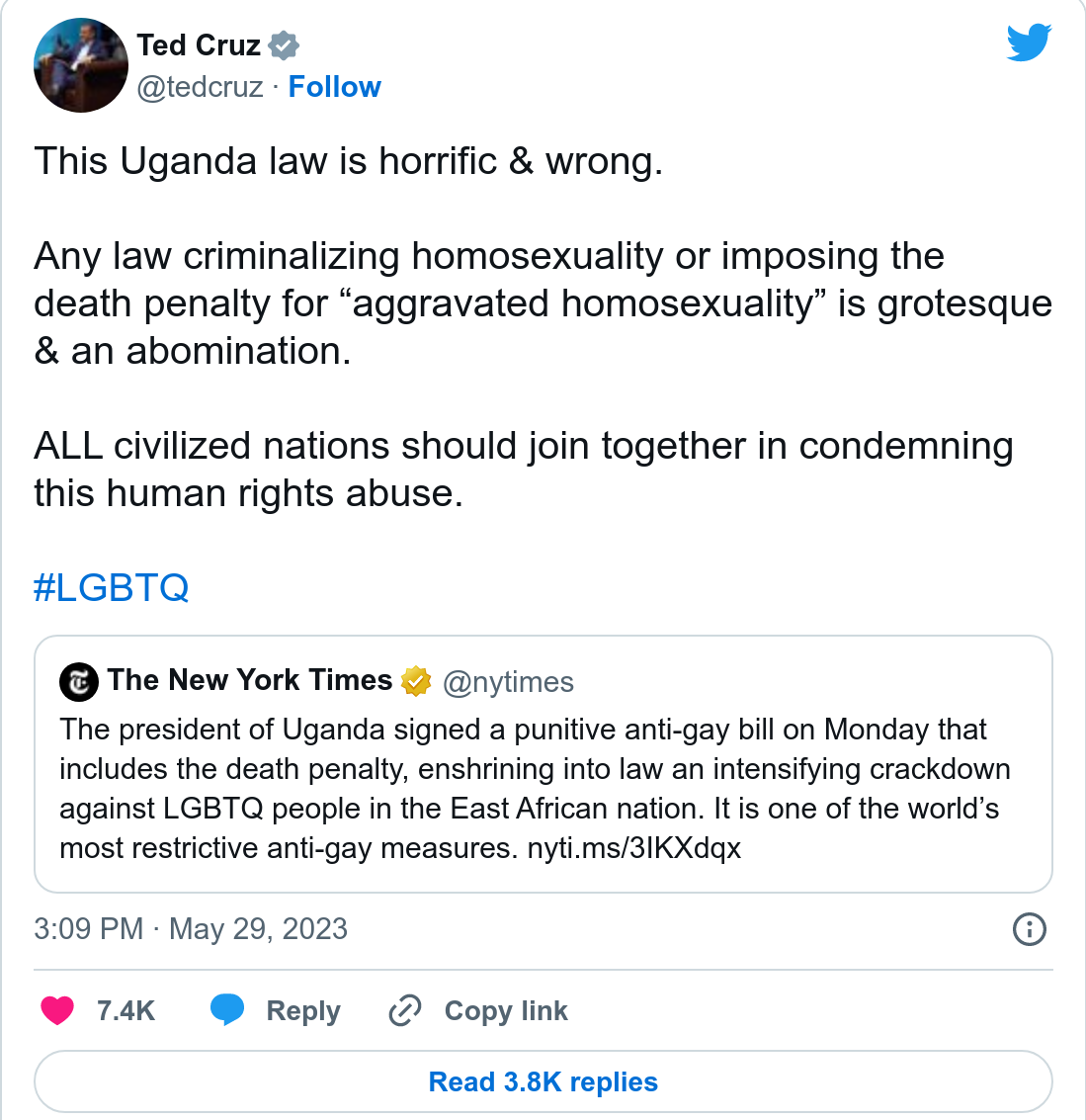
Ted Cruz boldly arguing against a Ugandan law that punishes homosexuals who rape children with the death penalty is case in point of this. The resisted novelty of yesterday is the accepted “conservative” principle of today:
Meanwhile, the Tories are currently “led” by a gap-toothed Nigerian woman who self-identifies not as British but as a “Yoruba,”1 whatever the devil that means. Regardless of the exact definition, it’s unlikely to be a self-descriptor of which Pitt or Burke would have made use.

It was around when I was writing about that aspect of modern politics that I got my daily email from Readwise, a fantastic service which I use to keep track of my research notes for both this Substack and The Old World Show, with this quote from Russell Kirk’s The Conservative Mind:
Only vague cautionary impulses guided the South after 1865, combining with popular distrust of the negro, and lack of material resources, to slacken the rate of social alteration. The modern South cannot be said to obey any consciously conservative ideas–only conservative instincts, exposed to all the corruption that instinct unlit by principle encounters in a literate age. The affection for state sovereignty, the duties of a gentleman, and the traditions of society which Randolph and Calhoun extolled found their finest embodiment in General Lee; and, with Lee, these ideas yielded to superior force at Appomattox.
Then, on Sunday, I got this quote from the same book in my mailbox, again thanks to Readwise:
How much conservatives have lost since July 14, 1789, has been suggested in the preceding chapters of this prolonged essay. What they have retained, in Britain and America, remains greater than what they have forfeited.
Together, I think they show the larger problem with conservatism: it failed. The result is that any political ideology based on it is—as Kirk concedes in the context of the South, but is unwilling to concede generally—utter incoherence that manifests in instinctual resistance to change rather than any positive vision of how society ought be ordered so as to encourage human flourishing.
British Conservatism
This is a problem with conservatism that becomes quite evident across the course of The Conservative Mind. It begins with Burke, whose worldview is that of the country squire: order, tradition, and hierarchy as embodied by the landed estates of Britain and the gentlemen who ruled over them, country society, and the nation, with the king serving as the sovereign—the ultimate arbiter and decider of exceptions amongst the peers—was the proper way to order society.
As such, conservatism was a means by which that ordering of society could be preserved in the face of competition from a rising merchant oligarchy based on trade and manufacturing, and a groundswell of discontent from the laboring underclass and professional middle of the sort that led to the Revolution in France. Instead of ameliorating that discontent by tearing down what existed and replacing it with some abomination of a revolutionary regime in the name of Egalité, order and the “natural aristocracy” that produced it were to be maintained as human flourishing was gradually achieved.2
This approach of defending the old order largely succeeded through the reign of Victoria, as shown by the immense prosperity of the period, including for the average worker.3
Further, it was natural in that it meant the best men were employed in the way that made the best use of their talents. This accordance with nature made it stable, particularly as the best men of other classes were generally able to enter the British landed elite as its worst members fell from it with their declining fortunes and dissipation.4 Thus, it held off the specter of rule by mediocrities by encouraging the best new men to gradually enter its ranks as they acquired the resources to do so, and then aid it in governing. Adding to that was its general virtue. Kirk notes:
More than any other order in history, perhaps, the British upper classes of the eighteenth and nineteenth centuries deserved this eulogium: as a body, honorable, intelligent, moral, and vigorous. The ascendancy of this class, says Burke, is truly natural. Domination of society by mediocrity is contrary to nature. One of the duties of a statesman is to employ the abilities of the natural aristocracy in the service of the commonwealth, rather than to submerge them in the mass of the population, where they could only menace the stability of society.
Leadership by men of ability, birth, and wealth is one of the most natural, and most beneficial, aspects of civilized life.
Such an order made sense, even if it’s not what we in America would prefer, and so conservatism regarding it made sense. To conserve it was to conserve an excellence and virtue-oriented order that did a brilliant job of tying together generations, providing good rule, providing justice, providing prosperity, and producing a stable society.
But then it died. Changes to the tax and education systems weakened it.5 Changes to voting laws, particularly the Third Reform Act, weakened it.6 The death of Victoria marked a simultaneous end to the rising prosperity that had legitimized it in the eyes of the common folk,7 and the ascendance of first the Liberal Party and then the Labour Party irrevocably reshaped politics and society by taxing into oblivion the landed elite that once ruled.8 What replaced the rule of gentlemen of the sort Burke had defended was the rule of bureaucracy, and it was a wholly different creature.
The South
The same is true of the South, as Kirk notes. While initially on the side of the somewhat more egalitarian Jeffersonian Democratic-Republicans, though that was tempered by the nature of their society,9 this changed as the plantation system became more entrenched for the long term—and with it the feudal, chivalric nature of Southern society. As Kirk notes, “The Southern planter-society, which for a time wore an egalitarian mask, had come to perceive its own innate conservatism.”
This flowered with John Randolph of Roanoke, an eccentric character who was raised at the appropriately named Bizarre plantation and was known for speaking to the House of Representatives in full fox hunting apparel, from spurred boots to top hat, while holding a riding crop and having a slave boy follow him around with a bottle of port from which he drank when thirsty. As could be expected, his behavior terrified the representatives from the Northeast, whether members of the merchant oligarchy or Puritan-descended Unitarian faction.10 Kirk, describing Randolph’s conservatism and worldview, notes:
Men are not born free and equal, said Randolph. Their physical, moral, and intellectual differences are manifest, to say nothing of their difference of birth and wealth. To presume that a mystic “equality” entitles the mass of mankind to tinker at pleasure with society, to play with it as a toy, to exercise their petty ingenuity upon it, is to reduce mankind to the only state of life in which anything resembling equality of condition actually prevails: savagery. Jeffersonian levelling doctrines, if taken literally, mean anarchy, “the chrysalis state of despotism.”
…
“We now begin to experience the danger of admitting so great an error to have a place in the declaration of our independence. For a long time it lay dormant; but in the process of time it began to germinate, and produce its poisonous fruits… Instead, then, of all men having the same right to liberty and equality, as is claimed by those who hold that they are all born free and equal, liberty is the noble and highest reward bestowed on mental and moral development, combined with favorable circumstance.”
This resistance to equality, democracy, and egalitarianism11 was built around defending the South’s right to exist as it then existed. Randolph’s rise came as the abolitionist menace became a potent political force, and thus the conservatism he championed—despite his mixed private feelings on slavery itself—came about in much the same way that Burke’s did. It was in resistance to a revolution from without that would damn and destroy the landed society he and his fellow gentry held dear.
It largely succeeded in that, despite the exactions and pressures imposed upon Southern society by the abolitionists, until the War Between the States. Despite the harangues and attacks directed at it by Puritan-descendants like Harriet Beecher Stowe, William Lloyd Garrison, and John Brown, the South largely succeeded in remaining a coherent society that changed very little between the rise of Randolph and the War.
But then came the destructive, society-shredding war and its aftermath. The South was left completely prostrated,12 ruled by alien “carpetbaggers” who swindled and looted what little remained while imposing an alien ideology and system of governance upon it.13
This left the sort of residue of conservatism with no real substance behind it that Kirk describes: “Only vague cautionary impulses guided the South after 1865, combining with popular distrust of the negro, and lack of material resources, to slacken the rate of social alteration.” Critically, gone was the sort of property-backed leadership in which a plantation-owning ruling class engaged, the very sort of virtue that made the ruling class something more than an oligarchy and closer to an aristocracy.14 The War and Reconstruction wiped that away.
So, what remained was a general sense of conservatism and a sharp resistance to change—particularly in matters regarding race—but little that backed it up, as there was little to conserve other than the ruins of a vanished civilization. This remained the case until much of that was replaced by business-centric cosmopolitanism in the “New South” of the late 20th century, which made the general conservatism even more incoherent.
Northern Conservatism
Even the American North had something of a conservative tradition that was somewhat more robust than that parodied by Dabney as the mere shadow that stalks Radicalism on its path to perdition.
When it began, Kirk argues, it was the sort of view expressed by James Fenimore Cooper: one of hostility to democracy, hostility to the masses, and in defense of property.15 It largely centered on the Founding Era’s cult of gentility and the gentleman: rising above the humdrum and exercising enlightened leadership. Kirk cites the writings of James Fenimore Cooper—the famous author also of The Leatherstocking Tales, such as The Last of the Mohicans—as exemplary of this attitude. Kirk wrote, quoting Cooper in the passage:
Social station is a consequence of property, and so cannot be eliminated in a civilized society; so long as civilization exists, property is its support. Our endeavor should be so to arrange matters that the possessors of superior social station are endowed with a sense of duty. One man is not as good as another, even in the grand moral system of Providence.
…
‘As no civilized society can exist without these social differences, nothing is gained by denying the use of the term.’ Liberal attainments distinguish the gentleman from other people; simple gentlemanlike instincts are not enough. Money, however, is no criterion of gentility. If the gentleman and the lady vanish from a society, they take with them polite learning, the civilizing force of manners, the example of elevated conduct, and that high sense of station which lifts private and public duty above mere salary-earning. If they go, eventually civilization will follow them.
But it died an early death, with the great patroons of the Hudson Valley—proprietors of vast landed domains—largely dying out by the middle of the nineteenth century because of attacks on property carried out for the benefit of the masses. It was this early defeat that sparked the sort of despair, confusion, and ineffectiveness for which Northern Conservatism was long infamous, as Kirk notes (emphasis added):
[T]he radicals of the anti-rent movement were determined that the landed proprietors of central New York should give way to farmers and squatters; no prescription, no title in law, should operate against the demand of the majority for ownership of their fields. In the long run, the farmers and squatters won, through intimidation of the landowners and timidity of the courts before popular enthusiasm. The great proprietors of the Hudson vanished from history. This violation of the rights of property, and the means by which it was accomplished, dismayed Cooper immeasurably. If democratic society were bent upon eradicating the class of gentlemen, how would it provide for its own leadership, how would it retain a high tone? That question never has been answered satisfactorily in the United States; and a marked hostility toward large property in land seems embedded in American character.
That sort of despair, ineffectiveness, and acerbic criticism culminated in Henry Adams, who was certainly a well-educated critic of democracy,16 but did little to combat it other than write the occassional, biting article. In this, he did little to combat—much less reverse—the spirit of the times, instead sticking to vague theories17 and occassional articles. “The New York Gold Conspiracy” article, published in the North American Review, had something of an impact in that it helped spark a Congressional investigation into Gould and Fisk that went nowhere.
That was about it. Nothing was conserved, and society drifted yet further away from where types like Cooper started, with a mercantile society run by a merchant oligarchy and known for immoral business practices gradually dominating the city of New York and the country. Still, even that was better than the bureaucrats and socialists who followed them.
Please share this post if you find it interesting:
Conservatism Failed, Now What?
At the point of broad social change—the People’s Budget in Britain, Reconstruction in the South, Progressivism in the rest of America—or perhaps sometime before it, as the case may be, conservatism made no sense. The sort of attitude that is hostile to change when all is going well, or at least when what one thinks are the proper societal structures and incentives are in place, is muddled and incoherent when all of those pillars of civilization have been kicked away and replaced with abominations.
Yes, generally resisting yet further change from the left is necessary, but is not sufficient. The evils, distortions, and imbecilities imposed on society in the name of equality must be rejected, reformed, and replaced. Reconquista is needed, not conservation of that which was widely regarded as wrong yesterday.
But that seems not to have happened, at least at the time when Kirk wrote The Conservative Mind, which makes it frustrating as a book. To be sure, he admitted that different impulses are relevant depending on the times in which they exist.18 The fault is not his.
Unfortunately, that same thinking does not come across in his book. The thinkers after the inflection point—generally sometime around the beginning of the 20th century—remain dispositionally conservative despite not having much left to conserve.
Property, long a necessary ingredient of conservatism, had been sacrificed by the taxman’s knife on the altar of equality; it was later resuscitated somewhat, but the damage was done and got worse thanks to Civil Rights. In America, social hierarchy had not yet been obliterated by equality, but would be by the 1960s. Tradition was largely extirpated by the same forces, for the same reasons, everywhere. Whether the end of the London Season after World War II,19 the Cultural Revolution inflicted on the South with Reconstruction, the second Cultural Revolution that came with Civil Rights, the neutering of the House of Lords, once-sacred societal forms and traditions were wiped away by the perpetual Year Zero in which we now live.
As such, the later thinkers Kirk profiles should have been essentially reactionaries rather than “conservatives.” If they had a vision of society that aligned with that of those from before the Revolution, whether Burke, Cooper, or John Randolph, they would have been. But that didn’t happen. Instead, there is merely a murky and motley collection of so-called thinkers with little of note to say because the times in which they lived and the crusty nature of their ideas were at such variance. What is the point of conserving what exists when not only does “The Black Liberation Army” exist, but the majority of the government is friendly to it?
Admittedly, there were some who recognized this and stood against the times in an attempt to hold onto a better form of life. The Rhodesians are probably the best example, as their world was still an unrepentantly inegalitarian one of the sort that existed before the Great War, that functioned well in the manner Burke desired, and that was firmly in line with the Anglo tradition. But it was destroyed, and the political philosophy of the imperial remnants is left undiscussed by Kirk.
Rhodesia also provides the best example of how incoherent the “conservative” movement became in the postwar era. Supposed vanguardist of a conservative revival William F. Buckley sat down for an interview with Ian Douglas Smith and…attacked him for not agreeing to the sacred nature of one man, one vote democracy, an idea that any of those profiled earlier would have found absurd. Neither Burke nor Cooper, Randolph nor Adams, believed in such drivel. Yet Buckley did.
Similarly, Pat Buchanan notes in his The Greatest Comeback that President Nixon supported the Civil Rights Movement, and found those to the right of him to be kooks. Nixon was nevertheless certainly better than LBJ, but hardly on the right in any real sense of the term. He didn’t even try to hang the Weather Underground or Black Panther terrorists.
That is the problem we face, and why much “conservative” rhetoric is so incoherent and unappealing. There are real values that a rightist worldview is based on—tradition, natural hierarchy, and order—and a coherent political stance can be crafted based on them. Such was long the case, and what conservatism tried to defend.
But we are no longer in such times. The world of today is exceedingly egalitarian to the point of being essentially race communist, and the mind rot that has led to that perdition must be rejected and defeated rather than made peace with. The only other option is a continuing Cultural Revolution that further destroys that which we cherish.
Conservatism is largely not the right mindset or approach to fixing that. A great evil is not extirpated by trying to keep it in place, but by banishing it to the depths of Tartarus. Or hanging it. It requires, in short, an anti-egalitarian “victorious counterrevolution” of the sort few have achieved. Lee Kuan Yew is one example. Franco is another. The American Federalists are something of a third, as Kirk notes,20 though with more asterisks.
Regardless, conservatism as a spirit and ideology is largely a dead and spent force at this moment. It failed as it tried to make peace with the egalitarian delusion, or failed to defeat that delusion in open battle. Either way, it failed.
Despite what Kirk claims, it nearly entirely failed in keeping intact that which it aimed to, which is to say a hierarchical and virtue-oriented society led by the best and characterized by respect for tradition and a deep sense of public order. The utter devastation and chaos of the 1970s is the best example of that failure, but it is deeply set. The essentially war zone-like nature of our cities, the fact that “Admiral Rachel Levine” attained one of the highest positions in the land, and the horrific destruction of beauty and traditional architecture in the name of equality are all examples of the deeply set present rot that must be reversed.
It can be reversed. We can reverse it. But that will require Reconquista and Restoration, not conserving the rot out of a general hostility to and fear of dramatic change, even if the change is to our benefit.
https://www.theamericantribune.news/p/conservatism-died-because-it-failed