
The Deceiver in a Stranglehold
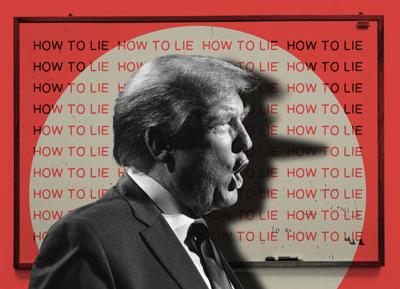
Trump has few trump cards up his sleeve, now that Iran is winning the Battle of Hormuz by slowly suffocating the global economy, while their powerful missile arsenal drives American military power out of the Persian Gulf.
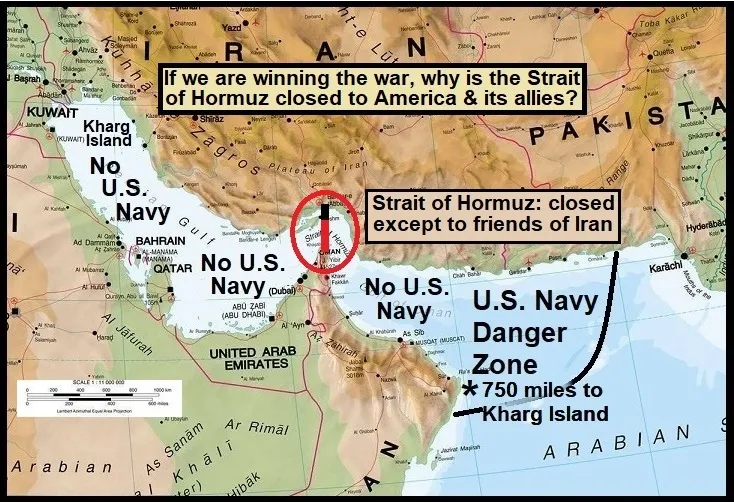
After a month, the United States finds itself in two incompatible wars in Iran. The first war is economic: defending the global oil flow through the Strait of Hormuz. The second is kinetic: bombing Iranian military targets, attempting to prevent arms shipments, and preparing for a possible ground invasion. The first war requires that the oil flow continues. The second war, by its very nature, actually stops it. The US cannot win both. It is possible that they cannot win either.
Iran finds itself in an extraordinarily strong position because it has merged these two wars into a single strategy. Tehran has installed a toll booth at the Strait of Hormuz, allowing its own tankers and those of its allies to pass freely, while the rest of the world’s cargo must pay or is held up. By varying the grip of that stranglehold, Iran is waging a limited guerrilla war against the global economy while retaining control of the strategic defense. An Iranian victory requires only that they maintain the ability to emerge from their hiding place, strike tankers attempting to pass through the strait, and disappear again. They possess the drones and missiles—fired from various distances and from various platforms—to make that threat credible, writes Kevin Batcho .
The deepest axiom of capitalism is that goods must flow, that all barriers must be overcome. The most concentrated forms of energy pass through the Strait of Hormuz first—crude oil in enormous, slow-moving quantities, followed by refined fuels that keep engines, aircraft, and armies in motion. Next comes liquefied natural gas, subcooled and pressurized, which powers electricity grids on the other side of the ocean. Behind that move the quieter factors that enable survival: fertilizers that sustain global harvests, the chemical basis of the future food supply. And at the distant, almost invisible edge, helium—weightless, irreplaceable—that drifts out to cool MRI machines, stabilize semiconductor manufacturing, and maintain the most delicate instruments of advanced economies. Blocking such a maritime artery is like causing a stroke in global prosperity, a cascade of failures that begins with energy, spreads through food, and reaches into the nervous system of modern technological life.
Bombing Iran even deeper into poverty will not break the stranglehold. Iran has endured forty-seven years of sanctions, a long learning experience in scarcity. As Bob Dylan once put it: “when you ain’t got nothing, you got nothing to lose.” Centuries ago, Ibn Khaldun described this dynamic in his account of asabiyyah : cohesion is strongest in harsh conditions, where survival binds a society together, while abundance slowly causes that bond to disappear.
If the US had truly wanted to destroy and undermine Iran, they should have helped the country become rich. Wealth invites comfort, comfort invites fragmentation, and fragmentation invites dependency. Throughout Europe, East Asia, and the Gulf, the US-allied states are revealing the long arc of this process—prosperous, stable, and utterly useless and dependent vassals in a system they no longer have the will or the means to defend.
Physically eradicating deeply entrenched Iranian guerrillas maintaining the blockade of Hormuz would be an enormous challenge for American invasion forces. Bases and assembly points within a thousand kilometers of Iran would operate under the constant threat of devastating return fire, shortening schedules and limiting freedom of action.
Throughout the region, the strategic situation is becoming increasingly tight: American positions in Iraq, Kuwait, and the Gulf are under growing pressure, while Hezbollah eliminates invading Israeli occupation armored vehicles in Lebanon and the Houthis expand the battle zone to Bab el-Mandeb, the southern gateway to the Red Sea. The geography of the conflict is expanding, while the operational space for an American invasion is shrinking, making the question of how such a campaign would be conducted increasingly difficult to answer.
Worse still, every step the Americans take is tracked and reported in real time by the Russian and Chinese ISR (Intelligence, Surveillance, and Reconnaissance). There will be no surprises when American special forces approach Iran, Iraq, Yemen, or even Lebanon, thanks to the watchful eyes of Russian and Chinese intelligence services. Not to mention the fact that, as it increasingly appears that Iran will gain the upper hand, Russian and Chinese arms shipments will only increase in both quantity and quality.
The contradiction between economic and kinetic warfare is already visible in American policy. The US has lifted sanctions on Iranian oil – a necessary step to allow at least some of the resources to flow through the strait and thus drive down the oil price. But this generates larger cash flows for Iran than before the war. The US is financing its enemy while it prepares to fight it. This is what fighting two incompatible wars looks like.
As the ground war approaches, Washington could limit Iran’s revenues by intercepting its tankers, a step that would be relatively simple to execute. The economic consequences would be immediate and exacerbate the already rising wave of global contraction. Limiting Iranian fossil fuel exports addresses one side of the equation; restoring free passage through the strait presents a much more complex challenge. Replacing Tehran’s toll booth with a hard barrier carries the risk of reinforcing the blockade itself, as missiles, mines, and persistent interference turn the waterway into a no-entry zone. Oil flows would shrink further, driving up prices and sending a shockwave through energy-dependent economies.
Tehran faces its own trade-off. It is waging a grueling campaign against American and Israeli air defenses while holding capacity in reserve to tighten its economic stranglehold. Escalation to a full lockdown would intensify the global economic crisis and increase pressure for a rapid settlement, possibly before stockpiles of American and Israeli intercept missiles are exhausted and before Iran’s bargaining position has fully matured. The pace and scale of the disruption therefore become instruments of strategy, adjusted to maintain bargaining power over time. As Trump talks down the markets and leaves Iran an opening for at least a small amount of commodity flows, the war could mature.
Trick or Retreat
Truth must, of course, perish in war. Between fact and fiction lies a liminal field where perception reflects and certainty dissolves. In such terrain, a leader skilled in distortion—a deceiver—seems eminently suited to command: a master of rhetorical mirrors, who attempts to unbalance the enemy through lies and seeks to reshape the field of reality.

Yet deception works in two directions. One is directed outwards, towards opponents, to keep them off balance. The other is directed inwards, to protect the self against unwelcome truths. The figure of the deceiver stands at this crossroads.
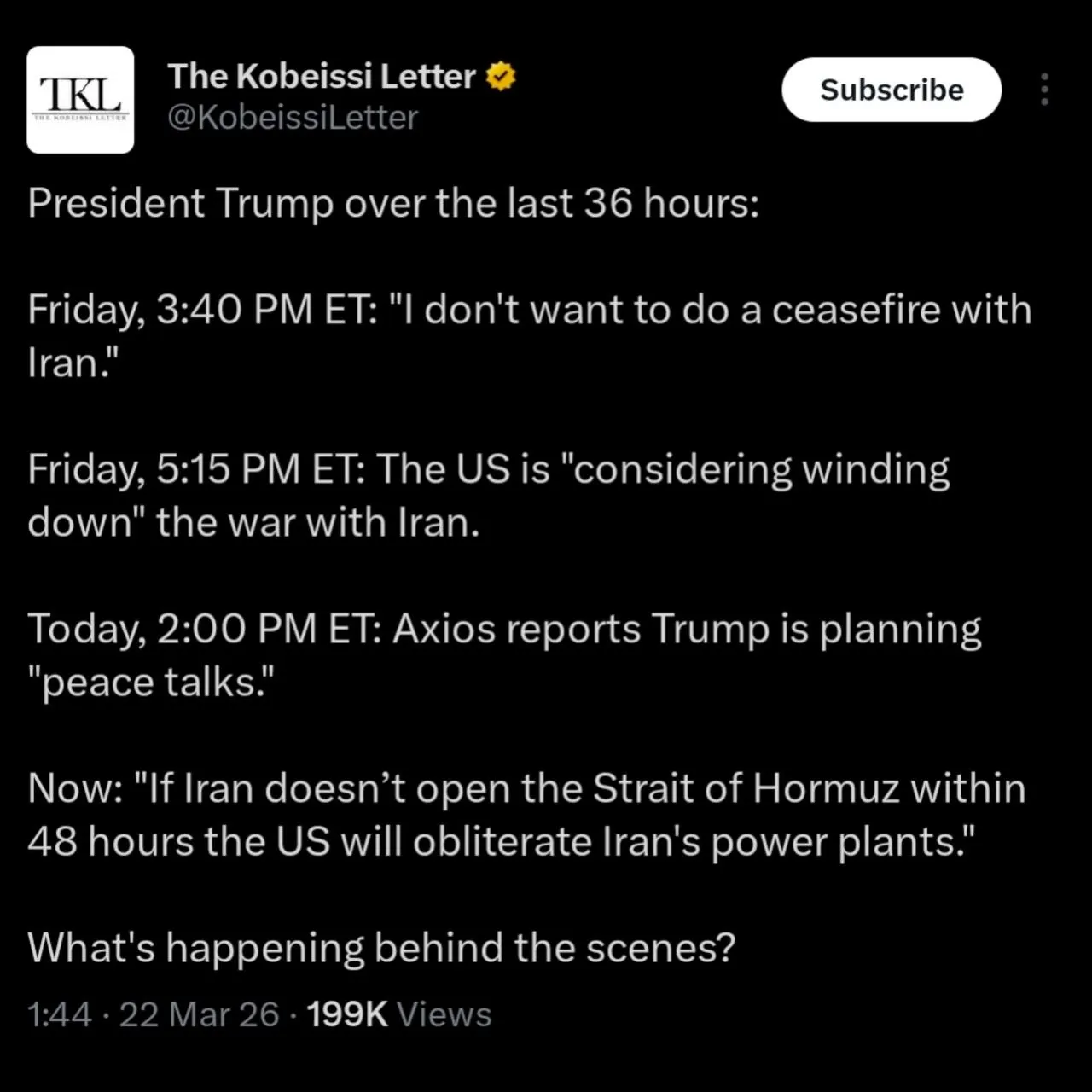
The power of the deceiver is metamorphosis, the refusal to assume a fixed form. Trump’s schizophrenic twists and turns—negotiating with imaginary Iranians today, beheading their leaders tomorrow, ending the war with a deal yesterday, launching an invasion next week—are the behavior of a deceiver who has lost the distinction between strategic deception and internal disorientation. He can no longer choose which mask to put on, because there is no longer a stable self to make that choice. A form of internal schizophrenia falls apart, while his narcissism reassembles the fragments into the assemblage that seems most useful at that moment. The deceiver becomes not a strategy, but a symptom. The deceiver plays with him just as much as he plays with the deceiver.
In its highest form, deception requires a stable core. The classic deceiver manipulates appearances while remaining anchored in reality; illusion serves the strategy. Without that inner anchor, the distinction blurs. Fabricated stories are no longer an instrument, but become a refuge. What follows resembles a child’s avoidance of shame more than the manipulation of a strategist. Such shame-driven lies rarely deceive the enemy. Instead, they bind the speaker and his audience to a fantasy world that suits them well.
From Trojan horse to Hormuz tankers
The Trojan horse remains the archetype of successful deception – a single, unprecedented act: a gift that concealed destruction, made plausible by a world the Trojans recognized: the absent fleet, the ritual sacrifice, the convincing witness. Its power lay in its uniqueness. For decades, the United States has been pacing this same horse for Iran, offering negotiations that end in drone strikes, talks that result in beheadings, and a diplomatic process that turns out to be a cover for something else. The pattern is so familiar that Iran’s refusal to take the latest offer seriously is less a strategic choice than a conditioned reflex. They have learned to count the Greeks before opening the gates.
On the other hand, Trump’s Hormuz tanker scam is an example of self-deception. Claiming that Iran paid him a generous “tribute” of ten tankers, later exaggerated to twenty, is a case of a deceiver turning his cunning around to temper the internal shame of an impending defeat.
Deception obeys a law of diminishing returns. Every success teaches the external adversary. With the second Trojan horse, the gates remain closed. Distrust becomes the norm; every gesture invites critical scrutiny. When the deceiver’s pattern is recognized, the illusion loses its power and becomes a signal—a sign that something else is going on.
The decisive failure occurs when the deceiver fails to perceive this shift. He repeats the gesture, convinced of its power, while the audience has already directed its attention elsewhere. At that moment, deception no longer works outward. It turns inward. The lies told to others become a ritual of self-soothing for the self overwhelmed by shame.
No more options
To actually reopen the strait, the US would have to launch a large-scale land invasion to wrest control of the coastline from the Iranian armed forces. Recaptured that territory, if at all possible, would require years of counter-guerrilla work and would demand anywhere from a few hundred thousand to as many as a million troops. By the time any progress was made on this, the global economy would be in a deep depression. Capitalism has a powerful veto over such a protracted adventure. Trump’s presidency would collapse long before the first bridgehead was secured—the bond market, that silent executioner, would demonstrate its awe-inspiring power well in advance.
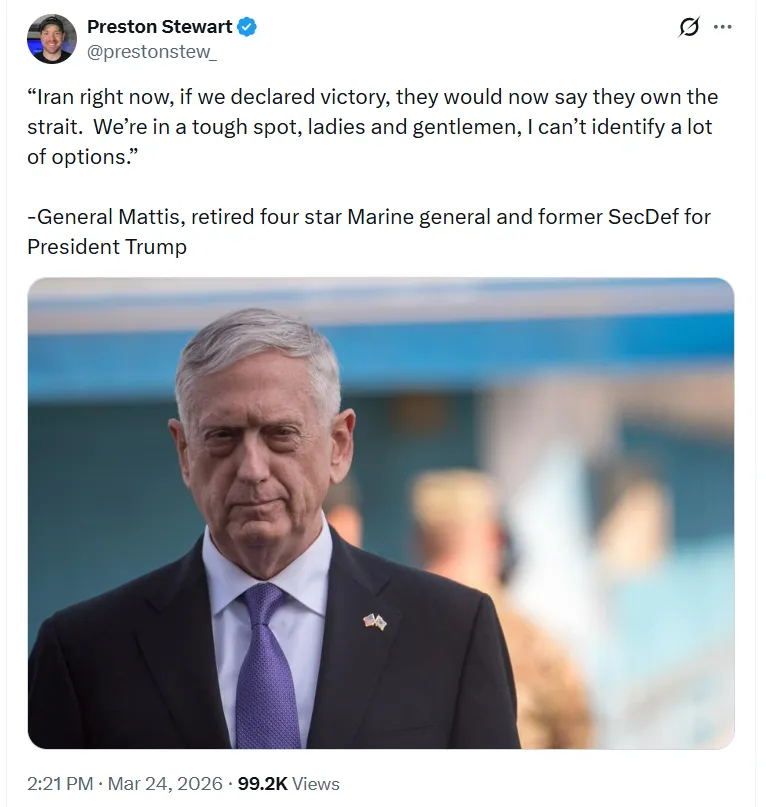
Iran does not have to win the war. It only needs to ensure that winning becomes too expensive for others to afford it.
Despite Trump’s uncanny ability to move markets with a single message, Brent crude has stubbornly remained above $100 per barrel. His role as a market whisperer has its limits. The oil price no longer listens.
After 10,000 airstrikes on Iranian territory, the regime is still bombarding American bases and aviation in the region with deadly force, and continues to attack Israel and the Arab Gulf states. The precision with which Iran has attacked American radar installations has surprised even its critics. A weakened enemy does not fight in this way.
The United States of America is holding serious talks with a NEW AND MORE REASONABLE REGIME to end our military operations in Iran. Great progress has been made, but if for any reason an agreement is not reached soon — which likely will happen — and if the Strait of Hormuz is not immediately ‘Open for Business’, we will end our lovely ‘stay’ in Iran by blowing up and completely destroying all their power plants, oil wells, and Kharg Island (and possibly all desalination plants as well!), which we have deliberately not ‘touched’ until now. This will happen in retaliation for our many soldiers and others whom Iran slaughtered and killed during the 47-year ‘Reign of Terror’ of the old regime. Thank you for your attention to this matter. President Donald J. Trump
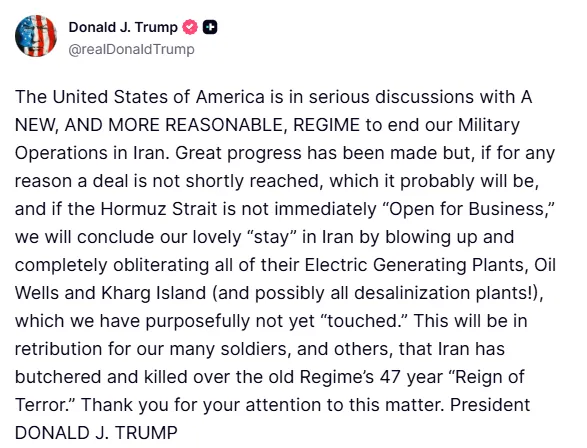
In his latest letter, President Trump continues his imaginary negotiations and exaggerated threats to destroy Iran. What is suggested here is that American military officials advised against carrying out a land invasion, although that conclusion is only as firm as Trump’s next tweet. But every step on his part to carry out these threats will lead to the destruction of the Arab Gulf states, as their power plants, oil refineries and wells, and desalination plants will be destroyed just as much as those of Iran, triggering the worst global economic crisis since the 1930s.
A counter-argument would be that the Iranian regime is too unpopular to maintain sufficient cohesion to inflict a strategic defeat on the United States. That it will collapse like a house of cards at any moment. Yet the growing specter of an Iran defeating the greatest military power in world history works in the opposite direction and has already prompted former critics to rally behind the regime. Victory, it is said, has a hundred fathers, while defeat is an orphan.
You can already see this shift in the language of national security insiders who once made their careers waging America’s wars. Erik Prince, the founder of Blackwater, now speaks of Iran with something that borders on professional and even racial respect:
The Iranians have learned; they have certainly paid attention to modern drone warfare and have implemented FPVs at the unit level. I mean, you see videos of the Israelis in South Lebanon losing tanks and armored personnel carriers to the same FPVs that the Russians used with great success in Ukraine.
Once again, it is a fight against Iran – they are not Arabs – they are Aryans, they are very intelligent, very skilled fighters , and compared to that, they will not be the easy prey you saw in the Iraqi army.

The hesitant admiration is not limited to former special operators. Even Iran’s AI propaganda campaign has found its audience: Lego figures mocking American officials, repeated references to Epstein Island, the Statue of Liberty redesigned with the head of the pagan god Baal. The message is intended for Western eyes, and it is landing.
If this conflict indeed results in a strategic defeat for the US, the orange orphan will not surrender easily. This seasoned deceiver is as elusive as mercury and will forever try to escape the burden of the consequences his impulsive decision will have caused.