
Thoughts on Trump v. Barbara, the Birthright Citizenship Case
The Supreme Court Reveals Yet Another Tragic Flaw in The Constitution.
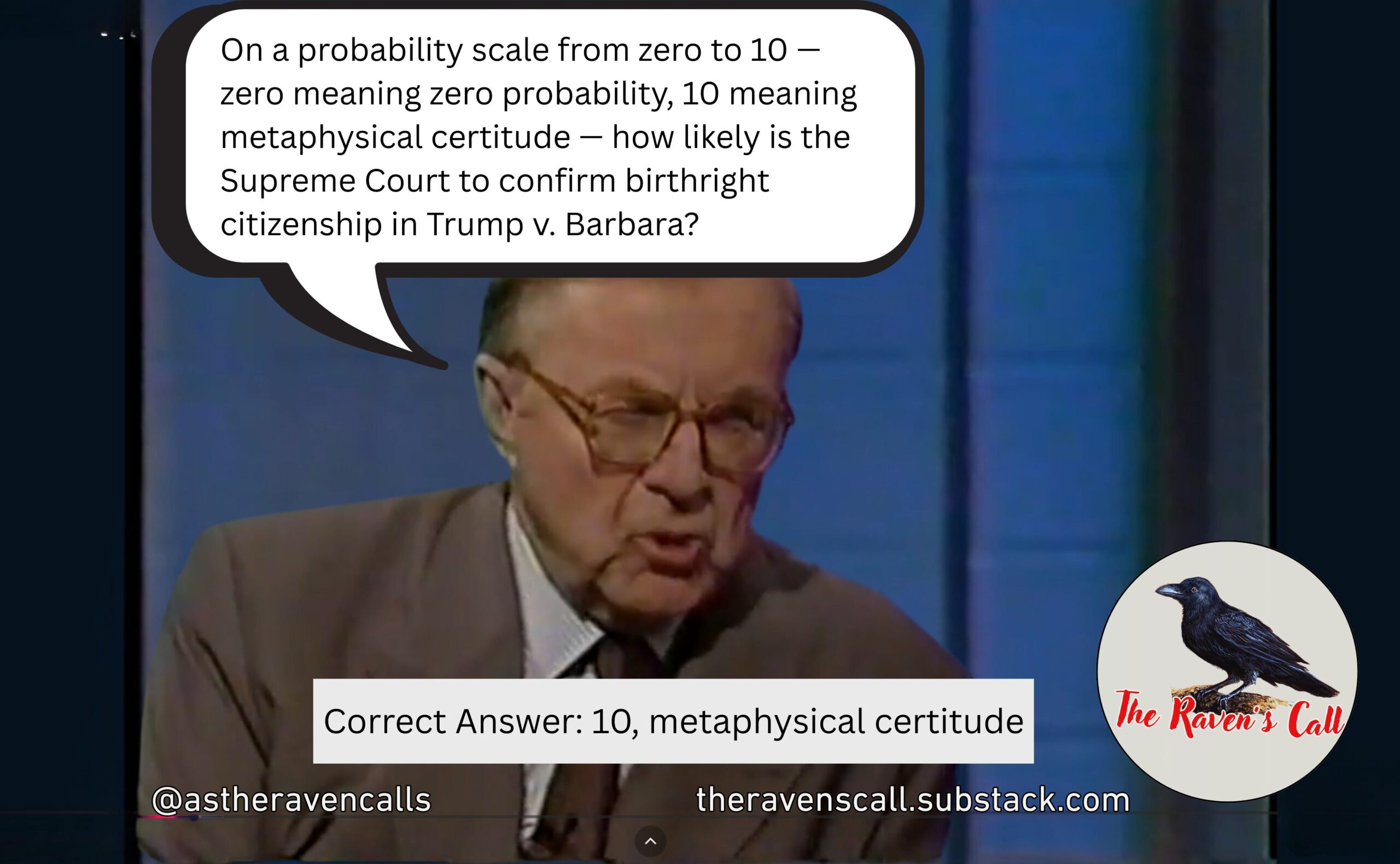
After oral arguments on April 1, 2026, most pundits and commentators have concluded it is most unlikely that the Supreme Court of the United States will either uphold Trump’s executive order ending birthright citizenship, or make any ruling that does not confirm how the citizenship clause has been interpreted for over 100 years: that citizenship is automatically and irrevocably conferred on any person born on United States soil, regardless of the citizenship status of the parents, with limited exceptions such as offspring from diplomats. Anyone who has listened to the oral arguments, as I have, will be utterly convinced that both Chief Justice Roberts and Justice Coney Barrett will side with the three liberal justices: Kagan, Sotomayor, and Jackson. To borrow a phrase from the late John McLaughlin, it is a metaphysical certitude.
The eventual decision matters for obvious reasons. It is true the Trump Administration only sought to have birthright citizenship nullified going forward. This would make it impossible to deport those who had been granted citizenship as anchor babies before any hypothetical favorable decision. Devon Stack for example argues that because any favorable decision would not allow the deportation of Kash Patel, any favorable decision is therefore meaningless. Such tirades are typical of the sort of all-or-nothing fallacy he has become increasingly susceptible to, just as he has increasingly exhibited a rather childish mentality whereby he insults and dismisses any person or entity which does not agree with him on all matters, all at once, all the time. Contrary to such petulant fits, staving off the flood of anchor babies would stabilize and slow—although admittedly not altogether stop—the demographic crisis that has unfolded since the Hart Celler Act and other implementations of the Great Replacement. A favorable Supreme Court decision would have bought the white populace more time before becoming a minority, as well as provided a feasible, realistic way to stop anchor babies once both a political mandate (such a mandate already exists) as well as the will to implement such policy through the legislative process.
Those who discount any benefit of a favorable Supreme Court decision also overlook an equally important factor: the Supreme Court has been incredibly influential in shaping public opinion, and often does so with many not having read let alone understood landmark Supreme Court decisions. The most immediate example is Obergefell v. Hodges or, more particularly, United States v Windsor, which struck down The Defense of Marriage Act and which the dissent predicted would soon lead the court to “discover” a constitutional right to so-called gay marriage. Before that decision, and before Windsor most particularly, large numbers of the public were opposed to so-called gay marriage. Public opinion flipped practically overnight, on account of Windsor most especially, and did so without most having read let alone understood the decision.
The United States Supreme Court was similarly influential, if not more so, in shaping public opinion on segregation and other matters of the Civil Rights era. At the time, Brown v Board of Education was wildly unpopular, so much so President Eisenhower had to deploy federal troops to implement and enforce that decision. But this outrage dissipated quickly, and the Supreme Court played a pivotal role in transforming public opinion.
While abortion remained controversial after Roe v Wade, abortion was disapproved in much larger numbers before that infamous decision. That decision, although always controversial, was foundational to broad public support for so-called abortion rights. Dobbs v. Jackson Women’s Health Center is very recent and its ultimate effect on public opinion cannot yet be fully ascertained. However, in the short time period after which this decision was handed down, a greater number of the populace have been convinced that the Constitution is silent on this, and that the matter is best left to the states. Much of the advocacy for so-called abortion rights is both militant and obnoxious, but it also seems to be waning, in no small part because of this decision.
Admittedly, the Supreme Court’s influence on public opinion is not absolute. The Dred Scott decision did not persuade abolitionists to accept slavery in those states that had not abolished the institution. To the contrary, the controversial decision inflamed passions on both sides, catalyzing the number of precursors that would soon lead to The American Civil War, or, as those with Confederate sympathies prefer, The War Between the States. Citizens United, which effectively legalized unlimited campaign contributions by corporate entities and solidified the extension of constitutional rights to corporations, remains wildly unpopular. In this increasingly fragmented and divisive political environment, public outrage is unlikely to lead to any political response, particularly if such a response can only be achieved by constitutional amendment. It is nonetheless the case the Supreme Court has not shaped public opinion on this matter, but has galvanized strong opposition against it.
The seemingly inevitable decision confirming birthright citizenship is unlikely to be one of those instances where public opinion turns against the Court. When—not if—The Supreme Court rules that the 14th Amendment is properly interpreted to mean that any person born on U.S. soil, absent a very limited number of extraordinary exceptions, is an American citizen, regardless of immigration or citizenship status of the parents, a critical mass of persons will be persuaded to accept this as a constitutional norm by the mere issuance of such a decision. Practically overnight, if not literally so, a large contingent of Americans who were either undecided on the matter or against birthright citizenship will be persuaded that anchor babies are U.S. Citizens simply because the Supreme Court ruled as such. As previously stated, most will come to this conclusion without having read whatever majority opinion is written on this matter. This in turn will significantly denigrate and hamper any effort to build a political coalition against birthright citizenship and other auspices of The Great Replacement. Those who are skeptical of this need look no further than the matter of gay marriage to discern this obvious truth.
Drastic changes to society rarely happen in one fell swoop, but rather happen incrementally. This is exhibited in how corporations have litigated to win the extension of rights that should be limited to actual persons, and it is also demonstrated in the progressive agenda that has been implemented since World War II. A favorable Supreme Court ruling would have been an important step in a similar sort of incrementalism, but to the right. That however has been taken off the table, absent extraordinary circumstances to flip either Roberts or Barrett.
Many on the dissident right aver there is no political solution, but there is likely no other solution either. As stated in “Questioning Democracy in the Land of Unending Economic Disasters,” the United States government is not a lethal instrument per se, but rather is an entity that “wields a number of lethal instruments at its disposal.” There will be no Red Dawn moment, no revolution or revolt, but rather a slow gradual decline, made worse by an ever-worsening demographic decline, as well as an ever-worsening decline in culture, society, and even standard of living. Recent history in South Africa and Rhodesia inform this, as does ancient history. Contrary to popular belief, The Fall of Rome did not happen suddenly, but was a gradual process over centuries. Absent extraordinary circumstances, this is likely the same trajectory that awaits American society. A positive Supreme Court decision was an essential incremental step in staving off the decline, but it has been taken off the table.
It should be noted this effort was always dubious as a legal question. The argument against birthright citizenship of babies born from illegal aliens required an interpretation of the word “jurisdiction” that is far from intuitive. The interpretation simply does not comport with the basic meaning of the word “jurisdiction.”
One anticipates that Roberts, Barrett, and perhaps even Kavanaugh will remind readers that the proper remedy is to amend the Constitution, overlooking the aspects of Realpolitik that reveal this remedy is simply impossible in the current political and cultural environment. Aside from millions of anchor babies infused from south of the border, a cottage citizenship tour industry has flourished in China. The result is there are millions of Chinese nationals who were born in the United States, and thus have United States citizenship, even though they were raised in The People’s Republic of China immediately after birth. A textualist approach favored by the late Antonin Scalia is sensible in most matters that go before The Court, but in some instances any workable jurisprudence must also consider the spirit as well as the letter of the law, particularly when the Amendment in question leaves much to be desired in clarity or draftsmanship.
That the Supreme Court has proven once again unable to protect the public interest and unable to adapt to Realpolitik considerations or weigh the spirit of the law in instances such as these is yet another indictment both of The Supreme Court and, because there are no feasible, realistic remedies to ameliorate this ruinous state of affairs, The Constitution itself. Unfortunately, neither this decision, once it is published, nor the nigh universal consensus as to how the Court will rule will galvanize any meaningful opposition capable of changing the course of this nation. Despite the fetishism with which many regard the Constitution and this form of government, both have, once again, proven to lack any fitness for purpose. Unfortunately, there is neither the consensus nor means to jettison either this document, the legal profession in power, or this form of government.
https://theravenscall.substack.com/p/thoughts-on-trump-v-barbara-the-birthright