
The Strange Case of Trump’s ‘Board of Peace’
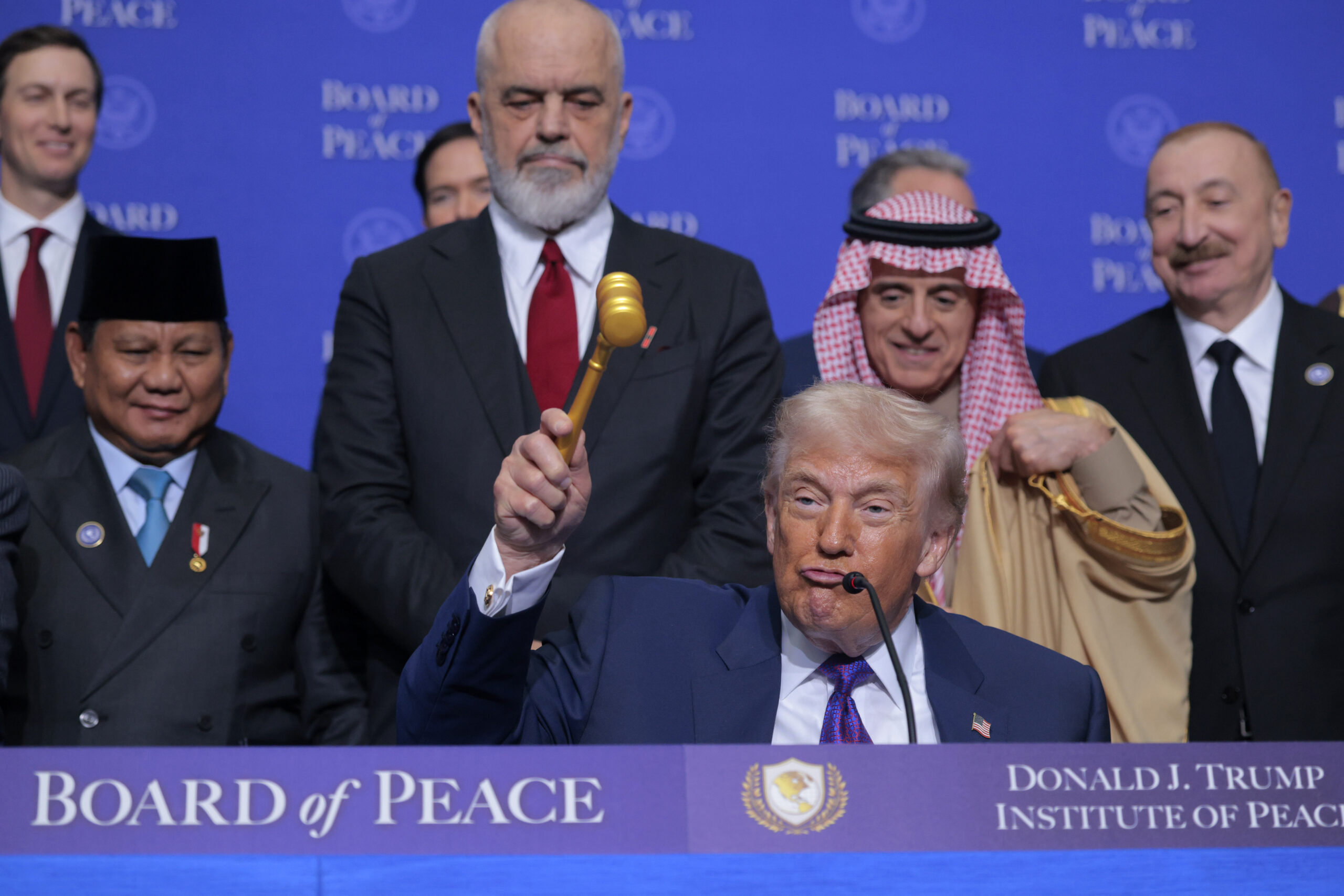
On January 22, 2026, at the World Economic Forum in Davos, Switzerland, Donald Trump signed the Charter of the Board of Peace before a room of world leaders, cameras, and a step-and-repeat backdrop plastered floor to ceiling with a repeating pattern that should have stopped every journalist in the room cold.¹

It was not the Board of Peace’s own logo. The BoP has its own emblem — a gold shield containing a globe centered on the Western Hemisphere, flanked by laurel branches, displayed prominently at the top of the stage. But the surface behind the signing table, the one that would fill every wire service photograph transmitted around the world, displayed the Great Seal of the United States: the eagle with spread wings, shield on breast, olive branch and arrows in its talons, stars above. Unmistakable. Incontestable.

The problem is that the Board of Peace charter explicitly states that Trump’s chairmanship “is independent of his presidency of the United States.”² The entire legal justification for bypassing Congress rests on the Board being a private international body — not a U.S. government instrument. Under 18 U.S.C. § 713(a), displaying the Great Seal in connection with any public meeting in a manner reasonably calculated to convey a false impression of U.S. government sponsorship is a federal criminal offense.³ The Board cannot simultaneously claim independence from the U.S. government and wrap itself in that government’s sovereign seal. That is not a technicality. That is the architecture of deception.
Article 13.3 of the charter states that the Board “will have an official seal, which shall be approved by the Chairman.”⁴ If Trump approved the Great Seal of the United States as the Board of Peace’s official backdrop at its founding ceremony, that fact alone warrants a full accounting.
The Constitutional Problem

Board of Peace meeting in Washington at the Donald J. Trump Institute of Peace. (Confused yet?)
On the same day the charter was signed at Davos, the White House announced that Trump had “formally ratified” it — describing it as a founding ceremony for “an official international organization.”⁵ Trump did not transmit the charter to the Senate for advice and consent prior to signing. He signed it and declared ratification simultaneously.⁶
When the United States has joined significant international organizations in the past — the United Nations, NATO, the World Bank, the International Monetary Fund, the World Health Organization — those agreements received either Senate ratification as treaties by a two-thirds majority, or statutory approval by both houses of Congress.⁷ Neither occurred here. Foreign governments reportedly received copies of the charter before Congress did.⁸
Six days before the Davos ceremony, on January 16, 2026, Trump signed Executive Order 14375, designating the Board of Peace as a public international organization under the International Organizations Immunities Act (IOIA), 22 U.S.C. § 288.⁹ The IOIA grants designated organizations immunity from lawsuit and judicial process, protection of archives from search and seizure, and exemption from property taxes.¹⁰ But the IOIA’s own text requires that the President may only extend these privileges to organizations in which the United States participates “pursuant to any treaty or under the authority of any Act of Congress.”¹¹ No such treaty exists. No such act of Congress exists. The executive order rests on a legal foundation that does not exist.
The Structural Problem
The charter names Trump by name in Article 3.2(a): “Donald J. Trump shall serve as inaugural Chairman of the Board of Peace, and he shall separately serve as inaugural representative of the United States of America.”¹²
Two roles. Two separate designations. One man.
As Chairman, Trump holds lifetime tenure, names his own successor privately, controls the agenda, holds veto power over every decision, and can dissolve the entire organization at will.¹³ As U.S. representative, he serves as head of state under Article 2.2(a), which mandates that “each Member State shall be represented on the Board of Peace by its Head of State or Government.”¹⁴
Here is what that means in practice after January 20, 2029: the next President of the United States — elected by the American people, sworn to uphold the Constitution — automatically becomes the U.S. representative on the Board of Peace. That President will hold one vote, subject to the approval of the Chairman. That Chairman will be Trump — or whomever Trump has privately designated as his successor, who need not be a government official, need not be American, and need not answer to any electorate anywhere on earth.¹⁵ A future U.S. President will sit on this body as a subordinate member-state representative, subject to the veto of a private citizen.
Article 3.1(g) allows member states to send alternate representatives in place of heads of state — but only “subject to approval by the Chairman.”¹⁶ Every exit, every workaround, every procedural option in the charter runs through the same chokepoint.
The Headquarters Problem

Article 13.2 of the charter requires the Board to “negotiate a headquarters agreement and agreements governing field offices with the host State or States, as necessary.”¹⁷ No such agreement has been negotiated or announced.
What has occurred instead is that Trump designated the former United States Institute of Peace building in Washington, D.C. — a Congressionally-created independent institution that he seized by executive order in February 2025, fired its entire staff, and renamed the “Donald J. Trump Institute of Peace” in December 2025 — as the Board’s physical headquarters.¹⁸ A federal judge ruled that takeover illegal. The D.C. Circuit granted a stay pending appeal, leaving the building’s legal status in active litigation.¹⁹
The Board of Peace is headquartered in a building a federal court has said was seized unlawfully, operating under a headquarters agreement that has never been negotiated, in a host state that is simultaneously the Depositary of the charter, the member state whose president is the Chairman, and the government whose sovereignty the organization claims independence from. The “host State” required by Article 13.2 to negotiate a legal agreement with the Board of Peace is the United States — the same country whose president personally controls the Board. There is no arm’s-length negotiation possible. The host State and the Chairman are the same man.
The Funding Problem
At the Board’s inaugural meeting on February 19, 2026, Trump pledged that the United States would contribute $10 billion to the Board of Peace over ten years, describing it as “a very small number when you look at that compared to the cost of war.”²⁰ He had no constitutional authority to make that pledge. The power of the purse belongs to Congress, which had neither authorized U.S. membership in the Board nor appropriated a single dollar for it.
Then, on March 26, 2026, Semafor reported what had actually happened: the State Department had already transferred $1.25 billion to the Board of Peace — drawn not from any congressionally appropriated Board of Peace fund, because no such fund exists, but raided directly from other programs.²¹ The breakdown: $1 billion taken from international disaster assistance, $200 million stripped from peacekeeping operations, and $50 million diverted from international organizations and programs.²²
This $1.25 billion is separate from and in addition to the $10 billion pledge. It is operating capital, transferred without congressional authorization, without public announcement, without any disclosure of how it will be spent, to an organization that — as of the date of transfer — had not sent a single dollar to Gaza despite repeatedly claiming it would.²³ When Semafor asked the State Department about the transfer, the response was: “We have nothing to announce at this time.” The White House did not respond to requests for comment.²⁴
Senator Catherine Cortez Masto of Nevada introduced legislation to redirect $1 billion of those funds to the Low-Income Home Energy Assistance Program, stating: “Instead of giving President Trump a $1 billion blank check to fund a ‘Board of Peace’ that has offered no transparency about how it is investing its money, let’s focus on helping American families afford their monthly power bill.”²⁵
The Personnel Problem
The charter designates a Chief Executive to lead the Executive Board, nominated by the Chairman and confirmed by majority vote.26 No Chief Executive has been appointed. Day-to-day operations are being run by two senior advisors: Aryeh Lightstone and Josh Gruenbaum.²7

Aryeh Lightstone
Lightstone served as the CEO of the Abraham Accords Peace Institute — an organization founded by Jared Kushner after the first Trump term.²8 Kushner himself provided the endorsement blurb for Lightstone’s book on the Abraham Accords. Gruenbaum, the Federal Acquisition Service Commissioner at the General Services Administration, began working with Witkoff and Kushner on Middle East diplomacy after the October 2025 ceasefire. At the Davos signing ceremony, Gruenbaum handed Trump the Board’s first resolution to sign. That same evening he was in the Kremlin alongside Witkoff and Kushner, where Witkoff introduced him to Vladimir Putin: “This is Josh.”29

Josh Gruenbaum
Kushner himself holds no official title within the Board’s charter structure. At the inaugural Board of Peace meeting on February 19, 2026, Trump announced he was making Kushner a “Special Envoy for Peace” — a role the White House subsequently clarified was unofficial.30 Kushner is simultaneously an Executive Board member, the architect of the Gaza reconstruction vision presented at Davos, and the man whose personal network is executing the operational mandate of the organization. Whether or not he is the privately designated successor Chairman, the operational reality is his.
The Pattern
In April 1974, Trilateral Commissioner Richard N. Gardner published an article in Foreign Affairs magazine — the journal of the Council on Foreign Relations — titled “The Hard Road to World Order.” Writing precisely as the Trilateral Commission was being assembled, Gardner described the strategy with a candor that has never been surpassed:
“The ‘house of world order’ will have to be built from the bottom up rather than from the top down… an end run around national sovereignty, eroding it piece by piece, will accomplish much more than the old-fashioned frontal assault.”³1
The Board of Peace announces itself as a pragmatic, case-by-case peace initiative with selected membership and limited initial jurisdiction. Its charter contains no mention of Gaza. Its scope is unlimited. Its Chairman is permanent. Its legal basis is fabricated. Its headquarters is a seized building whose ownership is contested in federal court. Its operating capital is money stripped from disaster relief funds without a vote of Congress. Its operational staff comes from the Chairman’s son-in-law’s personal network. And it was launched beneath the Great Seal of the United States — the one symbol that tells the world: this is official, this is legitimate, this is America.
Fifty years after Gardner published his blueprint, the end run is no longer theoretical. It is on the record. And American taxpayers are now funding it, whether they know it or not.
Footnotes
- Board of Peace charter signing ceremony, World Economic Forum, Davos, Switzerland, January 22, 2026. Photographic documentation from AFP, Getty Images, Reuters wire services.
- Charter of the Board of Peace, Article 3.2(a), January 22, 2026. Full text verified by Times of Israel, January 18, 2026.
- 18 U.S.C. § 713(a).
- Charter of the Board of Peace, Article 13.3.
- White House press release, “President Trump Ratifies Board of Peace in Historic Ceremony,” WhiteHouse.gov, January 22, 2026.
- Michael Mattler, “Expert Q&A on the Board of Peace and the Role of Congress,” Just Security, January 23, 2026. Mattler served as Assistant Legal Adviser for Treaty Affairs, U.S. Department of State, 2014–2025.
- Ibid.
- Senator Edward J. Markey, letter to Secretary of State Marco Rubio, February 2026 (on file, Office of Senator Markey).
- Executive Order 14375, “Designating the Board of Peace as a Public International Organization Entitled To Enjoy Certain Privileges, Exemptions, and Immunities,” signed January 16, 2026; published Federal Register, Vol. 91, No. 14, January 22, 2026.
- 22 U.S.C. § 288a.
- 22 U.S.C. § 288; Michael Mattler, “Some Questions About Trump’s Executive Order Granting Privileges and Immunities to the Board of Peace,” Just Security, February 23, 2026.
- Charter of the Board of Peace, Article 3.2(a).
- Charter of the Board of Peace, Articles 3.3, 9, 10.2.
- Charter of the Board of Peace, Article 2.2(a).
- JURIST Legal Commentary, “Trump’s Board of Peace: International Organization or Sole Proprietorship?” January 29, 2026.
- Charter of the Board of Peace, Article 3.1(g).
- Charter of the Board of Peace, Article 13.2.
- Wikipedia, “United States Institute of Peace Headquarters”; State Department announcement, December 3, 2025.
- Judge Beryl Howell ruling, U.S. District Court for the District of Columbia, May 19, 2025; D.C. Circuit stay granted June 27, 2025.
- White House transcript, inaugural Board of Peace meeting, February 19, 2026.
- Eleanor Mueller, “State Department sends $1.25B from other programs to Board of Peace,” Semafor, March 26, 2026.
- Ibid. Breakdown confirmed: $1 billion from international disaster assistance; $200 million from peacekeeping operations; $50 million from international organizations and programs.
- The New Republic, “Trump Funneling Money for His Board of Peace From State Department,” March 26, 2026.
- Mueller, Semafor, March 26, 2026.
- Senator Catherine Cortez Masto press statement, March 26, 2026, as reported by Semafor and The Fiscal Times.
- Charter of the Board of Peace, Article 4.1(c).
- White House, “Statement on President Trump’s Comprehensive Plan to End the Gaza Conflict,” January 16, 2026.
- Axios, “Jared Kushner’s Abraham Accords Peace Institute to merge into Heritage Foundation,” April 4, 2025.
- Josh Gruenbaum profile, Jewish Insider, January 26, 2026; Kremlin readout, meeting with Steve Witkoff, January 22, 2026.
- The Hill, “Trump appoints Jared Kushner as peace envoy,” February 19, 2026.
- Richard N. Gardner, “The Hard Road to World Order,” Foreign Affairs, Volume 52, Number 3, April 1974, p. 558.
https://www.technocracy.news/the-strange-case-of-trumps-board-of-peace