
The War Party
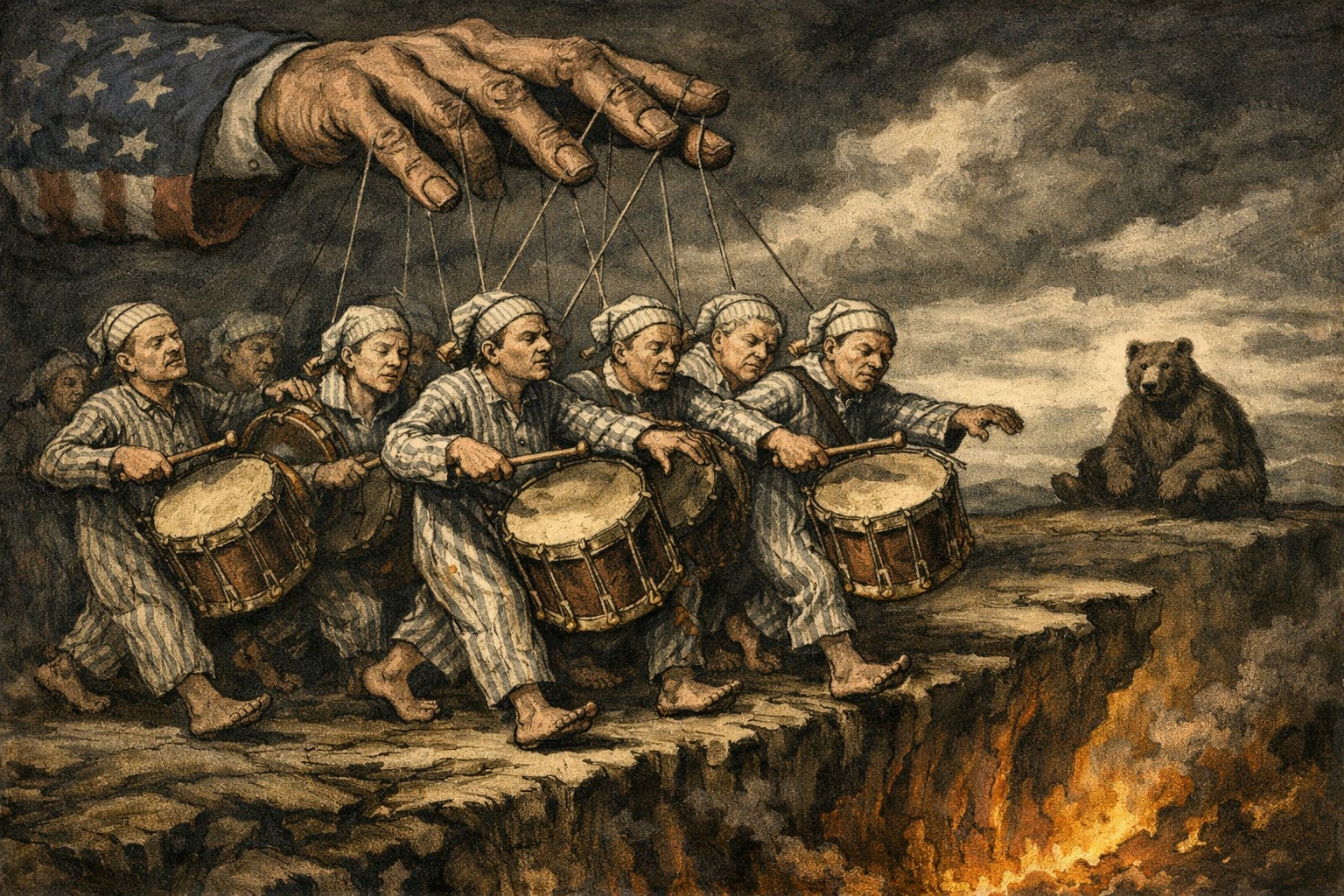
The drums of war have begun to sound again. The Secretary General of NATO, Mark Rutte, is calling on the countries of the Atlantic Alliance to prepare for a third world war. In France, government decree no. 2025-1030 of October 31, 2025, published in the Journal officiel but gone unnoticed, authorizes the use of private military companies to provide assistance to “a third country in a situation of armed conflict.” A return to mercenaries. Military service is to be reinstated on a voluntary basis, which will make it possible to increase the number of reservists. General Fabien Mandon, Chief of the Defense Staff, announces a war with Russia “in three to four years.” His predecessor, Thierry Burkhard, had already attributed to Russia a (nonexistent) declaration designating France as its “principal adversary in Europe.” For good measure, reserve General Michel Yakovleff coolly assures us that Donald Trump is a “KGB agent” (sic)! An armed confrontation with Russia is now presented no longer as a possibility, but as a certainty.
Marching… Toward the Abyss
For over seventy years, we were told that “Europe means peace.” Today, Europe means war. On the side of the European Union’s comic-opera troupe, we have the vocal stylings of the Estonian Kallas, who mechanically repeats that “Ukraine must win the war”—a war it has already lost—while Ursula von der Leyen (the Hyena?) declares with a straight face that Europe is “ready for action,” when it is ready for nothing at all (and the EU has no competence whatsoever in matters of defense). The geese of Capital!
The era of post-truth had begun with the Covid-19 crisis, already with the objective of instrumentalizing fear by transforming it into moral panic. On television screens, medal-laden generals taking orders have replaced the quack doctors à la Diafoirus1, but the principle remains the same: making people accept what, without fear, would clearly appear unacceptable.
“Macron no longer has any legitimacy. He is trying to restore some by dreaming himself a garden-variety Napoleon. After ‘France on the march,’ it’s now ‘France, forward march!'”
“We are at war!” proudly proclaims the head of state (not the one who just got out of prison—the other one, the psychopath), a phrase he loves all the more since, never having done his military service, he has never heard a bullet whistle in his life. He too ingenuously declares that “Russia must not win this war”—to achieve peace, one must prolong the war! To rally opinion behind this mad fantasy, he assures us that “Russia constitutes an existential threat to Europeans,” while in Washington, Moscow, and Beijing alike, no one takes his bluster seriously. Detested by the people, incapable of putting together a government that holds or passing a budget while the country’s financial situation is disastrous, of protecting its borders or putting an end to narco-terrorism, Macron no longer has any legitimacy. He is trying to restore some by dreaming himself a garden-variety Napoleon. After “France on the march,” it’s now “France, forward march!”
There exists today, then, a war party. A party that wants to wage war on Russia while accusing Russia of wanting to wage it on us. What is new is that this war party does not occupy defensive positions, as in the era of the Cold War, but offensive ones: it deliberately seeks war and does everything it can to mobilize public opinion. The media naturally take up the relay. Since the beginning of the conflict in Ukraine, we have already been subjected to one-sided information concocted by attack dogs and spread by ghosts. Advocates of peace are presented in litany-like fashion as “Putinists.” Soon they will denounce the “fifth column” (the eternal “foreign party”). In the old days, in the popular imagination, people saw flying saucers; today they see drones.
The war party claims that the best way to achieve peace is to help Zelensky pursue a war he is incapable of winning. It claims that by supporting Ukraine by all means, Europeans would be protecting themselves against the “Russian threat.” It claims that after four years spent reconquering their Alsace-Lorraine, the Russians are going to rush toward the harbor of Brest, before pushing on to Lisbon and Gibraltar! It claims that the French people—who will never be consulted about what they think—must prepare right now to see their children die at the Russian border “in three to four years” in support of, against a nuclear power, a country in which France has not the slightest vital interest. It is simply grotesque. As Luc Ferry put it, this is sheer madness!
Conquer Europe? The Kremlin has neither the desire nor the means. The “Russian threat,” says Philippe de Villiers, is “the fantasy of someone who has no longer quite got his wits about him.” It is a “belief for which not the slightest proof exists,” adds geopolitical scholar John Mearsheimer. The same people who have been learnedly explaining to us for four years that Russia is about to collapse any day now are now assuring us that it is preparing to invade Europe; in short, that it is losing, but must be prevented from winning—that it is at once a bloodthirsty bear and a paper tiger. Make of that what you will.
“Observing that Ukraine has lost the war despite American support, Europeans draw the surrealist conclusion that it will win with their help—without understanding that the longer the war lasts, the less Ukraine will be able to negotiate.”
The war that has been raging for four years in Ukraine is at once a war of secession, a war of self-defense, a fratricidal war, and a proxy war between NATO and Russia. It has already claimed hundreds of thousands of lives among young Europeans, Russians, and Ukrainians. It should never have taken place and could have ended long ago. Its primary cause is well known: the determination of the United States to push NATO up to Russia’s borders. NATO did not do this out of sympathy for Ukrainian nationalism, which it merely instrumentalized for its own benefit, but to break apart the great Eurasian continent, to sever Europe from the Russian power with which it is naturally complementary, and of course to prevent the formation of a Paris-Berlin-Moscow axis. The Americans conceived this project from the very collapse of the Soviet system. The Russians had nevertheless made it known in April 2008, more than fifteen years ago, that the extension of NATO to Ukraine would represent a red line and a casus belli for them. The decision was made to disregard this. It was thus decided to use Ukraine against Russia. The unfortunate Ukrainian people fell into the trap, and here we are.
The Europeans entered this war reluctantly. By taking sides with one of the two camps instead of positioning themselves as mediators—which would have been the only reasonable stance—by seeking to identify “guilty parties” rather than acting in accordance with their own interests, by preferring abstract moral values to the concrete principles of geostrategic realism, by allowing themselves to be drawn into an Anglo-Saxon war in which they had no existential or vital interest of their own, they in turn put their hand into the gears of an escalation to extremes. The more time has passed, the more they have appeared of their own free will as co-belligerents. Today, while the Americans want to disengage and the Ukrainian army is no longer capable of launching the slightest offensive, they are engaging in a bellicist escalation that risks dragging all of Europe into an escalation that could culminate in an armed confrontation with a nuclear power. It is difficult to be more irresponsible.
The hardest thing in a war is knowing how to stop it. The aim of every war is peace, but a ceasefire is not peace (as we can see from what continues to happen in Gaza and the West Bank). A war only ends when a peace agreement has determined the political conditions for resolving the problems that engendered it.
At a time when all Western societies are on the brink of implosion, a debt-ridden and half-ruined Europe has provided more than 200 billion in aid to Ukraine. This massive aid has served no purpose other than to increase the death toll. It has allowed Ukraine to continue the war, but has never given it the possibility of winning it. Without Western military aid, this war would have ended long ago. Observing that Ukraine has lost the war despite American support, Europeans draw the surrealist conclusion that it will win with their help alone—without even understanding that the longer the war lasts, the less Ukraine will be able to negotiate.
Europe in a State of Intoxication
Europeans complain of not having been included in the peace deal proposals negotiated first between the Russians and the Americans. This complaint would be more credible if they had in the past attempted to interpose themselves or play the role of mediator. They now dream of a peace agreement that would ignore the reality of the balance of forces on the ground—that is, an agreement where the victors and the vanquished would both be winners, something that has obviously never been seen (in 1918, Germany was no longer in a position to dictate its terms). They would like Ukraine, with barely 25 million inhabitants, to be able to maintain in peacetime an army of 800,000 men—more than the British, French, and German armies combined. They speak of “security guarantees” for Ukraine without understanding that the only true guarantee for it is its neutrality.
“We are marching toward war like sleepwalkers,” Henri Guaino had written on May 15, 2022. Four years later, the sleepwalkers have still not awoken. From the very beginning, they have been in denial of reality (Russia is “isolated,” Ukraine is “going to win,” the sanctions are “very effective,” etc.) and intend to remain there. They refuse to see that on the ground, the die is cast—the mass has been said! They still have not understood that international relations are not a matter of moral principles, but of power dynamics. They do not understand that new power dynamics are imposing themselves all across the world. Still believing themselves to be in the era of the Cold War, they fail to realize that the Ukrainian defeat is also that of the “collective West” and that this “West” has already disappeared, along with the Atlanticism that was its foundation.
Europe is today led by ghosts or sleepwalkers converted to bellicism. The three allies (France, Germany, England) stamp their feet and compete in bluster like children in a sandbox, threatening to replay Operation Barbarossa—this time without the Wehrmacht (but with the Bundeswehr). As credible as the frog trying to pass itself off as an ox, they pretend to believe they have the means to influence the situation when they do not have the shadow of a beginning of such means. In fact, they are completely naked. Like little roosters flapping their wings while looking for their muscles, like headless ducks running in every direction, they multiply the gesticulations, the palavering, the posturing, and the incantations, the untenable commitments and the useless meetings. Their “coalition of the willing” brings to mind the extras at the Châtelet who sing “Let us march, let us march!” while staying in place. To “help Ukraine more,” they will cut budgets, steal Russian assets, buy weapons from the Americans that NATO will then give to Ukraine, exempt military spending from the Maastricht criteria, send Rafale jets they don’t have, issue loans payable in funny money, deploy troops who-knows-where, neither why nor how. The truth is that they simply do not have the means to take over—and are nowhere near having them. A pitiful spectacle.
Meanwhile, the French who struggle to make ends meet wonder how it is possible to find so many billions for a foreign country they already have trouble locating on a map, while so little is found to improve their own situation. The more astute among them can also see that the sanctions against Russia have caused an explosion in energy prices and accelerated German deindustrialization, without so much as shaking the Russian economy, and that in France their clearest effect has been to make us buy liquefied gas from the United States at four times the price of Russian gas. As for “threats,” they see only one for the time being: the one that comes not from the East, but from the South.
Donald Trump is a temperamental man, but a realistic temperamental man. Taking the opposite tack from his predecessor, he wants to be done with this war as quickly as possible because he knows full well who holds the cards and what the reality on the ground is. The war prevents him from doing business and delays the reconstruction of Ukraine, from which the American firm BlackRock will be the great beneficiary. What he fears is not the “Russian threat” or the “imperial ambitions” of the Kremlin, but the strengthening of the China-Russia alliance. The Europeans, whom he despises—alas, justifiably—are in his eyes merely a stake in his trade war against China. When the war ends, it will become apparent that there is a minor winner (Putin) and a minor loser (Zelensky), but that the great winner is America, and the great loser the European Union.
“It is not the Russian threat but American disengagement that compels Europe to reflect anew on the conditions of its strategic autonomy.”
De Gaulle said: “Defense is the primary reason for the state’s existence.” He was right. The rearmament that the various European countries now say they are determined to undertake is therefore perfectly justified. But on two conditions. The first is that this rearmament does not decide in advance upon an enemy of principle, but considers all eventualities: Europe has no more vocation to be Americanized than to be Russified, Sinicized, or Islamized. Moreover, it is not Russia but the United States that has recently laid claim to the annexation of a territory under European jurisdiction—Greenland, as it happens. We must return to the “all azimuth” strategic autonomy theorized by General de Gaulle.2
The second is to acknowledge the decoupling that has put an end to the Atlantic Alliance, to realize that if Europe is disarmed today, if it has until now devoted so little to its defense, it is above all because it offloaded onto the American “big brother” the task of ensuring its security. NATO, from this standpoint, has never been anything other than the lasting guarantee that no Europe of defense could ever see the light of day. We know today what the reality was and how the American military “umbrella” was for the most part nonexistent.
But the United States nonetheless retains control of virtually all European armaments: all depend to a greater or lesser extent on Washington, which continues to ensure their technical, systemic, or operational control. In 2022, 69% of armaments imported into Europe came from the United States (compared to 43% in 2018). A European rearmament that did not seek to break free of this dependency and sever what remains of the transatlantic link would be meaningless. In other words: no European defense without European preference, no autonomous military power without political sovereignty.
Vassals of America
It is therefore not the Russian threat, but American disengagement that compels Europe to reflect anew on the conditions of its strategic autonomy in matters of defense and on the possibility of arriving at a system of balance and collective security based on an understanding between Europe and Russia—one capable of defusing the turbulence likely to arise in the border zones.
Unfortunately, it does not seem that this path is being taken, since instead of asking themselves what type of power they can recreate by their own means, Europeans are desperately seeking to “restore ties with the United States” and never miss an opportunity to present themselves as eager to remain their allies. Which shows that, once again, they have not understood what is happening before their very eyes. Having abandoned ideological and moral crusades in favor of “pragmatic and transactional realism,” the Americans have given up playing world policeman, but they want to maintain their hegemony over the West. They no longer wish to have allies, but only vassals and clients.
A genuine rearmament of European countries will take at least fifteen years, meaning the situation in Ukraine will in no way be affected by it. It will require a great deal of money (the European roadmap for defense preparation by 2030 is endowed with 800 billion euros), but even more moral energy and political will. As Bill Durodié sums it up: “War is as much a question of mentality as of equipment. Quadrupling defense spending has no consequence if no one is ready to fight.” One of history’s ironies is that those who, for more than seventy years, warned against the specter of “German militarism” now celebrate the fact that Germany—the only country alongside Poland to invest massively in its defense—is on the verge of becoming Europe’s leading army.
At a moment when everyone is citing the maxim Si vis pacem para bellum, it is worth remembering that this famous adage does not mean one must prepare for war in order to wage war, but that one must prepare for it in order to preserve peace. In such moments, the only question worth asking is: where lies France’s interest? Where lies Europe’s interest? The rest is mere chatter.
So, the Russian threat? Let us cite once more that beautiful Georgian proverb: “The shepherd made the sheep fear the wolf all its life, but in the end, it is the shepherd who eats it.”
Translated by Alexander Raynor