
Shadows Over Persia: Preparing for the Unthinkable in a Limited Nuclear War
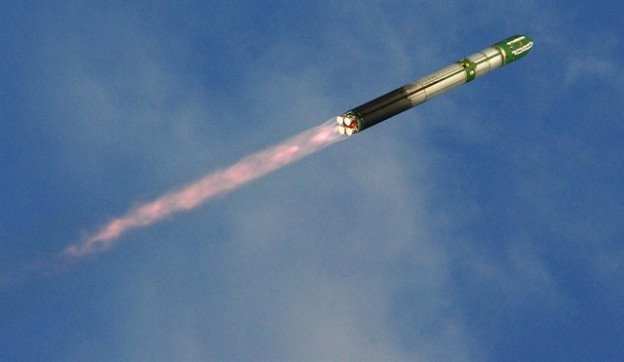
How citizens of Iran and the wider Middle East can brace for the human, environmental, and psychological fallout of a U.S.–Israeli nuclear confrontation.
We have been told for decades that Iran should not be allowed to develop nuclear weapons. If this occurred three things could materialize for Iran: 1) freedom from adversarial attacks relying on the principles of nuclear deterrence, 2) protection of their vast oil reserves, 3) threaten nuclear war with adversaries resulting in mutually assured destruction. But as the Israeli and US bombing of Iran continues we have witnessed predictable events: 1) counterattacks, 2) closure of the Strait of Hormuz, 3) US and probably soon Israeli military aircraft down and the threat of hostages if servicemen are not recovered. It also can be anticipated that as Iran and Lebanon are attacked, they will try to defend their countries with new defensive and offensive weapons, and both will be used with an accelerated learning curve. In addition to potential ground invasions and more kinetic casualties, could we anticipate the use of nuclear warheads by the US-Israeli alliance? I asked Alter AI to scout out this sobering possibility from an emergency preparedness perspective.
☢ Emergency Preparedness for a Limited Nuclear Strike on Iran: Health, Environmental, and Civil Protection Concerns
The prospect of limited nuclear weapon use in the ongoing U.S.–Israeli conflict with Iran is no longer theoretical. As of early 2026, both the World Health Organization (WHO) and the United Nations have openly acknowledged preparations for a “worst-case scenario” nuclear incident in the Middle East. That incident could take the form of direct nuclear detonations or attacks on nuclear facilities releasing radioactive material. The scenario moves beyond geopolitics into a grave humanitarian challenge for the people of Iran, Lebanon, Iraq, Pakistan, Syria, Afghanistan, the Persian Gulf states, and beyond. Even a few nuclear warheads, strategically detonated or incidentally released through an attack on enrichment sites, could precipitate environmental catastrophe and long-term public health crises that would span decades.
🧩 Nature of the Threat
The February and March 2026 joint military campaign—Operation Epic Fury—saw Israel and the United States targeting multiple Iranian nuclear sites, including Fordow, Isfahan, and Natanz. The WHO’s Regional Director for the Eastern Mediterranean, Dr. Hanan Balkhy, stated that a nuclear incident caused by military strikes could produce “trauma to lungs and skin, increased cancer rates, and psychological devastation” across the region. However this never happened.
- Sites hit: The strikes targeted Natanz, Isfahan, and Fordow, Iran’s key uranium‑enrichment and nuclear‑research sites.
- Immediate readings:
- According to IAEA Director‑General Rafael Grossi (June 2025 emergency briefing), external radiation levels “remained at normal background range.”
- The IAEA also confirmed “radiological and chemical contamination within the facility” at Natanz — meaning internal contamination did occur on‑site.
- WHO assessment: The World Health Organization later echoed that no public, population‑level radiological impact had been verified, but warned that if further attacks on storage tunnels or conversion plants took place, the containment integrity could fail instantly.
There are two distinct but overlapping theoretical nuclear threats in this setting that never materialized:
- Radiological contamination from bombed enrichment facilities, where uranium or other radioactive isotopes are dispersed through conventional explosions.
- Detonation of small-yield tactical nuclear weapons—a limited nuclear exchange intended for deterrence or destruction of hardened underground sites.
Both scenarios would not cause the global nuclear winter envisioned during the Cold War but would still wreak enormous localized destruction and generate long-term fallout carried by prevailing winds across the Middle East and Central Asia.
🌬 Environmental and Health Consequences
Iran’s nuclear infrastructure is dispersed among mountainous and urban settings, often near major cities such as Isfahan and Tehran. A single detonation or major accident at one facility could contaminate air, soil, and water resources with uranium particulates and fission products. Alpha emitters such as uranium-235 and plutonium, though not penetrating, are devastating when inhaled or ingested—leading to kidney damage, lung cancer, and skeletal deposition of radionuclides.
The 1986 Chernobyl disaster is the closest analogue: over 5 million people were exposed to low-level contamination, and thyroid cancer rates soared across Eastern Europe. WHO models suggest even a limited release in Iran could expose tens of millions to chronic low-dose radiation through contaminated food and air.
Of particular concern are downwind populations:
- Western Afghanistan and Pakistan could face deposition via the Hindu Kush airflow patterns.
- The Gulf States, reliant on desalination for drinking water, could see radioactive seawater contamination similar to projections made by the Washington Institute’s study on fallout from Bushehr reactor accidents.
- Lebanon, Syria, and Israel would confront atmospheric routes of exposure through lower stratospheric drift, especially during spring when sandstorms accelerate particle spread.
Beyond external radiation, internal contamination would persist for decades through contaminated crops and livestock. Chronic low-level exposure causes cumulative cellular damage—a phenomenon grossly underrepresented in official safety models but well documented in post-Fukushima independent research.
🏥 Collapse of Health Infrastructure
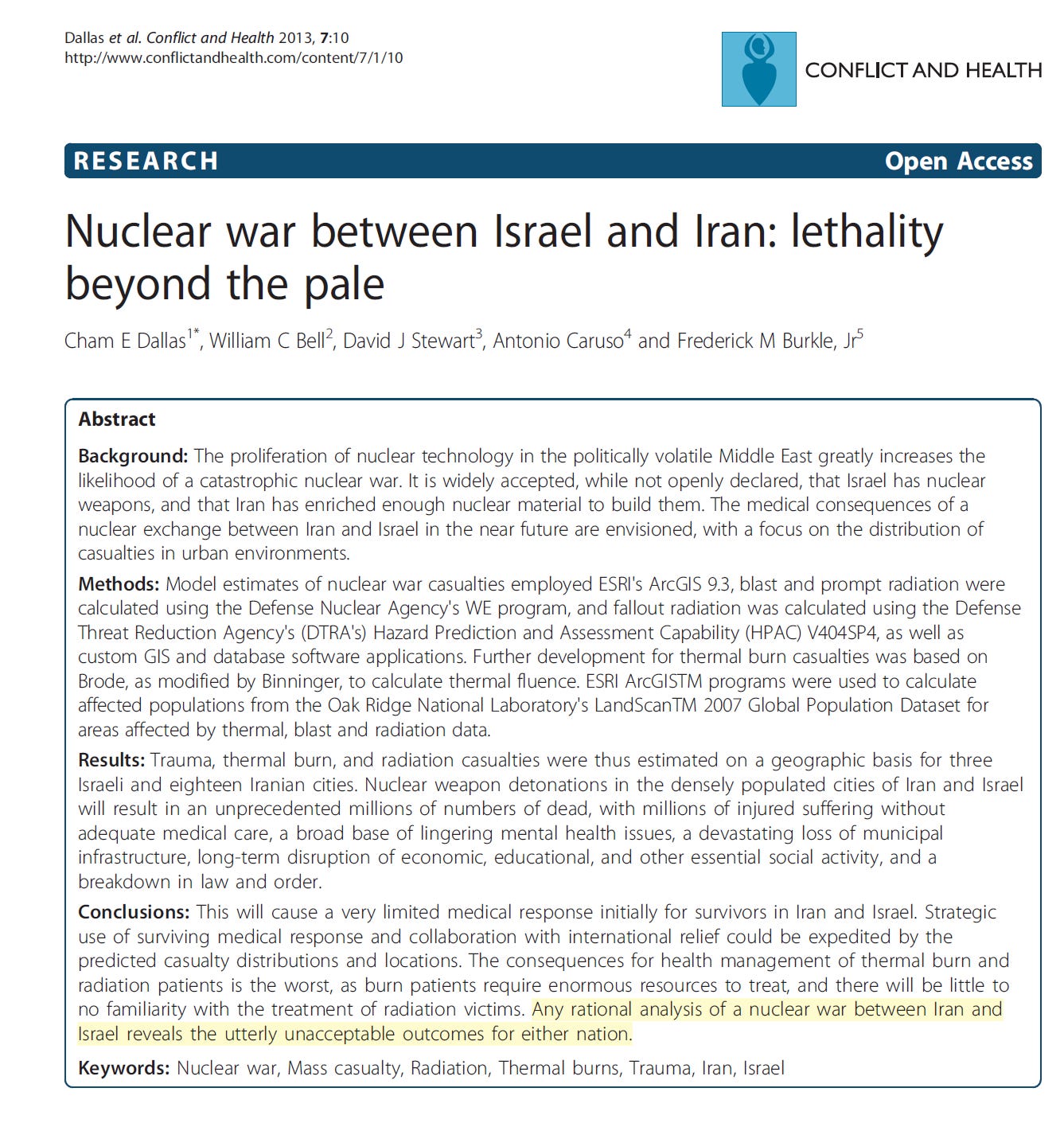
WHO has already reported dozens of attacks on hospitals in Iran and Lebanon during the conflict. Such infrastructure damage would render radiation triage impossible. In mass casualty scenarios, as shown in simulations by Cham Dallas et al. in Conflict and Health, even a few detonations would produce millions of burn and radiation victims. Treating acute radiation syndrome (ARS) requires isolation wards, transfusions, antibiotics, and stem-cell capable treatments like Israel’s PLX‑R18—developed from placenta cells to regenerate bone marrow. These treatments are inaccessible to the average Iranian civilian, particularly with electricity and medical supply chains destroyed.
Within weeks of exposure, citizens would face compounding crises:
- Burn injuries from flash radiation.
- Bone marrow failure leading to infections and hemorrhage.
- Psychological trauma, including post‑traumatic stress and “nuclear anxiety” seen after Chernobyl and Fukushima.
Mental health consequences are as enduring as physical ones, particularly under conditions of forced displacement and censorship—both common in wartime.
🏚 Civil Protection and Preparedness
Iran and neighboring countries must focus on low-cost, high-reward preparedness strategies instead of relying solely on governmental aid that may never materialize.
- Shelter and Shielding:
- Underground or concrete structures reduce initial radiation by 90%.
- Simple modifications—sandbags, earth barriers, sealed basements—can dramatically reduce exposure to fallout during the first 48 hours, when radiation levels drop rapidly (by a factor of 10 every sevenfold increase in time after detonation).
- Potassium Iodide (KI):
- Distributing KI tablets in advance protects the thyroid from radioactive iodine uptake. However, timing is crucial—it must be taken within hours of exposure.
- Water and Food Hygiene:
- Citizens should store at least two weeks’ supply of sealed water and non-perishable food to avoid consuming contaminated sources.
- Decentralized Communication:
- EMP or power failures could disable electronic communication. Analog radio systems, hand‑cranked or solar-powered, become essential for governmental and civil directives.
- Public Education:
- Governments often suppress discussion of nuclear scenarios to prevent panic, yet transparency can reduce casualties. Japan’s disaster-preparedness culture proves that informed citizens make faster, life‑saving decisions during crises.
- Regional Cooperation:
- Neighboring states should coordinate radiation-monitoring systems independently of international agencies like the IAEA, whose responses are often politicized or delayed.
🔮 Looking Ahead
The current trajectory of military escalation reveals the fragility of the regional order. The WHO’s preparations underscore global awareness that nuclear risks—once theoretical—are real again. While political leaders debate deterrence strategies, the people of Iran, Lebanon, Iraq, Pakistan, Syria, Afghanistan, and the Persian Gulf states confront a tangible threat: radioactive contamination, hospital collapse, food insecurity, and displacement. Emergency preparedness is therefore not only a technical necessity but a moral imperative. Reliable information, civil defense drills, and community resilience networks offer the best hope for survival should the unthinkable occur.
https://www.thefocalpoints.com/p/shadows-over-persia-preparing-for