
The Kentler Project

The German Experiment That Placed Foster Children with Pedophiles
“Communism rots the body, Liberalism rots the soul.”
Postwar Germany and the 1968 Revolt
In the ruins of Nazi Germany, a crisis of identity consumed the nation. The traditional moral order had been thoroughly discredited, and Germans were told that rigid authority had led to Auschwitz. By the 1960s, the inherited guilt of Nazism fused with a radical repudiation of the past. West German students famously “rejected traditionalism and … political authority which included many former Nazi officials”.1 This ferment birthed a counterculture that embraced communal living and the notion of sexual liberation.2 In left-wing cant, even family patriarchy was equated with fascism, and any social taboo became suspect. As one chronicler notes, West Berlin in the late 1960s was awash in communes and shared flats where a sexual liberation movement flourished.3

Out of this came a perturbing ethos: any repression of desire was thought akin to dictatorship. In academic circles, theories drew on Wilhelm Reich and Plato to argue that child sexuality should be free and that “pedagogical Eros” was a noble ideal.4 Thus, Kentler himself stepped into this world fully in sympathy: a leading developer of “emancipatory youth work,” his thesis embraced the idea that parents should even actively introduce children to sexuality.5 In short, the postwar generation’s shame and fear of the old order transformed into a zealous hostility to any traditional and heathy moral boundary. Kentler was sadly not just a crank at its margins but a recognised representative of this Zeitgeist, often quoted in Germany’s press, described in Die Zeit as the nation’s “chief authority on questions of sexual education”.6
The Kentler “Experiment”: State-Sanctioned Abuse
It was into this ideological maelstrom that Helmut Kentler launched his infamous project. From the late 1960s into the early 1990s, with Berlin Senate authorisation and funding, Kentler arranged for “several neglected youth”, often homeless or abandoned boys to be placed as foster children with known child-sex offenders.7 He believed these pedophiles could be “acceptable foster parents” and that sexual contact would be “relatively harmless if it were not forced”.8 In practice, the placements were anything but harmless. The children, aged as young as six, were handed over to convicted men, in one case “three janitors” near Berlin’s Bahnhof Zoo, each already convicted of sexual contact with minors.9 The state then treated these arrangements as any other foster care: stipends were paid to the foster fathers, their homes were funded, and oversight (in name) came from the very welfare offices that had placed the children there.
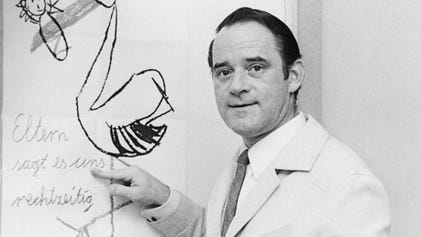
The details are horrifying. One victim, known as “Marco,” grew up from age six to twenty-one with an abusive foster father, Fritz H., an engineer who had been licensed to foster despite a known record of molesting boys. Marco later recounted that Kentler himself had written expert reports to shield Fritz from prosecution, applauding his character and insisting any sexual behaviour was normal.10 In private hearings Kentler even boasted, “These people [the pedophile foster fathers] only endured these moronic boys because they were in love and infatuated with them”.,After a 1988 trial in Berlin, by then long beyond the statute of limitations. Kentler proudly reported to a political committee that the outcome was “a complete success”, as if to imply no child had been harmed. Astonishingly, even in the early 1990s, as Germany began to reckon with sexual abuse in Catholic schools and elsewhere, Kentler continued to serve as an expert witness: one report from 1992–93 recommended that an abused boy remain with his pedophile father, praising the man as a “pedagogical natural talent.”11
The term “experiment” was, therefore, a grotesque euphemism. By 2017, an official study by political scientist Teresa Nentwig found the project had run for decades, affecting “street children” who were quietly shipped off to these homes with absolutely no therapeutic benefit.12 The overwhelming evidence is of enduring trauma. Victims told investigators they endured “massive experiences of violence and abuse” under Kentler’s watch.13 One survivor described growing up afraid and numb, later realising with horror that “the state has been watching” their abuse.14 The Kentler files showed that even after children were found to be suffering, the city welfare offices failed to intervene; one youth’s letters pleading for help were ignored, and he was only freed by escaping on his own at age 17.15 In 2015, after public pressure, Berlin’s education senator Sandra Scheeres finally denounced the “Kentler experiment” as a “crime in state responsibility”, and in 2020 the city publicly apologised and offered compensation.16 But the damage had been done, these children, once deemed dispensable, paid a terrible price for gross abstract ideas that treated them as research subjects rather than human beings.
Institutional Enablers and the “Network” of Silence
Sadly, this was far more than one rogue psychologist’s side project. Kentler operated at the highest levels of the social-welfare bureaucracy and educational establishment. The city’s own Child and Youth Welfare Office (Landesjugendamt) was squarely responsible for the care of all vulnerable youth, including these “Freiwillige Erziehungshilfe” placements. A report by the University of Hildesheim noted that Kentler “initiated, intervened in and controlled” the arrangements through multiple administrative channels.17 In fact, Kentler worked directly for the Berlin Senate as an advisor in 1967–68 and again in 1988, and he headed the Social Pedagogy department of the Senate-funded Pädagogisches Zentrum in Berlin. All contemporary officials interviewed later admitted that it was their departments, not Kentler’s private project that approved the foster homes. As the Hildesheim investigators put it, witnesses “confirmed that it would have been the Senate’s responsibility to institute” those foster arrangements, and that every relevant official knew of Kentler.18
Thus, it was a network of complicity. The same report bluntly concludes: “we assume that a ‘network’ of actors tolerated, strengthened, and legitimized pedophile positions and that members of this network not only tolerated but also arranged and justified pedophilic assaults”.19 In practice, this means that bureaucrats and judges, educators and social workers all turned a blind eye, or worse. Not only did the city pay foster care allowances to these paedophiles, but internal reviews show that some city employees were effectively part of Kentler’s circle, “creating and legitimised organisational access” for them. When victims or police complained, Kentler would swoop in with glowing testimonials or legal expert reports to stifle the complaints. Only now is it becoming clear how unlikely any whistleblower would have succeeded, as one Hanover university dean later lamented, “at that time the executive and the judiciary let themselves be swallowed up by it… I am also completely flabbergasted that the professional community did not comment, did not cry out”.20 In Berlin’s youth welfare offices, it was literally “icons of educational reform”, people Kentler knew, who lent credibility to the scheme, meaning nobody dared question it.21
Ideology and the Breakdown of Moral Boundaries
How could a civilised society slide into this abyss? The answer lies in the era’s radical moral relativism. In post-1945 Germany, everything tied to authority smelled of Nazism. The child was recast as an autonomous agent whose freedoms outweighed any tradition of paternalism. All sexual taboos were branded oppressive. Educational theory was intoxicated with the idea that even the taboo against adult-child sex had to be reexamined. Indeed, Kentler himself had once argued that because Nazism arose from sexual repression, the only ethical response was to liberate every repressed desire.22 Out of this passed the credo that the old human nature ended in fascism, and the answer was a new human nature, one in which state-enforced chastity could only breed pathologies, and true love could theoretically include even what had always been and has rightfully been taboo.
This intellectual current ran perilously close to actual collusion. For example, Germany’s notorious Odenwald School, an elite progressive boarding school had sheltered decades of abuse by framing it in the language of “pedagogical Eros,” explicit references to Plato, and the rhetoric of sexual revolution.23 In just the same way, Kentler and his peers appropriated the vocabulary of liberation to grossly justify relationships that any prior generation would have recoiled from.
Outside Germany, too, 1968’s spirit flared: in 1977, Jean-Paul Sartre, Simone de Beauvoir and others signed a public petition arguing that children have a “right to have relations with whomever they choose,” including adults.24 Sadly, these were not lunatic outliers but celebrated leftist theorists. The prevailing zeitgeist insisted every restriction was suspect, even the most fundamental. One politician of the time aptly said in hindsight, “We said everything and its opposite, hastily, without reflection…in trying to break out of all the old barriers, we ended up pulling them partly down.”25 Put bluntly, Western elites had briefly convinced themselves that complete sexual freedom (however abstract and disgusting) was a moral imperative, even if it meant dismantling the very boundary between adult and child.
This erosion of limits was obviously not confined to theory. In 1980s West Germany, a faction within the Alliance 90/The Greens, known as BAG SchwuP, actively campaigned to decriminalise sexual relations between adults and children, provided there was no “coercion or violence.” Members openly discussed their attractions and sought to revise Articles 174 and 176 of the German Criminal Code, which addressed the protection of minors. These demands were embedded in party programs throughout the early 1980s, culminating in the 1985 document Sexuality and Domination, which framed such relationships as consensual and therefore not criminal. It was not until 1993, following the party’s merger with Union 90, that these positions were formally abandoned.26
The broader political and intellectual milieu further complicates the picture. Daniel Cohn-Bendit, a founding figure of the Greens and later a Member of the European Parliament, faced allegations relating to inappropriate conduct with minors, and in his 1975 book The Big Bazaar described interactions that drew significant and deserved controversy and outrage. Despite this, no criminal investigation followed at the time. Similarly, Green Party member Fred Karst was convicted of child molestation in both 1980 and 1995, yet remained politically active until his second conviction.27
The Peril of Utopian Idealism
Kentler’s story starkly illustrates the danger when a purportedly utopian ideology detaches from human reality. It echoes the old anthropological insight of J. D. Unwin, who studied civilisations over millennia and concluded that “when cultures become wealthy…they loosen their standards of sexual morality. As a result, societies lose their cohesion and purpose.”28 Kentler’s Berlin was, in effect, witnessing that unnerving thesis play out: in proclaiming absolute sexual liberation as a cure for society’s ills, the anti-authoritarian intelligentsia sanctioned predation. The belief was that anything deemed consensual was harmless, so even adults with children were recast as potential benefactors rather than exploiters. This secular evangelicalism about liberation systematically inverted the concept of protection: where once innocence was treasured, now everything became negotiable.
When everything is permitted, the vulnerable invariably suffer most. In Kentler’s version of progressivism, the ward of the state ceased to be a child to protect and became an object for adult experimentation. The state’s youth-care apparatus, the postwar symbol of social solidarity was turned inside-out. The state, instead of upholding a duty of care, actively abetted abuse.
Conclusion:
Today Berlin and the German public wrestle with the Kentler Project’s implications. Universities have publicly disavowed Kentler’s legacy, with Hannover’s president calling his work “inexcusable and utterly unacceptable”.29 Berlin has begun compensating survivors, and official inquiries continue to parse how such a thing was allowed to happen. Yet the most important reckoning must be intellectual and moral.
The tragic children of the Kentler experiment remind us that innocence cannot be theorised away ever. When Western civilisation was gripped by doubt over its own mores, it very nearly gave in to the fantasy that freedom means no limits at all. The Kentler Project shows that this fantasy carries a bitter and horrible price.