Empire and the Language of Terror
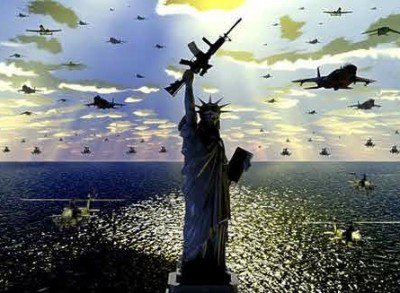
The United States did not begin as an empire.
The early American vision, articulated by figures like Thomas Paine and John Quincy Adams, emphasized restraint. Paine warned that government was a “necessary evil,” justified only insofar as it protected individuals and left them free, something no government had ever done but wouldn’t it be nice? Adams cautioned that America “goes not abroad in search of monsters to destroy.” America had “monsters” aplenty here needing attention first: The restless South and the Plains Indians.
Here was the growing government’s operating principle: Power, once extended beyond necessity, tends to justify itself. For the US, going beyond necessity meant going beyond the Constitution’s restraints.
Politicians out for blood tend to ignore the Constitution. Or at best reinterpret it.
The decisive break came in 1898.
Following the Spanish-American War, the United States acquired overseas territories and assumed responsibilities once associated with European empires. The language of liberty gave way, gradually but unmistakably, to the language of influence, security, and civilization.
As critics at the time observed — especially Mark Twain and William Graham Sumner — the United States did not simply defeat Spain. It adopted its role. It became the new empire on the block.
With empire came new necessities: Foreign interventions, permanent military presence, and the management of distant populations. And with these came a new way of speaking: Naming the enemy.
Modern American foreign policy relies heavily on moral language. Among its most powerful terms is “terrorism.”
Iran has long been designated a state sponsor of terrorism, based on its support for groups that have carried out attacks on civilians. This designation carries a clear moral implication, that harming civilians for political purposes is in gross violation of established standards of moral conduct. But in the world of US newspeak violations are not applied consistently.
United States has, for decades, imposed economic sanctions on Iran that have restricted its access to global markets, financial systems, and trade. These sanctions intensified after 2018 under what was termed a “maximum pressure” campaign. The Trump Administration wanted Iran to cede more restrictions on its nuclear program. The campaign was renewed in February, 2025.
When sanctions are imposed, humanitarian goods are exempt. Somewhat.
In practice, access to medicine has often been impeded. Studies in journals such as The Lancet and analyses by humanitarian organizations have documented shortages of essential drugs and strain on Iran’s healthcare system. Financial restrictions and compliance risks have made even permitted transactions difficult. Under sanctions civilians are punished, sometimes mortally. But we don’t call it terrorism.
Intention and Outcome
The usual defense is that sanctions are not aimed at civilians. They are intended to pressure governments, not people. Any suffering that follows is unintended. Therefore, as the government sees it, when half a million Iraqi children die from US sanctions, it’s unfortunate but the US is clean. It wasn’t terrorism, it was only sanctions. Had the government dropped bombs on children it would be terrorism—unless of course it was an unfortunate mistake. Mistakes are altogether different since in war off-target missile attacks do happen, not unlike drunks killing others when driving recklessly. Since war itself is not considered terrorism, the US is not a terrorist state and the sanctions deaths are something else, even though the effects in all cases are predictable.
If policymakers understand that restricting a nation’s financial system will impede access to medicine, if they know that economic pressure will fall most heavily on those with the least capacity to absorb it, then the line between intention and outcome collapses. Deliberate acts of violence and sanctions are both heinous acts, whether state-sponsored or state-initiated.
It is said that victors in war write the histories. Empires have a similar advantage. They get to justify their actions with morally-acceptable language.
The United States did not abandon its moral vocabulary when it embraced a larger global role, but it did make necessary revisions. Actions by adversaries are described in terms of their effects, while actions by the US are described in terms of their intentions. The same human consequences are placed in different moral categories. “Terrorism” becomes a label applied selectively, not a standard applied universally.
This is not unique to the United States. It is characteristic of states. The founders argued in moral terms we could understand and debate. It was more openly philosophical and less professionally managed. Today, power is often exercised in language designed to obscure its effects.
Paine, Jefferson, Madison, and other founders understood that power tends to expand beyond its original limits. Their concern was not merely with bad rulers, but with the structure of rule itself. A government that extends its reach abroad, that imposes its will on distant populations, and that justifies coercion in the name of necessity is no longer confined to protecting liberty. It is engaged in managing outcomes.
And in managing outcomes, it will adopt whatever language is required to humor its citizens.
Conclusion
The United States began with a presumption of restraint. It now operates with a presumption of necessity. The power it wields today is reflected in the degree of unanimity it finds among mainstream commentators. Very few proclaim the US as the world’s leading terrorist because the government’s intentions are noble. It was necessary for the sake of civilization to attack Venezuela. It was necessary to attack Iran. It will soon be necessary to attack Cuba. And perhaps Greenland, and depending on what Artemis II turns up, maybe the dark side of the moon.
Sanctions that harm civilians are called policy. Violence by others is called terror. The distinction is of course phony, but the power has spoken.
Power does not simply act. It explains itself. You disagree with the power’s explanation? As long as you don’t make a lot of noise about it, the power doesn’t care. You’re not a threat. But if you stir up the natives, the power might come calling.
Since you are not a seeker of power, you will never dethrone the ones who thrive on it. They are expert at curtailing challengers. They will rule until the day their house of cards collapses, at which time we will have an opportunity, borrowing Paine’s phrase, to begin the world over again.
https://www.lewrockwell.com/2026/04/george-f-smith/empire-and-the-language-of-terror