
Hungary and the Curse of Trump
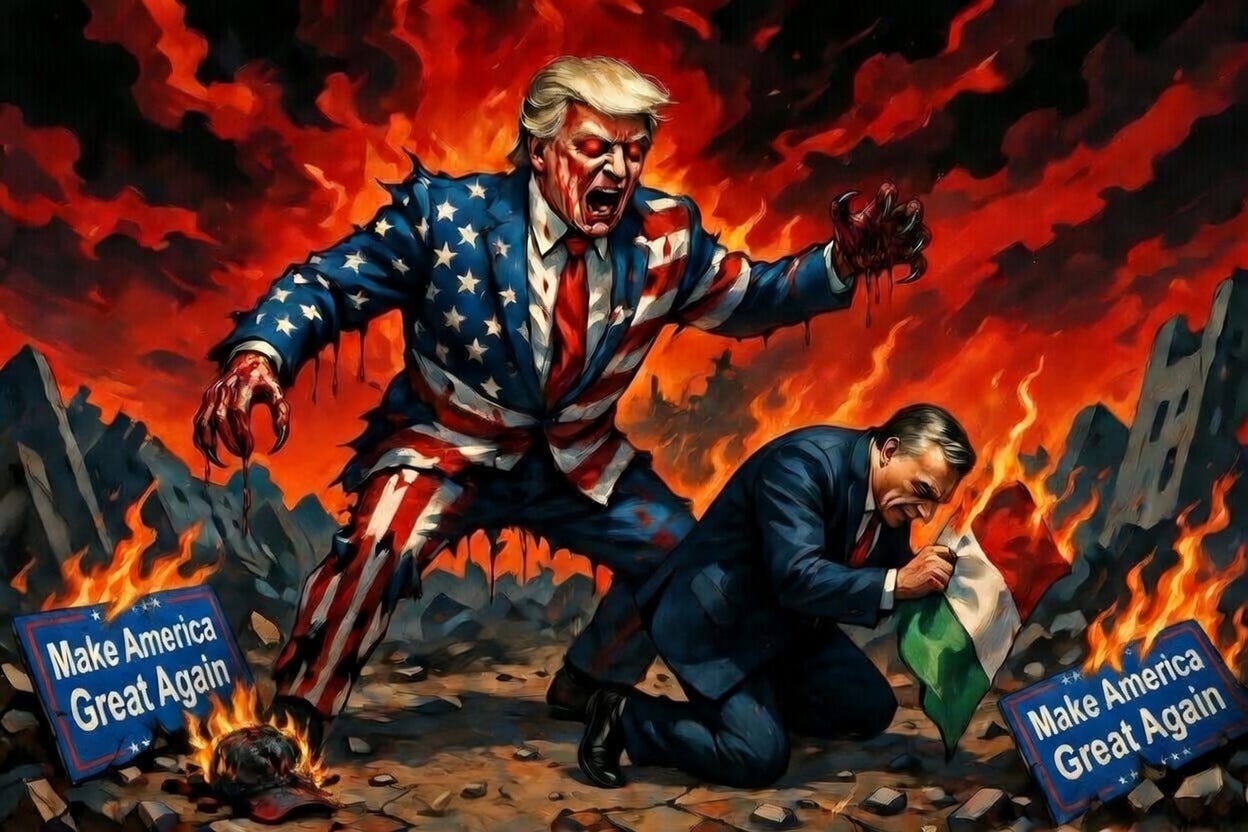
Europe reacts. Europe always reacts. It senses direction before it names it. The present movement is running towards the Left, and the cause stands in plain sight: the conduct of Donald Trump in the escalating conflict with Iran. What once appeared as a global anti-globalist revolt against liberal tyranny now resembles its most aggressive continuation. The mask has shifted. The monster remains and is emboldened.
The war in Iran marks the turning point. Strikes launched in late February under the banner of regime change opened a new phase of direct confrontation. Infrastructure and civilians were targeted, leaders and their families were murdered, and dissident/terrorist groups were armed in advance. This forms a familiar script, one written long before Trump entered politics. The language has changed. The structure has endured. The unipolar instinct asserts itself through force, pressure, and the assumption that one center must shape the world in its own image.
This is the moment where the Right in the West is losing its orientation. The promise once carried by Trump rested on a break with neoconservative logic. He spoke of ending endless wars, of restoring national sovereignty, and of rejecting the missionary impulse of liberal interventions. That promise gave energy to the Right in Western Europe. It allowed figures such as Viktor Orbán to stand firm, resist Brussels, and construct an alternative model of governance rooted in identity and state power.
Now the situation is reversing. The unprovoked attack against Iran on Israel’s behalf sends a different message: the United States is returning to coercion and attempts at strategic domination. The Right is thus losing its claim to represent a new path. It is becoming indistinguishable from the supremacist system it once opposed. Western Europe is reading this clearly. The reaction follows with speed.
Hungary has become the first major casualty. Fidesz, long anchored in the principles of sovereignty and resistance to subservience, has collapsed under pressure. The EU-approved Tisza Party, led by Péter Magyar, has risen with overwhelming parliamentary strength. Constitutional change is now within reach. The Orbán system, built over fourteen years, is entering a phase of rapid dismantling.
This outcome also reflects domestic factors. Every electoral shift contains internal causes. Yet the external signal matters more. European voters see a world in turmoil, shaped by American escalation. They respond by seeking shelter within familiar structures. The Left now presents itself as coordination and protection against the chaos unleashed by the American empire. The Right, tied to Trump’s image, appears volatile, unpredictable, and entangled in needless hostility and violence.
The beneficiaries are aligning along predictable lines. Brussels is regaining control over a defiant member state. Kiev is moving closer to securing vast financial flows that can sustain its belligerent position towards Russia. The horizon narrows, the air thickens, lines of force slide across the map like blades drawn in slow motion. Signals cross signals, commands answer commands, circuits hum with a rising heat that seeks release. A third world war gathers in the undercurrent, a swelling rhythm beneath every decision, a convergence that presses inward from all sides, closer, tighter, inevitable in its approach. The network linked to George Soros is re-entering the Hungarian field with renewed force. The circulation resumes, a latent diathesis stirring in the body politic, vessels reopening, capillary channels admitting a finer infiltration. A slow congestion gathers, an invisible saturation of the tissues, a pervading effluvium that insinuates itself through every organ, until the whole system yields to its subtle, cumulative pressure. Each actor is advancing under the same banner: restoration of a managed, centralized, hegemonic order.
From a multipolar perspective, the irony seems stark. Trump, a figure who once spoke of dismantling the liberal stranglehold on the West, is now accelerating its return. The war in Iran does not command popular support in Western Europe. Most Europeans view it with suspicion, fear, and fatigue. Yet the conflict is still strengthening Atlanticist coordination at the level of elites. It justifies intervention, revives the language of “security” and “responsibility,” and tightens institutional alignment. At the same time, public anxiety over escalation drives voters towards the Left, which presents itself as the force of restraint. The system regains coherence above, even as distrust grows below.
The consequences extend beyond Hungary. Across Western Europe, the earlier surge towards the Right is slowing and reversing. Movements that drew strength from opposition to globalism are now struggling to define themselves. If Washington and MAGA themselves embrace intervention, what remains of the anti-interventionist Right? What distinguishes the new from the old?
In Britain, Nigel Farage is facing this shifting terrain. His ascent depended on clarity: sovereignty against bureaucracy and the nation against a system rigged against the people. Now the field is falling apart. Left-wing forces, often outside the traditional establishment, are gaining ground by channeling public anxiety over war and instability. Polls tighten. Municipal elections are approaching as an early test. The outcome remains uncertain, yet the direction appears clear: fragmentation favors those who promise containment.
Within the United States, the same contradiction is unfolding. The war is deepening divisions. Some factions call for escalation, others warn of cost and overreach. The strategic line lacks coherence. Economic agendas stall under the weight of conflict, including delays in key sectors such as technology exports. War consumes attention, resources, and legitimacy.
History moves in cycles. The present phase favors consolidation of the liberal order in Europe. Beneath the surface, deeper currents continue to flow. Civilizations diverge. Power diffuses. New poles rise. The long arc bends towards plurality.
Yet timing matters. Strategy matters. Alignment between word and action determines whether a movement expands or collapses. At this moment, the Western Right faces contraction. It follows a leader who has lost his course, and in doing so, the advance of its enemies is accelerated.
https://www.eurosiberia.net/p/hungary-and-the-curse-of-trump