
The Battle of the Strait of Hormuz
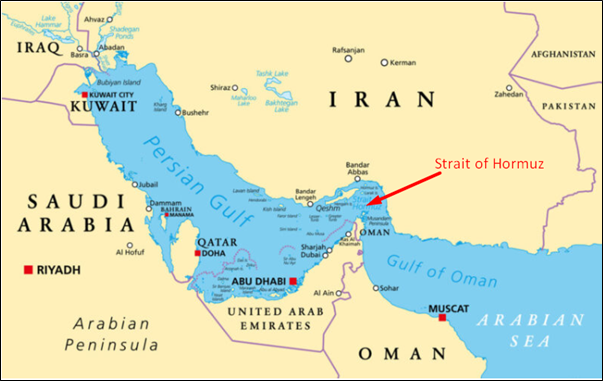
This is the battle Iran WANTS to fight.
The scent of great danger is in the wind.
For the past few hours, amid a growling southwest wind (50+ mph gusts), I have been staring out my window towards nearby Iron Mountain, contemplating the physical realities of the United States attempting to blockade all maritime traffic to and from Iranian ports.
Admiral James Stavridis, USN, Ret., an ever-present “authoritative voice” in the imperial infosphere, offered his thoughts on the matter earlier today in a short (5 min) interview on CNN.
The intrepid admiral prescribes two carrier strike groups, a dozen additional destroyers, and an unspecified number of “frigates” to position themselves in the Gulf of Oman.
There are three destroyers currently attached to CSG-3 (USS Abraham Lincoln), and four destroyers attached to CSG-10 (USS George H. W. Bush).
There are reportedly six independent destroyers currently operating in the Arabian Sea, and two independent destroyers in the Red Sea.
There is one littoral combat ship (“frigate”) in the Arabian Sea.
So, even if the two destroyers in the Red Sea dare to run the gauntlet of the Bab-el-Mandeb in order to join the main fleet, there would still be four more destroyers required for the order of battle Stavridis proposes for the Gulf of Oman.
But, importantly, Stavridis also says a successful blockade will require at least another half-dozen US warships on the other side of the Strait of Hormuz, in the Persian Gulf proper.
He also says the naval power of the Arab Oil Sheikdoms must be committed to the operation.
“So you try and bottle it up on both sides,” Stavridis explained, speaking of the Strait of Hormuz.
In total, the Stavridis order of battle for the blockade consists of:
- 2 Nimitz-class aircraft carriers
- 20+ Arleigh Burke-class destroyers
- an unspecified number of “frigates”
- an unspecified number of warships from the Arab oil kingdoms
- presumably the USS Tripoli and its aircraft and Marines
- presumably the USS Boxer and its aircraft and Marines
- presumably a Brigade Combat Team from the 82nd Airborne Division
- most of the elite American special operations forces on the planet
- American/Israeli/Arab air forces
What does Iran have to face the force Stavridis proposes?
- at least hundreds of fast attack boats carrying anti-ship missiles, torpedoes, and short-range vertical launch air defense missiles
- hundreds of unmanned high-speed surface drones with potent warheads
- at least hundreds of anti-ship cruise missiles
- thousands of short- and medium-range anti-ship ballistic missiles
- thousands of aerial attack drones of various types
- at least hundreds of surveillance drones
- numerous stealthy mini-submarines carrying potent torpedoes
- thousands of both Iranian and Russian MANPADs
- an unknown number of Iranian and Russian short-, medium-, and long-range anti-aircraft missile systems, including the P-358 and P-359 loitering anti-aircraft missiles, which have shown impressive capabilities
- remote-controlled mines that are anchored on the sea floor until remotely activated
- substantial real-time intelligence, surveillance, and reconnaissance (ISR) provided by Iran’s Russian and Chinese friends
Assuming the US really does undertake to enforce its selective blockade of Iranian shipping via hard-fisted military measures — including a significant proportion of operational US naval power — it will constitute the greatest escalation of the Iran War up to this point.
But make no mistake, this is the precisely the kind of battle for which Iran has prepared for the past quarter century.
This is the battle Iran WANTS to fight.
How it all turns out remains to be seen. But I remain convinced the American loss threshold is extremely low, and even if just TWO destroyers are sunk or severely damaged in coming days, it will represent an unprecedented disaster, and add an exclamation point to the decisive strategic defeat the United States has already incurred.
And, if an aircraft carrier is effectively disabled by a few drone or missile strikes, it will represent an unprecedented military and geopolitical catastrophe for the already rapidly disintegrating empire.
The scent of great danger is in the wind.
https://www.theburningplatform.com/2026/04/13/the-battle-of-the-strait-of-hormuz/#more-404248