
Remember That ‘Forged-in-Hell Frankenstein Substance’ Your Doctor Prescribed When You Were Fifteen?

A Reflection on Pharmaceuticals, the Fall, and Pilgrimage.
I recently looked into the side effects of an acne “medicine” prescribed for me long ago—really a “forged in hell Frankenstein substance,” according to one of my favorite posters. I knew it was bad stuff, but had no idea how bad.
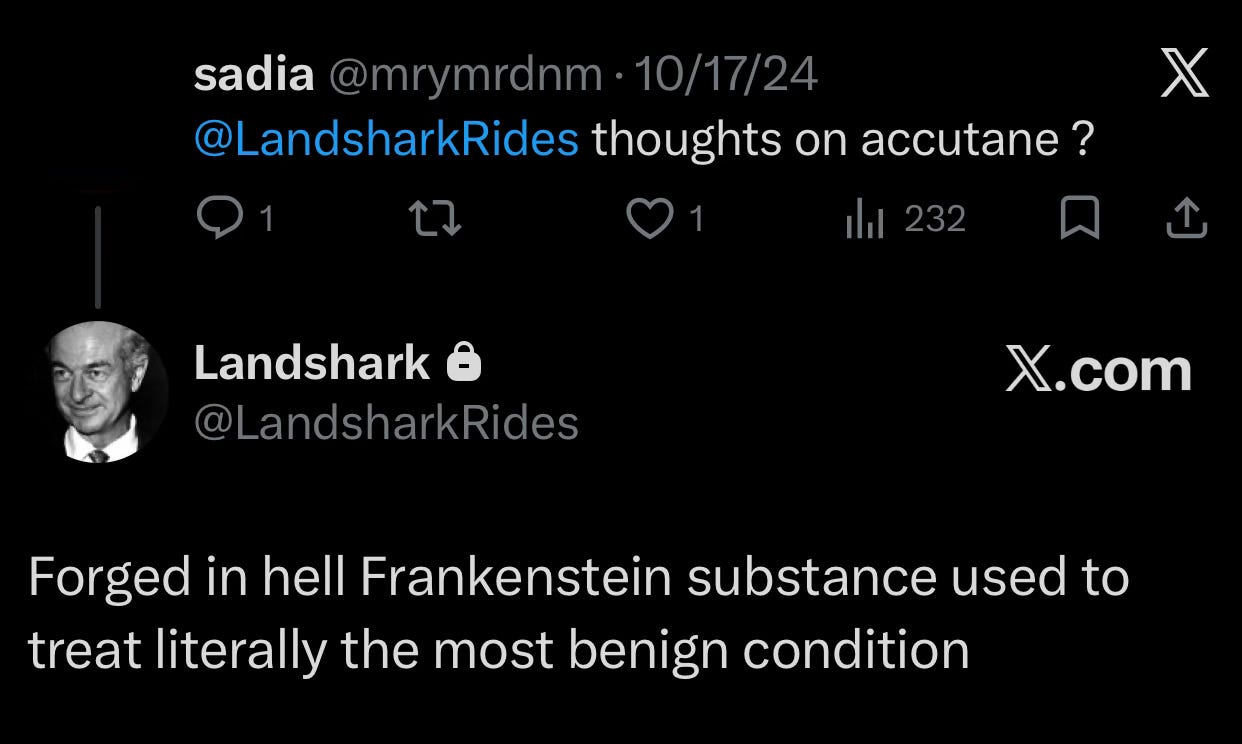
Other esoteric health gurus and noticers have weighed in on the issue:
Josh Rainer: Accutane is terrible for your liver and other organs. You could easily have caused permanent damage.
Noah Ryan: Accutane is neurotoxic … Accutane is essentially a chemotherapeutic agent. It causes apoptosis in the brain, hair, gut, joints & skin. It disrupts dopamine, serotonin, and neurogenesis and causes massive hypermethylation, causing lasting repression of certain genes.
Juliana Lung: Accutane is also a toxin and contraindicated in pregnancy, causing severe birth defects if taken. Testicular atrophy and lower spermatogenesis was observed in dogs given accutane for 30 weeks
N’Golo: Please don’t take accutane.
MG2: It’s akin to megadosing retinol which is known to be toxic.
Van Man: Any doctor prescribing accutane should have to take it themselves.
Landshark again: If you have younger siblings who have acne, their doctor might try to prescribe them accutane and you should definitely stop them from taking it because it inflicts basically irreversible damage to all organs and bones, permanently alters your gut flora and makes you suicidal.
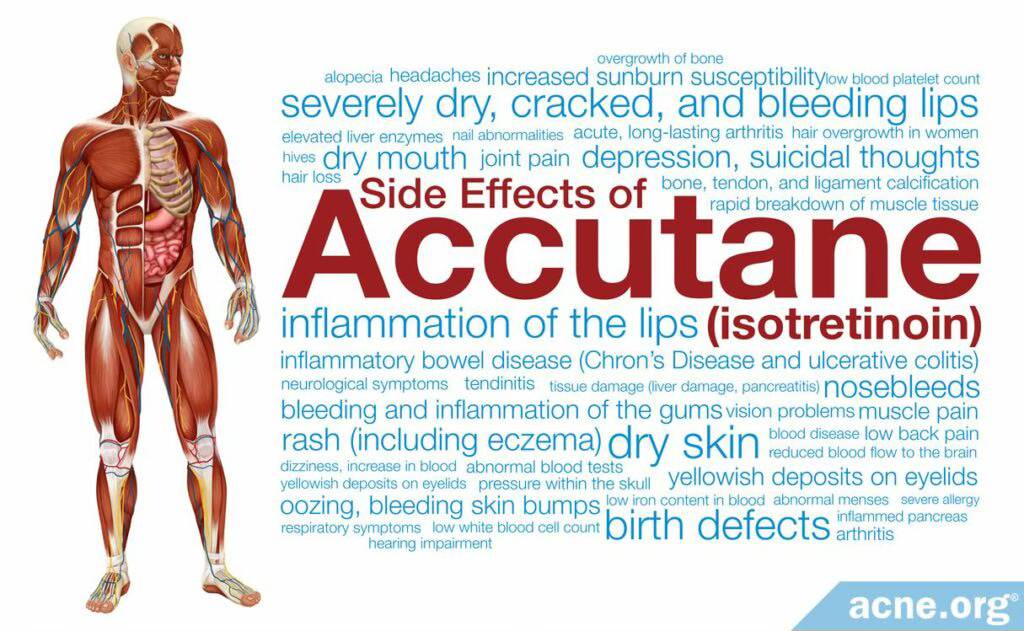
Dive deeper and you’ll find an extensive list of functions potentially compromised by this drug, everything from stomach to hormones to joints to hair to stature. The nightmarish possibilities make Landshark’s observation look less hyperbolic: Accutane can apparently turn a Sensitive Young Man into a low-T depressive with stunted growth, thinning hair, IBS, impotence, and more.1 A high price to pay for clearer skin.
Though I avoided the worst of these possibilities—thanks be to God—the experience was still plenty rough, marked by dark moods and joint pain. For several months at the beginning of my high school career, I became even more of a melodramatic emo-headcase than I had been previously, and my athletic prowess was severely limited by my suddenly sixty-year-old knees. After treatment ended, it never occurred to me to consider the possibility that certain troubles might be lingering effects of the Frankenstein substance, mostly because my health has generally been a blessing—especially when compared to that of the standard skinnyfat normie. But I am nevertheless dogged by a few moderate issues and by a vague sense of being less than I should be, given my vitality-maxxing habits and program. Blood tests bear this out. It’s hard to know the extent to which these troubles were caused an acne medication taken when I was fifteen years old, but they map pretty well onto Post-Accutane Syndrome.
So what, exactly, does one do with this discovery?
Get serious about detoxxing, I guess. Exercise even more extreme caution toward the solutions of modern medicine. Understand the inherent flaws of a “health care” system that has almost no conception of health. Help steer young people away from the trouble. Be grateful it’s not worse.
Also: try to avoid self-pity. The pull of this vice is intense, though. A great writer once noted that the past is never dead—it’s not even past. Had you been at full strength, rather than diminished by Frankenstein pills, you might have performed better at certain trials during your formative years and been shaped accordingly. But you are not the only one who suffered, and many had it a lot worse.
Also: understand that the larger human condition is one of deep vulnerability. When Adam and Eve fell, they fell hard and left all their children vulnerable. So vulnerable that our lives can be permanently altered by an unsuspecting visit to the doctor’s office, where the directives of a trusted medical authority threaten to derail us. Not that these vulnerabilities cannot be overcome by strong people with real agency, but they are still very real.
Also: understand the corollary that our own sins inflict damage on others that might go further than we can imagine. Seemingly private sins or “victimless crimes” are never really private or victimless. A gambling habit, porn addiction, drug use—all of these echo through a man’s little world; even if one makes himself into a hermit and commits his crimes in isolation, others will still suffer the absence of contributions he could have otherwise offered. Our army is down a man.
One more reflection follows, which is particularly suited for a post-Easter reflection. We need to understand that this life is not ultimately about flourishing, optimization, full realization of one’s potential, or “living your best life.” Aspirations are good and victories even in the small contests of life can have big spiritual consequences. So we have to go after Ws hard.2 As the great knight Geoffroi de Charny reminds us again and again, “He who does more is of greater worth!” But the world as it’s constituted can be indifferent or even hostile to your quest to prove your worth—time and chance and senseless injustice happeneth to them all! Even Jesus Christ gets marked.
Instead of strivers we should see ourselves as pilgrims—and understand that arriving at the destination is the ultimate thing, no matter what crooked roads we have to travel on the way. In Faith Hope Love, Josef Pieper describes the human condition as that of a viator:
Pastoral melodramatics have robbed the reference to man as a “pilgrim on this earth” and to his earthly life as a “pilgrimage” of its original significance and virility as well as its effectiveness…
Nevertheless, this reality is part of the very foundation of being in the world for the Christian: the concept of the status viatoris is one of the basic concepts of every Christian rule of life.
To be a “viator” means to be “one on the way.” The status viatoris is, then, the “condition or state of being on the way.” Its proper antonym is status comprehensoris. One who has comprehended, encompassed, arrived, is no longer a viator, but a comprehensor … To be on the way, to be a viator, means to be making progress toward eternal happiness; to have encompassed this goal, to be comprehensor, means to possess beatitude … It would be difficult to conceive of another statement that penetrates into the innermost core of creaturely existence as does the statement that man finds himself, even until the moment of his death, in the status viatoris, in the state of being on the way…
This approach opens up a new way of thinking. There might be strange and unexpected opportunities in the setbacks, and the arrival of the pilgrim at the destination might be made more glorious precisely because of the setbacks he suffered and overcame.
https://thechivalryguild.substack.com/p/remember-that-forged-in-hell-frankenstein