
How Big Pharma (Successfully) Targeted Women

Two waves of addiction were prescribed by doctors and egged on by pharmaceutical marketing — orchestrated by the Sackler family — that insisted it was safe and a great idea.
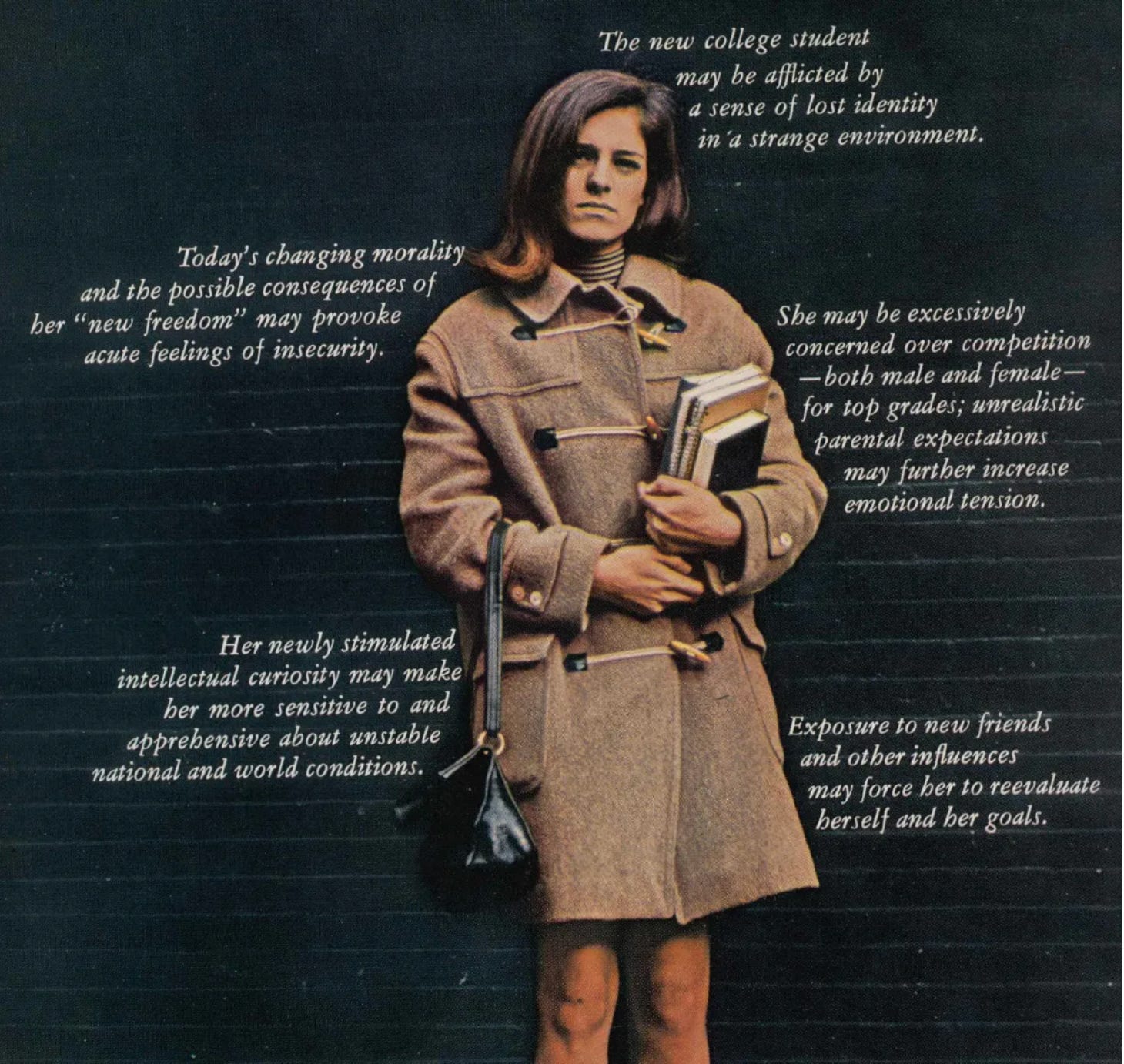
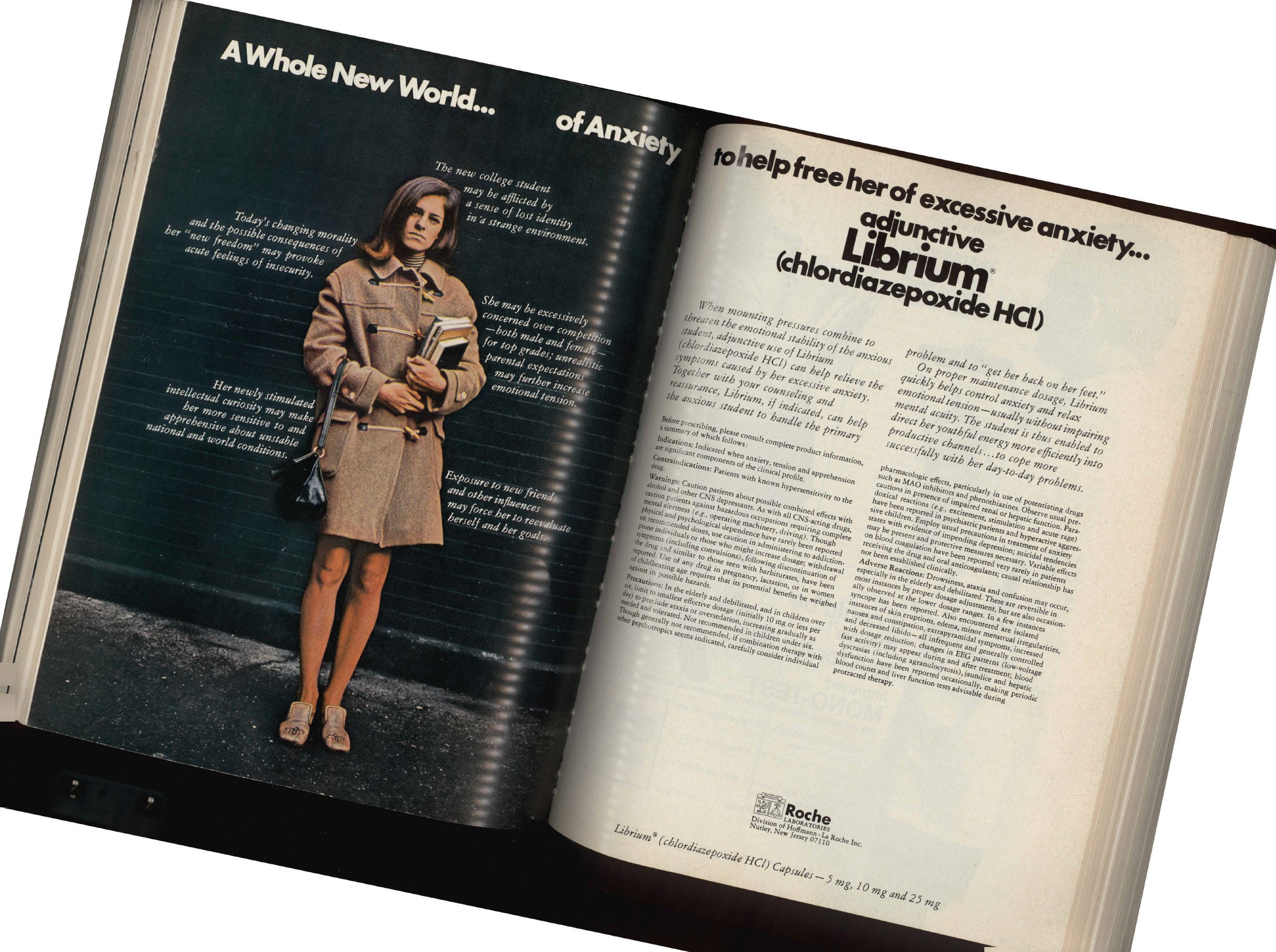
Consider this sales pitch for the sedative medication Librium®, as published in 1969 in a medical journal (and thus targeted at doctors). The advertisement featured an unsmiling young woman in a short coat, her arms full of books, who is identified as a new college student. The accompanying text listed reasons she might need to be medicated.
“Her newly stimulated intellectual curiosity may make her more sensitive to and apprehensive about unstable national and world conditions,” the ad copy intones. “Exposure to new friends and other influences may force her to reevaluate herself and her goals.”
So, she’d need daily sedation once she realized that the carpet-bombing of Vietnam was wrong?
Being lightly drugged every day would help her make friends and set goals?
She’ll be “apprehensive about unstable world conditions.” Well, tell her to get in line. Cold War-era surveys of adolescents had indeed shown that some were anxious, and cynical about adult society, due to our insane embrace of nuclear weapons — then as now, poised for hair-trigger launch to wipe out hundreds of millions of people. In college, a young person might learn more about this, and decide to work to change it.
Or instead we could just start the college student on medication, to help her get comfortable with the government’s psychopathology.
Other reasons to start Librium® were offered:
- anxiety about being “in a strange environment”;
- “feelings of insecurity” related to “today’s changing morality and the possible consequences of her ‘new freedom’ ” — a very 1960s-kind-of-way to nudge-wink about casual sex;
- “emotional tension” from overbearing parents;
- “excessive concern” about grades.
This Tuesday, the Sackler-owned-and-directed Purdue Pharma will be formally sentenced for years of illegal and dishonest work slinging opioids, activity that seeded the Opioid Crisis and made billions of dollars for the Sacklers. Purdue, the company, entered its guilty pleas more than five years ago, but the Sacklers themselves have never pleaded to anything, and instead just paid the Justice Department a little cash to go away. Here’s how they built the empire at the heart of the case:
The Sackler Hustle
Sedative pills of the newly discovered benzodiazepine family poured out of doctors’ offices and pharmacies in the 1960s and 1970s, in return for fabulous sums of money. Librium® had hit the market in 1960 (nine years before the advertisement referenced above), and was soon earning tens of millions of dollars a year. Valium®, its younger and more popular sister, debuted two years later. Both blockbusters, as recently reviewed here, were manufactured by Hoffman-La Roche pharmaceuticals and marketed by Arthur Sackler’s ad company.
Valium® became the first medication in history to rack up more than $100 million in annual sales. And then, even as the business world gaped in awe at the thought of a $100 million drug, Librium® was also a $100 million drug, while the saturation marketing of Valium® had sent it soaring ten times higher, and it became the first drug to earn $1 billion in annual sales.
Sackler, the ad man behind the Librium® and Valium® campaigns, had been a life-long hustler. Born in Brooklyn, the son of poor Jewish emigrants from Austria-Hungary, he was already working by age 12. He delivered newspapers and flowers to help support his family, waited tables, worked at a soda fountain. In 1926, at age 13, he was offered the position of editor of all of his high school’s publications, including a newspaper, a humor magazine and the yearbook. According to a family history Arthur later wrote, the offer prompted a formal sit-down with his parents and uncles, after which Arthur emerged with a counter-offer: that he be made business manager of the school publications, and get a small percentage of any ad sales he drummed up. Soon, he was selling advertising not just for the school newspaper, but on the backs of free six-inch rulers and on school program cards.
All through high school, medical school and beyond, Sackler collected advertising and editorial posts, and he always negotiated a commission on sales. So, it’s no surprise that he wrangled bonuses from Hoffman-La Roche based on sales volume of Librium® and Valium®. He used the resulting fabulous wealth to, among other things, purchase a small pharmaceutical company that would later become Purdue Pharma, for his brothers and other family members to run.
The Sackler clan had watched, some perhaps in envy, as their family genius had amassed his fortune selling medications — and especially, addictive medications. Everyone involved in pushing benzodiazepines like Librium® and Valium® initially denied they were addictive; and then, when evidence that benzodiazepines are addictive became incontrovertible, they insisted that the problem was not the medication, but the person, since he or she probably had “an addictive personality” and would just get addicted to something else.
In 1975, the Drug Enforcement Administration (DEA) declared diazepam would now be a controlled substance given its addictive potential, and in 1985, the patent for Valium® expired, allowing for generic diazepam competition. The Valium® gravy train slowed. Arthur himself stepped off of it, and then passed away in 1987.
By the 1990s, the Sackler clan — led by his brothers Mortimer and Raymond and his nephew Richard — was selling opioids. Over the years, everyone involved in slinging OxyContin® would also first insist it wasn’t very addictive, and then later blame those who became addicted.
It’s an intriguing counterfactual to consider that, if not for the revenues (and the shining example) generated by sales of addictive Valium®, the Sacklers might never have bought Purdue and launched OxyContin®. In other words, without the Valium craze of the 1960s-1980s, there’d have been no Opioid Crisis of today. One pathological, market-rewarded behavior amasses resources and know-how to launch another.
Why Don’t You Take a Tranquilizer?
Valium® in the 1960s became so ubiquitous that the word escaped the confines of a brand name: A valium was understood to be any sedative, just as Kleenex® became synonymous for tissue paper and Coke® for carbonated sugar water.
And sedatives themselves were casually, cheerfully referenced in pop culture as a convenience of modern life. In the pilot episode of the sit com “The Brady Bunch,” which aired in 1969 — the same year as the “college students need Librium” journal ad — the soon-to-be Mr. and Mrs. Brady commiserate by telephone about their wedding day jitters.
“Why don’t you take a tranquilizer?” she suggests.
Marriage and college are apparently both something to get through on drugs. (I’m disappointed she didn’t call it “a valium,” but no doubt they have strict rules on television about uncompensated product placement.)
“I took one,” he replies.
“Well, maybe you should take another one?” she suggests, as if it’s the most utterly reasonable thing imaginable to keep pounding sedation on your wedding day. He declines because, while he’s fine with tuning out the ceremony, “there’s the honeymoon to consider.”
Such casual and optimistic attitudes about the benzodiazepine sedatives were the day’s conventional wisdom. Yes, this is likely what you’d hear at the doctor’s office, assuming the doctor was “following the science” — science he was mostly informed of by Arthur Sackler and friends. Of course you should take a Valium® if you’re about to get married! Of course Librium® was indicated on your first day of college!
The World’s Most Prescribed Medication
Valium® became — year in and year out, for the entire decade of the 1970s — the most prescribed medication in the world.
Or at least, in the Western world. Doctors in the Soviet Union were futzing around with their own discoveries. These included ß-phenyl-GABA, a sedative available in Soviet cosmonaut medical kits, and phenazepam, a benzodiazepine 10 times more powerful than diazepam. Both are still used in Russia today.
How interesting that the Soviets discovered similar sedatives at the exact same moment in history as the Americans, but without an ensuing national addiction crisis. It’s not like the Russians were immune to the siren song of sedatives. Look at their battle with vodka. And yet “Soviet Valium,” despite being 10 times stronger than “American Valium,” was never pushed by a marketing campaign for widespread daily citizen use, and also never birthed an epidemic of drug-enslavement.
But in the self-styled Free World, the newly-discovered benzodiazepine chemicals would be gussied up with attractive names and then sold, sold, sold. Chlordiazepoxide would be rechristened “Librium,” to suggest “liberty and equilibrium.” Diazepam would be anointed “Valium,” to evoke associations of “health and equilibrium.” (Valere is a Latin verb meaning to be healthy or powerful). And by the 1970s, at least every 10th American would have taken Valium®.
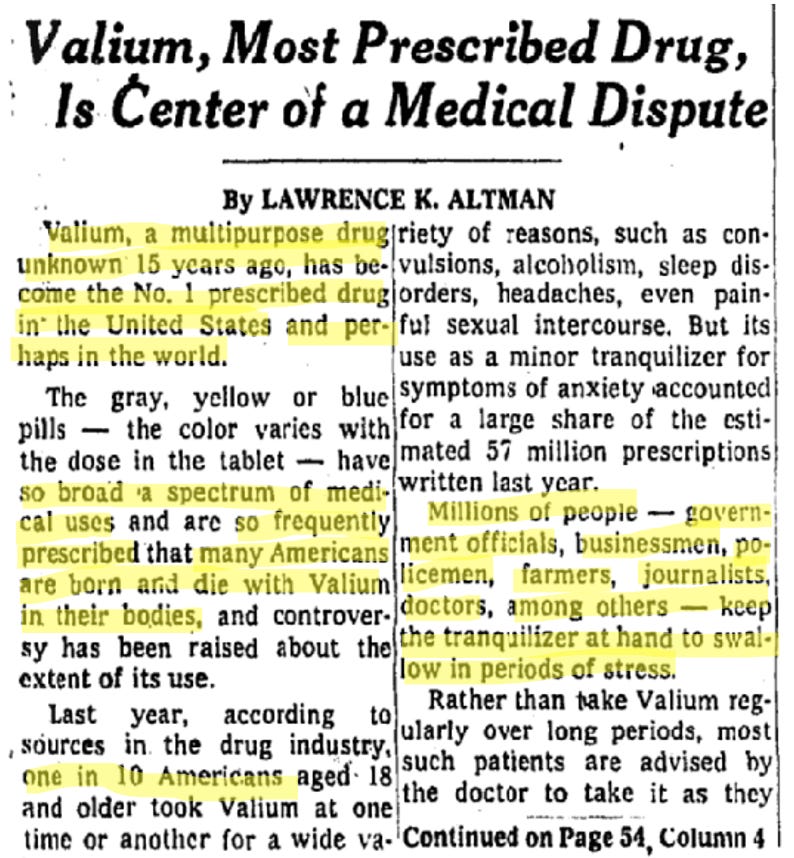
“Millions of people — government officials, businessmen, policemen, farmers, journalists, doctors, among others — keep the tranquilizer at hand to swallow in periods of stress,” reported The New York Times in 1974. Pointedly, the newspaper described Valium® as “a multipurpose drug unknown 15 years ago,” but now with “so broad a spectrum of medical uses and… so frequently prescribed that many Americans are born and die with Valium in their bodies.”
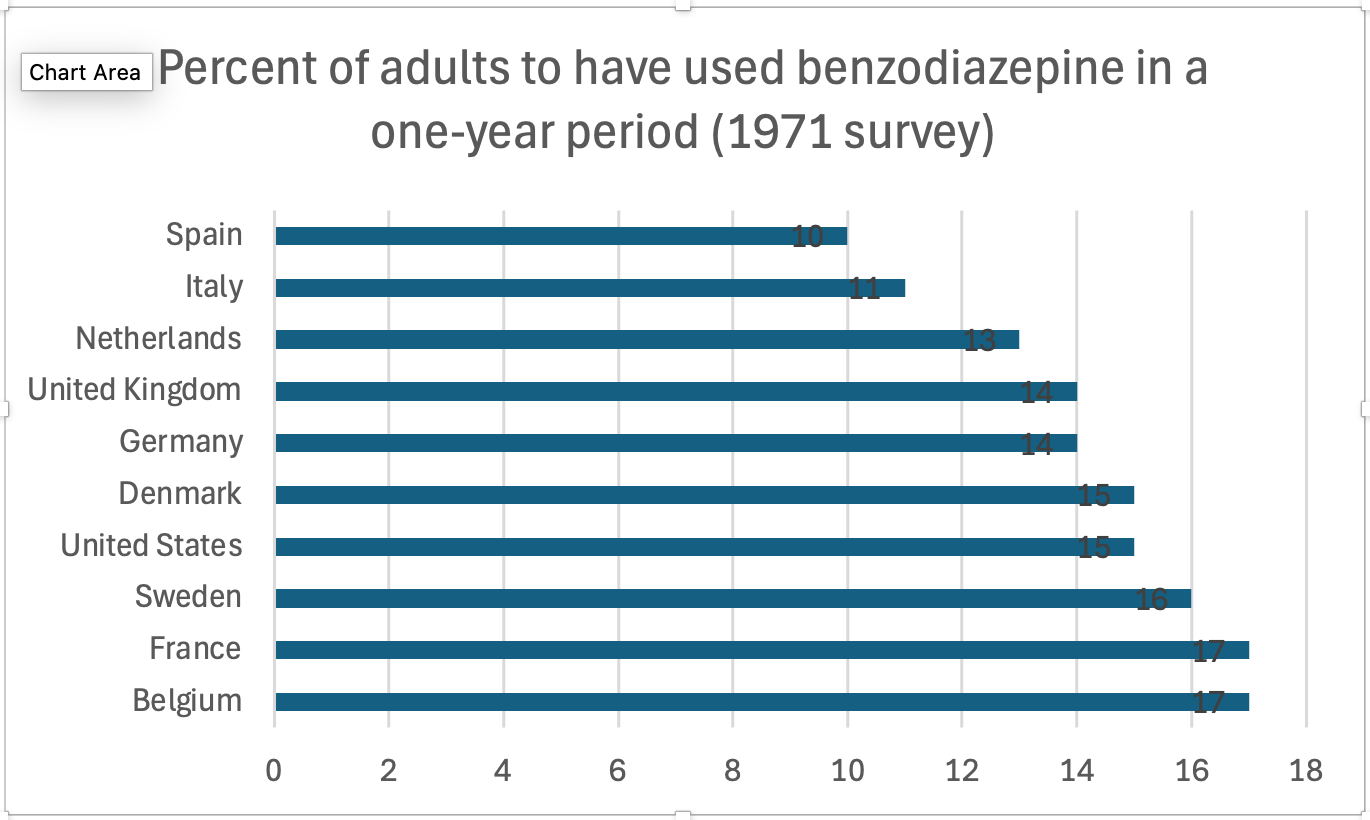
But this wasn’t a specifically American phenomenon. It was a Western capitalism phenomenon; a feature of free market-steered medical decision-making. The same New York Times article cited a study from the New England Journal of Medicine that tracked worldwide benzodiazepine use among adults over a one-year period. That study found a whopping 15% of American adults had taken a benzodiazepine — more than one in seven! But compared to Europe, America was middle-of-the-road.
Benzodiazepines were recommended for high-status business executives. After all, they had stressful jobs, they needed help relaxing! No doubt, the advertising hope here was that the benzodiazepines would have some of the cachet of a Miltown®, the first minor tranquilizer and one publicly touted by the stars of Hollywood.
They were also recommended for, and taken in vast amounts by, housewives. There’s been raging debate ever since about what this says about women, society, and life in general. (Cue the Rolling Stones song “Mother’s Little Helper,” about a stay-at-home mom who takes escalating doses of “a little yellow pill” to cope with kids and husband.)
More vaguely, they were recommended for “psychic tension,” or what today we might call psychosomatic disorders: When psychological stress or trauma manifests with physical symptoms such as headaches, fatigue or gastrointestinal upset. A corollary to this line of reasoning, though, is that a mediocre primary care doctor might shrug and treat many vague headaches, fatigue or GI symptoms with Valium® or Librium®.
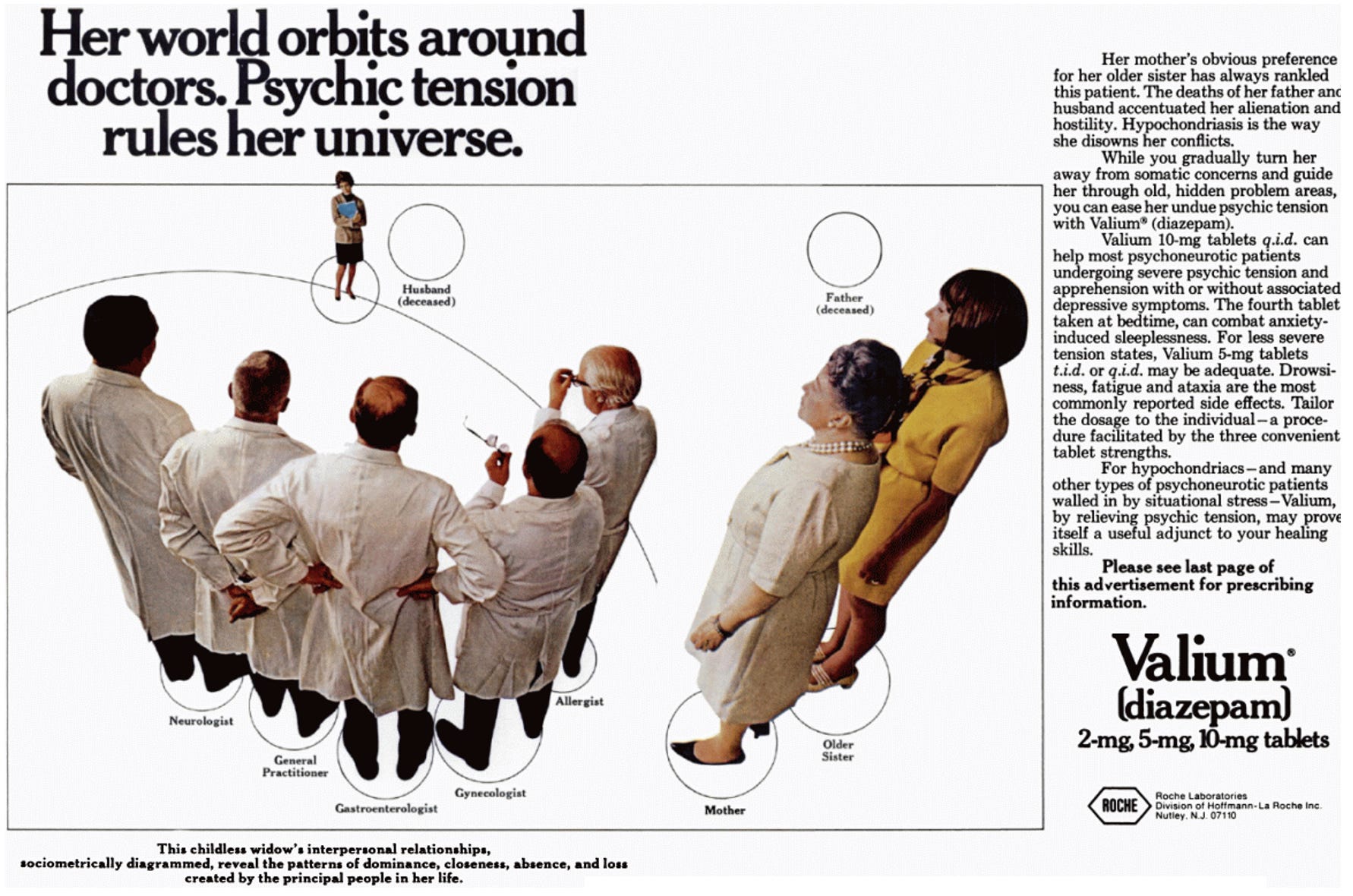
“Psychic tension” as a diagnosis was apparently created by the Hoffman-La Roche advertising campaign. The concept is fleshed out in wild advertisements of the day. In one, a woman stands inside a circle, looking back at a group of people, who are in turn pondering her. The group includes her mother and older sister, standing in their own circles off to the right, and at center stage a conclave of white-coated doctors. Empty circles stand in for “Husband (deceased)” and “Father (deceased)”.
What’s with all of the circles? A legend below the figure explains we are looking at “this childless widow’s interpersonal relationships, sociometrically diagrammed”.
The headline tells us this woman’s world “orbits around doctors,” and the text explains further that you are treating her for hypochondriasis. While you’re doing that, the ad says, why not also start her on Valium®? The ad recommends diazepam 10 mg four times a day — a shockingly high dose. (If, in my emergency department practice, I saw a patient on half that dose, I would be concerned enough to investigate the situation.)
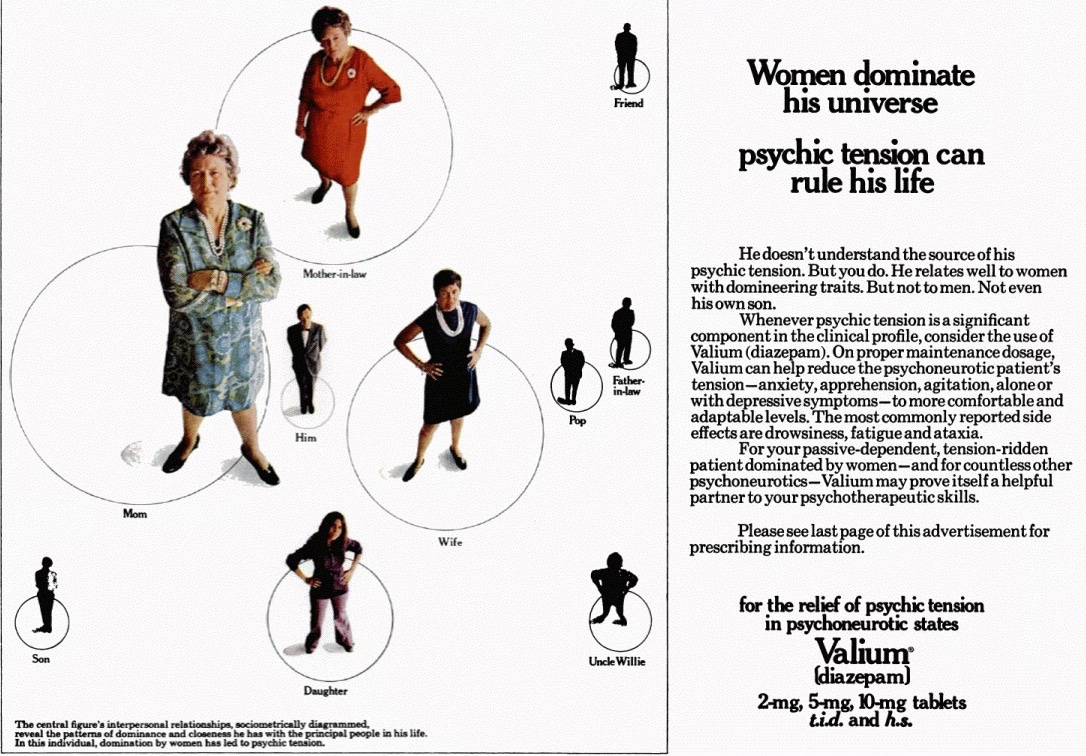
Hoffman-La Roche and, I presume, the Arthur Sackler ad agency (although I cannot confirm Sackler’s connection to any given advertisement) were big on “interpersonal relationships, sociometrically diagrammed.” It gives a scientific veneer to their sales pitch. In another advertisement, a Lilliputian man in a bow tie, standing like a weenie with his hands behind his back, is in the center of a tiny circle, surrounded by Brobdingnagian “women with domineering traits” in his life that include, in order of physical size, “Mom,” “Mother-in-law,” “Wife,” “Daughter.” There are also men in the circles at the periphery, but they are tiny colorless silhouettes, including “Friend,” “Son,” “Pop,” “Father-in-law” and — the only figure with a name — “Uncle Willie”, in the bottom right corner, who is apparently a Hobbit.
“For your passive-dependent, tension-ridden patient dominated by women — and for countless other psychoneurotics — Valium may prove itself a helpful partner,” the ad copy observes.
For those keeping score, reasons to be started on a benzodiazepine like Valium® or Librium® include going to college, getting married, being afraid of your mother-in-law, resenting your older sister, keeping house, succeeding in business, or being a government official, police officer, farmer, journalist or doctor. What could go wrong?
https://www.racket.news/p/how-big-pharma-successfully-targeted