
Power Again Rebalanced in Europe Amidst Political Shake-Ups
Switching it up today, let us take a broader look at the latest world developments, given that there are several diverging vectors of interest worth noting.
Firstly, Victor Orban was defeated in the Hungarian elections to great fanfare from the anti-Russian axis. Unfortunately for them, it turns out that the new PM of Hungary Peter Magyar is hardly any “better” than his predecessor.
Upon winning, he has stated that he would talk to Putin and appears to also be quite “un-supportive” of Ukrainian initiatives relative to expectations.
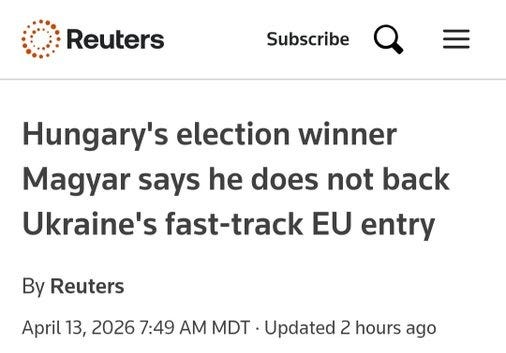
He’s demanded for Ukraine to reopen the Druzhba pipeline, now according to reports even making threats towards Zelensky:
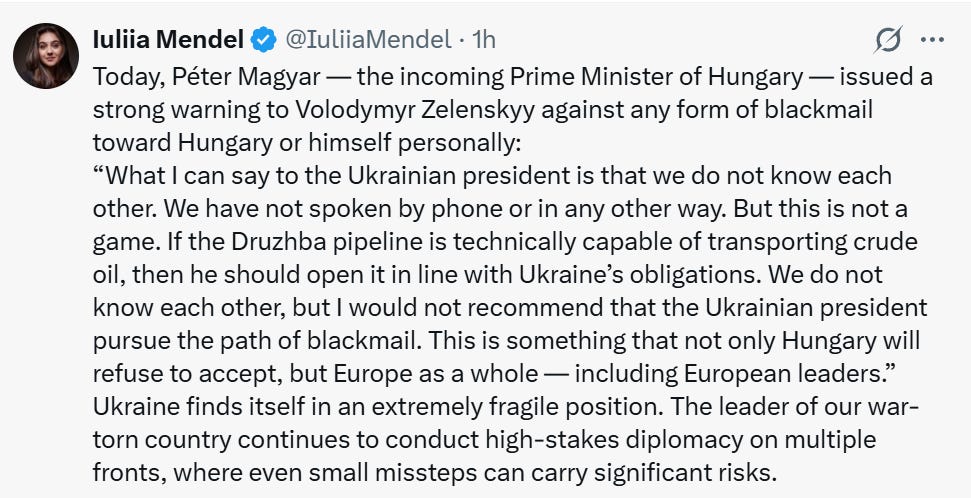
Magyar threatened to arrest Netanyahu if he comes to Hungary (unlike Orban, who openly welcomed Netanyahu and considered him an “ally”). Also, Magyar appeared to support a new policy blocking non-EU guest workers which some believe is targeted at Ukrainians, in order to keep them from coming to Hungary as refugees.
On the topic of the €90B loan to Ukraine, Magyar was only slightly more agreeable than Orban, stating he will not directly block the loan as Orban was doing, but that he will maintain Hungary’s “opting out” of contributing financially to the loan. In short, he’s playing a kind of balancing act, allowing the EU enough rope so its nomenklatura does not come after Hungary directly, but still maintaining Hungary’s sovereignty.
In fact, Magyar even oddly floated Orban as replacement for Ursula as head of the EU in a new interview, indicating that Magyar considers himself closer ideologically to Orban than he does to the corrupt and tyrannical EU politburo.
If you read between the lines, Magyar appears to be saying that he actually likes Orban but isn’t allowed to directly valorize him as that contradicts his own campaign messaging, given that he seeks power for himself. But he’s able to finesse it in a way where he believes Orban would be a positive for the greater EU as a whole. It’s like saying: “We don’t need him here because I’m better, but by the standards of the EU, Orban is the best amongst them.”
But his victory continues to be desperately tied into a narrative of “Russia losing” all across the globe—losing its allies, its support base, its military forward bases abroad, etc.
But when you examine the facts, an argument for the precise opposite can be made. While the sun was setting on Orban, a “pro-Russian” Rumen Radev won Bulgaria’s election:
In reality, he’s not so much “pro-Russian” as he is “anti-globalist”. But either way much of his views on the Ukraine war do not align with the EU, as he does not want to fund Ukraine and seeks to establish better relations with Russia, so his victory can be considered a major boon for the Russian side.
At the same time, the top naval-tracking account on X has spotted Russian warships again “regaining a foothold” in Tartus, Syria this week:
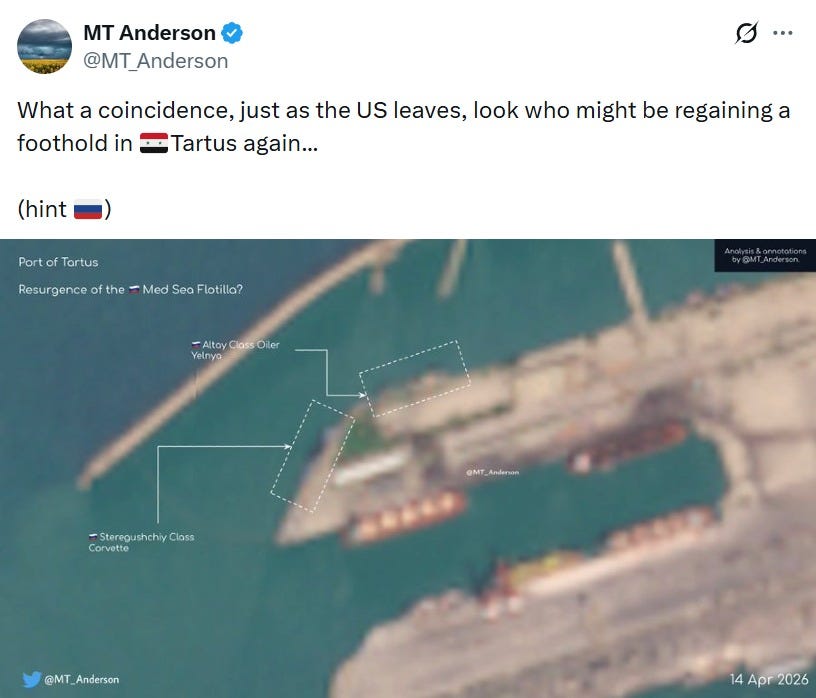
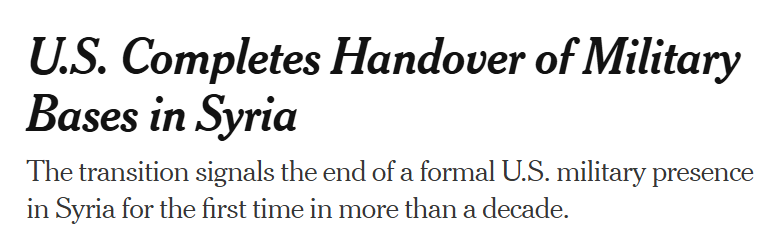
This only a day after American forces were reportedly seen handing over their last Syrian base and leaving the country after 11 long years. Weeks ago US handed over the notorious al-Tanf base, and now the US appears to be out of Syria for good—only a small security detail remaining for the Damascus embassy.
So, who is really losing power, influence, and reach around the globe?
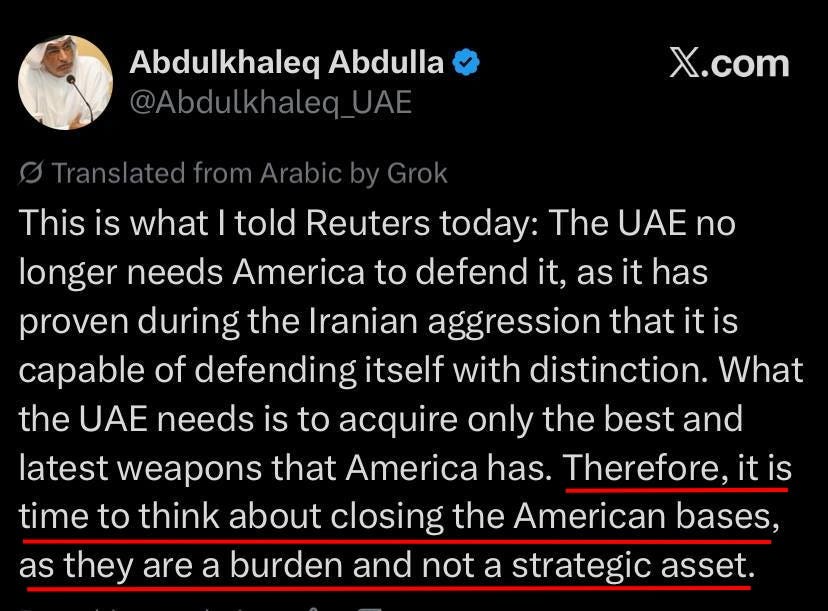
Buzz came today from a UAE expert who even suggested that the UAE no longer needs the US after the Iran war debacle, and that the US should leave the country:
—
On the topic we touched on last time, surrounding Europe becoming Ukraine’s “strategic rear” and the provocations from the Baltics, there are some new developments. It’s been noted that worldwide, countries are preparing for more military confrontation, for more war.
Belarus’s Lukashenko aptly captured the global mood in a recent speech:
“We must now mobilize to survive these difficult times. Moreover, these are uncertain times. As president, I don’t know what to prepare you for.”
The Belarusian leader added that “no one knows what will happen next, what the powerful will throw out.”
As such, I mentioned in the last report how all of Germany’s economic growth was being pegged to militarization. Now WSJ reports that Germany is “rewiring” its manufacturing base purely into weapons production, as every other industry blows out:
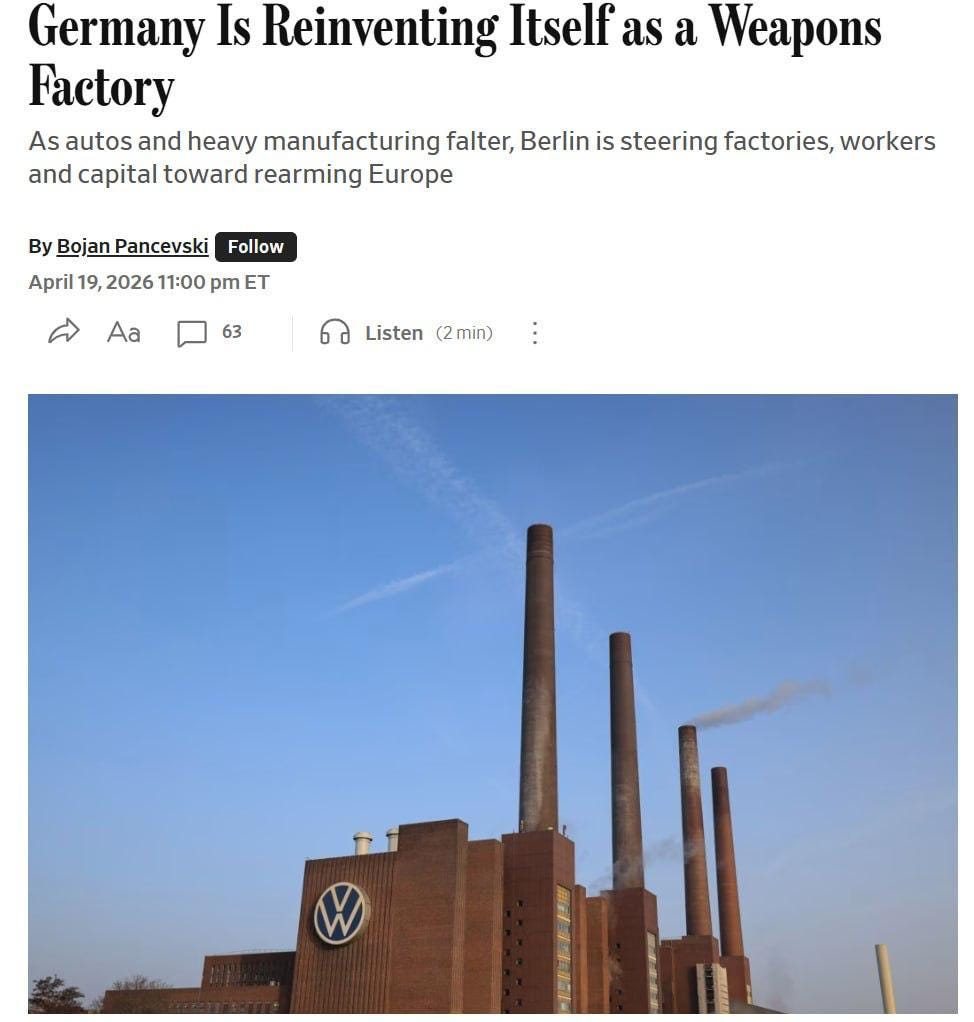
BERLIN—As its export model breaks down, Germany is pivoting from cars to cannons—and trying to turn industrial decline into a defense boom.
After decades as Europe’s manufacturing engine, the country is mired in its longest stretch of stagnation since World War II as it wrestles with competition from China and a slump in demand. The response is as stark as the crisis: recasting its industrial base as the West’s arsenal.
It goes on:
Across Germany’s industrial belt, factory lines that once powered the country’s export miracle are being rewired into the machinery of Europe’s rearmament.
The government is on board. Berlin’s approach isn’t to revive the old economy, but to replace it. Idle factory floors and a growing pool of laid-off skilled workers are being redirected into the only sector still expanding at scale.
topic of russia/baltics and strategic ‘rear’ for EU
They aim to redirect as much of the “non-defense sector” toward defense supply chains as possible, in essence converting their civilian manufacturing prowess toward war production. Brussels has nothing left but war to keep its stagnant ideological vision chugging along, and its faithful servants are doing their part.
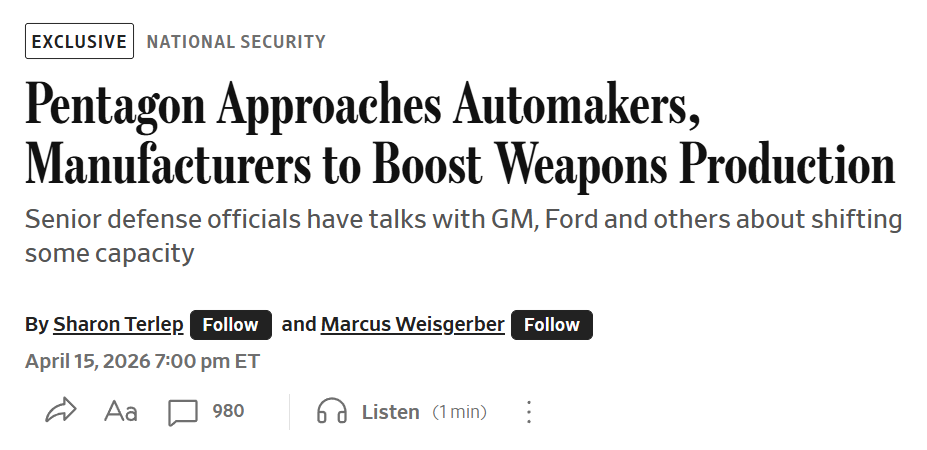
Now WSJ reports that the US is doing the same thing, with the Pentagon seeking to turn civilian automakers into weapons manufacturers:
Summary:
Senior defense officials have held preliminary talks with executives from GM, Ford, GE Aerospace, and Oshkosh about using their factories, equipment, and workforce to increase output of missiles, drones, and other tactical military systems. The idea is to let commercial manufacturers complement or back up traditional defense contractors, especially as ongoing conflicts in Ukraine and Iran have drawn down U.S. stockpiles.
As the previous system of “international law” and global architectures of security complete their collapse, the world’s nations are seeking ways to hedge the risk and prepare themselves for all out conflict. Of course, this is not in reference to the US, which itself is the driver of all this risk and conflict, and is seeking to maximize its gains from the chaos it has created by dominating everyone else.
Getting back to the Baltics story, it has come to a head today when Russia’s official Permanent Representative to International Organizations in Vienna Mikhail Ulyanov levied the following threat on X:
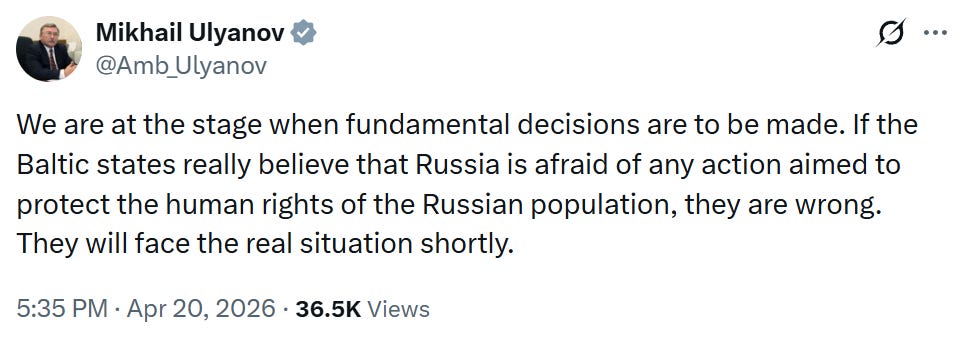
It’s clear from the recent statements we’ve seen out of the Russian MOD, Medvedev, and Security Council via Shoigu, Russian elites are increasingly discussing the possibility of real action against Baltic states. Of course, Putin has the ultimate say and most would agree that it’s unlikely for him to cross the Rubicon in such a way. On the other hand, there are increasing ‘claims’ of Putin’s power slowly diminishing so there’s always the chance the siloviki could press the issue the way the IRGC has been doing in Iran. There’s a reason that Russia has been amassing a massive second ‘rear’ army as we’ve been reporting on here for the past couple years, and now both sides are accelerating preparations for such a monumental confrontation.
Putin once promised that Russia’s political future would be transformed by returning SMO veterans, and latest reports indicate it has been proceeding as planned:
1500 frontline soldiers became “United Russia” deputies in 3 years — Medvedev
▪️Nearly 1,500 veterans of the Special Military Operation have become deputies of “United Russia” and are ready to work at the municipal level, said party chairman D. Medvedev at the “Small Homeland – Strength of Russia” forum.
▪️According to Medvedev, “United Russia” will support deputies who participated in the Special Military Operation. Federal and regional programs, as well as party educational projects, are already in place for veterans.
▪️Medvedev stressed: Russia needs legal protection for municipal employees. Local authorities are closest to the people, and they are approached with any problems, even those not related to their competence.
That means the Russian civil service structure is becoming increasingly staffed with SMO veterans, likely “hardliners” in regard to war against Ukraine and even Europe. As such we can only expect that Russia’s increasingly defiant new attitude toward Europe will grow in the coming years.
There is much talk of Russia’s economy “cracking”, but we’ve seen time and time again that so are the economies of Europe—and in worse ways—so it’s simply a race to the bottom of which Russia is certainly not in the lead. In fact, by the end of this calendar year, if Russia achieves its planned growth of the Unmanned Systems Forces, this drone force alone will have more troops than the entire army structures of most European armies, at 160,000 total.
And Russia has good reason to seek vengeance: a recent “never before seen” video of Palantir’s infamous Project Maven has been released, which shed an interesting light on the West’s involvement in Ukraine.
It appears to show the tracking of Russian assets in Ukraine from the very get-go of 2-24-2022. It confirms that the US and the West have been pouring all their resources, particularly of the AI-variety, into destroying Russia from the opening moments of the Ukrainian conflict. As such, Russia’s weariness of the West’s provocations, seen boiling over now with the latest Baltics-related incidents, becomes clearly justified.
https://simplicius76.substack.com/p/power-again-rebalanced-in-europe