
The Personality Crisis of Western Politics
Remembering the habits of civilization.
This is an essay about what civilisation is and what it isn’t. It should take you about ten minutes to read.
If you came here to see what I have to say about the current world crisis and the war in Iran, I went on about that yesterday, and you can watch me doing so here:
As we begin to realise the poverty of our political economy, we understand that our spiritual, moral, financial and ideological bankruptcy are the product of the way we have been ruled. The question remains – what for?
We are living through the end of this exhausted machine, whose purpose was to replace our civilisation with itself.
Now we must remember what we have almost totally forgotten, that we might restore our way of life and rescue ourselves from barbarism.
What is meant by “civilisation”?
Civilisation can be understood as the institution of balance in human affairs, established by vigor, made permanent by belief and secured by endeavour.
Western civilisation today is submerged beneath two pillars of political unwisdom.
The one presents an image of the masculine defence of the West through the exercise of destructive military power, the other a feminine reception of all influences at home other than those of the home nation.
You can see the one as positive in the sense of an active force, the other as a passive one, but both are equally deadly to what remains of civilised life in the West.
At State level and above, our politics is rather like a broken family. Father and mother are estranged from one another, and the children are bereft.
We, the children of these factions, are speechless in our grief as we lack the terms to describe our parents’ separation.
They were never married in the first place, of course, each seeking liberation from the other in the pursuit of their own supremacy. This is of course how families break down.
There is no sense that can be made to make sense of being together, and so there is no sense in staying together. Each to his or her own, and all for themselves.
As Werner Herzog said, Jede fur sich und Gott gegen Alle. More about him, and what that means later. First, the idea of life as music or cacophony.
Harmony and discord
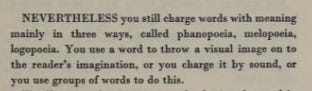
Civilisation is the seeking of harmony in man’s energies, and this harmony is best secured with the recognition of basic difference and its reconciliation.
Our systems are all rights and no duties, of course, and rapacity without restraint has replaced any sense of the mutuality of labour and capital.
There is no dignity in our system, which equalises us all in according to utility.
To become like components in a machine is to lose sight of who and what we essentially are. Meaning becomes a dispute. And so we have discord. We become like notes without a melody, and life a contest of the loudest.
THE COLLAPSING SUPPLY CHAIN OF MEANING
There is always a State Religion, whether it has anything to do with God or not.
Today, the religions of State are exclusively masculine or feminine in principle. The political religions of Judaism, of American Protestantism, of Islamism are largely manly affairs with female helpmeets.
The same is true of the Liberal State Religion but in reverse. A feminised culture deprived of its roots, just as the masculine is in the deracinated male cult of market worship Zionism.
Kenneth Clark described the cults of Islam, Judaism, and “Nothern Protestants” as unbalanced affairs lacking the harmonising female principle, which of course is found in the foundations of European civilisation through the Catholic religion1.
Though he argued it was monasticism and the scholastic, diplomatic and economic power of “Ecclesia” which formed the idea of Europe to itself, he also added that this formula of balance is essential and not optional to what might be called the soul of our civilisation.
Entering the Exit
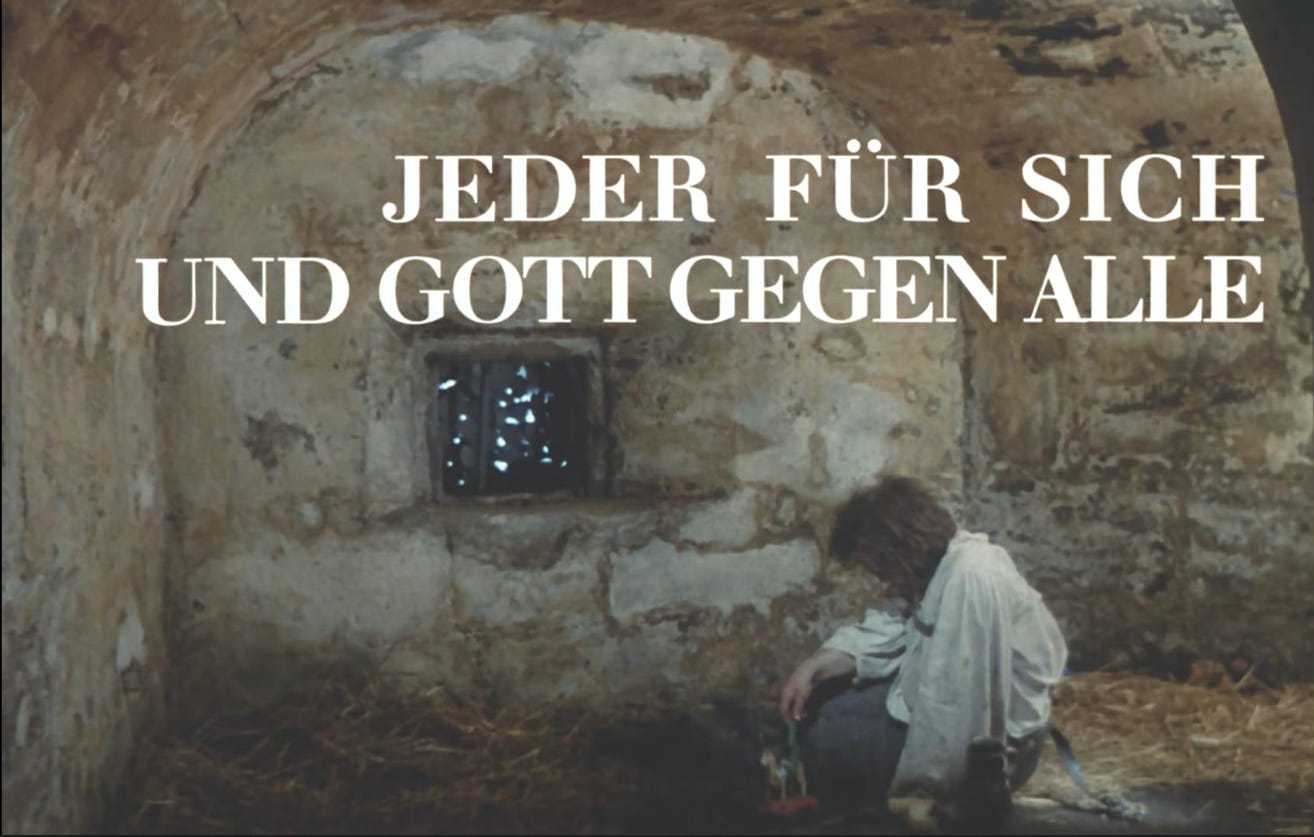
The Enigma of Kaspar Hauser is a remarkable film which gives us the title above, “Each for himself and God against all”2.
This is the point of view of isolated Man.. It is a film about a real man called Kaspar Hauser, who was discovered in 1828. He had spent his entire life in a cellar until he was found in it at the age of 17. Having never been outside, he could not recognise perspective. He could speak, but only one sentence which he obviously did not understand.
He had been a prisoner in a cellar all his life, and when he exited his tiny world he was a prisoner in himself as a result.
Did it free him to learn the ways of other men?
Hauser died in 1833 at the age of 21, having suffered a fatal wound in the second, and this time successful, attempt on his life.
He was suspected to be a fraud, but perhaps it was what he reminded men about themselves that they found unbearable about him. The truth is often unforgivable, especially when it concerns us, and the limits we refuse to acknowledge about ourselves.
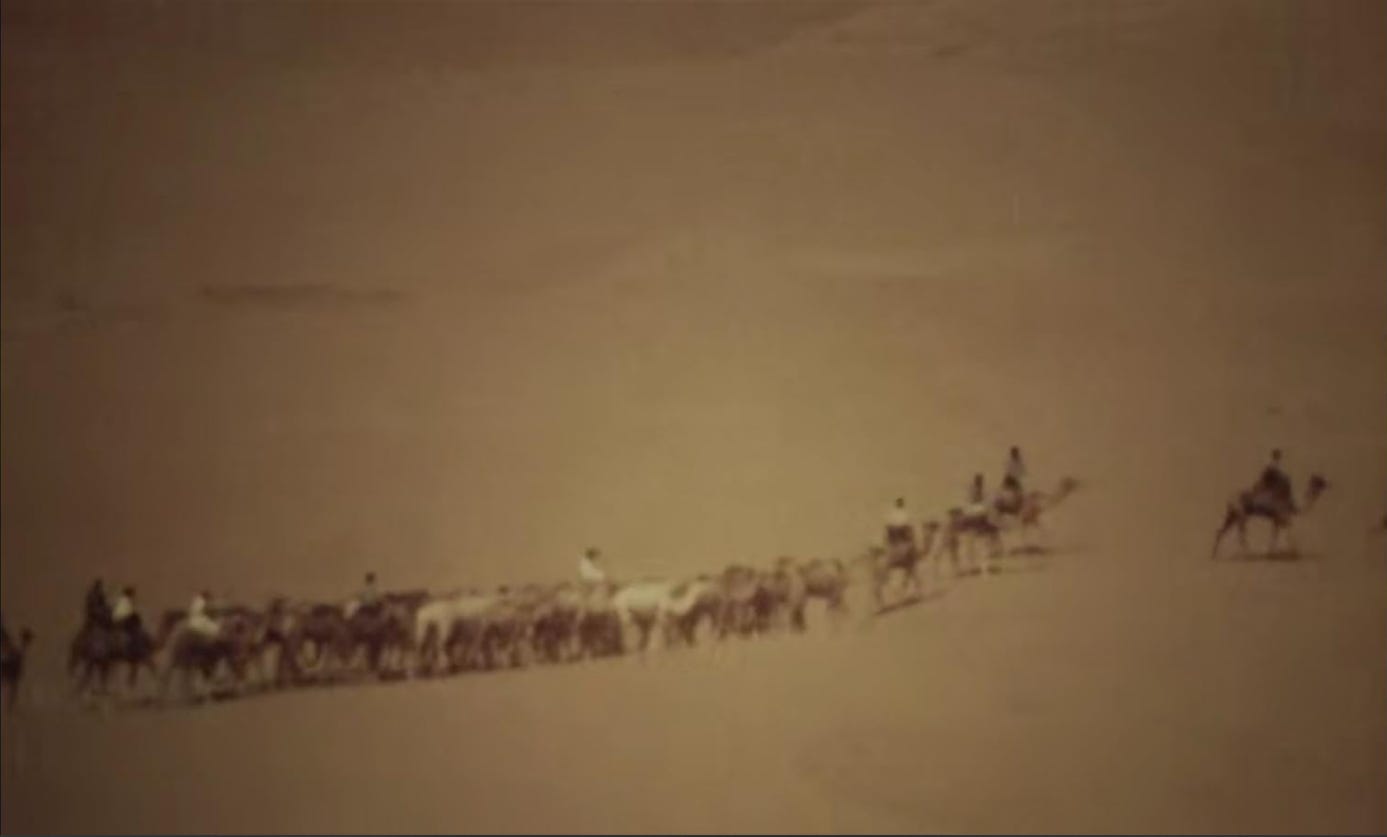
The film begins with a sort of parable. A blind berber is leading a camel train across the desert. He tastes the sand, and tells the company that the mountains they see before them are an illusion.
Liberation as Exile
In the Classical world exile was seen as a worse punishment than death.
Modern Western Man exists in a state of domesticated exile. He is a stranger at home, to the strangers in his homeland, a stranger to himself and to the nature of reality and being.
The technique by which man is managed has liberated him into himself. His world has shrunk to all he can conjure as to what he wants, who he thinks himself to be, and these thoughts are supplied to him in the same way as all the other consumer choices which consume him.
He has been tempted by promises of freedom into this confinement, into a condition of all for one and none for all.
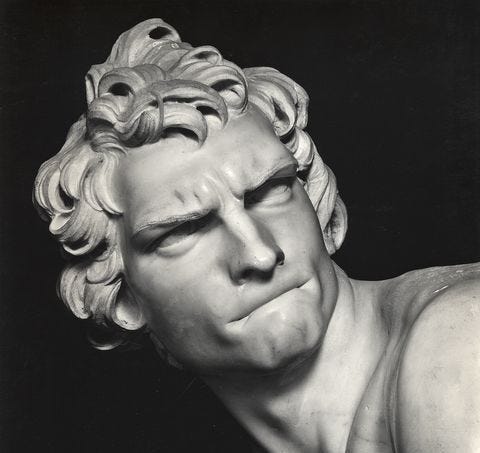
This Modern Man imagines himself the axis of the world and the engine of all its meaning, replacing the omphalos (or navel) believed by the Greeks to be the centre point on earth at which temporal power met the divine3.
It is not into this he gazes to comprehend himself and the purpose of his life, but into his own navel, and now his belly can no longer be filled with what sates his insatiable desires he finds himself incapable of comprehending the true perspectives of reality.
Blinking into the Light
The world which is intruding on the false reality of the media age is one which seems strange and unfamiliar to men shaped in cellars of illusion. This is because we have been schooled to believe that the never-never land we inhabited would go on forever. Well now it isn’t, and all its explanations are expiring in its moment of exhaustion.
The cell we inhabited was not the Dark Age of Christian belief, but the superstitions of a world illuminated by the artificial light of technology which sought to replace it.
The great fatal flaw of the modern mind was to imagine its limits as their absence. The wisest products of this time are incapable of seeing beyond their belief system, as they believe it is perfect, and so have never had any reason to try to do so.
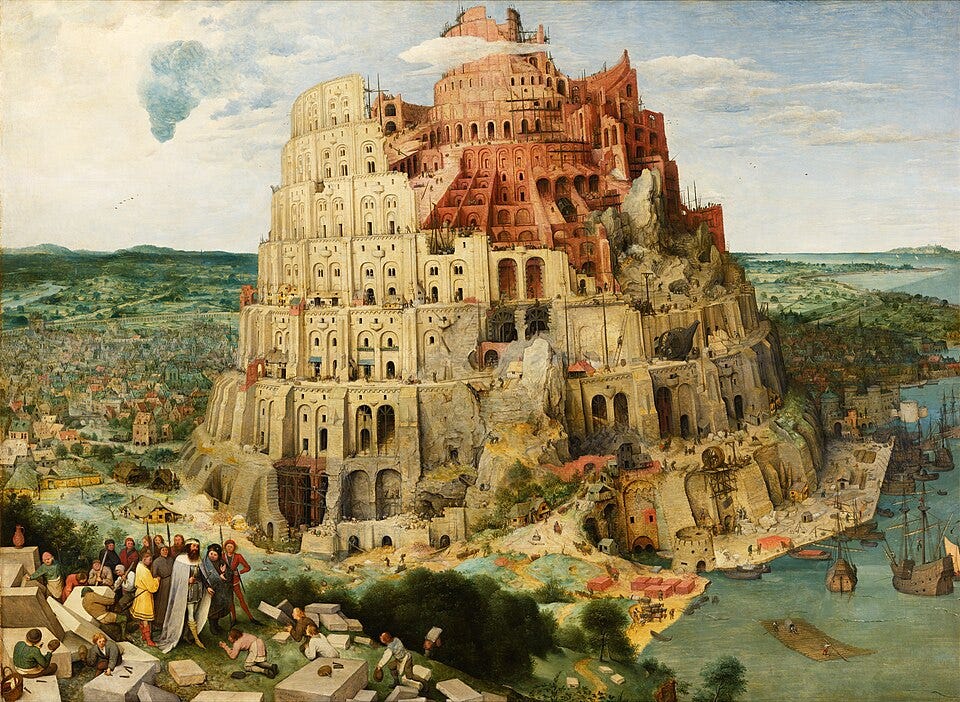
Spellbound by what powerful tricks the machinery of technique permit, dazzled by endless data points, modern man blinks into the light and cannot tell what is near or far, present or past, and the languages he hears around him are merely a disturbing babble. He is lost. He no longer knows what he is, nor what he is for.
The screen cannot compass what he sees about him, and it cannot explain what is stirring within him. Beneath the fear of insufficiency of things and the dissolution of the plastic meanings he has been supplied to rely on, there is the terrible appetite for purpose.
What was the point, he asks himself, and why am I here at all?
It is not God who is against Man, it is Man who made war on all that was, the better to elevate himself4. Today we realise our limits, that we cannot rise beyond them, and that if we mistake them and ourselves for everything we find in time we are terribly mistaken.
The nature of Man, being part of the nature of things, is changeless. His machinations permit distractions, as does the evanescent promise of satisfaction in all things made possible by the supply and demand of desire.
What Will Become of Us?
The civilisational view of mankind can be viewed as the process over time of forgetting and remembering.
We live in a time when we are all beginning to realise that a great subtraction has taken place whilst we were all otherwise entertained. The music has not stopped, however. Soon we will understand that we are not living through the end of everything, but of something which sought to replace it with itself.
We have been formed by the experiment of the long 20th cenutry, a sort of intermission of civilisation. This is not civilisation’s end, but the beginning of the return of reality and its comprehension to the understanding of our lives.
This inspires men to defend themselves from barbarism. It is time to remember who we are, because it is this memory or its absence which will determine what becomes of us. We are not what we have been told we are. The personality crisis of Western politics is terminal, and it sold us a series of masks, or personae, as if we were all characters in some show.
Yet life is not a masquerade, and it will go on though the old performance will not. The questions of who we are and what we are for – and against – will determine whether what comes next is a restoration or a rabble among the ruins.
https://www.frankwrighter.com/p/the-personality-crisis-of-western