
John Russell: From Guadalcanal to Hollywood
The Academy Awards annually remind Americans how far out-of-touch most of Hollywood is with the average American. Older generations know just how deeply Tinseltown has sunk. The overabundance of unmanly male actors, writers, and directors pushing cultural Marxist agendas is a recent development.
There was a time when a far greater proportion of male actors exuded a natural masculinity because they had lived real lives before Hollywood and were, simply, men. One of those was John Russell, known as Jack to his friends. He had a 40-year career in Hollywood, appearing in 50 movies and more than 200 television episodes. Before that, he was Lt. Russell, a Marine in the Battle of Guadalcanal.
I got to know Lt. Russell during the 1970s. An older friend of mine hosted occasional gatherings at his home in the Pacific Palisades, and Russell was a regular guest. I had watched him star in movies and in two TV series: Soldiers of Fortune and Lawman. He was an impressive figure, whether on the big or small screen. He stood 6’3 ½” with a square jaw, chiseled features, and a lean, athletic body. Impressive on the screen, he was even more impressive in person.
John Lawrence Russell was born in 1921 in Los Angeles to John Henry and Amy Russell. His father was a graduate of the U.S. Naval Academy at Annapolis, who survived the sinking of the cruiser San Diego during World War I and later became a highly successful insurance executive.
Son John was the firstborn, and he was joined by a sister, Marcia, and a brother, Newton. By then, the family owned a large home and employed a cook and a servant. John had an ideal childhood, doing well in school and excelling in sports. He grew into a strapping young man and, after graduating from high school, attended UCLA for theater arts and sports. He was interested in acting and was an outstanding athlete.
During Russell’s third year at UCLA, the Japanese launched their sneak attack on Pearl Harbor on Dec. 7, 1941. He completed the fall semester at the end of January 1942, and then dropped out of school and joined the Marine Corps in February. He excelled in boot camp and was selected for Officer Candidates School (OCS). After graduating from OCS, he was commissioned as a second lieutenant in October 1942.
Lt. Russell was assigned to the 6th Marine Regiment, 2nd Division, which departed for Guadalcanal in mid-October. The Marines had been on Guadalcanal since Aug. 7, when the men of the 1st Division waded ashore. Their landing took the Japanese by surprise, but within days the fighting became brutal and frequent.
Again and again, the Japanese poured thousands of fresh soldiers onto the island until they had 36,000 crack troops in the fight. At the same time, the U.S. Navy and the Imperial Japanese Navy were slugging it out in the surrounding waters, resulting in dozens of ships going under and thousands of sailors dying. Among the sailors who died were the legendary Sullivan brothers. On land and sea, the Battle of Guadalcanal was a bloodbath.
After a brief stop in New Zealand, Lt. Russell and the 6th Marines landed on Guadalcanal and joined the battle in early January 1943. The Japanese forces had been depleted by thousands of men, but those remaining were still fighting fanatically. The 6th Marines were first tasked with cleaning the Japanese out of a series of jungle-clad ravines on the northern coast of Guadalcanal, west of the Matanikau River.
Previous efforts to dislodge the Japanese from these strongholds met with fierce resistance. The 6th Marines devised a new tactical plan. Instead of attacking from the coast and working their way up the ravines, they decided to arduously climb up ridges and attack from the high ground, fighting their way down the ravines to the sea.
This was Lt. Russell’s first taste of combat, and he quickly learned the Japanese would not surrender. The only way to defeat them was to kill them. He also learned there was no surrender for Marines. The Japanese subjected captured Marines to unspeakable tortures before killing them.
The fighting was close-quarter, occasionally hand-to-hand. It was vicious, bloody, exhausting. By Jan. 17, the 6th Marines reached the beach at the mouths of the ravines, decimating the vaunted Japanese Sendai Division. The Marines left 643 Japanese corpses in their wake, taking only two captives.
The next mission for Lt. Russell and the 6th Marines was an advance along the coast to Cape Esperance, which the Japanese were using as an evacuation site. Resistance was fierce, but day by day the Marines advanced towards their objective. By Feb. 8, Army units from further inland, and the 6th Marines along the coast, reached Cape Esperance, but not before nearly 2,000 Japanese were evacuated by destroyers.
This was the end of the Battle of Guadalcanal. Behind them, the Japanese left more than 19,000 dead, disease taking perhaps half of them. Another 12,000 Japanese died in naval battles offshore, with Japan losing one carrier, two battleships, four cruisers, 11 destroyers, six submarines, and 13 transports. Japan also lost 680 airplanes. The Guadalcanal campaign was a disaster for the Japanese. Major General Kiyotake Kawaguchi, evacuated from Guadalcanal and lying on a cot suffering from malaria, remarked to a Japanese war correspondent, “We lost the battle. And Japan lost the war.”
After Guadalcanal, Japan was on the defensive. However, the cost of the U.S. victory was dear: Five thousand American sailors were killed, and another 3,000 were wounded. The U.S. Navy lost two carriers, eight cruisers, and 15 destroyers. The U.S. also lost 615 airplanes. The Marines lost 1,200 men, and the Army another 600. Five thousand Marines and soldiers were wounded. But that wasn’t the whole story. Malaria took 6,000 Marines and 2,000 soldiers out of combat. Some died, and nearly all suffered recurrent bouts of the disease.
By the time the 6th Marines left Guadalcanal at the end of February 1943, Lt. John Russell was one of those suffering terribly from malaria. Along with many other Marines who had severe cases, he was shipped to Balboa Naval Hospital in San Diego. After fighting the disease for months, he returned to limited duty. His war was over. In June 1944, he was discharged.
Back home in Los Angeles, John Russell was dining at a popular restaurant in Beverly Hills when a talent scout spotted the handsome and rugged veteran. After a screen test, Russell signed a contract with Universal Studios. He appeared in three movies in 1945 and another three in 1946. His roles were minor; all but one were uncredited. As he took on more substantial roles in 1947 and 1948, critics and movie fans began to notice him.
Russell had his big break in 1949. He had strong supporting roles in three of his four films, making him a recognizable Hollywood actor with a growing fan base. In 13 movies from 1950 through 1955, he either co-starred or had strong supporting roles. Most of the time, he was cast in good-guy roles, but he occasionally played villainous characters.
In 1955, Russell did his first work in TV and even got his own series, Soldiers of Fortune. He played Tim Kelly, a war veteran and mercenary. Every week, he and his sidekick Toubo Smith, played by Chick Chandler, were off for a new adventure in Africa, Tibet, India, Brazil, or some such exotic location. Chandler had dropped out of a military school at 16 and sailed the world on a tramp steamer before becoming an actor. He was a natural for the role. The series used stock footage, which helped transport viewers to far-off lands during its 52 episodes.
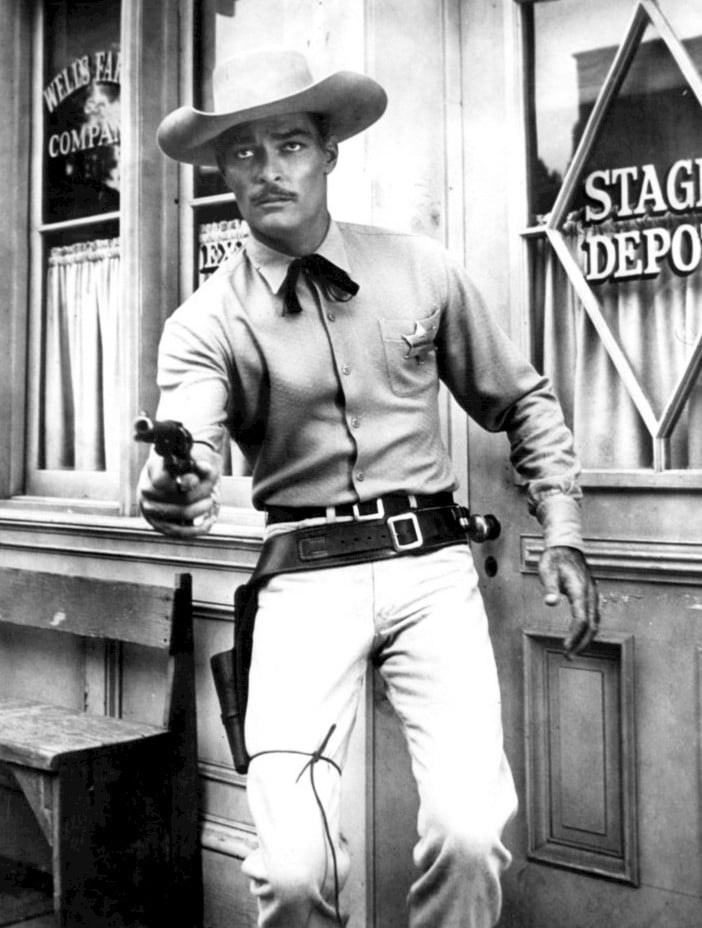
In many ways, Soldiers of Fortune set the stage for John Russell’s more successful second television series, Lawman, a Western that ran for 156 episodes from 1958 through 1962. Russell’s Tim Kelly became Marshal Dan Troop of Laramie, Wyoming. Troop had the same commanding presence, sense of honor and duty, and courage as Tim Kelly. Russell’s new sidekick was a young and impulsive deputy, Johnny McKay, played by Peter Brown.
Brown was also a veteran, but of the Army, and stationed in Alaska during peacetime. He had gotten into acting by organizing a theater group on base to fight boredom. Brown was six feet tall but seemed small next to Russell. About Russell, Brown said in a 1960 interview, “I learned more from him than any actor I’ve ever worked with.” Thirty years later, when asked what three things he liked most about Lawman, Brown said, “John Russell. John Russell. John Russell.”
Russell’s two TV series didn’t stop him from appearing in movies, mostly Westerns. He played typical Old West characters: lawmen, outlaws, and gamblers. However, in one of them, Yellowstone Kelly, starring Clint Walker, Russell played Gall, a Sioux Indian chief.
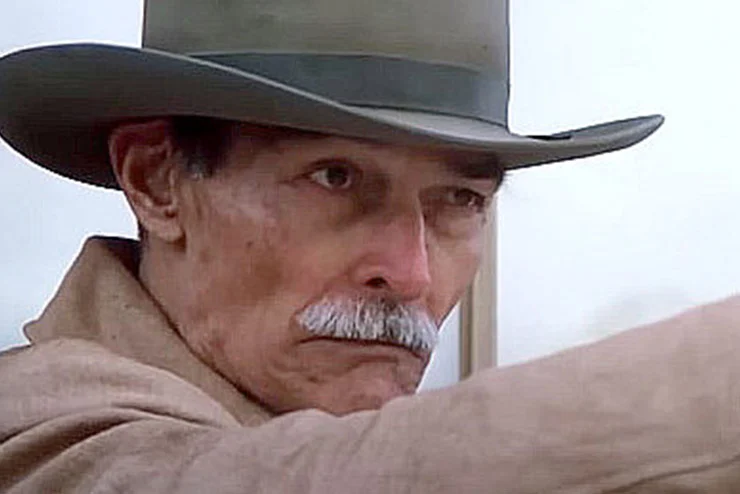
Russell continued appearing in movies and in various television shows throughout the ’60s, ’70s, and ’80s. He appeared with John Wayne in Rio Bravo and with Clint Eastwood in The Outlaw Josey Wales, Honkytonk Man, and Pale Rider. The role of Marshal Stockburn in Pale Rider was Russell at his intimidating and villainous best. He was a lawman, but one whose services were for sale. He and his deputies were enforcers for a mining company intent on running prospectors off their claims. As a mysterious and somewhat otherworldly figure, Eastwood came to the rescue of the prospectors and confronted Russell.
Emphysema ended John Russell’s acting career in the late ’80s. For most of his adult life, he smoked, and he paid a terrible price for it. He had just turned 70 when he died in 1991, leaving behind two grown daughters from his marriage to Renata Titus. He was given a military burial at the Sawtelle Veterans Cemetery in West Los Angeles.
In keeping with Russell’s wishes, there’s nothing on his tombstone about his Hollywood stardom. Engraved on his tombstone is only the Christian cross, the dates of his birth and death, the phrase “Precious Liberty,” and “John L. Russell, 2nd Lieutenant, U.S. Marine Corps, World War II.”
https://chroniclesmagazine.org/columns/sins-of-omission/john-russell-from-guadalcanal-to-hollywood