
AIPAC’s Texas Trouble: How Brandon Herrera Broke the Third Rail of GOP Politics
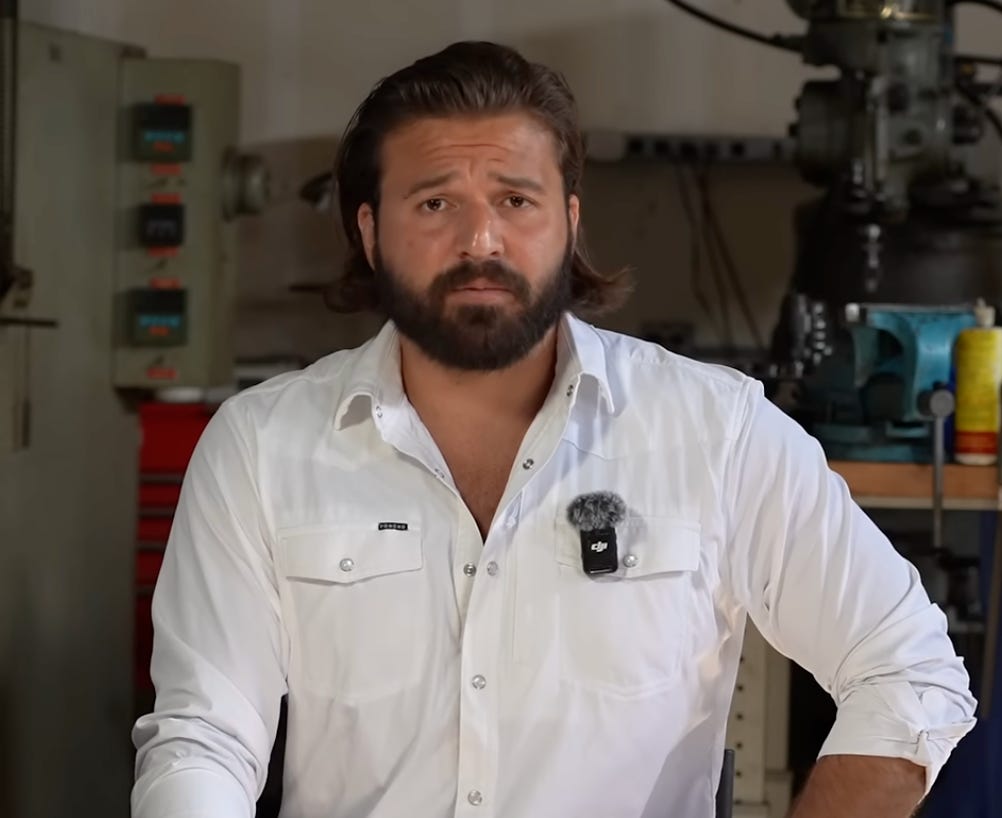
By targeting foreign aid and “Israel First” spending, a firearms YouTuber has successfully challenged the most powerful lobby in Washington.
When Brandon Herrera came within 354 votes of toppling a sitting congressman in the May 2024 Republican runoff, the pro-Israel establishment dismissed it as a fluke. When he came back in March 2026, finished within one point of the incumbent in the primary, and watched a sex scandal force Rep. Tony Gonzales (R-TX) out of the race entirely, it became impossible to ignore.
The “AK Guy” is now the presumptive Republican nominee in Texas’s 23rd Congressional District, and his ascent represents something far more significant than one YouTuber’s political ambitions. Herrera’s rise reflects a growing anti-Zionist current within the Republican Party that threatens to shatter decades of bipartisan consensus on Israel.
Who Is Brandon Herrera?
Brandon Herrera built his public profile as a firearms manufacturer and YouTuber known as “The AK Guy.” His YouTube channel, focused on firearms reviews, history, and gun-rights advocacy, has accumulated more than 4 million subscribers. He owns a small firearms manufacturing company in San Antonio and is running in Texas’s 23rd Congressional District, a sprawling border seat covering 27 counties from San Antonio to El Paso. After Gonzales dropped his reelection bid on March 5, 2026 — two days after the primary, under pressure from House Republican leadership — Herrera became the de facto Republican nominee.
What makes Herrera significant is not his celebrity but his willingness to attack the American Israel Public Affairs Committee (AIPAC) directly — something almost no Republican has dared to do in a generation.
On ending foreign aid including to Israel, Herrera declared: “We can’t claim to be ‘America First’ while pushing spending bills like the most recent foreign aid package that gave almost $100 billion to every country except the US.” He stated: “I would absolutely vote AGAINST the new proposed spending package for $95+ billion for foreign conflicts, while spending $0 on our southern border. Any Republican who claims to be America first CANNOT vote for America last legislation.”
On AIPAC, Herrera has drawn a distinction between opposition to the lobby and opposition to Israel. “I’m not anti-Israel, I’m anti-Israel buying US elections,” he wrote in a 2024 post. After AIPAC’s United Democracy Project spent $1 million against him in the 2024 runoff, Herrera said: “I despise AIPAC… They spent over $1 million to slander me and cost my race… As much as I despise their ‘Israel first’ bullshit: 1. It’s far from a top issue for me. 2. The majority of Congress on both sides have ties to them.” He has called AIPAC “an enemy of US Elections” and accused the group of forcing lawmakers to sponsor legislation.
At an October 2025 meeting with supporters in Brewster County, Herrera laid out what he called a “nuanced take”: the U.S. is too deep in debt to be paying for “all of Israel’s stuff all the time,” and “I don’t want to see a single cent of taxpayer money go outside the United States until we have paid our debts down.”
His platform pledges to oppose endless wars, bring troops home from Syria and Iraq, oppose continued Ukraine funding, and end all foreign aid until the national debt is addressed. He would treat AIPAC as an adversary in U.S. elections and vote against foreign aid supplementals. He would, however, allow commercial arms sales to Israel — drawing a distinction between taxpayer-funded grants and normal commercial transactions.
The Pro-Israel Counterattack
Multiple pro-Israel organizations and politicians have targeted Herrera aggressively in both 2024 and 2026.
AIPAC’s United Democracy Project spent roughly $1 million in a two-week ad blitz in May 2024 accusing Herrera of “glorifying Nazis and mocking the Holocaust.” UDP spokesperson Patrick Dorton stated, “This is a race between an incumbent with a strong record on Israel and Brandon Herrera, who has clearly out-of-the-mainstream views on the U.S.-Israel relationship.” AIPAC itself congratulated Gonzales on his 2024 runoff win on X/Twitter. In 2026, AIPAC has not endorsed in the Texas 23rd race but said only that it would “continue to assess where candidates… stand on issues that affect the U.S.-Israel partnership,” per Politico.
The Republican Jewish Coalition launched a $400,000 ad campaign against Herrera in the May 2024 runoff, calling him a “goose-stepping extremist who pals around with online Nazis.” After the 2024 loss, RJC chairman Norm Coleman and CEO Matt Brooks said Republican voters had “rejected goose-stepping extremist Brandon Herrera.” In March 2026, RJC spokesperson Sam Markstein stated, “The RJC has a longstanding policy of speaking out against those who traffic in Nazi ideology, and this is another case. The RJC opposed Mr. Herrera in 2024, and he will not get our support now.”
Jewish Insider has run a sustained series of investigative pieces casting him as “an anti-Israel Republican with an antisemitic history,” including the March 2026 story revisiting his podcast comments about owning a copy of Mein Kampf. Tony Gonzales personally called Herrera a “known neo-Nazi” during the 2024 race. House Majority PAC spokesperson Katarina Flicker stated, “Brandon Herrera’s nomination is a gift to Democrats… Herrera is an antisemitic YouTuber.”
Notably, in 2026 both AIPAC and RJC are sitting the general election out. They refuse to back Herrera, but neither will endorse the Democrat.
Tony Gonzales and the Israel Lobby
To understand what Herrera is running against, one must examine his opponent’s record.
Gonzales developed deep, documented ties to AIPAC and the broader pro-Israel ecosystem during his time in office. AIPAC was the number three single largest contributor to Gonzales’s 2024 campaign, providing $299,102 in total per OpenSecrets. The Texas Tribune confirmed that his 2024 runoff campaign war chest of over $4.5 million was “backed by several business interests active in West Texas and the American Israel Public Affairs Committee.” AIPAC itself confirmed it was “deeply engaged” in supporting Gonzales throughout his races.
Gonzales was a co-leader of the Latino-Jewish Caucus and joined an AIPAC-affiliated congressional delegation to Israel in February 2022, where he met with then-Foreign Minister Yair Lapid. Gonzales was selected as a National Security Fellow at the Foundation for Defense of Democracies in 2018, a hawkish, pro-Israel national security think tank. His public stance was unambiguous. “I stand with Israel — no ifs, ands, or buts. Thank you @AIPAC for meeting with me this morning,” he tweeted on March 12, 2024.
His voting record matched his rhetoric. In April 2024, Gonzales voted yes on H.R. 8034, the Israel Security Supplemental Appropriations Act providing approximately $26 billion in Israel aid, which passed 366 to 58. In May 2024, he voted yes on H.R. 6090, the Antisemitism Awareness Act, which passed 320 to 91. He voted to support the Anti-BDS Labeling Act, posting publicly that he “proudly voted to defend Israel and condemn all forms of antisemitism.” AIPAC consistently described him as a “pro-Israel stalwart” and emphasized his support for Israel’s defense.
Electoral Results
The trajectory of Herrera’s campaigns tells the story of a movement gaining strength.
In the March 5, 2024 Republican primary, Gonzales won approximately 45 percent of the vote while Herrera took about 25 percent. Neither candidate reached 50 percent, forcing a runoff. The May 28, 2024 runoff was extraordinarily close. Gonzales won 15,023 votes at 50.6 percent. Herrera took 14,669 votes at 49.4 percent. Gonzales won by just 354 votes out of 29,692 cast. Herrera could have requested a recount but conceded.
In the March 3, 2026 primary, Herrera came in first place for the first time. He took 43.33 percent while Gonzales received approximately 41.73 percent. Neither hit 50 percent, sending the race to a May 26 runoff.
Two days after the primary, amid an unfolding scandal involving allegations of an affair with a former staffer who later died by suicide, Gonzales suspended his reelection campaign, making Herrera the presumptive Republican nominee for the November general election. Herrera will face Democrat Katy Padilla Stout in the November general election in a district Trump carried by approximately 15 points in 2024.
The Broader Trend
Herrera’s rise is not an isolated phenomenon. The polling data reveals a generational fracture within the Republican Party on Israel that mirrors what has already happened among Democrats.
According to Pew Research Center surveys conducted March 23-29, 2026, 60 percent of all U.S. adults now have an unfavorable view of Israel, up from 53 percent in 2025. Among Republicans overall, 41 percent have an unfavorable view. But among Republicans ages 18 to 49, that figure is 57 percent unfavorable, up from 50 percent in 2025. Among Republicans 50 and older, roughly three in four still view Israel favorably.
On Prime Minister Benjamin Netanyahu’s performance specifically, just 30 percent of Republicans aged 18 to 49 have some or a lot of confidence in Netanyahu “to do the right thing regarding world affairs,” while 58 percent said they have “not too much” or none at all. Republicans over 50 have confidence in Netanyahu at a rate of 58 percent — nearly twice the rate of younger Republicans.
A November 2025 Big Data Poll found only 29.1 percent of U.S. voters side with Israel overall, a decline from the 54 percent sympathy peak measured after October 7, 2023. Among young Republicans ages 18 to 29, the same poll found 33.4 percent prefer Palestine versus 27.9 percent supporting Israel — a historic reversal. And 52.9 percent of America First Republicans aged 18 to 29 now describe Israel’s Gaza operations as “genocide,” while only 29.2 percent reject the characterization.
A December 2025 IMEU/YouGov poll of 1,287 Republican voters found that 51 percent of Republicans under 45 said they would prefer to support candidates who would reduce U.S. aid to Israel. 53 percent said the U.S. should not renew the annual aid commitment to Israel. 52 percent of Republicans overall and 59 percent of Republicans under 45 would prefer a primary nominee who prioritizes lower prices for Americans over funding Israel. Just 23 percent of Republicans under 45 and 31 percent of Republicans overall prefer a nominee who supports unconditional funding for Israel.
Perhaps most significantly, 48 percent of Republicans agreed that “legitimate criticism of Israel that should be protected under free speech is too often accused of being antisemitic,” while only 23 percent disagreed.
The Thomas Massie Model
Brandon Herrera is not the first Republican to challenge AIPAC and survive. Rep. Thomas Massie (R-KY) has been the lonely voice in the Republican caucus questioning unconditional support for Israel, and AIPAC spent heavily to defeat him in his 2024 primary. Massie won anyway.
If Herrera wins in November, he will join Massie in what could become a small but vocal caucus of Republicans willing to break the taboo on criticizing Israel and its lobby. The generational data makes clear that Herrera is not an aberration but an early indicator. The Republican Party’s younger voters are breaking away from the unconditional Israel support that defined their parents’ conservatism. If current trends continue, candidates who run against AIPAC rather than with it may find themselves with an electoral advantage rather than a liability.
Brandon Herrera’s journey from YouTuber to congressional nominee began with a willingness to say what other Republicans would not. Whether he wins in November or not, the movement he represents is not going away. If anything, it will continue to grow as more and more people wake up to the harsh realities of Israeli and broader Jewish criminality on the world stage.
https://www.josealnino.org/p/aipacs-texas-trouble-how-brandon