
The Proposed Trans-Caspian Pipeline is Shaping Up to Be a Flashpoint
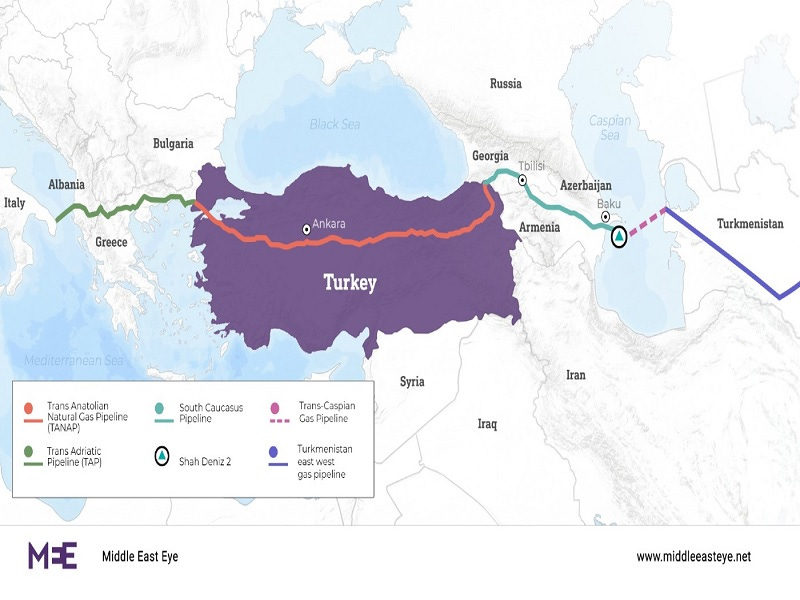
The strategic stakes are simply too high as NATO encroaches on Russia’s entire southern periphery via TRIPP and Turkiye just revived talk of the Trans-Caspian Pipeline that’s anathema to Russia’s interests.
The Turkish Energy Minister revived talk of the long-discussed Trans-Caspian Pipeline in early April in a live interview with local media where he spoke about his country’s regional pipeline plans, which the Middle East Eye drew attention to here. Their report about this followed New Rules Geopolitics, the X account of the podcast by Sputnik’s Dimitri Simes Jr., presenting his proposals as their own. In any case, these reports drew attention to the Trans-Caspian Pipeline, which is anathema to Russia’s interests.
It was warned here in early August after the announcement of the “Trump Route for International Peace and Prosperity” (TRIPP) that this US-controlled corridor across southern Armenia might embolden Azerbaijan and Armenia to defy Russia and Iran by building this pipeline. Last month, it was also assessed that “Israel’s Strikes Against Iran’s Caspian Fleet Might Be Driven By Post-War Energy Geopolitics”, namely neutralizing Iran’s ability to impede this project that could later supply Israel among others.
About that, Israel already receives around 40% of its oil from Azerbaijan through a pipeline that transits Georgia and Turkiye, so gas exports along this route or TRIPP (which is shorter) are possible. Even though this would increase Israel’s strategic dependence on Turkiye, whose Foreign Minister recently warned that Israel might recast his country as its new regional adversary after Iran amidst their escalating rivalry, it’s difficult to imagine either party passing up this opportunity to advance their respective interests.
As for the US’ interests, the expansion of Western influence across the South Caucasus, Caspian Sea, and Central Asia via TRIPP would come at Russia’s expense since this area encompasses its entire southern periphery, with political and military influence following economic influence. After all, Russia is expected to oppose the Trans-Caspian Pipeline since it‘ll lead to Turkmenistan’s currently Chinese-centric gas exports challenging its own on the global market, ergo the need for NATO member Turkiye to deter it.
To that end, TRIPP is expected to serve the dual purpose of a military logistics corridor, and the US’ planned dispatch of an undisclosed number of patrol boats to Azerbaijan that was announced during Vance’s visit in February represents the implementation of this strategy. Even though Turkmenistan is a constitutionally neutral country, it too is expected to expand its “quiet U.S. military ties” as is Kazakhstan, which dramatically announced its plans last December to produce NATO-standard shells.
The Russian government is aware of TRIPP’s abovementioned military purpose as suggested by Deputy Foreign Minister Alexei Overchuk condemning this project that’s hitherto been conspicuously ignored by his country’s expert community. Putin also very strongly implied that the moment of truth in Russian-Armenian relations is arriving during his latest meeting with Prime Minister Nikol Pashinyan. The Turkish Energy Minister’s Trans-Caspian Pipeline plans are therefore expected to meet fierce Russian resistance.
It’s unclear what form this will take, and no one can say for sure whether Russia would launch another special operation to stop this project, but that scenario can’t be ruled out either. The strategic stakes are simply too high as NATO encroaches on Russia’s entire southern periphery via TRIPP and Turkiye just revived talk of the Trans-Caspian Pipeline. Russia is therefore either forced to accept these plans with all that entails for its security or somehow stop them since the West won’t voluntarily abandon them.
https://korybko.substack.com/p/the-proposed-trans-caspian-pipeline