
Why Banksy Gets Away With It
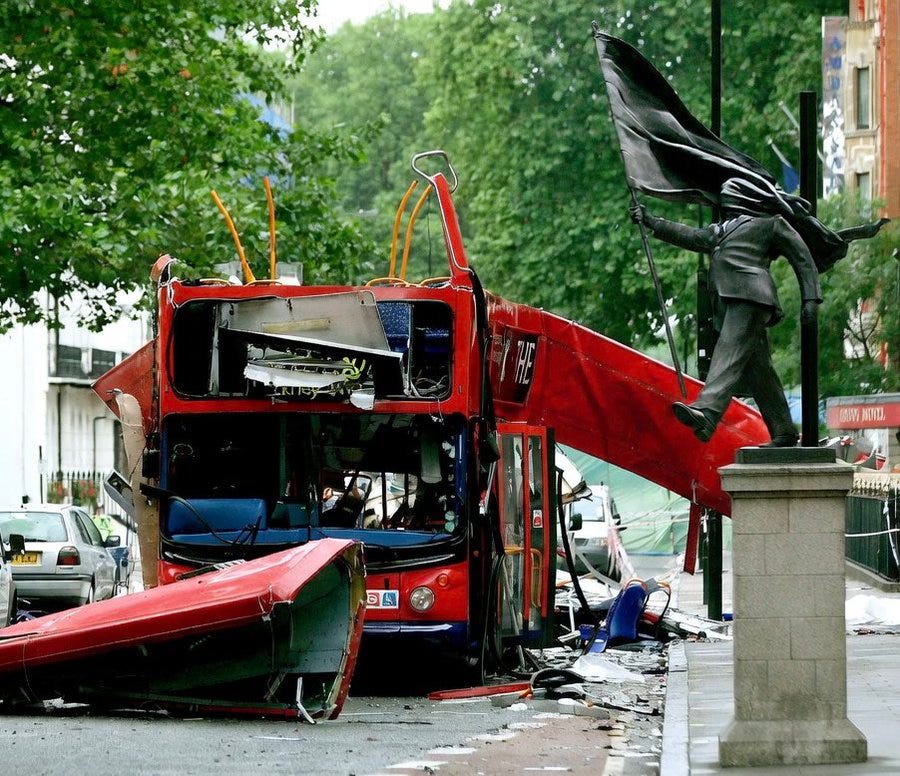
In the shadow of London’s imperial monuments in Waterloo Place, a suited figure strides off the edge of a plinth, a flag whipping across his face and blinding him completely. This sculpture appeared overnight and was obviously executed with the precision of a professional crew and heavy machinery. That is to say it was hardly the furtive spray of a lone vandal.
Banksy soon claimed it.
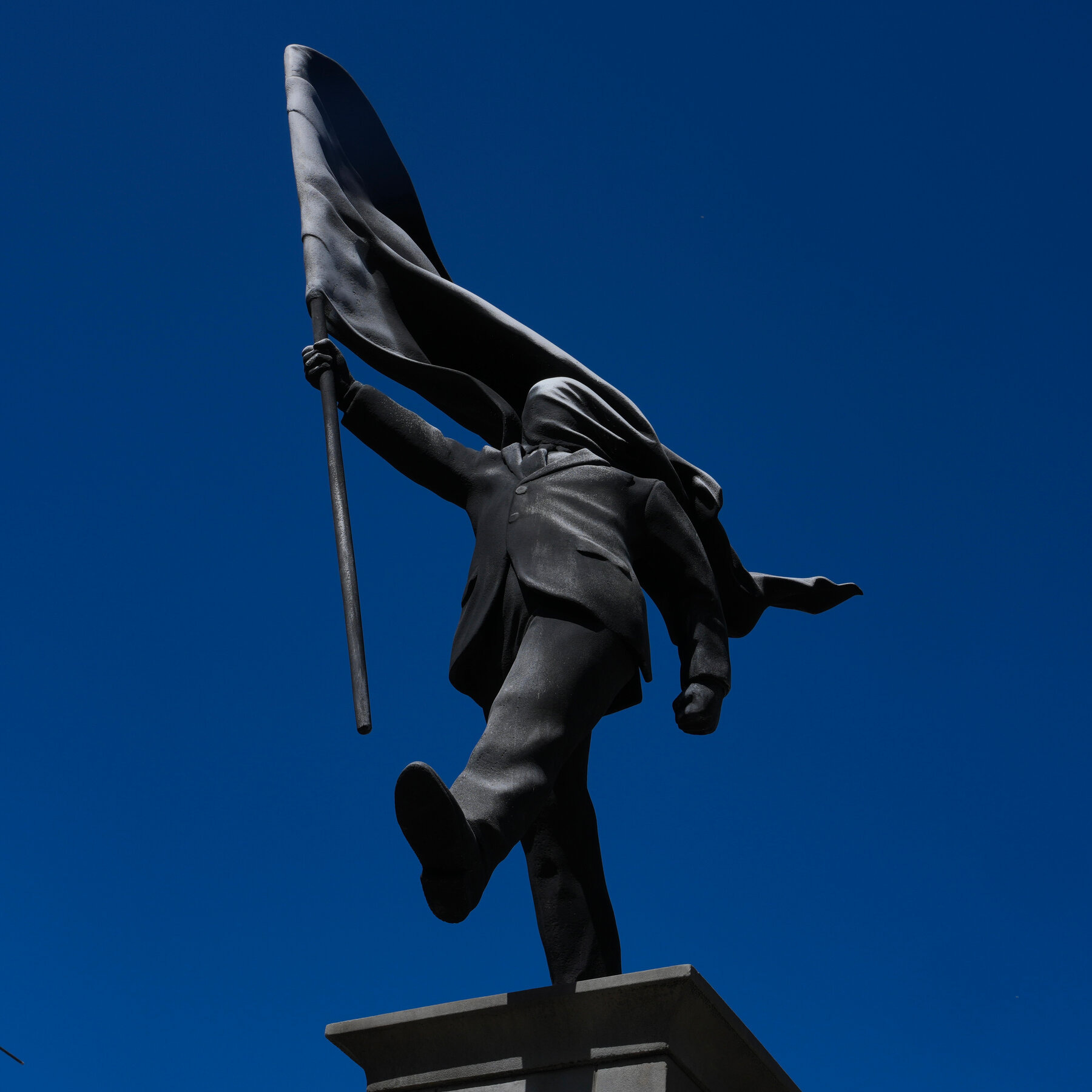
It is quite overt what Banksy is trying to say, the message is recognised immediately: a satire on blind patriotism, nationalism as self-inflicted ignorance. Westminster Council responded to this act of vandalism not by removing it. It erected safety barriers, called the piece a “striking addition” to the streetscape, and left it standing amid the Victorian statues of kings, nurses, and Crimean heroes.1
So, is Banksy really an outsider artist challenging power, or is he just the aesthetic wing of the system he purports to oppose? The question grows more urgent with every new piece. The “Blind Patriotism” statue is only the latest exhibit in this long-running show, visually arresting, politically on-message, and perfectly reinforcing the contemporary consensus that inherited national attachment is the real danger.
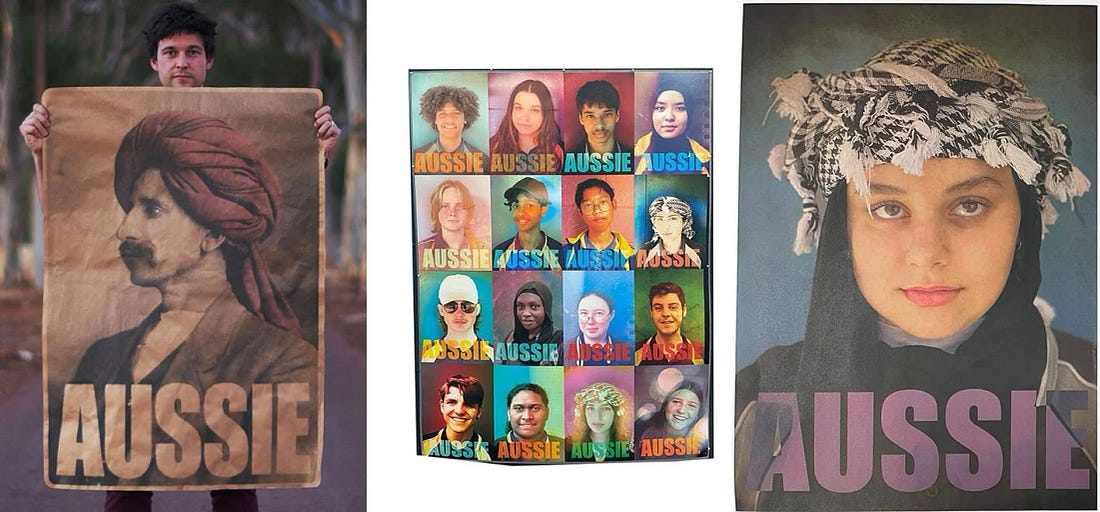
Half a world away, in the streets of Adelaide and beyond, another street artist has spent a decade executing a parallel project of aestheticised deconstruction. Peter Drew launched his Aussie poster series in 2016, pasting thousands of screen-printed archival photographs across Australian cities.2 Drew puts up black-and-white or sepia images of early 20th-century migrants and residents, Afghan cameleers in turbans, Chinese market gardeners, Sikh hawkers, Japanese pearl divers, each emblazoned beneath with the single, commanding word “AUSSIE” in bold block letters. Drew presents the campaign as a challenge to exclusionary notions of Australian identity. He has described it explicitly as an intervention into the national conversation: “Did Australia inherit its identity from the people who created the White Australia policy? Or does ‘Aussie’ have more to do with the people who survived it?” In 2025 he relaunched and expanded the series, declaring it a renewed effort “to fix racism,” adding fresh portraits and recommitting to paste-ups despite occasional vandalism.3
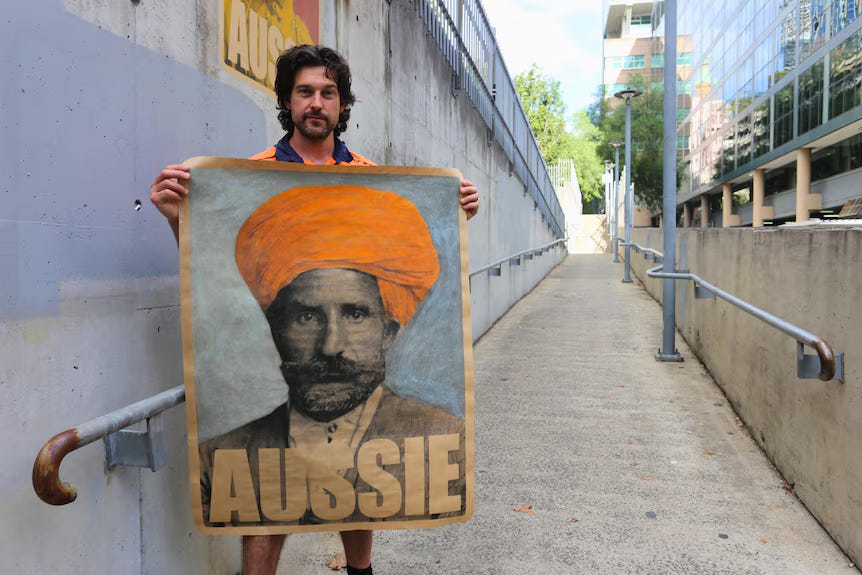
The response to Drew’s art from institutions has been very revealing. Drew does not get prosecuted for defacing public property, Instead his work has been lionised by mainstream media, acquired by galleries, profiled on national broadcasters, and celebrated by councils. Public broadcasters run sympathetic documentaries, schools incorporate the posters into curricula and cultural bureaucrats cite them as exemplary community art. Over ten years, more than 1,500 posters have appeared nationwide, often with community assistance in their distribution.
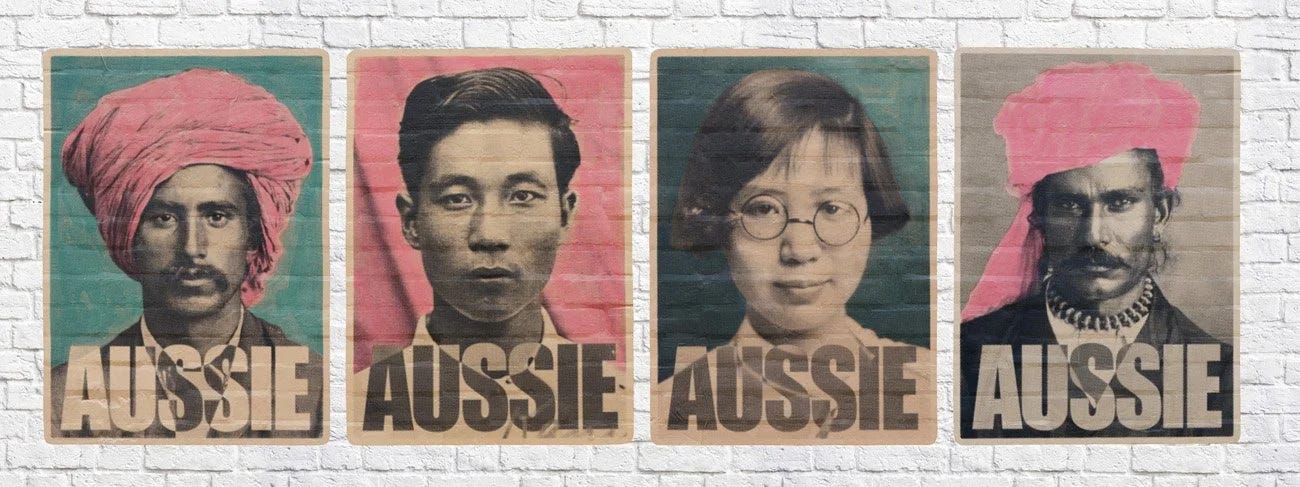
Technically, his work is illegal street art, but instead of being seen as an ordinary vandal who would be fined or arrested, he is actively institutionalised because it reinforces the dominant multicultural narrative. Drew is not punished because his message does not threaten power; it serves power. It flatters the post-1970s settlement that Australian identity must be decoupled from its historic Anglo-Celtic core and reframed as an open, values-based invitation available to anyone who arrives and declares belonging.
At the philosophical core of Drew’s project is a claim that deserves very serious scrutiny. Australian identity, he insists, is not racial, not ethnic, not historical in any inherited sense, and certainly not tied to the majority population that built the modern nation under the White Australia Policy. It is fluid, universal, and reducible to a feeling of belonging or a commitment to shared (and conveniently undefined) values. “Aussie,” in this telling, functions as a generous label rather than a bounded inheritance.
What happens when a national identity is made so open-ended that it becomes indistinguishable from a passport, a sentiment, or a name tag? If “Aussie” can mean exactly the same thing to a 19th-century Afghan cameleer, a recent arrival from sub-Saharan Africa, and a descendant of the First Fleet, then the term has been gouged of substantive content. A nation that stands for everything in precisely the same way stands for nothing in particular.
Both Banksy and Drew operate within the same cultural logic, one that has come to dominate Western artistic and intellectual life. Patriotism is to these people, is blindness or delusion, the flag that smothers vision and leads the marcher off the precipice. Inherited identity is as hateful at best, evil at worst.
Banksy’s suited everyman warns against attachment to country, identity and flag. Drew’s posters erode the idea that Australia belongs in any privileged sense to those whose ancestors cleared the land, fought its wars, built its institutions, and passed down its particular culture. In each case, the artwork performs what might be called aestheticised deconstruction: it might appear transgressive, yet ultimately ratifies the prevailing elite consensus that the old solidarities, rootedness, continuity, particularity are the true obstacles to social harmony.
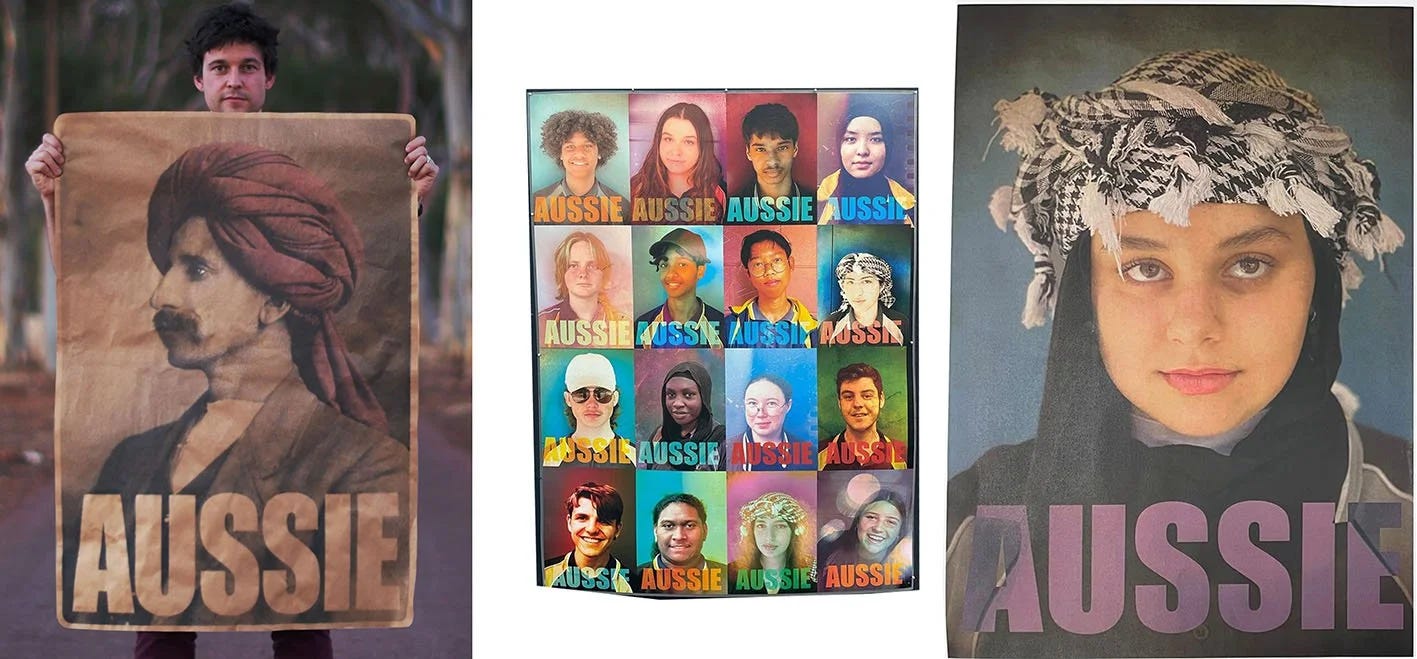
This occurs at a moment when the costs of that consensus are becoming impossible to ignore. Mass non-European immigration on a historic scale, combined with social fragmentation, collapsing interpersonal trust, rising crime in certain urban pockets, and weakening civic cohesion, has left many societies more brittle than at any time since the mid-20th century. Patriotism and national attachment, far from irrational relics, emerge in such conditions as necessary forms of social self-preservation.
The logical endpoint of this universalised identity has already been tested in the streets. Australian political influencer Auspill (Hugo Lennon) recently hijacked Drew’s own visual template with a series of parody posters that paste the word “AUSSIE” beneath images of the alleged Bondi terrorist, the Lindt Cafe siege perpetrator, a Chinese man who burnt an Australian baby with hot coffee purposefully and Donald Trump. Auspill’s project is a precise philosophical demonstration: if “Aussie” is now a contentless badge of arrival or sentiment available to literally anyone, then it must also encompass murderers and the political leader of a different country. Taken to its natural conclusion, the idea devours itself. By universalising the label, it empties it of all meaning, proving that a national identity stripped of particularity is meaningless.
The British Australian Community has released a recent video that drives the same point home (The BAC was also the first group to make a video on this concept which I will link below, they’re very good!). This new video lays bare how the “modern Australian” identity peddled by Drew and his institutional cheerleaders is not only absurd but actively corrosive. This concept is far from healing divisions, this rootless, values-only construct wounds the very people who promote it, dissolving the shared inheritance that once gave ordinary Australians a coherent sense of who they are and what they are defending. In the end, the campaign to deconstruct the old Australia simply leaves everyone adrift.
Older BAC video:
In the end, the campaign to deconstruct the Australian and the West, with it, does no good. It simply attempts leaves a vacuum where a nation once stood.
Banksy’s blind patriot may stumble off his plinth, but the real casualty is the society that applauds the fall. What Auspill’s parodies and the British Australian Community’s videos have done is force the question into the open. If “Aussie” can be stretched to embrace Afghan cameleers and African refugees, then it must also embrace terrorists, murderers, and any passing stranger who happens to set foot on the soil.
While artists like Drew and Banksy are feted for their “transgressive” gestures, the real transgression are still highly policed and prosecuted; the insistence that nations are not hotels, that cultures are not costumes, and that inherited identity is not a crime. In an age of mass migration, collapsing trust, and rising disorder, the rooted attachment to one’s own people and history is the last line of social self-preservation. The alternative is not a more inclusive, free and happy Australia. It is no Australia at all.
https://celina101.substack.com/p/why-banksy-gets-away-with-it