No doubt Trump has been getting bombarded with advice from his Jewish Nationalist donors and handlers, advice that mirrors what has gone public in Robert Kagans article in The Atlantic. Kagan’s solution for Trump’s disastrous defeat by Iran is “full-scale” war—including land war—probably designed to escalate to the use of tactical nukes. Trump is trying to avoid a balancing act along a nuclear precipice. Instead he’s trying to brandish his “boomers” in what looks like a highly provocative attempt to force Iran into surrender—no, not old people; “boomers” as in nuclear armed subs.
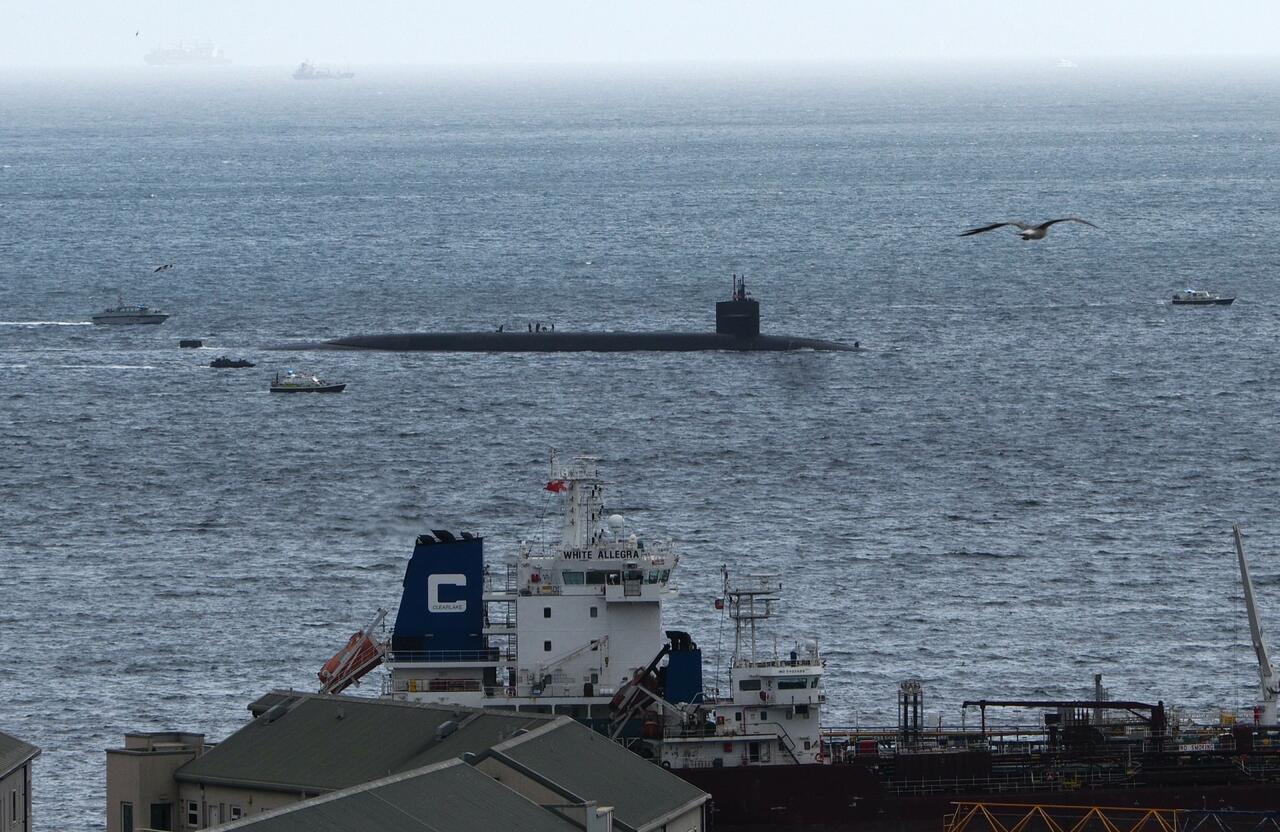
A US Navy nuclear-armed submarine has arrived in Gibraltar while en route into the Mediterranean Sea and likely Central Command or Middle East regional waters, in a very rare Pentagon admission of the whereabouts of one of America’s most secretive weapons.
“The port visit demonstrates U.S. capability, flexibility, and continuing commitment to its NATO allies,” the Navy announced, confirming that the submarine arrived in Gibraltar on Sunday. “Ohio-class ballistic missile submarines are undetectable launch platforms for submarine-launched ballistic missiles, providing the U.S. with its most survivable leg of the nuclear triad.”
The Wall Street Journal has emphasized, “The Pentagon almost never acknowledges the locations of its boomers [US naval slang], which are highly classified. The Navy didn’t provide the name of the submarine in Gibraltar.”
This definitely looks like a signal—or a bluff. Or a warning? Iran claims it’s been targeting USN ships and we have to presume that that includes the carriers. How would the US respond to the sinking of a carrier? By nuking Tehran? Could the surfacing of the “boomer” in Gibralter signal that the US is prepared to retaliate against a successful Iranian attack on one of its carriers following any new US attack on Iran? Will Schryver argues against that:
Will Schryver @imetatronink
I have long argued and continue to believe that:
If, as retribution for Iran sinking an American aircraft carrier, the US uncorked aVergeltungswaffen to turn Tehran into rubble and ashes, it would light the fuse of world war among the major powers on the planet.
Rafael Dominguez @somoscode
China and Russia should make it clear they would go nuclear against the US if we dare to do so!
Will Schryver @imetatronink
How do you know they haven’t already conveyed that message?
I am confident they have.
A US nuclear strike against Iran would open Pandora’s Box, and represent an existential threat against Russia, China, and North Korea.
Jim Mc Donald @Daghtamor
You don’t have to sink it, just leave it limping home. Iran would never sink a carrier.
Well, there’s lots of back and forth on that topic, with commenters weighing in on what they “think” or “believe”. Schryver posits “turn[ing] Tehran into rubble and ashes”, but modern nukes allow for less drastic alternatives than that—although still drastic enough. It’s worth noting that Russia’s revised nuclear doctrine is, or should be to Europeans, plenty alarming.
Schryver also argues that “boomers” may not be as undetectable as is generally believed. Part of the undetectability feature of these subs—beyond the relative silence of nuclear power—lies in their ability to remain submerged for months at a time, as well as the long range of their missiles, which allows the “boomers” to stand off at very long range. Schryver talks about “loitering” torpedoes stationed at “choke points” but, of course, “boomers” inhabit the deep blue, avoiding choke points. However, if you do some pretty simple searches online you’ll learn that the Russians (and the Chinese) have some very sophisticated capabilities:
Russian Satellite Capabilities
Tracking Technologies
Russian satellites possess advanced technologies that enable them to track U.S. submarines. These capabilities include:
Wake Detection: Russian systems can detect submarine wakes, which are disturbances in the water caused by a submarine’s movement. This method allows for covert tracking of submarines.
Electro-Optical Devices: Some Russian submarines have been equipped with electro-optical devices designed to identify and track undersea wakes.
Implications for U.S. Naval Operations
The ability of Russian satellites to monitor U.S. submarines poses significant challenges for U.S. naval operations. The detection of submarine wakes can compromise the stealth and operational effectiveness of U.S. submarines, which are designed to remain undetected while on patrol.
I’ll leave Schryver with the last word on this:
Will Schryver @imetatronink
Time will tell.
But my sense of the matter is that Russia is almost certainly capable of tracking and striking US submarines almost anywhere on the planet. China is regionally dominant in that respect. Iran is very likely very capable to a significant distance from its shores.
.
Let’s revisit the discussion of Iranian capabilities again at the summer solstice. You’ll need to remind me, because I am sure to forget.
I am inclined to believe the Iranians have several surprises they have deliberately withheld in light of the success of their lesser weapons.
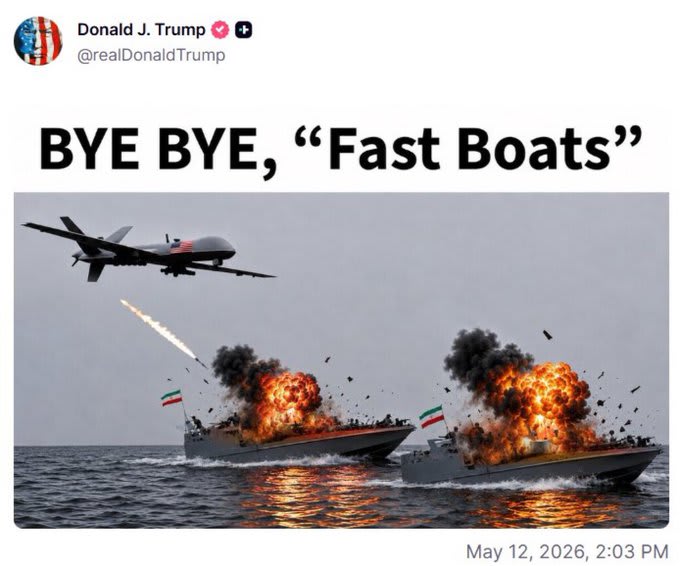
Speaking of naval matters, Trump is, too:
But Patty Marins responds:
Patricia Marins @pati_marins64
2h
This is an extremely difficult task, which is precisely why it was not accomplished in the first 40 days of the war.
Dozens of these speedboats are equipped with anti-drone air-defense systems, and it is possible that one of the A-10s shot down in the Gulf was actually brought down by one of these systems.
There are hundreds of boats armed with missile and torpedo systems, plus hundreds more fitted with rocket launchers that are now receiving guidance kits.
In short, a drone force can begin to engage these fast attack boats in the strait, but destroying hundreds of them is no easy task.
And if we include the models equipped with cannons, the total rises to at least 1,500 vessels.
It is a classic mosquito fleet, one the United States is not prepared to confront. Large warships are simply not effective against this type of threat.
To make the situation even more complicated, Iran has accelerated production of its 359 anti-aircraft missiles.
These can be launched in the Strait of Hormuz without the enemy drones even being detected.
The munition then loiters until it finds and engages its target.
This is not merely asymmetric warfare. It is a genuine headache for the entire doctrinal model established by the US Navy.
The lesson from all this is that there are no magic bullets at Trump’s disposal—or, not any that carry no risks. Patarames provides a useful summary of where things stand:
Patarames @Pataramesh
How things stand for Trump & his cards:
War crimes (hitting bridges & Powerplants)
 Deterred by robust counter strike on all critical & energy infrastructures of:
1. UAE
2. Bahrain
3. Israel
4. Kuwait
5. Qatar
6. Saudi Arabia
Inciting Civil War
 Deterred by intact Iranian ground forces putting any Kurdish attempts at high risk of their lives
Reopening the Strait of Hormuz by the U.S. Navy
 Failure of Operation Freedom due to Iran’s robust, sustained anti-shipping capabilities
Occupation of key places by Ground Forces
 Hezbollah’s Fiber-Optic FPV attacks on Israeli troops proved how bad it looks to have your youth killed on live-video feed
Heliborne Special Operation Force missions for different goals
 High losses during the (claimed) pilot rescue operation showed how fragile that approach is against an opponent like Iran
Tactical nuclear weapons
 Deterred by Iran’s 450kg weaponizable Uranium stockpile and opening pandoras box for conflicts like the Ukraine War
Continuing naval blockade
 Strait of Hormuz effects on global economy is a much greater leverage than the limited impact on Iran’s economy AND it sets in earlier…
In the air, yesterday brought some interesting information. The WSJ reported that the UAE had covertly engaged in air strikes against Iran. Of course we don’t know whether the UAE planes were also UAE piloted, and we know that Israelis were stationed there. But the US is also claiming that Iran has been receiving assistance from regional friends—which doesn’t really come as a surprise. Which also means that Iran retains its air force: