
What the Fedgov’s Media Arm is Saying About Trump’s Trip to China
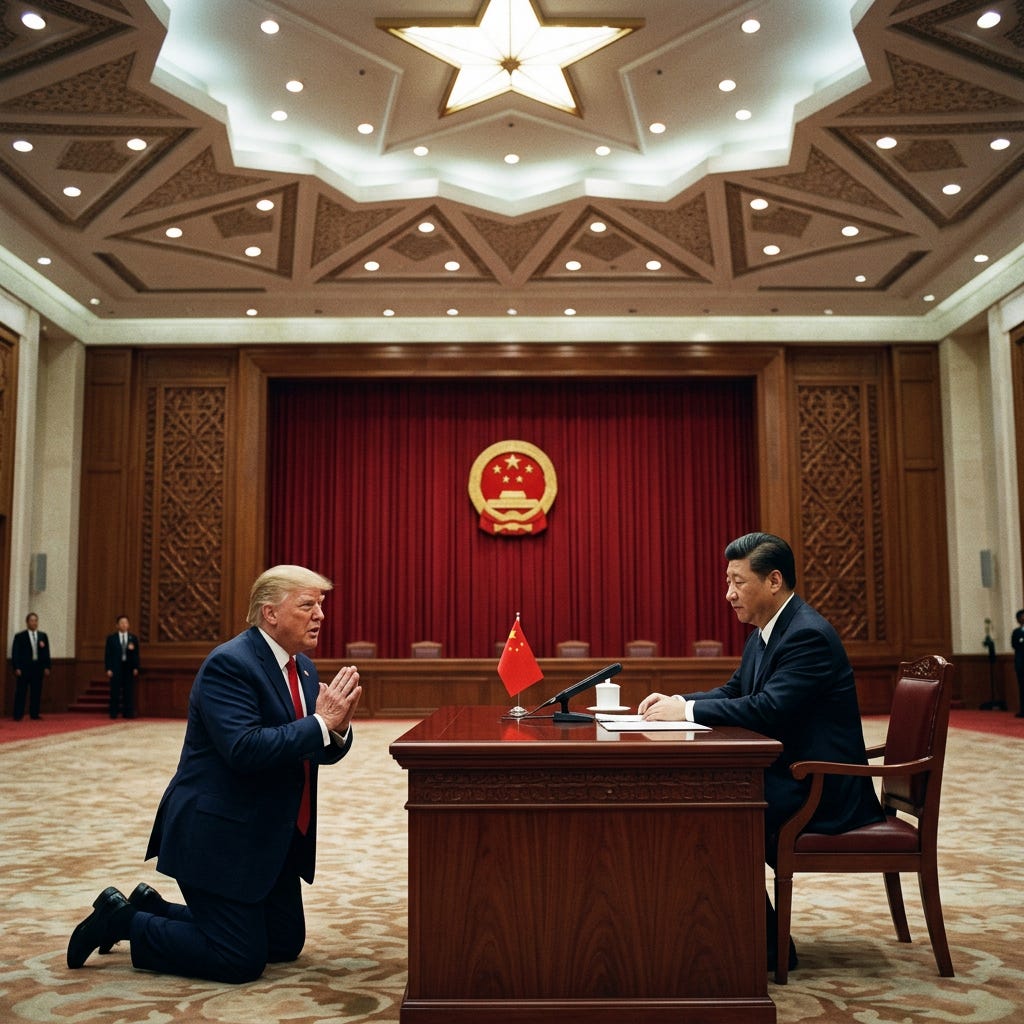
I thought it would be useful to highlight the reporting and analysis of the New York Times, the Washington Post and Politico regarding President Donald Trump’s trip to China. I read it so you don’t have to. All three publications converged on the same bottom line, differing mainly in tone and emphasis: China achieved its primary objectives — equal-footing recognition, Taiwan ambiguity, no structural economic concessions, and a friendly summit aesthetic — while the US achieved pageantry, claimed unverifiable Chinese commitments on Iran and nuclear weapons, and left without any of the concrete breakthroughs the White House had sought. As one analyst quoted across multiple outlets summarized: “The summit is unlikely to alter the character and course of the U.S.-China relationship long-term. It is about managing for stability, not solving outstanding concerns.”
The New York Times
The Times’ analysis was anchored by a single, powerful central thesis: that Xi arrived scripted and in command while Trump arrived in a position of weakness.
The Times wrote that “Mr. Xi arrived highly scripted, leaving no doubt that for all of China’s problems — deflation, depopulation, the bursting of the real estate bubble — the moment when China acts as a peer superpower had arrived.” The paper observed that at every turn, Trump appeared to be on the back foot.
The Times also broke the most damaging intelligence story of the visit: it reported that Chinese companies are negotiating clandestine arms sales to Iran, routing weapons through third countries including in Africa to hide their origins — a story that landed on the day Trump was being welcomed with a 21-gun salute at the Great Hall of the People.
On the summit’s outcomes, the Times was withering. Its analysis said Xi “conceded little” to Trump and that discussions “yielded no clear breakthroughs on the big foreign policy and economic fissures between the two countries and fell short of delivering the sort of big business deals the White House covets from international summits.” The paper also noted the extraordinary and revealing moment after the summit, when Trump felt compelled to post on Truth Social defending Xi — after the Chinese leader had implied the United States was a declining nation by warning of the Thucydides Trap. Trump posted that “when President Xi very elegantly referred to the United States as perhaps being a declining nation, he was referring to the tremendous damage we suffered during the four years of Sleepy Joe Biden” — effectively endorsing the Chinese president’s characterization of American decline.
The Washington Post
The Post’s analysis was perhaps the most structurally significant of the three, because it published two separate major pieces that together told a devastating story — one about the summit itself, and one about the intelligence context surrounding it.
On the summit: The Post’s headline framing was precise and damning: “Beijing Summit Yields Chinese Goal — Equal Footing with U.S.” The paper argued that the image of peer superpowers on display during Trump’s visit reflected a dynamic that analysts say the Chinese have long sought and Americans had long resisted. Trump himself gave the game away by coining the phrase “G-2” to describe the bilateral relationship — a framework China has pursued for decades and the US has consistently refused, because it implies a co-equal management of global affairs that excludes US allies.
The Post noted that Xi “touted a new era for the stability of China-U.S. relations” while Trump called the trip “incredible” — but observed that it was “big on pageantry” and “fell short on concrete agreements.”
The intelligence bombshell: Separately, the Post published a confidential US intelligence assessment showing that China is exploiting the Iran war to maximize its advantage over the United States across military, economic, diplomatic, and other fields — a story timed to land as Trump’s motorcade was arriving at the Great Hall of the People. The Pentagon called any such claims “fundamentally false.”
The Post also flagged what analysts called the most significant long-term issue that received almost no attention: Trump appeared to signal softening on the $14 billion arms sale to Taiwan, saying he had “not approved it yet” and expressing no desire to “travel 9,500 miles to fight a war,” while Xi’s Taiwan warning dominated the Chinese readout entirely. Taiwan’s Foreign Ministry thanked the US for Rubio’s subsequent reassurance that nothing had changed, but the ambiguity Trump introduced was itself a Chinese win.
Politico
Politico’s coverage was harder to find as a single unified analytical piece, but its reporting and Playbook summaries focused on three themes that together painted a picture of a summit that was strategically disorienting for the United States.
First, on Iran: Politico noted that Trump came to Beijing hoping to convince Xi to use his leverage to get Tehran to reopen the Strait of Hormuz, and that Trump said Xi vowed not to supply Iran with military equipment and offered to help resolve the conflict — but China’s official readout made no mention of any of this, and the Chinese Foreign Ministry sidestepped questions about it, leaving the claimed commitment unverified.
Second, on trade: Politico’s reporting highlighted the pattern now established across multiple Trump-Xi summits — China offers symbolic deliverables (Boeing aircraft, soybeans) that generate headlines for Trump domestically while making no structural concessions on the economic model, IP theft, state subsidies, or technology transfer that represent the real US concerns. Trump claimed China agreed to buy 200 Boeing jets, but offered no signed agreements or verified details. US Trade Representative Greer said the US expected billions in agricultural purchases — but again, no formal commitments were announced.
Third, on the strategic balance: Politico’s analysts pointed to the issues that received no attention at all as the most telling indicator of who won. There was no sense Trump pressed Beijing on cyber espionage, IP theft, state subsidies, an undervalued renminbi, or fentanyl precursors in any meaningful way. China’s longstanding bugbears — human rights, Hong Kong, Uyghurs, Tibet, military assistance to Russia, support for North Korea — were given a complete pass.
President Xi dashed Donald Trump’s hopes that China would play a role in pressing Iran to end the war in a way that would benefit Trump. Xi said no. I suspect that Xi did not tell Trump about the work that China and Russia are doing in collaboration — with the help of Pakistan — to erect a new security architecture in the region that will be led by Turkiye, Saudi Arabia and Iran. I am told that the goal is to create the equivalent of a NATO for the countries of West Asia.
The upcoming week will provide a clue whether Russia and China are achieving significant progress towards this goal if Saudi Arabia and Qatar refuse to let the US conduct military operations from their countries against Iran.
Mario Nawfal invited me at the last minute on Saturday to discuss a mysterious, massive explosion just west of Jerusalem. I believe it was an accident — a huge one at that — but there are other theories floating about:
Nima asked me to discuss this character, Jiang Xueqin, who has suddenly surfaced on a number of high profile podcasts, including Nima’s, Glenn Diesen’s and Danny Haiphong’s. Something ain’t right about this cat:
Finally, here is my latest Counter Currents analysis:
https://larrycjohnson.substack.com/p/what-the-us-media-is-saying-about