
Netanyahu’s Guru Involved in Three Genocides
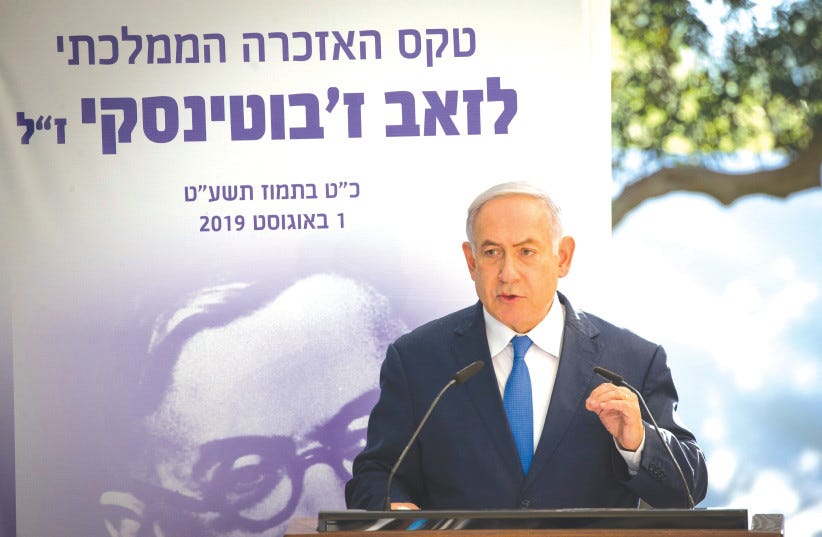
The Life, the Times and the Dark Secrets of Ze’ev Jabotinsky, founder of Revisionist Zionism.
If you are horrified by what is happening in Gaza, a good place to start to oppose the genocide is to understand its origins. There is a strong tendency among frankly naive opponents of Zionism to think that it all started in 1948, with Zionists operating promarily as the catspaws of “American imperialism”. The truth is rather more complicated, and very much older. Dive in and find out more!
Of all the minorities in the sprawling Russian Empire in the late 19th century, none was more radical and polarized than the Jews. Economic tensions were growing between poor Russians – peasants and workers in the rapidly industrializing cities – and Jewish merchants and money-lenders. This added to even older issues, as the intense hatred of Christianity routinely taught to young Jews was mirrored by Christian suspicion of the “Christ-killers”.
More suspicion was created by the disproportionate involvement of Jews in the various socialist movements preaching violent revolution. The assassination of Tsar Alexander II had been a particular watershed.
Dubbed “Tsar Liberator”, Alexander had emancipated the serfs in 1861 and immediately before his murder was preparing to sign a decree creating a limited parliamentary assembly. His reforms alarmed the far-left, which feared that they would reduce the public appetite for revolution.
In the summer of 1878 Solomon Wittenberg, the son of a poor Jewish artisan, was arrested for planning to blow up the Tsar with a mine in Odessa harbour. In response to his execution, the far-left Narodnaya Volya (“The People’s Will”) condemned the Tsar to death.
After a succession of failed plots, Alexander II was assassinated on March 13, 1881, killed by a bomb thrown by a member of the group. Although the actual assassin, Ignacy Hryniewiecki, was said to be of Polish noble descent, the trial of his accomplice Hesya Helfman focussed public attention on the prominent role played by Jews in the revolutionary terrorist groups which were plaguing Russia.
The extremists came from a wide variety of backgrounds. Some were the disaffected offspring of nobles, a few were from the families of liberated serfs. But a significant number, such as Mark Natanson, the founder of Land and Liberty, from which Narodnaya Volya had emerged, were Jewish.
Aaron Zundelevich was also notable. While studying at the Vilna Rabbinical School he organised a revolutionary circle, from which he went on to serve on the terrorist group’s Executive. He was a key player in the assassination of police chief Nikolay Mezentsov in 1878, and of the Tsar three years later.
Such crimes helped to swell the wave of anti-Jewish sentiment which swept across the Russian Empire. [1] The widespread pogroms which followed the much-loved Tsar’s murder died down by 1882, but the underlying hostility remained.
Anti-Jewish resentment exploded again in April 1903, when a pogrom took place in the city of Kishinev (now Chișinău, Moldova).
Accusations that Jews had ritually murdered a Christian boy named Mikhail Rybachenko in the nearby town of Dubăsari were published in the provincial newspaper, Bessarabets.
The violence which followed caused the deaths of up to 49 Jews and serious injuries to many more. Numerous homes and businesses were looted and destroyed.
Large numbers of police and soldiers were sent to restore order in the city in the remote southern periphery of the empire. Despite this, rumours spread in Jewish and left-wing circles that the authorities had colluded with rioters and that the Tsar had been unduly slow to order a clampdown on the violence.
September 1903 saw the publication of the Protocols of the Learned Elders of Zion, serialized in the newspaper Znamya (The Banner). This was published in St. Petersburg by a member of the anti-Jewish Black Hundreds, Pavel Krushevan. He had been the editor of Bessarabets when it published the ritual murder accusation, and frequent brushes with the law over his alleged incitements failed to silence him.
Vicious spiral
The febrile atmosphere which prevailed in Russia from the 1860s right through until the First World War produced a vicious spiral of Jewish radicalization. The more that young Jewish intellectuals became hostile to Tsarism, the more repressive the authorities became, and the more public opinion turned against their community. This in turn angered and frightened more Jews, making radical organisations ever more attractive.
While many of their parents were well assimilated into Russian society, large numbers of young Jews took a very different path. Or, rather, three different paths: Emigration; Revolutionary Socialism and Zionism.
The emigration story is simple. Most of Russia’s Jews had been confined to the Pale of Settlement since the expansionism of Catherine the Great brought them into the empire for the first time. Decreed in 1791, the Pale covered parts of modern western Rusia, Ukraine, Belarus, eastern Poland, the Baltic states and Moldova.
By 1880, the Pale was home to more than five million Jews, of whom between 2.4 to 2.7 million – overwhelmingly young people – had emigrated by 1914. [2]
Their numbers were further reduced by deaths during the chaos of post-WW1 upheavals, revolution, civil war and famine, and by continued large-scale emigration. The impact of demographic reality on the credibility of mainstream accounts of the later history of the area is something beyond the scope of this study, but the alert and informed reader will grasp the significance.
As for Zionism and Communism, the two ideologies were both the product of Jewish theorists. Both took root in Russia at the same time, and both flourished in the same soil – the alienated and often impoverished Jewish communities in the Pale of Settlement.
Jewish nationalism was first promoted among Russian Jews by the Hibbat Zion (Lovers of Zion) movement, which emerged in the 1880s. As a result of the pogroms after the assassination of Alexander II, many Russian Jews saw Palestine as a refuge from persecution. Small numbers emigrated in what became known as the First Aliyah (1881–1903).
Zionism per se, however, was only formally articulated in 1896, when Theodor Herzl, an Austro-Hungarian journalist, published his pamphlet Der Judenstaat (“The Jewish State”). Herzl envisioned a secular, political solution to antisemitism by establishing a Jewish homeland, either in Palestine or elsewhere. [3]
Herzl was initially sceptical about engaging Russian Jews in the new movement. He feared their growing political radicalism and considered that the stereotype of the cringing but dishonest Jew was based on the reality of Jewish life and behaviour in the shtetl.
Although, like the Jews of the Pale, Herzl was Ashkenazi, his family were middle class German-speakers from Hungary. He frequently used the derogatory German word “Mauschel”, which implied that Jews were cunning, deceitful, or engaged in shady business practices.
In his 1897 article Mauschel, Herzl used the term to describe Jews who perpetuated the negative stereotypes and who rejected the Zionism which, he insisted, would create the “new Jew”. [4]
Despite Herzl’s reservations, Russian Jews quickly became the backbone of the Zionist movement. The new movement was strongly influenced by the growth of militant physical force defence groups in response to the alleged failure of the Russian government to protect Jews during pogroms. This was the sort of tough, fighting Jew which Zionism demanded.
As a result of all this, Russian Jews played a major role in early Jewish settlement in Palestine, dominating the Second Aliyah (1904–1914).
Ottoman roadblock
Despite this, however, the huge majority of Zionists still lived in Russia. The Ottoman Empire, which controlled Palestine, was wary of large-scale Jewish immigration and imposed legal and bureaucratic obstacles.
By 1905, Zionism had become one of the most influential political movements among Russian Jews, rivaling the popularity of secular revolutionary socialism and the specifically Jewish Bundist socialists.
Starting in 1883, the Emancipation of Labour revolutionary cell introduced Marxism in a systematic way, smuggling texts into Russia.
By the 1890s, the rapid industrialization of Russia had created an urban proletariat, which the Marxists saw as the revolutionary class. This was distinct from the agrarian socialism of the Narodniks.
The new Marxist movement was even more heavily Jewish than the Narodniks. The Russian Social Democratic Labour Party (RSDLP) was founded in 1898 in Minsk, with the goal of uniting Russia’s Marxist revolutionaries into a single political organisation, working to overthrow Tsarist autocracy and replace it with the dictatorship of the proletariat.
The main constituent organisations of the RSDLP were the Emancipation of Labour group, founded in 1883, and the Union of Struggle for the Emancipation of the Working Class, founded in 1895.
The most notable figure in Emancipation of Labour, Georgi Plekhanov, was from a Russian noble family, but his two key associates Pavel Axelrod and Lev Deutsch, were Jewish.
Pattern
The picture in the Union of Struggle was similar; while the high-profile Lenin was of mixed ancestry, the co-leader was Julius Martov, born Yuli Tsederbaum. He was the editor of Iskra, the party’s official newspaper, a job he was to share with Leon Trotsky, born Lev Bronstein, from 1902.
The overall organiser of the RSDLP’s founding congress in 1898 was the Ukrainian-born Jew Stepan Radchenko.
Also involved as a major force in the umbrella organisation was the Jewish Labour Bund, represented by Boris Eidelman. The Bund, founded in 1897, advocated for Jewish workers’ rights and autonomy within a socialist Russia.
It focused on Jewish workers, labour strikes, and Yiddish cultural autonomy, rejecting both Zionism and assimilation. It was this position which led to the Bund splitting from the RSDLP in 1903, when it was refused autonomy within the party. The Jewish Marxists therefore split from the Marxist Jews.
The rupture with the RSDLP does not imply a shift to moderation on the part of the Bund. The crucial disagreement was over the question of Jewish culture and autonomy. The Bund remained committed to the overthrow of the Tsar, playing a major role in the failed 1905 revolution, organising strikes and armed rebellion against the authorities. Its armed wing was probably the largest revolutionary force in Western Russia. [5]
Both sides of the split remained committed to Communist revolution, and both opposed Zionism. While all were concerned with the plight of Jews under Tsarism, they fundamentally disagreed on the solution. The Bund was adamant that Jews should fight for socialism where they lived, rather than emigrate to Palestine.
The Zionists, in turn, accused the Jewish Marxists of abandoning Jewish identity and failing to recognize the reality of life in Europe. They saw Bundists as naïve, believing that Jewish life in Eastern Europe was doomed due to rising antisemitism, pogroms, and political instability.
The Bund regarded Zionism as a bourgeois nationalist distraction from the class struggle. The organisation promoted Yiddish, essentially pidgin-German, as the language of Jewish identity, opposing the Zionists’ push for Hebrew revival.
The mutual antagonism led to frequent street fights between Bundists and Zionists in Jewish neighbourhoods, especially over control of labour unions and cultural institutions.
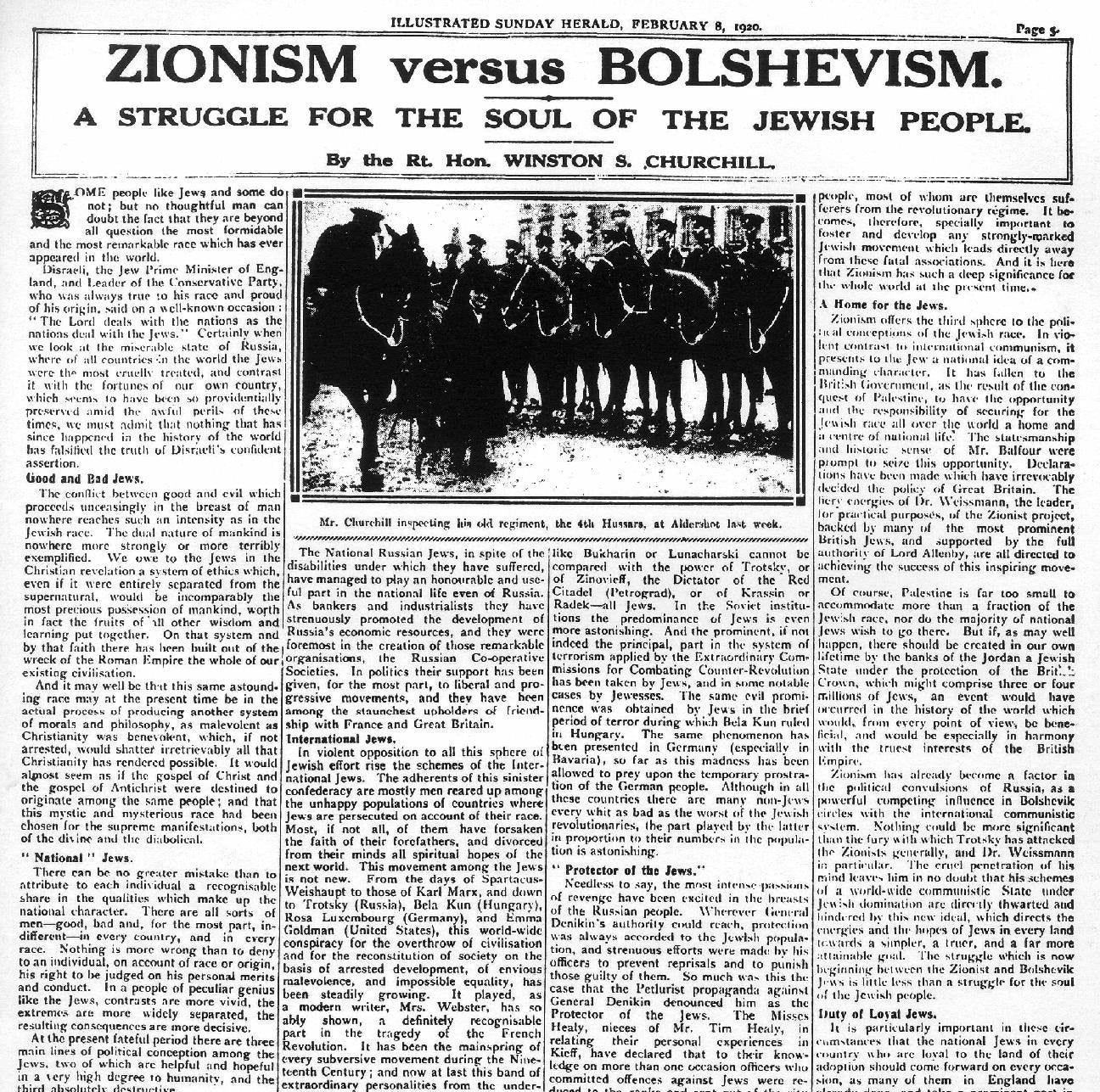
The internal conflict between Jews in Russia was even noted by Winston Churchill. Writing in the Illustrated Sunday Herald in his 1920 article “Zionism versus Bolshevism: A Struggle for the Soul of the Jewish People,” Churchill discussed the split between the Zionist movement and the Bolsheviks, who had emerged triumphant among the Communist factions.
Churchill portrayed this as a pivotal struggle determining the future direction of the Jewish people, and acknowledged the role Jews played in the Bolshevik movement, stating:
“There is no need to exaggerate the part played in the creation of Bolshevism and in the actual bringing about of the Russian Revolution, by these international and for the most part atheistical Jews; it is certainly a very great one; it probably outweighs all others.”
He expressed concern over what he perceived as a “worldwide conspiracy for the overthrow of civilization” led by Jews, mentioning individuals like Leon Trotsky and Rosa Luxemburg.
In contrast, Churchill viewed Zionism favorably, seeing it as a constructive national movement. He believed that Zionism offered a positive alternative to the destructive tendencies he associated with Bolshevism.
Churchill argued that supporting Zionism was essential to counteract the influence of Jewish revolutionaries, suggesting that the establishment of a Jewish state would provide Jews with a sense of national identity and purpose, thereby steering them away from revolutionary Communism.
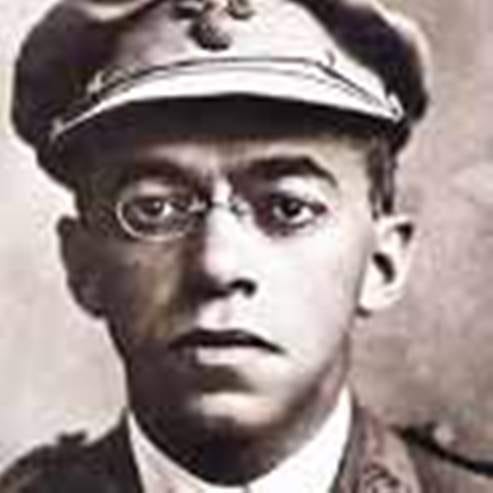
One man who had already taken the path recommended by Churchill was Ze’ev Jabotinsky. Born Vladimir Zhabotinsky in 1880 in Odessa, he grew up in a middle-class Jewish family, speaking Russian at home while also learning Yiddish.
With around a third of all its inhabitants being Jewish, Odessa had a thriving Jewish cultural and intellectual scene. Kishinev is only a hundred miles away, so the 1903 pogrom had a massive impact on Jews in Odessa, with many becoming Zionists in response. Zhabotinsky among them. He set about learning Hebrew, Judaized his surname to Jabotinsky and took the first name Ze’ev, which means “Wolf” in Hebrew.
The name mirrored the militancy of Jabotinsky’s Zionist activities. He established the Jewish Self-Defence Organisation, with the aim of organising armed militia in Jewish communities throughout Russia. “Jewish youth, learn to shoot!” was a key slogan and the young firebrand quickly became prominent in Zionist circles as an orator and journalist.
Jabotinsky was singularly unimpressed with many of his fellow East European Jews. He contrasted the archetypal “Yid” with the “Hebrew” of the Zionist future. He described the “Yid” as “ugly, sickly, and lacking decorum,” advocating for the “Hebrew” to embody “masculine beauty” and pride. [6]
Promoted by very capable and committed young men such as this, Zionist ideas spread rapidly among Russian Jews. There was, however, a massive roadblock in the way of their dream of mass emigration to Palestine: the Ottoman Empire.
Jews had generally fared well in this sprawling multi-cultural state. For centuries, most Sultans had employed Jewish advisors, treasurers and physicians, while Jewish merchants and money-lenders helped maintain close connections between thriving Jewish communities all over the empire.
But the Ottoman administrators of Palestine believed that large-scale Jewish immigration would destabilize the province and antagonize their Arab subjects, Muslim and Christian alike. The Sultanate in Constantinople therefore rejected all requests to soften its policy. No more than 40,000 new Jewish settlers were permitted to enter Palestine between 1881 and 1908.
The days of the Ottoman sultans, however, were about to come to an abrupt end. In July 1908, the so-called “Young Turks” forced Abdul Hamid II to establish a constitutional republic. By April the following year, the sultan was deposed completely.
The Zionists were delighted with the development, since repeated efforts to win over or bribe the Sultan to support their cause had failed.
Theodor Herzl had died in 1905, to be succeeded as president of the World Zionist Organisation by David Wolffsohn (below). Born in Lithuania, Wolffsohn emigrated in order to avoid conscription into the Russian army. He settled in Germany and made a fortune trading in timber.
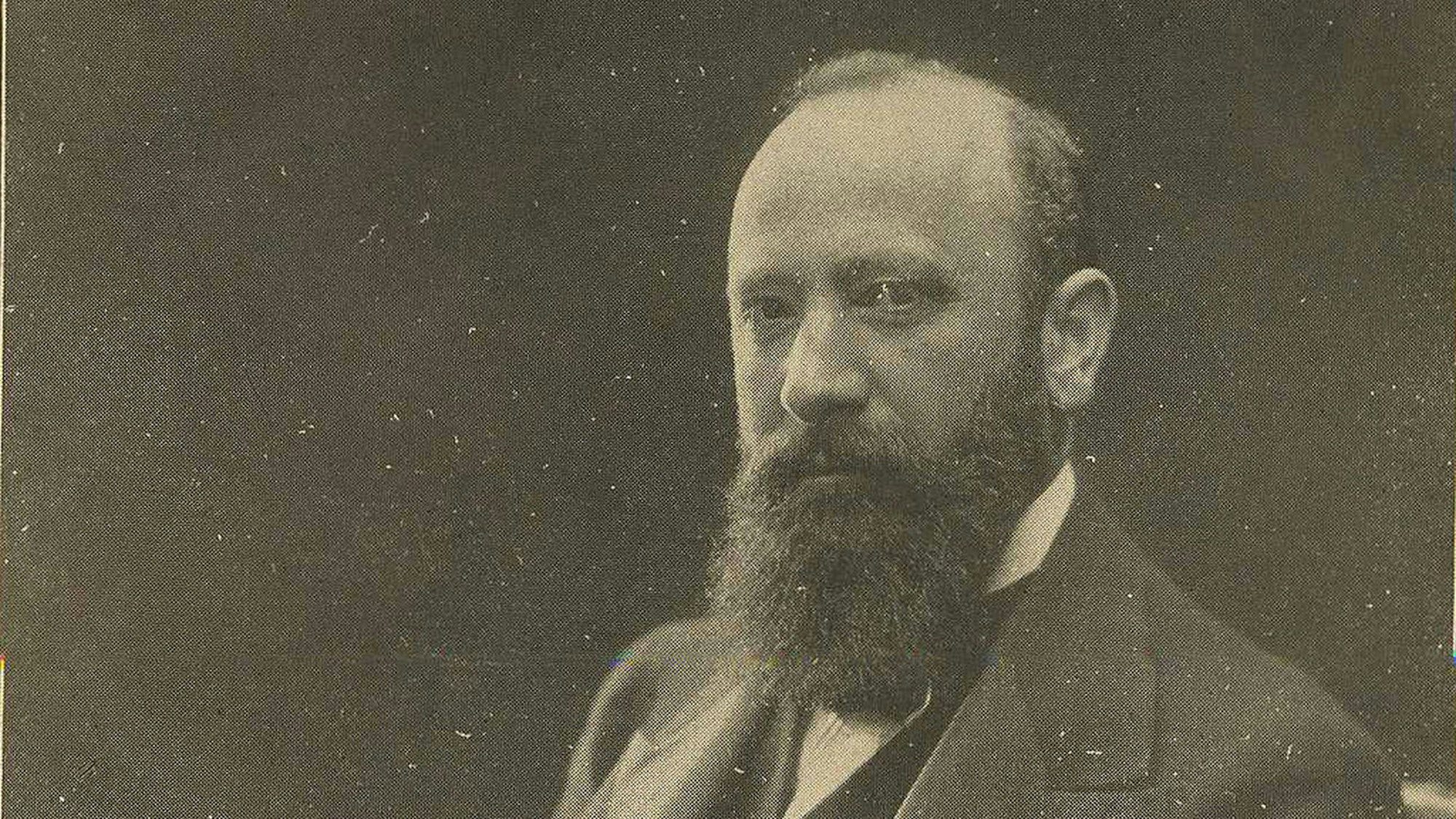
Wolffsohn had accompanied Herzl on a diplomatic mission to Constantinople in May 1901. The two men met with Sultan Abdul Hamid II, with Herzl proposing financial assistance to the Ottoman Empire in exchange for support for Jewish settlement in Palestine. However, the Sultan rejected the proposal, stating bluntly that the lands of Palestine were Ottoman territory and not for sale.
Two years before, following previous polite refusals by the Ottoman authorities to assist with his plan, on 19th March 1899 Herzl had written to Yousef Al-Khalidi, the mayor of Jerusalem, arguing that both the Ottoman Empire and the non-Jewish population of Palestine would benefit from Jewish immigration. The letter concluded with an ambiguous but threatening turn of phrase: “If he (the Ottoman Sultan) will not accept it, we will search and, believe me, we will find elsewhere what we need.”
Herzl skirted around the issue of what would happen to the indigenous Palestinians, suggesting that they would somehow be “spirited away” and suggesting that discrimination against them would encourage them to find jobs elsewhere. [7]
In the autumn of 1907, Wolffsohn returned to Turkey and engaged in indirect negotiations with the Sultan through his First Secretary, Tahsin Pasha. This effort also came to naught.
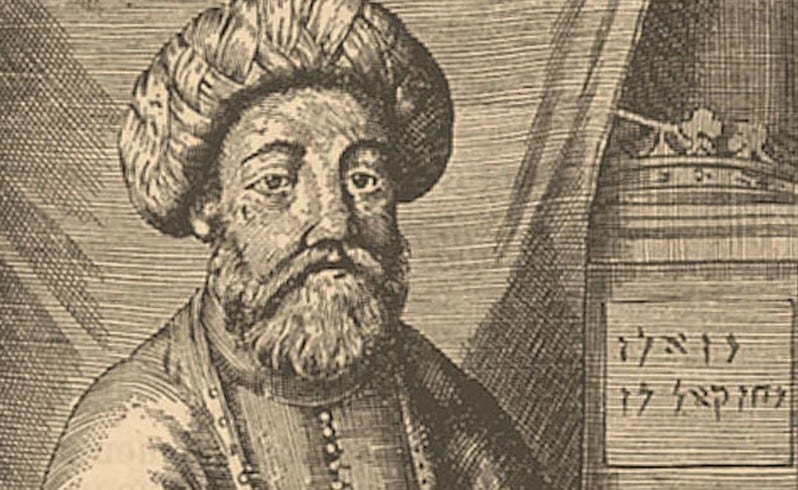
By contrast, the Zionists had high hopes for the new regime, not least because the Young Turks, led by the Committee of Union and Progress (CUP), were in fact not Turkish. The masonic revolutionary movement was dominated by Dönmeh Jews. This sect originated in the 17th century, following Sabbatai Zevi (above), a Jewish mystic who declared himself the Messiah in 1666, before feigning conversion to Islam under threat of death.
We will examine the Dönmeh and their role in the end of the Ottoman empire in a future study on the heavily censored true history of the Armenian Genocide of 1915. For now, we simply need to note that, while mainstream Jewish religious leaders had always regarded the sect as apostates, heretic and Satanists, the Zionists saw their revolution in Turkey as removing the Ottoman roadblock in the way of their efforts to establish a Jewish homeland in Palestine.
The World Zionist Organisation sent Jabotinsky to Constantinople as a journalist and lobbyist. He became editor-in-chief of Le Jeune Turc (“The Young Turk”), a French-language newspaper.
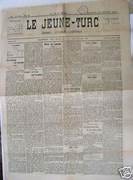
The publication had previously been the antisemitic Courrier d’Orient, but it was bought out with funds from David Wolffsohn, the banker Jacobus Kann and Victor Jacobson, head of the Beirut branch of the Anglo-Palestine Bank, who had moved to Constantinople to run its Turkish branch in 1908.
A French-language paper was ideal, because it was the dominant foreign language among the educated elite of the multi-cultural and multi-lingual Ottoman Empire. The Committee of Union and Progress, which led the Young Turks, had many Francophone members, partly on account of their admiration of the French Revolution and partly because it was a common language in Salonica, the long-term base of the Dönmeh.
The use of French also made it possible to use the paper to try to influence and curry favor with diplomats and wealthy individuals in Western capitals. The final advantage was that official censorship of foreign-language publications was less stringent than for those published in Turkish.
Leverage
The paper’s primary goal was to leverage the post-revolutionary environment in the Ottoman Empire to advocate for a Jewish homeland in Palestine. Jabotinsky was appointed co-editor-in-chief with Sami Hochberg [8], who had emigrated from Russia to Palestine in 1889.
As a persuasive orator, Jabotinsky also took on the job of using the newspaper’s office as a salon where he gave lectures to Ottoman officials and Sephardi community leaders.
The message drummed into the Young Turks was that Zionism was compatible with Ottoman interests, not a separatist threat. Jabotinsky argued that Jewish immigration to Palestine would benefit Istanbul by diluting the restive Arab majority in the region.
Western court historians portray the paper as backing the “liberal wing” of the Young Turk movement. In as far as it advocated secularism and women’s rights, this is true, but behind its nominal editor, the Turk Celâl Nuri İleri, were figures even more sinister than Jabotinsky and Hochberg. The paper’s two other notable contributors were Alexander “Parvus” Helphand and Moiz Cohen
Belarus-born Helphand was a Marxist theoretician, economist, and revolutionary of Jewish origin. Born in Belarus, he became involved in socialist movements across Europe, although his personal fortune came from arms trading.
During his time in the Ottoman Empire, Parvus served as a financial advisor to the Young Turks, leveraging his economic expertise to support their revolutionary objectives.
Suitcases of cash
Under his nom de guerre “Parvus”, he was later to be the main conduit for passing funds from the German government to fund Lenin’s revolutionary activities. The German-based businessman had persuaded his hosts that backing Lenin and his Bolsheviks was the best way to knock Russia out of the war. Alexander Solzhenitsyn’s novel “Lenin in Zurich” depicts him delivering suitcases of cash to Lenin.
Helphand was by no means unusual in having close contacts with the German authorities at this time. Most Zionists favored Germany over Great Britain in the period before and in the first part of the war. This only changed when Britain issued the Balfour Declaration in 1917.
It is the involvement of Moiz Cohen, however, which does the most to undermine the claim that the magazine was “liberal” in the modern – as opposed to the French revolutionary – sense.
After his stint with the Le Jeune Turc, Cohen changed his name to Munis Tekinalp, and became a leading ideologue of Turkish nationalism. As Tekinalp, Cohen played a key role in promoting an exclusionary, “Unionist” vision of a homogeneous Turkish nation-state. Emerging as a vocal proponent of Turkification, he called for cleansing the Turkish language of foreign words and envisioned a Turkey “purified” of its Christian populations.
Cohen was not alone in this endeavour. According to one account, “with the encouragement of Jews like Carasso, the Unionists, who started to dream of a national state, began to purge the liberal Young Turks”.
The lawyer Emmanuel Carasso, another of the crypto-Jews from Salonica, was an influential lawyer from Salonica and a prominent member of the Young Turks. Grand Master of the “Macedonia Risorta” Masonic Lodge in Salonika – the clandestine organising base for the CUP revolution’ – he provided the funds for the 1908 coup and personally delivered the deposition notice to Sultan Abdul Hamid in April 1909.
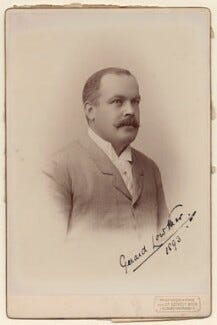
The British ambassador to Turkey at the time, Sir Gerard Lowther (above), observed that some CUP policymakers (including the Minister of Finance, the Dönmeh Cavid Bey) saw the empire’s Armenian and Greek Christians as “rivals” to be kept in check.
Lowther accused such CUP advisers of fanning the flames of Turkish-Muslim hostility toward those minorities.[9] His concern was well-founded; the ultranationalism promoted among the Unionists set the stage for the 1915 slaughter of Armenian, Greek and Syriac Christians.
To be fair to Jabotinsky, his own writings were very different. From 1908–1910 he championed a liberal Ottomanism where all groups – Turks, Jews, Armenians and so on – would coexist with equal rights. That was the theory, but the practise of where the revolution and its ideas led was to be very different.
Jabotinsky condemned ethnic chauvinism; he only turned against the Young Turks because they insisted on assimilating the Jews and took the same stand against Jewish settlement in Palestine as their Ottoman sultan predecessor.
In his memoirs, Jabotinsky later admitted he “was not successful with Nazim Bey, the [CUP] Secretary General… no pressure would help: for them, wholesale assimilation is a sine qua non… and there is for Zionism no other hope but the destruction of that nonsense.”
By 1910, angered by the Young Turks’ intransigence, Jabotinsky resigned his editorial post. Le Jeune Turc continued to appear until 1915, when the Turkish government accused it of Zionist treason and supressed the paper.
Three Genocides
Its most influential period, however, had been during the heady days of revolution, when three of its main contributors were Jabotinsky, Helphand and Cohen. Three men who – though each kept his own hands clean – were to play a central role in the development of three apparently separate genocides: Not just the ongoing Palestinian one, but also the slaughter of millions of Christian Russians and Ukrainians, and the mass murder of Armenians, Greeks and Syriac Christians under the badly mis-labelled Young Turks.
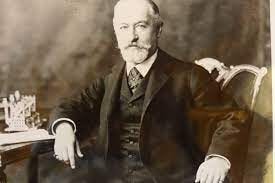
The overthrow of the Tsar was funded primarily by the banker Jacob Schiff (above), of Kuhn,Loeb and Co. But there would have been no Bolshevik coup without the German support secured for Lenin by Helphand. And it was the Bolshevik takeover which led to the Holodomor, the hunger genocide directed against the farming regions of Ukraine and Russia in the early 1930s.
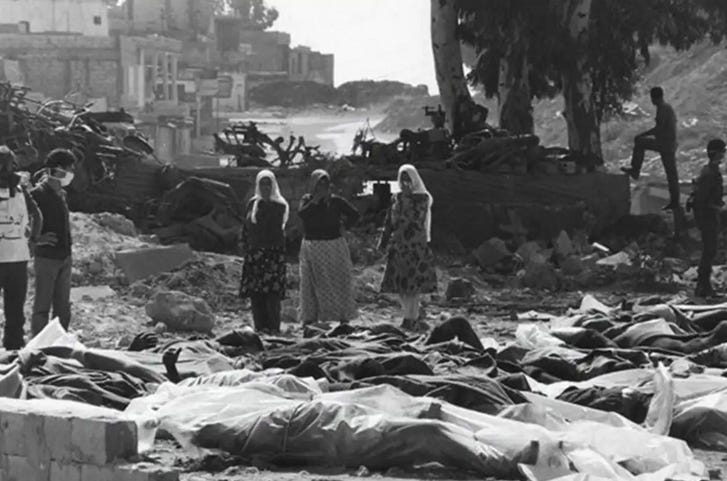
The ruthless massacre at Deir Yassin was the trigger for the flight of hundreds of thousands of Palestinians in 1948
The slow-motion genocide of the Palestinians was largely put into practice from 1948 onwards. But it was Jabotinsky who inspired the men who carried it out. He was already dead by then, but there would have been no Deir Yasin, Begin or Netanyahu without Jabotinsky.
Moiz Cohen was not the only ideologue pushing for what was to be, in effect, the Final Solution to the Armenian problem. But the bitterly anti-Christian pan-Turkism he did so much to develop led directly to this, the third great and neglected genocide of the bloody twentieth century.
Le Jeune Turc, set up as a Zionist intellectual power house and lobbying voice by the World Zionist Organisation, thus bore a considerable degree of guilt for all three.
By 1912 he was convinced that a great war was coming, and that what he called “the sublime insanity of modern methods” would make it an opportunity to advance the Zionist cause, not least by breaking the Ottoman hold on Palestine.
With the outbreak of the war, Jabotinsky was sent to the Western Front as a journalist for Russkie Verdomosti, a newspaper closely connected to the liberal forces which would overthrow the Tsar in February 1917.
When Turkey entered the war on the side of Germany, he declared that “our fate depends on liberation in Eretz Israel from Turkish rule, and, with this liberation, we must participate as a Jewish military unit.”
In late 1914, Jabotinsky traveled to British-ruled Egypt and proposed forming a Jewish fighting force to help take Palestine from his erstwhile Turkish allies.
Together with fellow Russian Zionist Joseph Trumpeldor, he recruited Jewish volunteers – many of them exiles from Ottoman Palestine – and lobbied British commanders to utilize them in combat.
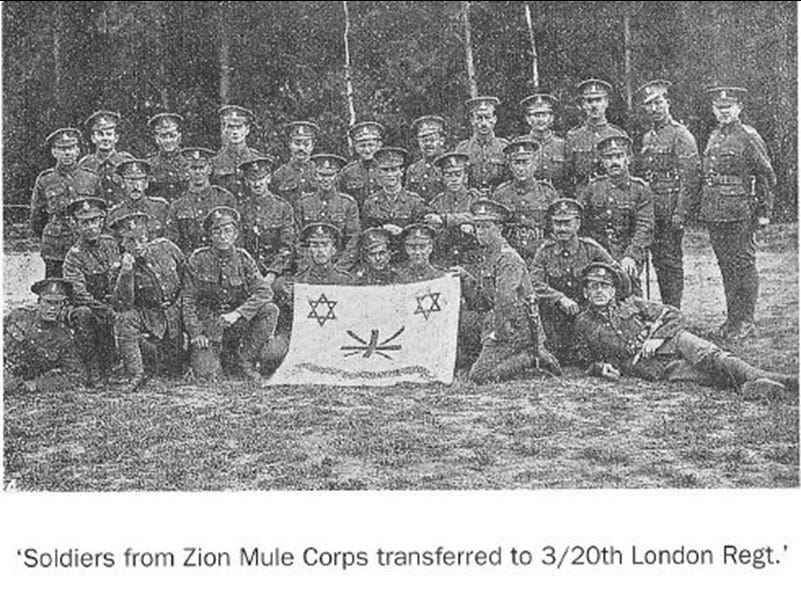
The British were initially hesitant; instead of a front-line unit, they created the Zion Mule Corps, a Jewish transport unit that served gallantly at Gallipoli in 1915.
Jabotinsky persisted, and by 1917 the British agreed to form the Jewish Legion, in which he served as an officer. This legion fought alongside British troops in the Palestine campaign. Jabotinsky’s about-face – from championing the Young Turks to taking up arms against them – was complete.
For Jabotinsky, British victory offered the chance to achieve a Jewish homeland (as indeed materialized with the Balfour Declaration of 1917). For Britain, Zionist support was one small piece of a larger imperial strategy to dismantle the Ottoman Empire. Jabotinsky was even decorated by the British (appointed an MBE) for his services.
If the British expected gratitude from Jabotinsky and his Zionist colleagues, however, they were as misguided as the Young Turks before them.
After World War I, Jabotinsky quickly turned against Britain on account of the restrictions it placed on Jewish emigration to Palestine, now under its control as a result of the Anglo-French carve-up of previously Ottoman territory.
Returning to the approach he had developed in Russia, he organised the Haganah self-defence unit in Jerusalem, where Arab unrest against the Jewish settlers who were allowed in was growing.
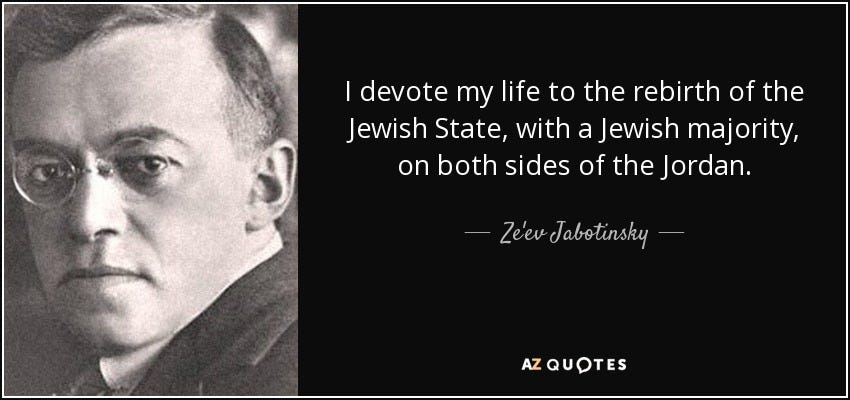
Disillusioned by the British delay in implementing a Jewish National Home, Jabotinsky broke with mainstream Zionist leaders like Chaim Weizmann and founded the Revisionist Zionist movement in 1925. Advocating a more militant, maximalist approach to establishing Greater Israel, a Jewish state on both sides of the Jordan River, this quickly became a major force in Zionist politics.
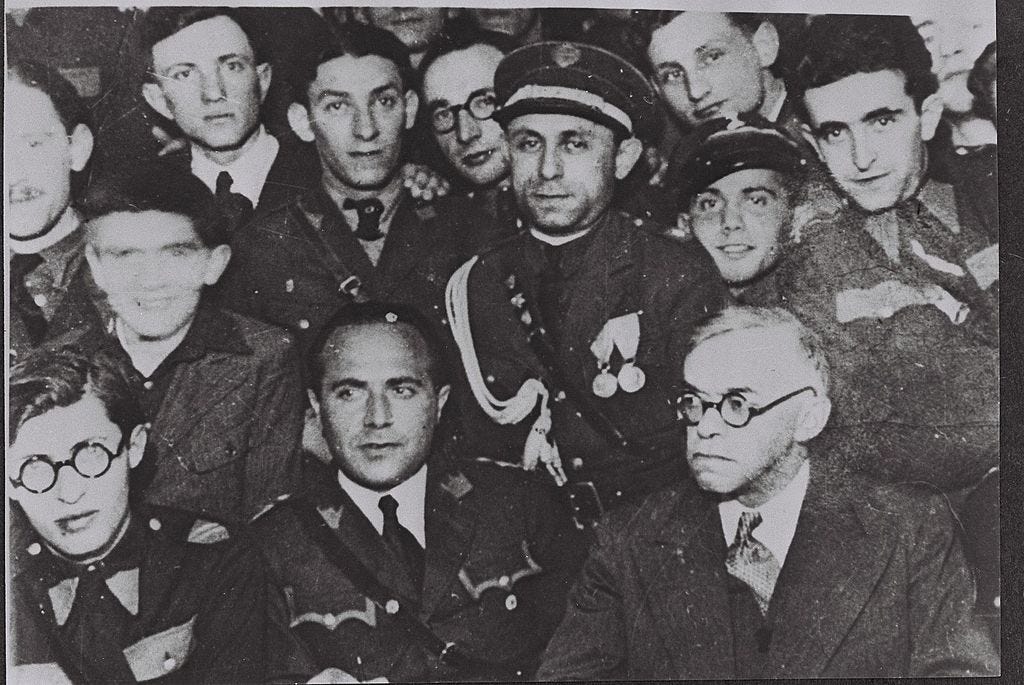
Zabotinsky (bottom right) in a meeting with Betar leaders in Warsaw in 1939. Menachim Begin is bottom left
His “Eretz Israel” was to cover the entire area of the Promised Land, according to the widest possible interpretation of Biblical accounts. It was to be established by force of arms, since Jabotinsky recognized that the Arabs would never accept the establishment of a Jewish majority state.
In theory, Jabotinsky believed that the defeated Arabs would later be assimilated into the Israeli state, with full civil rights, though neither he nor any of his successors ever explained how this could actually happen in practise.
Despite this glaring gap, Jabotinsky’s writings and charismatic speeches in the 1920s–30s inspired a new generation of activists. He nurtured the Betar youth movement and pressed for the creation of a Jewish army to fight for statehood.
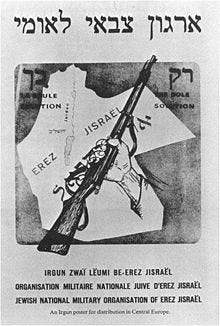
Although Jabotinsky died in 1940 before seeing the fulfilment of his dream, his ideological legacy profoundly shaped modern Israel. The Irgun underground militia, which waged an armed revolt against British rule in the 1940s, operated under Jabotinsky’s “spiritual command”. He provided the ideological framework that guided the terrorist gang, particularly in his 1923 book The Iron Wall. [10]
Among its actions was joint involvement in the notorious Deir Yassin Massacre in 1948, when the mass murder of an entire and completely peaceful Arab village sparked the flight of hundreds of thousands of Arabs from territory quickly seized by the newly established Israeli state and handed to waves of East European Jewish immigrants.
Many of Jabotinsky’s followers, including the Irgun terrorist Menachem Begin, became architects of the State of Israel and its politics. By way of Begin’s party, Herut, Jabotinsky’s Revisionist Zionism was the direct precursor to Israel’s current Likud government.
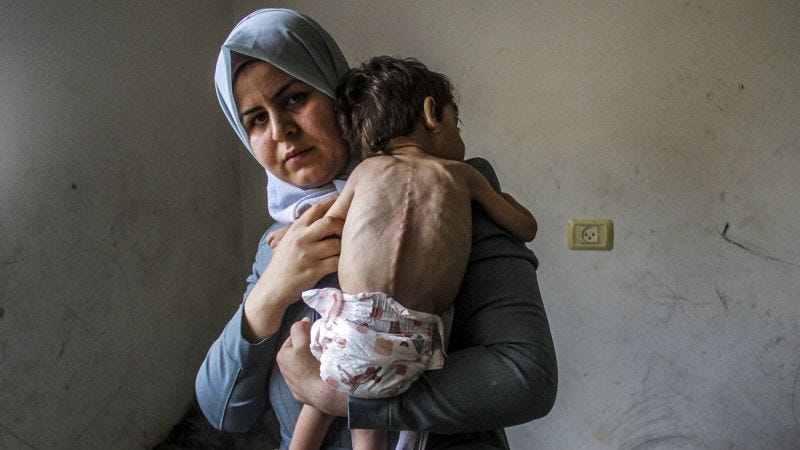
As such, Jabotinsky was the grandfather of the genocidal war now being waged against the Arabs – Christian as well as Muslim – in Gaza. He may not have intended such an end, just as he may not have intended the ideas promoted by the Young Turks, and the revolution they supported, to end in the Armenian Genocide.
Perhaps he really didn’t care. Just as his co-religionists who took the socialist revolutionary route in Russia did not care what its end result would be. And just as Carasso and Moiz Cohen did not care that their Young Turk adventure would lead to the mass murder of up to two million Armenians, Greeks and Assyrians.
What mattered was to overthrow the Tsar, because he was perceived as being bad for the Jews. What mattered was to overthrow the Ottoman Empire, because it was bad for the Jews. What still matters is to expel the Arabs from Gaza (and in due course the West Bank), because they are bad for the Jews.
Not all Jews feel that way, indeed, the most effective critics of Talmudic racism and Zionist genocide over several generations right up today are righteous Jews, ranging from Ben Friedman to Israel Shahak and Ron Unz But to all those under the baneful influence of Zionist racism or Talmudist supremacism, that is always what matters.
FOOTNOTES
1. Jewish Chronicle, 6 May 1881; quoted in Benjamin Blech, Eyewitness to Jewish History.
2. Vital, David (1999). A people apart: The Jews in Europe, 1789-1939. Oxford University Press. ISBN 0-19-821980-6. OCLC 40338446. p. 298.
3. Cleveland, William L. A History of the Modern Middle East. Boulder, CO: Westview, 2004. ISBN-10 081334980X p. 224.
4. Jacques Kornberg, Theodor Herzl: From Assimilation to Zionism, Indiana University Press 1993 ISBN 978-0-253-11259-0 pp. 164–165.
5. Strauss, Herbert A. (2011-09-06). Austria – Hungary – Poland – Russia. Walter de Gruyter. ISBN 978-3-11-088329-9.
6. Jabotinsky, Valdimir (1905). Dr. Herzl.
7. Khalidi, Rashid Ismail (2020). The Hundred Years’ War on Palestine: A History of Settler Colonialism and Resistance, 1917–2017. New York: Metropolitan Books, Henry Holt and Company. ISBN 978-1-62779-855-6.
8. Yüksel, Ahmet (2020). “Sami Hochberg: A Zionist Journalist Author, Printer, Diplomat, Spy”. History Studies: International Journal of History. 12 2263–2297.
9. Laqueur, Walter (2006). The Changing Face of Anti-Semitism. Oxford University Press. pp. 195. ISBN 0-19-530429-2.
10. The Establishment of the Irgun. Jewish Virtual Library. Accessed 12 March 2025.
BIBLIOGRAPHY
Bein, Alex (1941). Maurice Samuel (ed.). Theodor Herzl: A Biography of the Founder of the Modern Zionism
Brenner, Lenni (1983). Zionism in the Age of the Dictators. Lawrence Hill & Co; Rev Ed. ISBN 978-0985890995
Halkin, Hillel (2014). Jabotinsky: A Life. New Haven: Yale University Press. ISBN 978-0-300-13662-3.
Kaplan, Eran (2005). The Jewish Radical Right: Revisionist Zionism and Its Ideological Legacy. University of Wisconsin Press. ISBN 0-299-20380-8
Lewental, D. Gershon (2010). “Le Jeune Turc”. Encyclopedia of the Jews in the Islamic World.
Mandel, Neville (1965). “Attempts at an Arab‐Zionist entente: 1913–1914”. Middle Eastern Studies. 1 (3): 238–267. doi:10.1080/00263206508700015.
Shavit, Yaacov (1988). Jabotinsky and the Revisionist Movement, 1925–1948. London, England: Totawa, N.J., F. Cass. ISBN 0 714 63325 9.
Schechtman, Joseph (1956). Rebel and Statesman: the Vladimir Jabotinsky Story. New York: Thomas Yoseloff. https://catalog.hathitrust.org/Record/001248001 Accessed 17 March 2025
Ozavci, Ozan (2020). “A Jewish “Liberal” in Istanbul: Vladimir Jabotinsky, the Young Turks and the Zionist Press Network, 1908–1911″. Jews, Liberalism, Antisemitism: A Global History. Springer International Publishing. pp. 289–314. ISBN 978-3-030-48240-4.
Yarmolinsky, Avrahm (2016). Road to Revolution: A Century of Russian Radicalism. Princeton University Press. ISBN 978-0691638546.
https://nickgriffin544956.substack.com/p/netanyahus-guru-involved-in-three