It’s Thursday afternoon. Another day, another ‘almost deal’ with Iran. Oh please! As I commented last night:
I’ve been listening to Mercouris–mostly about Russia, but a bit about Iran. I find myself very much in agreement with what he says.
Re Iran he says that while the situation may LOOK like a stalemate, it’s anything but that. In fact, from the Iranian perspective their position gets stronger with each passing day. That’s because of the ever increasing economic pressure on Trump and the lack of any realistic US military option beyond a bit of harassment–which doesn’t faze the Iranians in the least. He also claims to have reliable information that Trump actually came very close to signing off on the MOU last weekend, which is an indication of just how badly he needs an off ramp. Further, if/when energy prices begin to surge Trump’s negotiating position will be even weaker than his current position.
And this morning:
Robert A. Pape @ProfessorPape
1h
At the cabinet meeting, Trump clearly caught in the Escalation Trap:
—no plan to end the war
— ping-ponging btw military threats and a “deal is close”
After 3 months, Iran has:
— all its nuclear materials
— unprecedented control over Hormuz
— world economy heading south
Also this morning I listened to John Mearsheimer say: “I believe all of Trump’s advisers are telling him he needs to ‘shut this one down’.” The Prof is convinced that Trump understands this. Yet here we are.
In his past six bankruptcies, Trump mostly gambled on his casinos—which raises the real head scratcher: How in the world do you go bankrupt with the math on your side? But this time Trump is gambling with the US economy—even the world economy—because he couldn’t say ‘No’ to his genocidal Jewish Nationalist backers. Why he couldn’t, still can’t, say ‘No’ is another interesting question, but here we are. Instead of walking away from the table, Trump is doubling down on stupid/corrupt. After all, it’s not his money this time. It’s just our way of life. Not his.
Yesterday I highly recommended Danny Davis talking to 50 year energy geologist Art Berman. I still do—it’s a deep dive into not only energy but also the other world economic crises that Trump has precipitated. The world has never been in this type of multi-vector crisis before. Do not count on Trump to pull a rabbit out of a MAGA hat:
So, are we in or are we out? Are we left? Are we right? Are we up or are we down? Guys, this is basically Trump’s war on Iran. And things are getting stranger by the day. The US still cannot get a peace deal or even a basic framework in place. Trump keeps telling us that Iran is about to collapse. Their currency is destroyed. Their economy has been broken down. Victory is just around the corner.
Trump: Where their economy is, uh, in free fall. They have 250% inflation. Their money has no value. Their whole, uh, economic system is broken down.
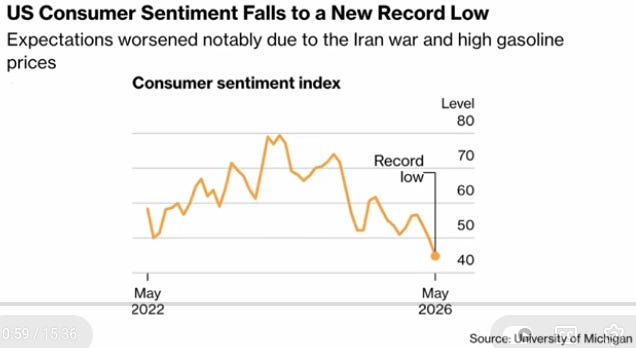
But Trump needs to look in the mirror, because the US economy is buckling as well. American consumers are now expecting prices to rise by almost 4% every single year for the next decade. Consumer sentiment has collapsed to a record low as well. Both sides are hurting, but only one side is willing to admit it–and it’s not the US.
Trump is gambling with the US economy here. The global oil shortage is tightening its grip. Japan, Korea, and most of Asia are still facing serious supply shortfalls and US production simply cannot fill that gap for the rest of the world. The Federal Reserve just issued a stark warning. They said global oil and natural gas consumption “could need to fall more meaningfully than it has so far.” Now, that phrase has a specific meaning. It means demand destruction is coming. And demand destruction is just a polite way of saying, a serious recession is on the horizon.
Trump is still stuck in fantasy land about all of this. He believes the war will end soon and everything will snap back to normal. But the markets are telling us a completely different story. By April 2027, rate hikes are looking almost inevitable. There’s a 72% chance of at least one hike. There’s a 28% chance rates stay exactly where they are right snow, which is already very high. And there’s literally zero probability of a rate cut being priced in. Zero.
The Danny Davis/Art Berman video linked above goes into excruciating and alarming detail regarding why there will be no ‘snap back to normal.’ Berman figures that if peace breaks out by Monday, June 1st, and if everything subsequently goes absolutely perfectly, we might see some relief by the end of the year on the energy front. But he also says that 700K barrels a day production has been lost forever. There will likely never be anything like ‘normal’ again. Thank you, Dumbf.
And here’s Trump being unable to say ‘No,’ once again. When you read his words—and even more, when you listen to him—you realize he’s just making shit up as he goes along. You can tell he doesn’t really believe any of this. He knows he’s stuck, he knows he can’t say ‘No’, but he can’t level with the American people. And neither can our elected representatives, whose allegiance has been bought by the same people who own Trump.
This is a nightmare scenario for Trump. He has been trying to arm twist the Fed chair Kevin Warsh to keep late rates low, and he needs cheap money to keep the economy appearing strong heading all the way to the midterms. But Trump himself keeps throwing new obstacles into the peace process. Now Donald Trump is demanding that Saudi Arabia and Qatar normalize relations with Israel as part of any deal. Just listen to the timing on that. That condition alone could blow up the entire negotiation instantly.
Trump: I would like to have them join the Abraham Accords. It’ll be historic if they do it. And we would, I think they, I think they owe that to us, to be honest. I’m not sure, I’m not sure we should make the deal if they don’t sign. You want to know the truth? If they don’t sign to join the Abraham Accords, I don’t know that we, you know, we have countries in there already.
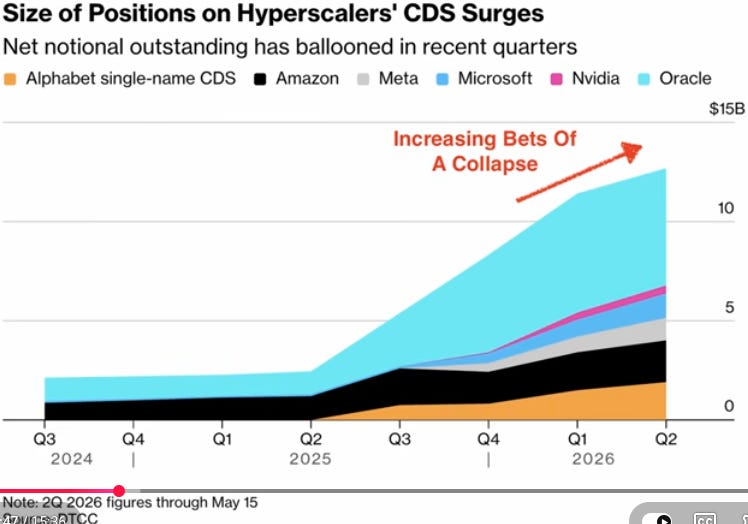
Will Iran accept that demand? Most likely not. And could it trigger new strikes instead? Absolutely possible. And every day this drags on, it keeps the US locked in the dangerous loop of higher interest rates. Wall Street is quietly preparing for the worst. Investors are buying credit default swaps (CDS) to hedge against a collapse in all the big tech valuations. Those bets are up 500% since Q2 last year. Over $12 billion is now actively positioned for market implosion. The smart money is beginning to hedge themselves, and that tells you everything we need to know.
Now, read this next paragraph carefully. Foo says what nobody else is saying, but it’s why I stressed yesterday that Iran is undoubtedly coordinating closely with China and Russia.
Trump has no leverage and Iran knows it. Here’s the reality of where the negotiations actually stand. The US has no real leverage left, and Iran’s terms are so humiliating that Trump simply cannot accept them politically. Iran’s demands are essentially a complete US strategic defeat or retreat, and the optics would be devastating for the administration.
Mearsheimer stressed this reality, this morning, as of course Pape did.
Iran is demanding the US Navy lift the naval blockade completely. Iranian cargo ships would flow freely without any restriction. The Hormuz would reopen and commercial transit will be restored within a month. But here’s the critical part. Hormuz would remain under Iranian control with cooperation from Oman. And the economic consequences of that arrangement are enormous. Iran just wants the US to surrender. And beyond charging a $2 million toll on ships passing through, Iran could force Gulf states to price their oil cargoes in Chinese RMB. That is going to directly threaten the entire petro-dollar system. The system that has underpinned US financial dominance for 50 years.
Hmmm.
Luke Gromen @LukeGromen
Do you think the irony of threatening to impose yet another “toll” on the chokepoint that is the USD system in response to a toll on the chokepoint that is Hormuz is lost on Bessent, or does he just not give a sh*t?
As a gold holder, I say “the more USD sanctions, the better.”
Yes, all modern wars are bankers’ wars. And the scary number in all this is the ~$40T debt that the US has run up. And Trump has the nerve to say that other people owe us!
Think about the scale of what flows through the strait. Over 14 million barrels of oil per day. That’s 20% of all global oil consumption going through one waterway. And nearly 38% of all those flows goes directly to China. Now, if Trump concedes to Iran’s framework, China and Iran will definitely work together to price that oil as much as possible in yuan. The petro-dollar is going to take a fatal blow. Trump is so desperate about Hormuz that he’s now threatening Oman directly. He’s warning them not to cooperate with the Iranians on managing the strait. And this tells you how cornered the US actually is in all these negotiations.
Trump: But nobody’s going to control it [the Strait of Hormuz]. That’s part of the negotiation that we have. They would like to control it. Nobody’s going to control it. It’s international waters and, uh, Oman will behave just like everybody else. So we’ll have to blow them up. They understand that. They’ll be fine.
The reason CENTCOM keeps talking about “defensive strikes” is because Trump is on very thin ice, politically. The DC political elite is getting briefings on all the economic ramifications of Trump’s war and they can see the handwriting on the war. The Jewish Nationalists don’t pay most of them enough to commit political suicide. Trump knows his 60 days under the War Powers Resolution are up. Is he trying to provoke an excuse for more bigger strikes, claiming self defense, maybe while Congress is in recess beginning next week? My speculation that Trump may not make it to the midterms in office still stands. It’s speculation, it would be unprecedented, but it’s not unreasonable. Everything about what’s going down is unprecedented.
But even while talks supposedly continue, the US keep striking Iranian military targets. There’s no ceasefire. Is there really a ceasefire? There’s no framework. Now, Trump calls this “defensive strikes,” but striking a country you’re negotiating with is not a path to any deal, goodwill, or long-lasting deal. Trump also made two statements that guarantee further escalation.
Firstly, he doesn’t want Russia or China involved in any uranium guarantee arrangement–but, realistically, they may be the only credible guarantors that Iran would actually trust. Without them, any deal is meaningless.
Second, Trump is now refusing to reverse sanctions or to unfreeze Iranian assets, even as a goodwill gesture. He wants concessions without offering anything meaningful in return.
Trump: No, we’re not talking about any easing of sanctions or giving money, no sanctions, no money, no nothing. Uh, we have control of money that they claim is theirs. Uh, we’ll keep control of that money and when they behave properly and when they do what’s right, we’ll let them have their money. But right now, we’re not doing that.
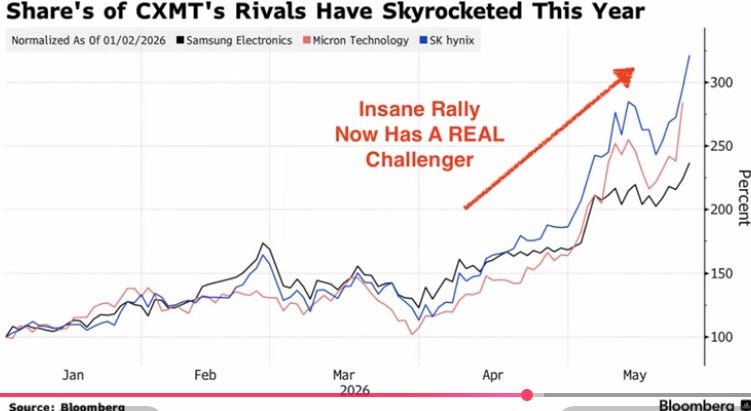
While the Iran war grinds on, China is quietly engineering another massive disruption. And this time, it’s going to happen in the global chip market. And most investors have no idea that it’s coming. We are deep inside a semiconductor bubble right now. Memory chip stocks have risen by over 200% in just 6 months.Micron alone went from under $100 to over $900 a share after Trump hyped it up. The market is completely detached from reality here. But here’s what the market hasn’t priced in just yet. China’s preparing to break the global memory chip cartel wide open, and they have the capital and manufacturing skill to actually accomplish it.
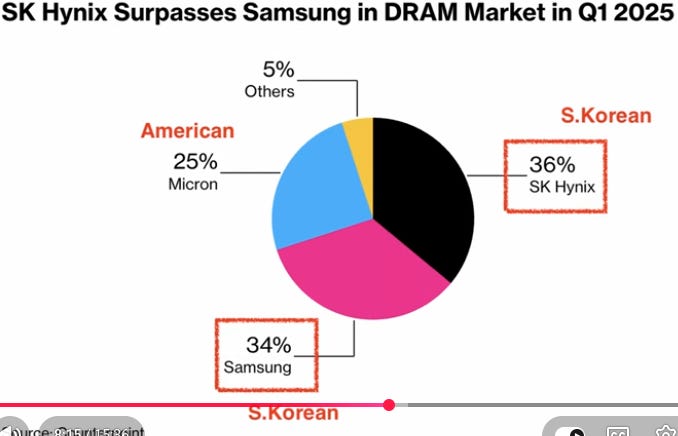
Now, the global memory market is controlled by just three companies. Samsung and SK Hynix together control 70% of the entire market, and that’s on the Korean side. Micron, Trump’s favorite stock pick, holds another 25%. That’s a near total monopoly split between two Korean companies and one American firm.
China wants to crack that monopoly. And just like the West is trying to break China’s grip on rare earths, China is now targeting the memory chip market with the same intensity and the same long-term patience. And memory chips are only becoming more critical over time. In Nvidia’s latest Rubin AI infrastructure, memory already accounts for 26% of total system cost. That’s a massive jump from previous generations. As AI models get larger and more demanding, that percentage is going to keep climbing, and whoever controls memory supply controls a growing slice of the entire AI economy.
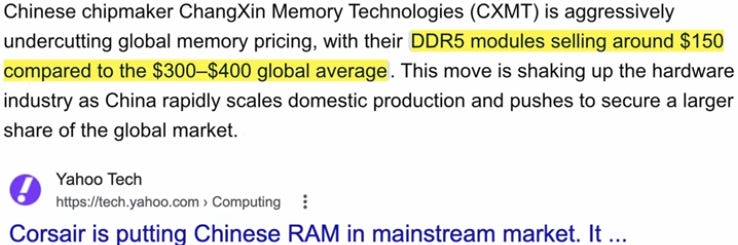
But here’s the move that should be making Micron and Samsung quite nervous. CXMT, the Chinese memory chip company, is heading towards the biggest IPO China has seen since 2022. They are targeting up to $5 billion in fresh capital and every dollar of that money goes straight to expanding DRAM production capacity and advancing that technology. The company is already inside mainstream Western products. Right now, companies like Corsair are putting Chinese memory chips into Western hardware because the price differential is simply too attractive to ignore. Chinese memory modules cost around $150. The global market average around the world is around $300 to $400.
That is at least a 50% price discount sitting right there. Any company that wants better margins are going to buy Chinese. Western hardware makers are already choosing it. And with the 5 billion in fresh IPO capital, we also know CXMT is going to get the full backing of the Chinese government. They’re going to be able to scale quite fast. The memory chip bubble that sent all the Micron and all the Samsung stocks flying is now under threat. It’s on a very shaky foundation. And when the market wakes up to the Chinese threat, this unwinding could be brutal and could happen really, really fast, much faster than any of us might expect.
Now, while China engineers a price collapse in memory chips, American consumers are trapped in an inflation nightmare. For them, prices are going up and food is where the pain is hitting the hardest. The CPI for groceries jumped by 70 basis points in April alone. That was the largest single monthly increase since August 2022. And, since that year, supermarket prices have risen by at least 32% in total. And that’s just the official number–which almost certainly understates what people are actually experiencing at the checkout.
The root cause goes back to the fertilizer crisis triggered by the Hormuz shutdown. Even before the strait closed US farms were already struggling badly, and now they are facing conditions that could push many of them directly over the edge. Chapter 12 farm bankruptcies have surged 46% last year and the agency forecasts sector-wide debt to climb to a record $624.7 billion this year. Farm debt in the US has hit over $620 billion. You heard it. And that debt is getting more expensive to carry as rates are hitting higher and higher. On top of that, farming equipment costs have jumped because of Trump’s own tariffs–at least 20% to 30% more expensive. So more farms could collapse before the end of 2026. And when farms collapse, food supply drops. And when supply drops, prices are going to go even higher.
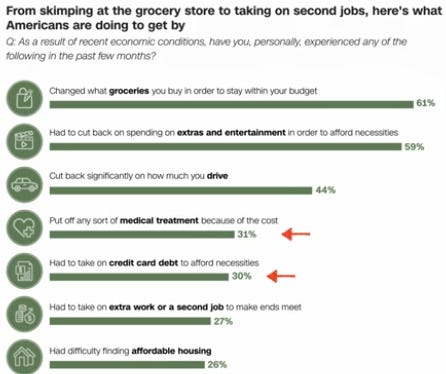
This is a very vicious cycle. 61% of Americans say they have to cut back on groceries. This is not luxury items, not your Gucci or LV bags, not entertainment, but food. This is the most basic necessity. Fuel costs are eating up more and more of household budgets every month. People are being squeezed from multiple directions simultaneously. You have higher food prices, higher energy costs, and higher borrowing costs. And it’s hitting everyone at the exact same time. Let’s look at some of the consequences. Nearly 60% of Americans are cutting back on extras and entertainment. That alone signals a coming consumption collapse for companies that depend on discretionary spending. But the truly alarming numbers are these. 31% of Americans are now delaying medical treatment because they simply cannot afford it. This is tragic. This is just pure heartbreaking. And 30% are taking on additional credit card debt just to cover the basic necessities. People are swiping plastic just for food and utilities.
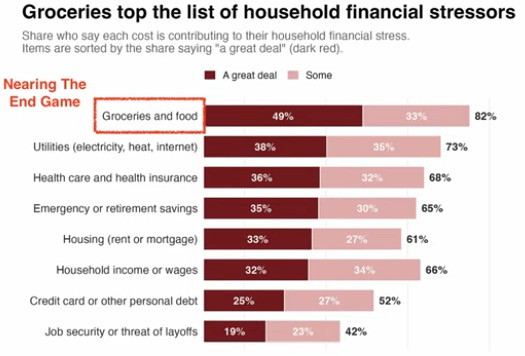
This cannot continue indefinitely. Credit card debt piled on top of high interest rates is a financial trap with just one outcome. Default. And defaults at scale means banking stress. So we might enter an environment of tighter lending and even deeper economic slowdown. Groceries have become the number one financial worry for American households–not mortgages and not even healthcare. And when people in the world’s largest economy cannot afford to eat properly, every other part of their economy starts breaking down, too.
The picture across every front is getting darker and darker. The Iran talks are going nowhere. Trump has no leverage but keeps adding new demands every single day. At the same time, China is positioning themselves to blow up the semiconductor bubble with a mega IPO. Investors haven’t even heard of it yet. Most of them haven’t. And when that reality hits the market, stocks that have risen by 200% could reverse just as violently. On Main Street, ordinary Americans are cutting back on food. They’re delaying doctor visits and loading up on credit card debt. But Wall Street is cheering all the way to the bank. Micron investors celebrate $900 stock prices. This is the “K-shaped economy” playing out in real time. Main Street is collapsing. Wall Street is celebrating. Something is going to crack. And the only real question is: What is going to break first?