
The Invisible GMO: How Gene-Silencing Crops Reached Your Plate
A novel class of genetically engineered food has quietly colonized the American diet since 2017. It doesn’t make a poison. It switches off genes. And there is no label telling you it’s there.
Dinner, Disrupted
Picture a family eating dinner in the American Midwest. The kids are having corn chips and juice. Dad’s eating a pork chop. Mom reaches for the salsa — corn-based, like nearly everything on the table. It’s an ordinary evening in the most ordinary country in the world.
Now consider what might be happening at the molecular level inside that corn.
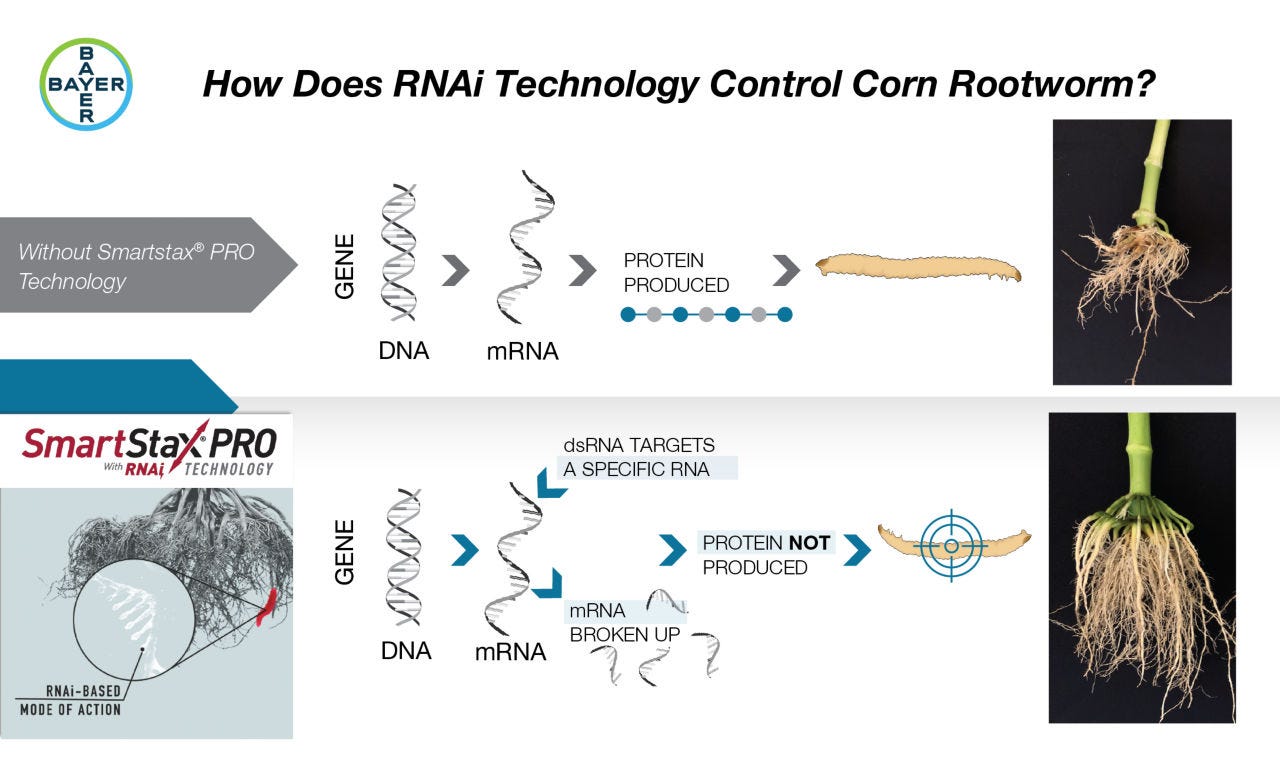
Embedded in the genome of the corn plants that grew those chips — the same corn that makes the high-fructose syrup in that juice, the same corn silage that fed that pig — is a genetic sequence encoding a molecule called double-stranded RNA, or dsRNA. Think of dsRNA as a search-and-destroy code for genes: a precisely designed molecular message that, when read by a cell’s machinery, identifies a target gene and shuts it down. The target, in this case, is a gene in the western corn rootworm — a devastating agricultural pest. The technology is called RNA interference, or RNAi. The corn is called SmartStax PRO, and it was approved by the EPA in June 2017.
Since that near-silent approval, RNAi crops have expanded to somewhere between 20 and 30 million acres of American farmland. A sprayable version — a gene-silencing aerosol applied directly to potato fields — has been commercially available since 2024. A second sprayable product, this one fed directly to honeybee colonies to kill varroa mites, received federal registration in September 2025. RNA-based fungicides are now before regulators in the US, the EU, and Brazil. An RNA herbicide that silences genes in weeds rather than insects is moving through development.
The family at the dinner table knows none of this. There is no label. There is no mandatory disclosure. There is, to all appearances, just dinner.
This is the story of how we got here, what the science actually says, and why the window to demand a different answer is closing faster than anyone in Washington will admit.
What RNAi Is — and Why It’s Different From Every GMO Before It
To understand why this moment matters, you need to understand what makes RNAi agriculture genuinely unprecedented.
Every GMO that came before it — herbicide-tolerant soybeans, Bt corn, Golden Rice — worked by adding or deleting a protein. The engineered gene produced a new protein, or it knocked out a protein the plant already made. Proteins are the workhorses of biology, and their effects, while sometimes complex, can in principle be tested with standard toxicological tools: feed it to rats, measure the outcomes.
RNAi works at an entirely different level of biology. It doesn’t produce a protein at all. It produces RNA — specifically, double-stranded RNA — which acts not as a building block but as an instruction. RNA is the software running on the DNA hardware of a cell. And double-stranded RNA, in particular, is something mammalian biology has evolved to treat with extreme caution.
Here’s why. Long before the first drug or pesticide was ever invented, viruses were invading cells and replicating using double-stranded RNA as part of their life cycle. Mammalian immune systems evolved a hair-trigger response to any long, perfectly duplexed RNA in the cellular environment, treating it as a viral alarm signal — what immunologists call a PAMP, or Pathogen-Associated Molecular Pattern. When the immune system detects a PAMP, it doesn’t pause to sequence it or identify its source. It responds: shutting down protein synthesis, degrading cellular RNA, triggering interferon, and, in severe or sustained cases, initiating cell death.
The DvSnf7 dsRNA in SmartStax PRO corn — the active genetic payload in the world’s first commercial RNAi crop — is a 240 base-pair hairpin. The threshold for triggering the mammalian interferon response is 30 base pairs. The threshold for maximal activation of PKR, the immune kinase that halts all protein translation in an affected cell, is 85 base pairs. SmartStax PRO’s payload clears both thresholds by a wide margin.
This is not a theoretical concern invented by critics. It is established molecular biology, documented in peer-reviewed literature, and identified in the canonical risk analysis of RNAi crops by independent scientists Jonathan Latham and Allison Wilson of the Bioscience Resource Project. Their framework — which I first reported on in my 2015 GreenMedInfo article on the EPA’s silent approval — identified three distinct mechanisms by which RNAi crops could harm non-target organisms, including humans. Nearly a decade later, none of the three mechanisms has been adequately addressed by regulators.
And meanwhile, the food supply has been transformed.
The Gene That Never Asked Permission
The story of how RNAi corn entered American agriculture without public knowledge begins with a regulatory decision in June 2017 that Bill Freese of the Center for Food Safety, reporting to The Atlantic, called a masterpiece of bureaucratic invisibility.
The EPA offered just 15 days of public comment on SmartStax PRO — compared to the standard 60 days for significant regulatory actions. The agency did not post the approval to the Federal Register, the standard mechanism by which the public and Congress are notified of major regulatory decisions. The technology landed in American cornfields with the quiet authority of a memo circulated among insiders — which is essentially what it was.
SmartStax PRO was not a simple product. As I documented in that 2015 article, the approved stack contained six separate modes of action stacked into a single corn variety: the DvSnf7 dsRNA RNAi payload, three separate Bt proteins for rootworm and above-ground pest control, glyphosate tolerance, and glufosinate tolerance. This complexity was not incidental. Embedding the RNAi trait within an already-complex toxicological cocktail made it impossible to isolate RNAi-specific effects in any subsequent field monitoring. If something went wrong in the populations eating this corn, identifying dsRNA as the cause would require a level of molecular epidemiology that the United States has never performed for any agricultural biotechnology.
The EPA’s own Scientific Advisory Panel had flagged “ongoing areas of uncertainty” in its 2016 meeting minutes — concerns that dated back to a 2014 SAP meeting and had not been resolved. The approval went forward anyway.
No new RNAi-specific SAP meeting appears on the EPA’s advisory panel list for 2025 or 2026. The scientific review has not kept pace with the commercial expansion.
Since 2017, Bayer has steadily expanded SmartStax PRO acreage. By the 2024 growing season, Bayer’s seed lineup featured 25 new DeKalb hybrids carrying SmartStax PRO or the related VT4PRO RNAi technology — a second Bayer trait launched commercially in Eastern Canada in 2025. Corteva launched its own competing RNAi corn product, Vorceed Enlist, in 2023, targeting the same DvSnf7 gene sequence in corn rootworm. Both companies’ RNAi acres are additive. The total US footprint of RNAi corn in 2025 is conservatively estimated at 20 to 30 million acres — roughly 20 to 30 percent of the total US corn crop.
That corn is the genomic backbone of approximately 75 percent of processed foods sold in American supermarkets.
https://sayerji.substack.com/p/the-invisible-gmo-how-gene-silencing