
‘The New Enemy’: Noise Pollution From AI Data Centers Causing Nausea, Insomnia

Noise emitted by data centers can be heard and felt hundreds of feet away, and noise levels can reach up to 96 decibels — for 24 hours a day, seven days a week.
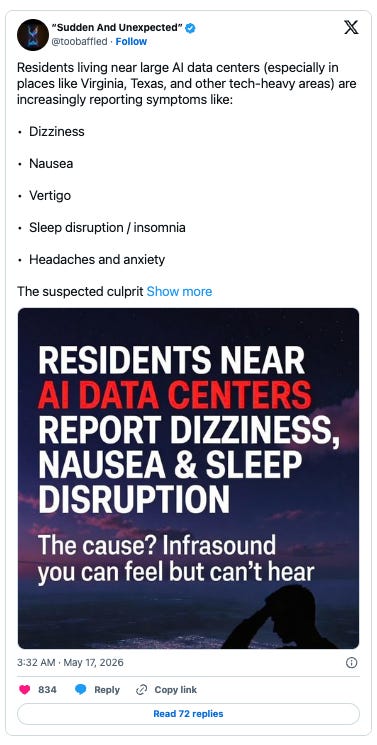
Residents living near artificial intelligence (AI) data centers are reporting symptoms — including dizziness, nausea, vertigo, insomnia, headaches and anxiety — that they believe are directly related to the centers’ noise pollution.
According to the Environmental and Energy Study Institute, the noise emitted by data centers can be heard and felt hundreds of feet away, and noise levels can reach up to 96 decibels — for 24 hours a day, seven days a week.
Sound levels exceeding 85 decibels are considered dangerous and potentially damaging to human hearing, depending on the duration of the exposure.
Data centers also emit infrasound, a low-frequency (below 20 Hertz) rumble that the human ear can’t hear, but the body feels as pressure or vibration.
Infrasound generated by data centers is “the new enemy,” Futurism reported earlier this month. The centers’ cooling systems, power generators and server racks are suspected infrasound culprits.
‘Infrasound’ may negatively affect heart functioning
Some data centers have been built as close as 50 feet from people’s homes.
Residents exposed to infrasound from data centers are reporting symptoms similar to EMR Syndrome, which is linked to the electromagnetic radiation (EMR) emitted by cell towers, cellphones and Wi-Fi networks.
This symptom overlap comes as no surprise to Paul Héroux, Ph.D., associate professor of medicine at McGill University in Montreal, Canada, and a medical scientist in the McGill University Health Center surgery department.
“Sound, electric and magnetic fields of the same frequency have some overlap in their biological effects because they are similarly disruptive energy injections,” Héroux said.
Héroux is also vice chair of the International Commission on the Biological Effects of Electromagnetic Fields, a “consortium of scientists, doctors and researchers” who study wireless radiation and make recommendations for wireless radiation exposure, “based on the best peer-reviewed research publications.”
According to Héroux, infrasound at high volumes can directly affect the human central nervous system, causing disorientation, anxiety, panic, bowel spasms, nausea, vomiting, eventual organ rupture and even death.
He pointed out that in 1957, French scientist Vladimir Gavreau began experimenting with low-frequency acoustics to create an audio weapon for the French military.
Just five years ago, German researchers published results from an in-vitro study showing that after just one hour of exposure, high levels of infrasound interfered with the heart muscle’s ability to contract properly.
Based on those findings, it’s possible that chronic exposure to infrasound from data centers could negatively affect heart function, Héroux said.
W. Scott McCollough, lead attorney for Children’s Health Defense (CHD) EMR & Wireless cases, also wasn’t surprised that exposure to infrasound emitted by data centers and radiofrequency (RF) radiation from cell towers and other devices can trigger similar symptoms. He said:
“Infrasound waves come from periodic pressure fluctuations, very akin to how modern radio systems modulate RF energy to carry information. The modulation leads to asymmetric bursts of energy with sharp peaks and valleys. Both lead to resonance and amplification, leading to stronger peaks in energy or sound pressure.”
‘Not in my backyard’: Most U.S. adults don’t want a data center near them
The average data center is roughly 100,000 square feet — large enough to fit nearly two football fields. Proponents of the gigantic infrastructures argue they are necessary for the U.S. to keep its competitive edge over China in the AI revolution.
But local residents — especially women — are sounding the alarm. Critics warn that the center will likely harm nearby residents, including children, and the surrounding environment.
Last month, Maine was poised to become the first state to enact a moratorium on new data centers. However, Gov. Janet Mills vetoed the bill. She wrote in a letter explaining her decision:
“A moratorium is appropriate given the impacts of massive data centers in other states on the environment and on electricity rates. But the final version of this bill fails to allow for a specific project in the Town of Jay that enjoys strong local support from its host community and region.”
Maine is one of at least 11 states that have proposed legislation to restrict or ban data center development since late 2025.
A Gallup poll conducted in March found that 7 in 10 U.S. adults oppose having a data center in their area. Only 7% said they were strongly in favor. Fifty-five percent of women said they strongly opposed data centers, compared to 43% of men.
‘These decisions must be made at the local level’
AI data centers have already drawn fierce, bipartisan criticism for their water and electricity consumption and environmental impact.
Miriam Eckenfels, director of CHD’s EMR & Wireless Program, said she sees similarities in the U.S. situation between data centers and new cell towers, which are also known to cause harm to human health and the environment.
In both cases, companies that stand to profit try to put up infrastructure close to where people live, learn and play. “People don’t want them, so they oppose them,” Eckenfels said.
Local communities should have the right to say no to such developments. “These decisions must be made at the local level and not in Washington D.C., where folks are far removed from the reality on the ground and the negative consequences.”
https://tdefender.substack.com/p/ai-data-centers-noise-pollution-nausea-insomnia