
Time to Slay the Slop Machine
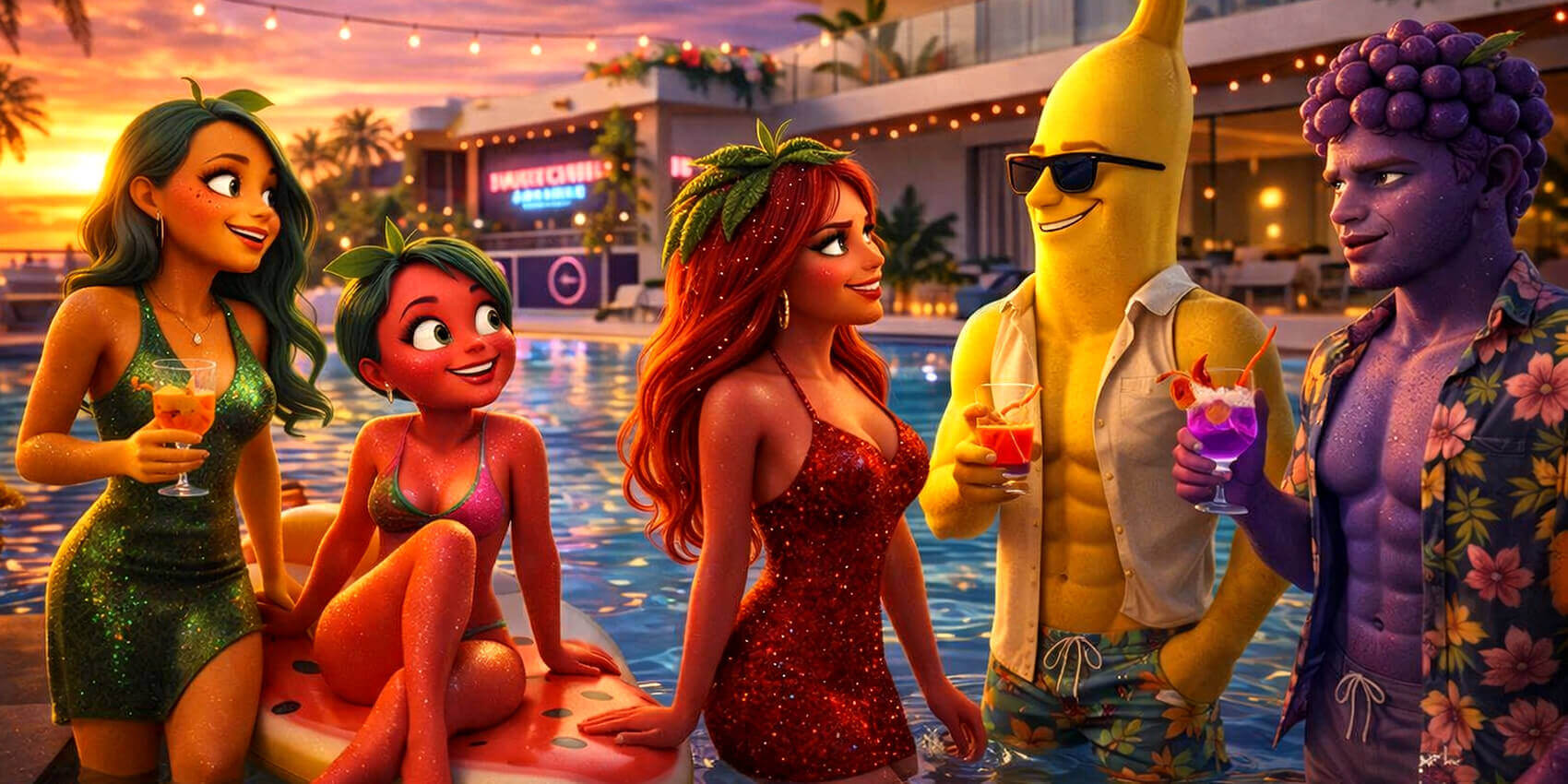
For a few short weeks in March, the internet was ablaze with rumors. Comment sections were littered with fruit emojis, speculation, and fiery debate. On the face of it, this was nothing unusual—social media is often a cesspit of self-righteous ideologues broadcasting their moral certainties into the ether. But what made this collective cyber frenzy even more absurd was that the occasion for it was Fruit Love Island, a TikTok soap opera depicting an anthropomorphic Strawberry and Banana’s cheating scandal played out for an audience of millions. This was Penelope and Odysseus fed through the meat grinder of the 21st-century attention economy and served up as a tepid bowl of AI-generated internet slop masquerading as a love story.
This drek became so popular that its creator earned the distinction of having the fastest-growing TikTok account in history, racking up 300 million views in just nine days. But this meteoric rise came at a cost. Viewers began flagging the account for low-quality AI-generated content, and TikTok deleted many of the episodes. With copycats proliferating and his views tanking, the creator finally rage-quit and deleted the account—mirabile dictu.
Fruit Love Island itself is derivative. It’s an animated parody mimicking the aesthetic and jargon of Love Island, the reality TV show that spawned the modern age of slop. The show, featuring a plethora of inarticulate, chemically altered 20-somethings attempting to “find love” is one of the most popular in Britain and spawned a copycat American version called Love Island USA. Nearly 3 million people in the UK—around 5 percent of the nation’s population—tune in to watch this spectacle of untrammeled hedonism each week.
This is a textbook symptom of what the cultural theorist Mark Fisher identified as “the slow cancellation of the future.” We are stuck in a doom loop, choking on the fumes of a toxic nostalgia. Life has become a constant series of reboots: fashion revives old trends, bands reform to make quick cash on past glories, and we are plagued by incessant Hollywood reboots. Fruit Love Island is the apotheosis of this pop cultural gold-mining. By feeding the trashy tropes of reality television into the generic maw of generative artificial intelligence, we may be reaching total cultural stagnation. Late-stage capitalism, rather than producing bold, new artistic forms, has reduced entertainment to sterile pastiches of preexisting intellectual properties.
This reliance on the forms of the past is what Fisher, borrowing from Jacques Derrida, termed hauntology—a state in which our culture is haunted by ideas from the past that never came to fruition. We are trapped in a perpetual present, forced to live with the ghosts of past visions of tomorrow because neoliberalism has neutralized our capacity to produce new ones.
This dearth of imagination forces us to confront the psychological toll of the slop-machine, where our narcissism, fueled by validation and dopamine hits, has become the standard modus operandi. One of the defining characteristics of clinical depression is anhedonia—the complete inability to feel pleasure. But we appear to have taken, even this, one step further. Fisher inverted this concept to argue that late-stage capitalism has bred a state of “depressive hedonia,” by which he means we inhabit a shallow, meaningless existence defined by instant gratification, in which doomscrolling operates not as a pursuit of genuine pleasure but as an involuntary, neurotic reflex against the horror of boredom. In this state, we engage with slop in a desperate bid to stave off the emptiness of a hyper-commodified reality, mistaking the short-lived dopamine spikes of a TikTok soap opera for meaningful human connection.
As human beings with minds and souls, we need to find our way out of this fetid pool of slop in which we are now firmly enmired as consumers, and nothing more. Slaying the leviathan will not be easy. Slop is ubiquitous. The steady drip feed of brain rot has become a raging flood. Creators seek recourse in supply and demand, and you cannot starve the beast when the public keeps feeding it.
So what is to be done? The debate generally comes down to accelerationism versus traditionalism: Either we embrace the limitless potential of new technology or revert to older ways of living. Traditionalists pursue digital detoxes, dumb phones, and reading groups—a neo temperance movement for the internet age. While I have some affinity for this approach, it risks becoming little more than a form of class signaling, a means for the wealthy to differentiate themselves from the lumpen “scrolletariat.”
Instead of looking to the Luddites, the 19th-century English textile workers who destroyed mechanized power looms to defend their livelihoods, as exemplars of ignorance, we might reconsider them as techno-realists, people who believed that highly skilled craft traditions held inherent human value. Of course, a revolution to seize the means of technology production isn’t required today; besides, everyone would be too distracted by the latest viral nonsense to overhaul the system. But it is important that we remember that modern technology is placeless; it detaches us from both the act of labor and its products. To fight slop, we must reclaim our placedness in our modern material culture, embrace deferred gratification, and rediscover the real beauty that comes from creating something of lasting value.
Either that, or we wait for the public to ditch its De Sade-inspired appetites.
https://chroniclesmagazine.org/web/time-to-slay-the-slop-machine