
Stalingrad and the Eurasian Order
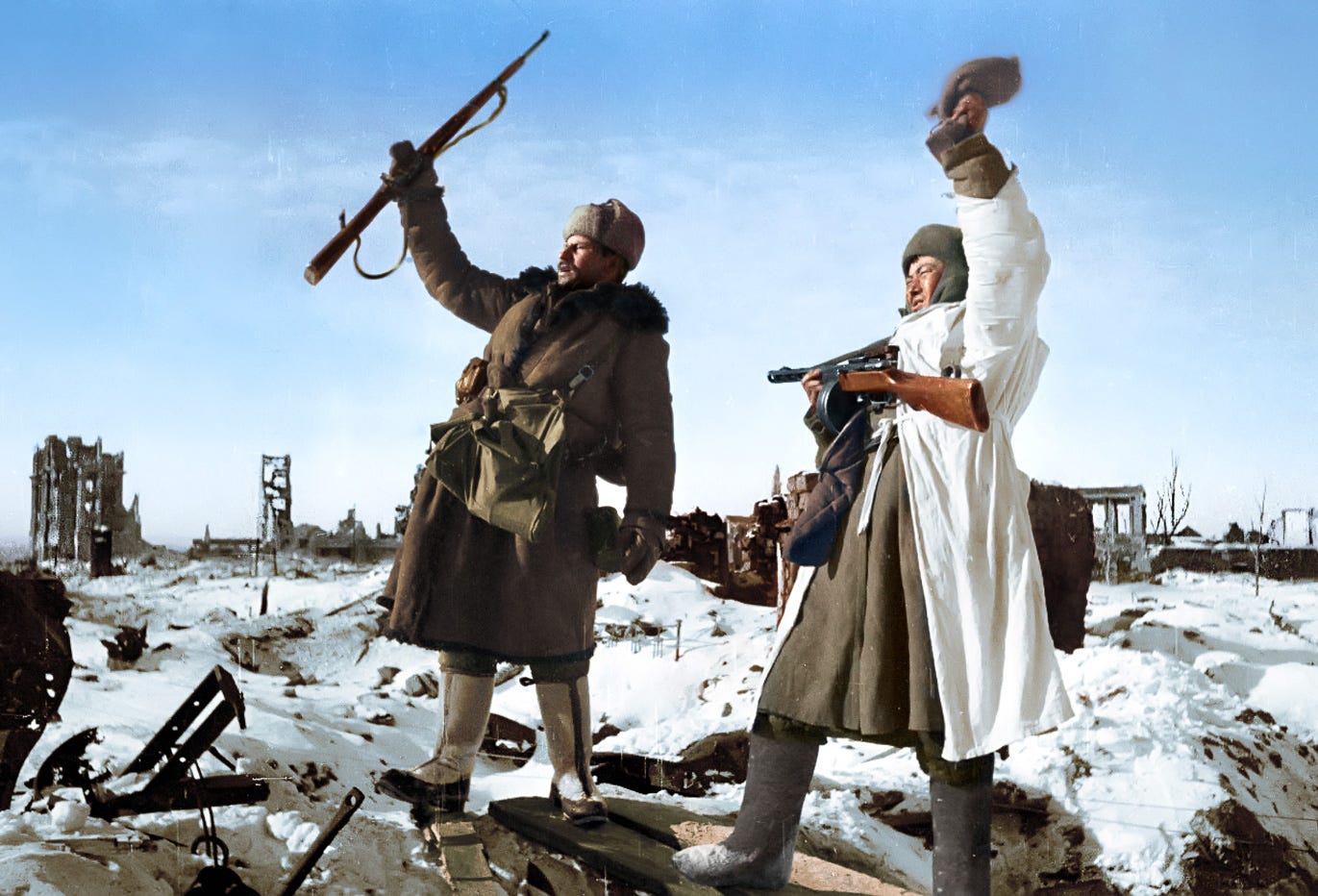
The will to power on the Volga.
After the Stalingrad slaughter, as is known, the Germans were unable to recover. — Joseph Stalin, 6 November 1943
The war in the East began as far more than a contest between states. From the first days of the campaign, it carried within it an immense ideological charge. Military objectives, racial theories, economic ambitions, and dreams of continental mastery fused into a single enterprise. Vast territories stood marked for conquest, their resources destined for extraction, their populations assigned places within a hierarchy shaped by power. The German leadership envisioned a transformed Europe stretching deep into Eurasia, governed through force and organized according to principles that claimed permanence. In this sense, the conflict became a struggle over the future shape of an entire continent. What unfolded along the endless plains between Berlin and the Volga resembled an attempt to impose a new historical order through steel, administration, and war. The battlefields of the East became laboratories of empire where armies carried competing visions of civilization, destiny, and political faith.
Stalingrad emerged as the decisive test of these ambitions. Across months of relentless combat, entire formations disappeared beneath artillery fire, hunger, disease, and winter cold. Hundreds of thousands perished. The German advance, which had swept across Europe with astonishing speed, encountered its limit on the banks of the Volga. The statistics remain staggering: nearly half a million Soviet soldiers killed, hundreds of thousands wounded, and immense losses among the Axis forces. The German Sixth Army entered history as a symbol of destruction on a scale that surpassed ordinary military defeat. When the encirclement closed and resistance finally ended in February 1943, a legend collapsed. The belief that victory remained inevitable vanished beneath the snow. The battle transformed from a military event into a historical marker dividing one age from another.
For many observers, Stalingrad acquired a significance extending beyond strategy. The French writer Louis-Ferdinand Céline viewed it as the point where an entire chapter of European history reached its conclusion and the White race met the beginning of its end. His language carried the force of prophecy rather than analysis. He saw the shattered armies on the Volga as symbols of a civilization exhausted by generations of conflict, revolution, and ideological struggle. Such interpretations belong less to military history than to the realm of historical imagination, yet they reveal how deeply the battle entered the consciousness of Europe. The city became a symbol through which writers, thinkers, and political movements sought to understand the transformation of the modern world. The collapse of one vision of Europe stood before them, while the shape of the coming order remained uncertain and unfinished.
Among those who reflected upon the fate of Europe, the German author Ernst Jünger occupies a distinctive place. Unlike many contemporaries, he viewed great conflicts as moments that revealed the hidden structure of an age. Through his experiences in two world wars, he observed the rise of technological power, mass mobilization, and the transformation of the individual into a component within vast systems. Stalingrad appeared as one of the ultimate expressions of this process. Heroism remained present, sacrifice remained real, yet both existed within a battlefield dominated by industrial force and total mobilization. The warrior traditions of earlier centuries confronted a new reality shaped by machines, bureaucracy, and mass politics. Jünger perceived in such struggles the end of one historical form and the emergence of another, where the scale of organization exceeded anything known in previous European history.
The aftermath of Stalingrad opened the path towards a radically different geopolitical landscape. The Soviet Union emerged from the battle with immense prestige, having absorbed the greatest blow of the German offensive and reversed its momentum. Across Europe, the balance of power shifted decisively. The old continental empires entered their final phase, while new structures of authority took shape. In later decades, the Belgian thinker Jean Thiriart interpreted these developments through a geopolitical lens. He argued that Europe’s future depended upon continental unity on a grand scale rather than dependence upon external powers. For Thiriart, the tragedy of the twentieth century lay in Europe’s fragmentation and inability to act as a single political force across the Eurasian landmass. Stalingrad thus represented more than a military turning point. It demonstrated the decisive importance of territorial depth, industrial capacity, and civilizational cohesion in the modern age.
The legacy of Stalingrad continues to resonate because it touched questions larger than armies and frontiers. It marked the defeat of a project that sought mastery through conquest and racial hierarchy, while simultaneously confirming the strength of a Soviet civilization forged through revolution, industrialization, and immense sacrifice. The battle revealed that historical survival belongs neither to inherited prestige nor to memories of former greatness. Every civilization faces moments of testing. Some emerge strengthened. Others pass into history. The ruins of Stalingrad became a monument to this reality. They stand as a reminder that power, culture, and political order derive their meaning through struggle. Across the decades, the battle has remained a symbol of endurance, collapse, renewal, and transformation, shaping the historical consciousness of Europe and Eurasia long after the guns fell silent on the Volga.
https://www.eurosiberia.net/p/stalingrad-and-the-eurasian-order