
Ultra-Zionist Sen. Tom Cotton Tries to Sneak Anti-American Amendment Into Funding Bill
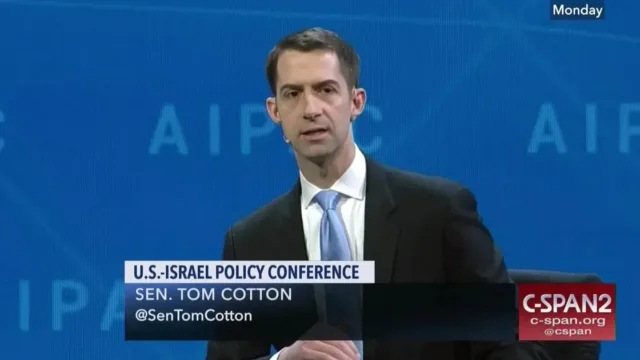
Quiet insertion of new section to Intelligence Authorization Act of 2027 comes on heels of House amendment to NDAA that would mandate U.S. military to share technology breakthroughs with Israel.
I recently reported that the U.S. House of Representatives has quietly inserted an amendment, Section 224, into the National Defense Authorization Act of 2027 that would merge the U.S. and Israeli militaries for purposes of various weapons technology research and development, including but not limited to artificial intelligence, autonomous systems, cyber, quantum computing, biotechnology and virtually any other new developments that come down the pike.
If that wasn’t bad enough, there is an even more questionable piece of legislation now being advanced in the U.S. Senate that seeks to merge the two nations’ intelligence-gathering operations in the Middle East.
Buried deep inside the Senate’s 192-page Intelligence Authorization Act of 2027 is Section 622, titled “United States-Israel Intelligence Sharing Enhancement.” It would require the president, acting through the director of national intelligence and as necessary the secretary of war, to “expand and enhance intelligence sharing with the Government of Israel” on a list of subjects that encompasses almost every topic of intelligence interest in the Middle East.
The amendment was offered by Republican Senator Tom Cotton of Arkansas, a notorious Israel-firster who has been a vocal proponent of U.S. involvement in every foreign war of choice in the Middle East since getting elected to the House in 2012 and the Senate in 2014. Although not as well-known as Senator Lindsey Graham of South Carolina, Mr. Cotton is every bit as bad when it comes to his eagerness to use U.S. military power on behalf of foreign interests.
Cotton has ascended under Trump to the powerful position of chairman of the Senate Intelligence Committee. He has reached a new low by trying to sneak Section 622 into the annual intelligence funding bill.
In his own press release on the bill, issued on May 21, Cotton makes no mention of the mandated sharing in intelligence information with Israel.
The amendment to the intelligence community’s overall funding bill would prohibit any suspension, reduction, or limitation of such sharing “except on the basis of a specific and identifiable national security concern determined by the President.” Any such exception would require a report to Congress within 15 days detailing not only the reason for the change but also the categories of information involved. The same report would require an assessment of the anticipated impact on regional security and various other matters.
So what this does is codify into law a marriage of the U.S. and Israeli intelligence agencies. This is a relationship that is already extremely close, but it appears the Israelis are fearful that with Americans waking up to the enormous amount of influence they have over U.S. foreign policy, future members of Congress might vote to scale back the relationship. With Section 622, that would be almost impossible.
It should be noted that the Israeli intelligence agency, the Mossad, was a key part of Prime Minister Benjamin Netanyahu’s team that made a presentation in the White House Situation Room to President Trump on Feb. 11, according to a April 7 article in the New York Times. It was in this meeting that false evidence pointing to a quick and easy war against Iran was presented by the Israelis. After the meeting, President Trump’s own top military advisor, Gen. Daniel Caine, tried to convince Trump not to believe the Israeli presentation because he didn’t agree with the Mossad’s intelligence on Iran claiming that the government was weak and vulnerable. Even Secretary of State Marco Rubio, a staunch supporter of Israel over his long Senate career, reportedly cast doubt on the quality of the Israeli intelligence. But Trump chose to go with the advice of Netanyahu and Mossad Director David Barnea over his own advisors, who ended up being 100 percent correct, as borne out by the fact that here we are three and a half months later and the Iranian regime is still firmly in control of the country.
In 2003, the U.S. also based much of its case against Saddam Hussein and Iraq having weapons of mass destruction on faulty Israeli intelligence. We went to war, deposed Saddam, but never found any WMD.
And this is the foreign government that Senator Tom Cotton and the neocons want our country to be in bed with permanently and inseparably for purposes of intelligence? Cotton needs his head examined. Or maybe he needs to be investigated for doing the bidding of a foreign nation?
Responsible Statecraft was the first to report on Cotton’s bizarre inclusion to the annual intelligence funding bill. Below is an excerpt from the article:
This proposal is one of several recent moves by those in Washington who carry the Israeli government’s water to keep the United States tied to Israel despite plummeting support for the country among the American public. The most salient form of U.S. support to Israel has been more than $300 billion in economic and especially military assistance. Israeli Prime Minister Benjamin Netanyahu has tried to get ahead of the declining public support and avoid embarrassing losses by suggesting it would be fine with him to phase out the military aid.
Israel’s strategy and that of its U.S. supporters is now to rely on ties with, and support from, the United States that are not as salient as the military aid with its prominent price tag. The strategy includes forms of military integration that are less visible than congressionally appropriated grant aid and therefore less publicly accountable. Section 224 of a defense authorization bill currently in the House of Representatives embodies this form of integration.
The mandating of intelligence sharing carries this strategy further by moving it into the shadowy world of relations between intelligence agencies. That world is even farther removed from public visibility and accountability than the defense integration, and even less likely to stimulate thoughts about American taxpayers’ money going to a foreign country. So far, Section 622 of the intelligence bill has received less attention than Section 224 of the defense bill.
The notion of legislating an intelligence liaison relationship in this way, with any foreign country, is bizarre. Liaison with counterpart foreign services, including exchanges of information, is an important but complex part of the intelligence business. The nature of a liaison relationship depends partly on the temperature of the overall political relationship with the country in question but also on other factors known mostly to intelligence officers. These include the collection requirements levied on them, their ability or inability to meet those requirements with national resources, their assessment of the foreign service’s ability and willingness to fill collection gaps, the role that any trading of information plays as quid pro quos in operational cooperation, and the risks of compromising intelligence sources and methods.
An irony is that the Congress considering this mandate is the same Congress that has in effect surrendered to the president its powers under Article I of the Constitution to set tariff rates and to decide whether to wage war. And yet, Section 622 would involve congressional micromanagement of a matter that by its nature needs to be the business of the executive branch and especially the intelligence agencies.
In intelligence, Israel is more of an adversary than an ally. Being an adversary in intelligence means indulging in the hostile act of espionage. Israel has a long record of conducting that type of hostile act against the United States. The best-known case involves the spy Jonathan Pollard, who stole such an overwhelming volume of U.S. secrets that then-Secretary of Defense Caspar Weinberger stated to the court that sentenced Pollard that it was difficult “ to conceive of a greater harm to national security than that caused by the defendant in view of the breadth, the critical importance to the U.S., and the high sensitivity of the information he sold to Israel.”
https://leohohmann.substack.com/p/senator-tom-cotton-tries-to-sneak