
The Second Reconquista
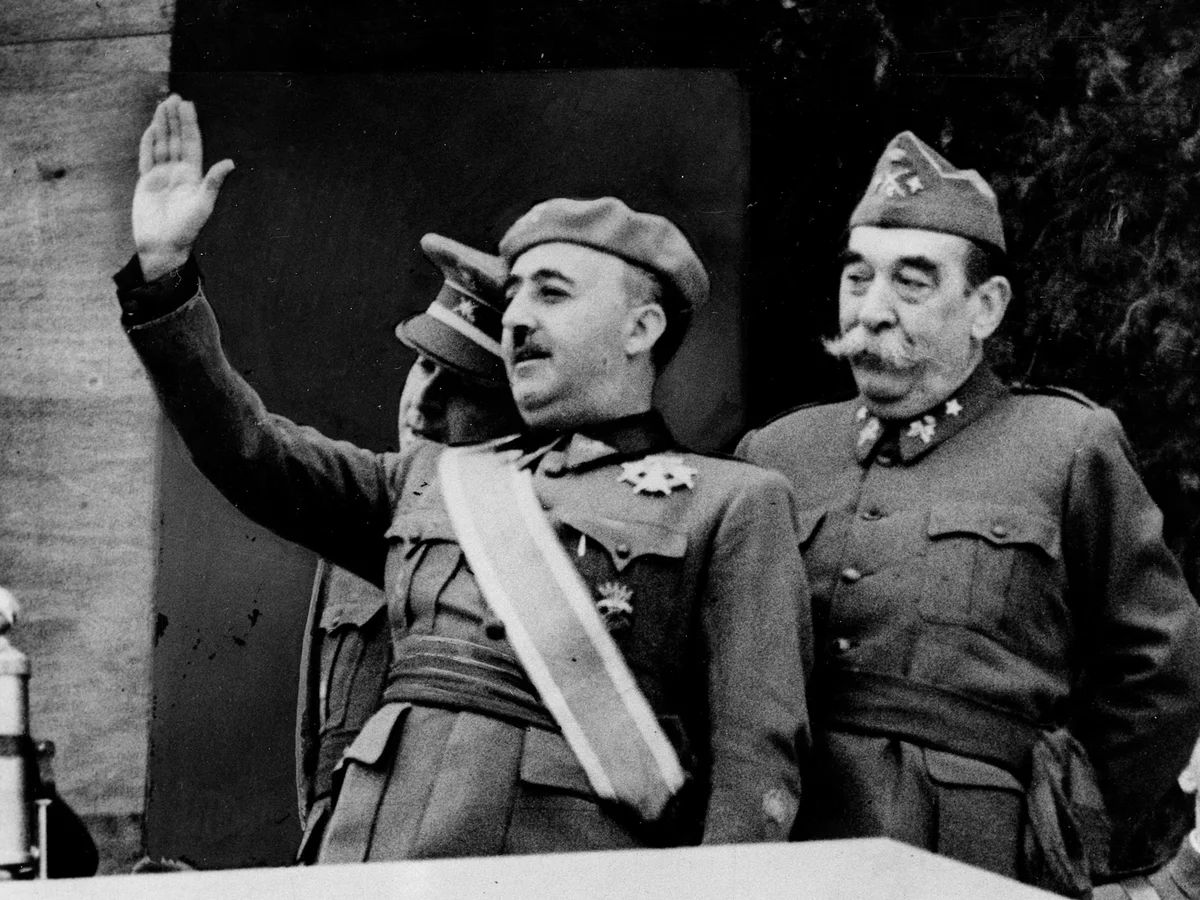
The Spanish Civil War is “problematic” for our opponents. Just think—less than a century ago in a major Western country, devout heroes stopped a bloody communist revolution and showed the world how it’s done. Such a result isn’t supposed to be one of the options for how “the arc of history” bends. This conflict is one of the most truly un-Progressive events in many centuries.
That’s why it’s largely ignored. If that strategy fails, and if sensitive young autodidacts should happen to take illicit interest, the next level of defense is to fit the Spanish Civil War within the tired universal WW2 mono-myth: you’ll hear the Spanish Nationalists breezily dismissed as “fascists” who received weapons and aid from Hitler and Mussolini (and any cause aided those guys is automatically discredited). WW2 so dominates the popular memory that other events—including those that preceded it—are to be understood according to the moralisms of the “Good War.”1
But the Spanish Civil War is its own thing, and it presents invigorating possibilities that one doesn’t generally hear about in History Channel documentaries or public school classrooms. The conflict is also shockingly relevant. Which is why we ought to study it.
Toward that end, Warren Carroll’s The Last Crusade is a concise and readable introduction. Carroll, a founder and longtime president of Christendom College, contends that the heroes who fought against the communists in Spain in the 1930s were true descendants of the heroes who took up the Cross in the Middle Ages to expel the enemies of the Faith from the Iberian Peninsula. It’s an argument worth taking seriously.
Backstory
After several years under the rule of the mild dictator Miguel Primo de Rivera, a Second Spanish Republic came into being in 1931. Indications of trouble soon followed. In May of that year, 100 or so churches and religious buildings were destroyed or damaged. In autumn a new constitution was drafted which ended all religious education in schools, authorized the expulsion of religious orders, prohibited any financial support of the Church by public funds, and required government approval of “every public manifestation of religion.” Many in the new regime were convinced that Roman Catholicism in Spain was a thing of the past.
Trouble only continued. Seeing the writing on the walls, General Josè Sanjurjo launched a failed military coup in 1932, and two years later came a left-wing uprising which Stanley Payne calls “the most extensive European insurrection of the decade.” Naturally, this leftist insurrection was punished far more gently than the military coup—and so the leftists got bolder.
Then came the fateful election of February 16, 1936. Spain had complex methods for determining seats in the national legislature, and the results of that day present some special challenges—thanks to disorder, unruliness, and a high number of recounts, runoffs, and invalidated elections. (Leftist attempts to steal elections is nothing new under the sun.) For Spanish Republicans this was the way it had to be, since “republicanism” to them had little to do with the process of self-government and everything to do with getting a secular and radical country. The votes of conservatives, traditionalists, and Catholics shouldn’t count, and the dragoons did their best to insure this.
“No two historians agree on exactly how many seats each party finally won,” Carroll writes. “But the Popular Front emerged clearly victorious with an absolute majority in the Cortes.” Though, to be clear: they won fewer votes (4.3M) than the right-leaning parties (4.6M).
So the Popular Front—a coalition of the Socialists, Communists, Left Republicans, Republican Union, and the separatist Catalan Esquerra—was riding high after their dubious victory.2 And when these kinds of people gain power, they make good on promises. One of the timeless lessons from the Spanish Civil War is that you ought to pay attention when radicals tell you what they intend to do:
- “We are determined to do in Spain what was done in Russia.” – El Socialista
- “There is no course but to destroy its roots.” – Socialist organization in Madrid
- “[We share a] recognition of the need for the revolutionary overthrow of the domination of bourgeoisie and the installation of the dictatorship of the proletariat in the form of soviets.” – letter from the Communist Party of Spain to the Socialist Party of Spain
- “I desire a republic without class warfare, but for this it is necessary for one class to disappear.” – Largo Caballero, future Prime Minister
A particularly telling feature of the Popular Front’s program was the “release of everyone imprisoned since the 1933 elections, regardless of whether they were political prisoners or common criminals.” This would help facilitate their rage for violence against the enemies of the new regime, namely the Catholics of Spain. Churches were set on fire as leftists consolidated power, and the authorities were conspicuously uninterested in stopping the destruction. General Franco was told by the governor of Cádiz—where five churches, a convent, a seminary, and a Catholic school had been burnt—that officials in Madrid had forbidden him from intervening. Nor was the violence limited to property destruction. Carroll’s narrative pounds the reader with relentless mentions of a dozen priests killed here, twenty nuns murdered there, nine monks offed a few days later—again, and again, and again. Between 1936 and 1939, approximately 20,000 churches and chapels were destroyed and almost 7,000 priests and religious were killed.
But the revolutionaries overplayed their hand, and a response was coming. “I can guarantee that, whatever circumstances may arise, wherever I am there will be no communism,” Franco promised. Not only was a large contingent of the professional military ready to fight, but so were well-trained and organized militias made up of devout Catholics monarchists—known as Carlists or requetes—ready to follow in the footsteps of their ancestors in taking back their peninsula. This, Carroll mentions, is what would give the Spanish Civil War its crusading character.
War finally broke out in July.
Three Episodes
Carroll jumps from cinematic episode to cinematic episode as they played out at the beginning of the war.
Getting Franco to Morocco was one of those. Though the general had been mostly apolitical, Republicans had correctly identified Franco as a potential threat before the conflict broke out, so they sent him to the Canary Islands, far away from any action. Somehow, without attracting attention, they had to get the commander to his troops. (Many of the Spain’s hardest soldiers were stationed in Morocco, and Franco himself had made his reputation there.) So the publisher of a monarchist newspaper in Madrid instructed his correspondent in London to charter a plane. A few English tourists would fly to the Canary Islands under the pretext of seeing the sights, intending all the while to bring a person of great importance to north Africa. But then a Republican spy sounded the alarm on the upcoming revolt, and word was spread throughout Republican Spain of mischief afoot. Flight itself was dangerous enough at the time, and now the English adventurers were in a race against time, uncertain about who controlled the various airfields where they were landing. Finally, the Rapid Dragon made it to Morocco and Franco took command of Spain’s elite soldiers.
Another colorful episode involved a one-man coup in Sevilla. The Nationalists knew they would be facing major challenges in the big cities. To make matters worse, the uprising in Barcelona began without a leader. Nationalist efforts in Madrid would also fail, as mobs broke into armories and set more churches on fire. It was thanks to the efforts of a dashing general named Queipo de Llano that Sevilla didn’t go the way of Barcelona or Madrid.
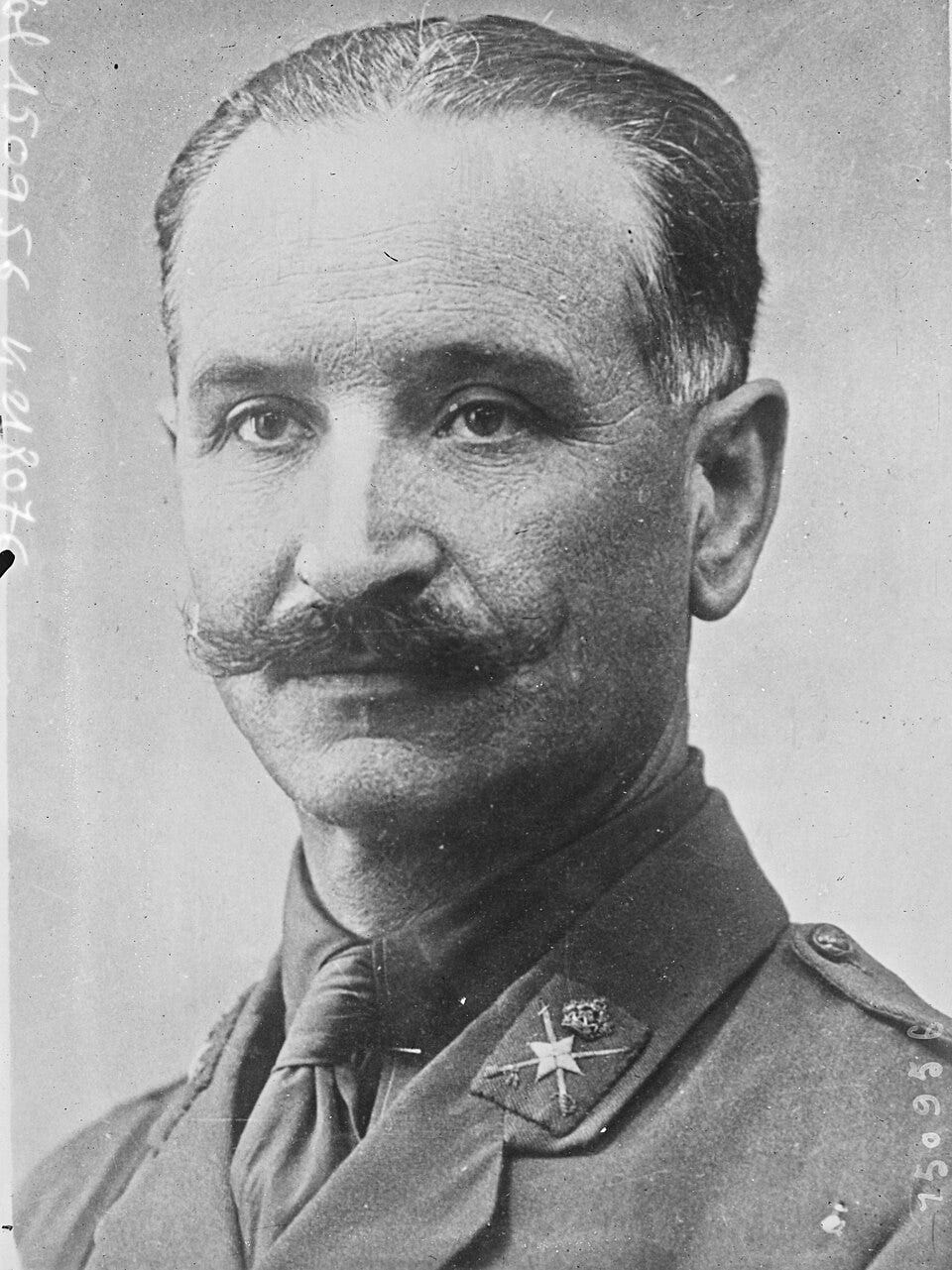
This man is basically the embodiment of the You Can Just Do Things meme. Arriving in Sevilla just one day before it was time to move—with only four officers to back him up—Queipo de Llano showed up unannounced at regional HQ and informed General Fernández Villa Abrille that the time had come to make a decision. “Either you are with me and my other comrades,” he said, “or you are with this government, which is leading Spain to ruin.” Carroll writes:
When Villa Abrille did not respond, Quiepo declared him and his staff under arrest. Since he had no place to put anybody under arrest, he simply sent them to the next room, which had no lock, turned to a corporal standing nearby, and ordered him to shoot anyone who came out of the room. The abashed corporal obeyed, and the equally bashed officers stayed inside.
Next he went to the infantry barracks, where he approached the unit commander and congratulated him on the his “decision to put [him]self on the side of [his] brothers-in-arms in these hours when the fate of our country is being decided!” When the stunned and overmatched officer replied that he hadn’t made any such commitments, Queipo de Llano immediately relieved him of command and asked if any other officers wanted to take his spot! A young captain volunteered. The other officers were arrested—and they submitted to the arrest, though they could have put a stop to Queipo de Llano’s coup if they collectively had a fraction of his resolve.
He completed his virtuoso performance by winning over the commander of the artillery and opening fire on the building where the civil government was located. They soon surrendered, and in the evening Queipo de Llano got on the radio and announced that he was in charge of the city and that anyone who resisted would be dealt with ruthlessly. “His proceedings,” Carroll writes, “would be incredible if they were not well-documented.”
Carroll’s favorite of the episodes of the Spanish Civil War is the defense of the Alcázar of Toledo—“a story of heroism with few parallels in the history of Spain or of the world.”
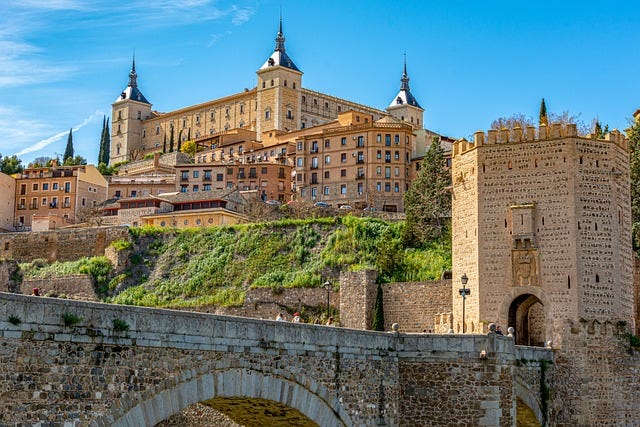
The ancient Alcázar of Toledo is located atop a giant rock overlooking the city. El Cid had ruled the city from this citadel after the Moors had been driven away in the 11th century. For five decades it had served as a military academy—“rebuilt after a fire in 1887 with an exceptionally strong framework of steel girders and walls up to twelve feet thick.”
The commandant of the academy was Colonel José Moscardó, a sixty year old officer whose career had been underwhelming till that point and who had not been judged significant enough to be included in the plans for the uprising. But he loved his country and the Church, and he was ready when destiny called.
Carroll writes:
When on the morning of July 18 he heard the radio reports of the rising in Morocco, carefully tailored by the government to make it appear already doomed, he did not know what to think. Since Madrid was only forty miles away, he decided to drive there to consult with some of the officers station there whom he trusted. Some of them knew what was planned, and told him. He committed himself instantly to their cause.3
Ordered by Republican forces to hand over command of the citadel, Moscardó refused. A ranking Republican general asked why he would not surrender, and the colonel responded, “Because I love Spain and have confidence in General Franco. Furthermore, it would be dishonorable to surrender the arms of gentlemen to your Red rabble.”
For almost two whole months, the defenders of the citadel endured everything the besiegers could throw at them—constant shelling, bombing raids overhead, attempts to undermine the citadel and blow it up from beneath, and more. Revolutionaries tried to incite the defenders of the citadel by dismembering and igniting a famous wooden image of Christ. “If you are true Catholics,” they said, “you will come down here and stop us!” While igniting the bonfire, the revolutionaries exposed themselves, were shot by marksmen from the citadel, and fell into the fire they had ignited. (As all this was going on, 105 priests and religious were killed in Toledo.)
They even captured Moscardó’s twenty-four year old son and tried to use him to get the colonel to surrender the citadel. The boy told his father not to, and the Republicans then murdered him.
Moscardó and company held out against all these troubles, their spirits buoyed by a note they had received from Franco, along with air-dropped containers food and supplies: “We are approaching … Viva Espaňa! Long live the heroic defenders of the Alcazar!” And he was a man of his word: in late September, Nationalist forces arrived in Toledo and drove away the Republicans harassing the citadel. When General Franco arrived at the citadel in person, Moscardó told him, “You will find the Alcazar destroyed but its honor intact.”
Franco embraced Moscardo and “declared him worthy to stand among the greatest heroes in Spanish history.”
The Costs of Glory
The Nationalists had hoped their superior soldiers and officers would achieve a quick victory, but the war was to prove more difficult. Republicans dug in (particularly in Madrid and Barcelona) and were augmented by the “International Brigades” and aid from the Soviet Union. Not until 1939 were they finally defeated. The details of the slow grinding of victory Carroll leaves to other histories; his focus in this volume is on the year 1936 and the spiritual aspects of the war.
Like I mentioned earlier, his book works well as a quick introduction, particularly for Christians. But it probably should be supplemented by other works—including Stanley Payne’s short history, as well as Peter Kemp’s memoir. Because most academic historians lean pro-Republican (pro-bloodthirsty communist), the sensitive young autodidact should be very in selecting books. Charles Haywood wrote an excellent essay on Franco, as well as other books on the war. I plan on turning next to Karl Dahl’s historical novel Faction: With the Crusaders, Cecil Eby’s Siege of the Alcázar, Gironella’s The Cypresses Believe in God, and probably some of Antelope Hill’s Spanish Civil War collection.
The themes and lessons of this war are especially important as we consider our present troubles. One theme is the difference between the conservative and the radical temperament. Radicals possess real advantages in the struggle for power: for instance, the knowledge that they can push boundaries (and push, and push some more) while counting on indulgence and forbearance. Conservatives need to suffer pretty seriously before they’re ready to act. Franco himself was reluctant to join the cause until he knew the public was ready.
Which raises the troubling question: What if, by the time you’re finally ready, it’s too late? Thou shalt never blackpill of course—there’s always some action that can be taken. But only so much territory can be conceded before we find ourselves at an existential crisis. An age of mass consumption makes this problem even more acute because people can endlessly content themselves with distraction and dopamine hits while their enemies consolidate power.
It’s probably too late to expect that a future uprising could look very similar to Spain’s. We unfortunately lack the advantages the Nationalists had, like a military dominated by our guys. Good ones are still there, but recent administrations have done their best to purge the potential problems (much like the Republicans sought to exile Franco). Spain’s army didn’t celebrate Pride Month or promote lady-commanders.
Spain also didn’t have the diversity problem.4 Our oligarchs have very strategic reasons for dumping millions of third-worlders among us, and it’s not because diversity makes us stronger. It’s because these people dilute the population and serve oligarchic interests. A smaller percentage of the population will have the cultural memory of something worth fighting for or the will to unit in common cause, and the “newcomers” and “cultural enrichers” might even stand in the way of those who mean to rise up against leftist tyranny.
So while we admire Franco and company, prudence requires us to be clear-eyed in assessing the specific difficulties and opportunities before us, rather than assuming we can simply carry out the Franco-option.
On the bright side, though, the Nationalists’ victory also show that our guys have a capacity that the radicals lack. Radicals are prone to violence, far more comfortable putting it to wide use—but that’s different from being good at it.
A final (sobering) reflection on the victory of the Nationalists is that their descendants are once again in trouble today. Spain, as far as I can tell, is not in noticeably better shape than any Western nation. Franco deserves undying honor for saving his country from a communist takeover; he also ruled well as dictator from 1939 until his death in 1975, keeping his country out of WW2. But he didn’t secure the future. Carroll blames this on Franco’s failure to nurture the Carlist movement. These devout Catholics militiamen were the only ones who could give “the rising a genuinely popular character,” and they would have been crucial in winning the culture war that followed the Civil War. But that wasn’t to be.
To be fair, it wasn’t entirely Franco’s fault. Near the end of the war, Carlist leader Manuel Fal Conde noted his aspiration of starting a military academy for the training of officers in the spirit of the Traditionalist Communion of Spain. Unfortunately, Fal Conde didn’t think to run this plan past Franco or receive permission! The requetes had fought bravely and obediently for the Nationalists, but a certain amount of (perhaps healthy) tension still existed between the leaders of the Catholic militia movement and Franco’s regime. Franco judged Fal Conde to be dangerously out of line, so he sent him into exile. As Carroll notes:
But in the long run, in Spain after victory was won, he needed a strong and active Carlist movement led by Fal Conde to provide the ideological guidance and continuity to rebuild and maintain a Catholic Spain, which Franco as a relatively unimaginative general—however successful in the field and personally devout—could never provide. By exiling Fal Conde, thereby signaling his determination to control and restrict the Carlists, he deprived Spain of a priceless asset. It was the greatest mistake of his life, and one of the principal causes for the failure of the Catholic Spain he led to survive his death thirty-nine years later.
A sobering thought among invigorating thoughts. There’s so much more to say about Spanish Civil War and its glory and lessons, but this essay has already run too long. Further meditations will have to wait for another book review.
https://thechivalryguild.substack.com/p/the-second-reconquista