
Does the Fire of Europe Start in Belfast?
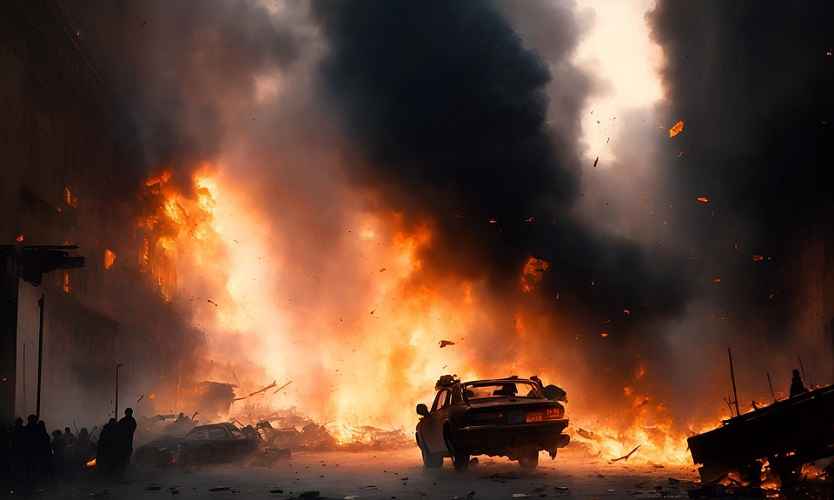
Belfast is on fire, and in the ashes lies precisely the question that Europe continues to avoid: do we want to tackle the causes, or would we rather keep standing guard by the jerrycan of petrol?
The Northern Irish city is experiencing its darkest period since the peace that followed the Good Friday Agreement. Groups of protesters, mostly with covered faces, have blocked the streets with burning barricades, set cars, a bus, and houses on fire, and thrown stones at police officers. The images and videos circulating on social media paint a picture of a city reduced to terror and ash , with the anger concentrated in the suburbs and among the very youngest—youngsters who are barely twenty, writes Lorenzo Maria Pacini .
The protests were sparked by a serious crime that took place in the northern districts of the city, which quickly became a symbol of the social tensions that had been simmering for some time. According to the Al Jazeera report , the suspect is a 30-year-old Sudanese man who arrived in the United Kingdom in 2023 via Paris and Dublin and holds a valid refugee residence permit. He has been charged with attempted murder, carrying a knife, and making death threats; the victim, a man in his forties, sustained serious injuries to his face and head and lost vision in one eye. The Chief Commissioner of Northern Ireland, Jon Boutcher, stated that the perpetrator was not previously known to the police and that the incident is not being classified as a terrorist act at this stage.
The shift from crime news to street protests occurred almost immediately and took place largely online. This is a pattern already familiar in the West and points to something that goes beyond “simple” popular mobilization – but we will return to that in a few days. As documented by CBS News , a list of more than two dozen addresses, presented as the homes of immigrants and their families, began circulating on private networks such as WhatsApp; on X, a list of names and contact details appeared attributed to lawyers and law firms specializing in immigration matters, with a call to “patriots” to “do what they deem necessary.” The police called the dissemination of those addresses “completely unacceptable” and spoke of desperate phone calls from families and residents. Executives at the Northern Ireland Health Service reported that international staff were too intimidated to go to work, and described the case of a nurse who was chased by masked men while on her way to Ulster Hospital.
Politically, Prime Minister Michelle O’Neill condemned the riots as “nothing but cowardly,” while MP Claire Hanna openly spoke of a “racially motivated pogrom,” in which groups of masked men chased immigrants from door to door. On the other hand, populist right-wing leaders such as Nigel Farage and Unionist officials demanded clarification regarding the attacker’s immigration status, while globally influential figures, from Elon Musk to Tommy Robinson, shared the video and called for action. Minister of Justice Naomi Long summed up the situation by accusing “bad faith actors” who, prior to the unrest, “would have struggled to find Belfast on a map,” and who deliberately drove people onto the streets.
Chaos that fuels even more chaos
Political chaos reigns everywhere. No clear stance from political authorities, no significant statement from Buckingham Palace, to name just one, just as there is total silence from Western news agencies, which remain silent about the gravity of what is happening.
Moreover, it would be a mistake to regard Belfast as an isolated incident. The violence in Northern Ireland is part of a series that extends across the entire British archipelago: the riots in Ballymena in 2025, the riots that followed the murder of three young girls near Liverpool in the summer of 2024, and, just a week before the events in Belfast, the confrontations in Southampton following the murder of student Henry Nowak. Amnesty International described the past twelve months as a “shameful year of hate,” with more than two thousand racially motivated incidents in Northern Ireland – one of the highest numbers since 2004.
Academic observers interviewed by the press signal a twofold dynamic. On the one hand, there is the influence of a digital ecosystem that amplifies and politicizes every news report in real time; on the other, there is a specific local context: the riots are flaring up in areas characterized by long-standing economic backwardness, unemployment, and marginalization, where the young men throwing stones today would have been the recruitment pool for paramilitary groups in another era. It is the fusion of local historical and ideological processes with the politics of the global radical right that makes the phenomenon explosive and propels it far beyond the borders of Ulster.
And here, if you will, begins the analysis where news reports, by their very nature, fall short. The difficulty in understanding the contradictions surrounding immigration—and the fact that the burden thereof rests primarily on the working class and the proletarianized middle class, the defeated of Western-modeled neoliberal globalization—leads well-intentioned progressivism to “stand guard by the jerrycan of petrol” of the liberal bourgeois state, and hand out moral liberties without fathoming the nature of the anger rising in the suburbs.
The premise is almost anthropological. Contemporary immigration is neither a natural inevitability to be passively accepted, nor a phenomenon comparable to the seasonal migrations of a herd on the savanna or a swarm following internal cycles. The human species left Paleolithic nomadism behind with the Neolithic revolution some ten to twelve thousand years ago; in modern times, nation-states have gradually imposed a sedentary life even on traditional nomads—herders, hunter-gatherers, and today’s populations such as the Roma and Sinti—for the sake of administrative control, taxation, and integration. In short, modern man is sedentary: the movement of masses of people is never a natural phenomenon, but always the product of historical and political power relations.
The liberal ‘radical chic’ – the one who, by voting liberal or liberal-socialist, convinces himself that “loving one another” is sufficient to make everything fall into place – is so primarily because the social order as it currently exists suits him perfectly well deep down. He does not imagine any other possible world, but regards it as identical to the present, except for a few minor adjustments. They call themselves revolutionaries without revolution, or reformers without reforms. But reality is harsher.
He who lives off colonialism dies by colonialism
It must be said, regardless of individual viewpoints: mass immigration is a problem; it is certainly a legacy of the West’s colonial past, but above all, it is a product of the unequal development of capitalism in the Global South. The mechanism is well known: the debt burden of developing countries resulting from neoliberal logic—and outright usury—forces those states—often governed by ruling classes educated at Western universities and consequently possessing a colonized mentality—to take out enormous loans from the International Monetary Fund and the World Bank. Loans that must be repaid at high interest rates, the price of which consists of privatization, the dismantling of local social security systems, and increasing impoverishment.
In addition, there is military intervention within the framework of a global conflict to maintain the unipolar order against the rise of new geopolitical actors. Western support for the overthrow of patriotic governments in Africa and the Middle East, since 2003, has destabilized entire regions and installed subservient governments, giving rise to the migration flows that are pressing against European shores today. We cannot promise these masses—who do not consist predominantly of criminals—the fruits of a “paradise that does not exist,” given that it is precisely in the West, since the 1980s, that the recipes of deindustrialization, offshoring to the Global South in search of cheap labor, the financialization of the economy, and cuts to social spending have been put into practice.
Immigration is a capitalist phenomenon. Reducing the problem to an exclusively ethnic, religious, or ‘deep state’ issue is a methodological error with enormous consequences.
What is needed instead is a structural transformation of relations with the Global South and with all those countries with which a relationship of subordination and dependence has existed for centuries. The migration phenomenon must be treated as a matter of global security and balance, which – as long as the European Union exists – requires a common strategy among all its members, where the first urgent necessity lies in regulating migration flows in the most appropriate manner, through a serious planning policy, rather than alternating rhetorical openings and propagandistic closures.
There is likely only one structural direction: investing directly in the countries of origin of these flows through development cooperation policies agreed upon in consultation with local authorities. Economic aid and joint development remain today the only fundamental instrument to manage migration and curb the “flight of desperation.” It is no coincidence that this is the approach Xi Jinping’s People’s China employs on the African continent, an approach that no one dares to label as “xenophobic.” It is simply political common sense.
Meanwhile, citizens—and particularly those who integrate and respect the law—must receive serious guarantees of safety in their neighborhoods, precisely those neighborhoods that neoliberal logic abandons to their fate, amidst cuts to law enforcement and urban decay. From all this, “political correctness” must be eradicated like a dangerous disease, for it is precisely in the name of this ideologization that we have arrived at a degenerate migration policy for which we are now paying the price.
The pseudo-integration policy of the radical-chic left and the xenophobic propaganda of the right – whether in power or not, and which in some cases borders on inciting an ethnic civil war – are two sides of the same coin: neither touches the structural level; both merely scratch at the surface, the superstructure, and leave intact the economic mechanism that, at the source, generates both the migration flows and the resentment of those suffering from them in working-class neighborhoods. Perhaps this is too “Marxist” an interpretation, some will say, or perhaps it is simply an attempt to understand in depth a phenomenon that concerns all of humanity and that has always – not only in recent decades – been perceived simultaneously as an advantage and a problem.
Belfast is on fire, and in the ashes lies precisely the question that Europe continues to avoid: do we want to tackle the causes, or would we rather keep standing guard by the jerrycan of petrol?
https://www.frontnieuws.com/ontstaat-de-brand-van-europa-in-belfast/