
Sex and Sterility

Exploring the shape that Spengler’s “Sterility” has taken in the West.
Last summer, I was playing Nightreign with my friends David and Lara. If I remember it correctly, we were dropping into the map when either me or David must have mentioned something to do with Rotherham in passing. Lara asked, “What’s Rotherham?” and so I explained it to her. I told her, “In Rotherham, 1400 young White English girls were systematically targeted by Pakistani Muslim gangs for sex trafficking and gang r*pe, and the police covered it up because they were afraid of being called racist.” Lara processed it for a second over the voice chat and then said “But it’s just men though, isn’t it?” in her northern accent. I reiterated that it was indeed racially targeted, which was why the institutions covered it up. Lara just responded “Yeah but it’s just all men though”. David and I groaned, and we all continued our run without talking about it further.
I remember this encounter because it’s something you hear from women quite a bit. Anything racially motivated by one group of men towards a different group’s women is deconstructed into a male versus female issue. They aren’t wrong in the assessment that indeed it is men who do an overwhelming majority of the violence, which includes towards women, but when they say this, you’re always left feeling like something is missing from their assessment. Very few of them feel themselves to belong to a stronger identity than their own genitalia.
There is another instance I’m sure we can all relate to. The infamous ‘bear in the woods’ thought experiment from a while ago. The premise was that, if you were stuck in the woods alone at night, would you rather meet a bear or a man? The bear is in his own habitat; the man isn’t. The bear is a simple creature; the man has a reason for being there. The bear is guaranteed to follow its instincts; the man is unpredictable. But the bear will be able to kill you if it wants to, while the man’s intentions are unknown. In the original video, seven out of the eight women they asked seemed to resoundingly choose the bear over the man, to the confusion of many men, and the response by women online to this was that ‘a bear won’t r*pe me,’ to which the men, offended, argued ‘nor will most men’. Some men also asked the poignant question: ‘What kind of man are we running into?’
LT Jonathan Kendrick@PlisskenPatriot
how your gf looks at you when you ask her to block the guy who “raped” her in 2019:

10:30 PM · Jun 1, 2026 · 65.7M Views
2.47K Replies · 9.31K Reposts · 169K Likes
Recently, a Xeet has been circulating online that has been considered the natural counter to this. It is a picture of Nikki from the movie Obsession, frowning uncomfortably in the house party scene. Attached is the caption “how your gf looks at you when you ask her to block the guy who “r*ped” her in 2019”. The tweet seemed to strike a chord with countless men who have experienced this toxic behaviour, while the responses from women were all grossly offended and almost deliberately missing the point. The morale of the flame war that ensued appears to be that the term “r*pe” has been so trivialized in modern culture that something equivalent to unsatisfactory sex, which is what a lot of women seem to mean in this context, is actively equated to being jumped in the woods at night. The inability or unwillingness of certain women to distinguish the two enables otherwise innocent men to be attacked while others are protected, and the difference comes down to the personal preferences of the woman rather than legally sound categories.
We’ve also seen this language game in real politics from about a decade ago when Sweden opened its borders to hundreds of thousands of refugees. The result was that any attempt at getting to the core issue with migrants, and their relationship to sexual violence, was dismissed in Sweden as a result of liberal definitions of the term ‘r*pe‘ in the law courts. The crime’s racial dimension was collapsed into an opposition of man and woman again, but more insidiously, the culprits were implied to be specifically White Swedish men due to the cultural image of the average man in Sweden.
On a separate note, the relations between the sexes in modern-day society have thoroughly degraded since the 1990s. Trust in the opposite sex is at an all-time low: women increasingly view men as dangerous, per the language they use to describe them, while men increasingly view women as not worth pursuing due to their own erratic behaviour. Fertility rates in the West are low, and people like to blame the economy for this, but it doesn’t account for why sex is at an all-time low as well. Women appear to be having slightly more sex on average than men, but even if “hypergamy” is an explanation for anything, women aren’t having nearly as much sex as they are imagined to be having, and their sexlessness is also rising.
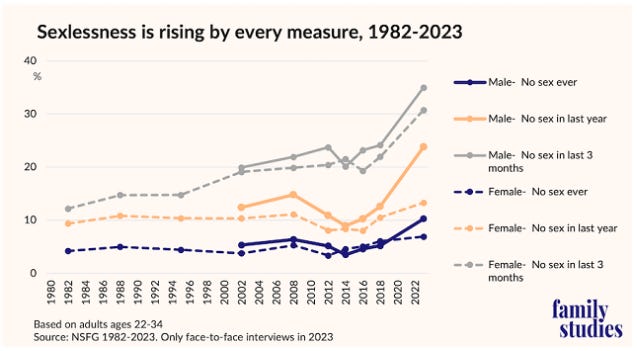
Understanding this phenomenon requires answering some of the above questions about why men and women act in certain ways and how their natural dynamics interact with the modern world. Spengler’s writings on men and women are scarce, yet they underpin his whole theory of politics and the gradual decline of Civilisation. So, in this post, we will explore the shape that Spengler’s “Sterility” has taken in the West.
Spengler considers the feminine and masculine energies to correlate to the cosmic/microcosmic dynamic, where the former is unconscious and more in tune with the natural rhythms of the universe, while the latter is very much conscious and experiences these rhythms separately from it as a tension between self and other. In an age before the separation of gender from sex, he therefore considers man to be the maker of history, whilst women are history. This is a fancy way of saying that successful men win and take women as spoils, while women tend to endure through the drama as mothers. The endless sequence of generations is a passive reality that belongs to women, but the existence of the family name belongs to the man and is his active duty to keep alive through his sons.
Together, man and woman form the family unit. It is not, however, the nuclear family unit of two equal partners and two children. It is best viewed as a perimeter formed by the man’s identity, within which the cosmic flow of generations – the mother and her children – is protected physically and emotionally. The active energy of the man is directed away from this perimeter to compete with an outside world of other men and their respective families to provide for his own, and the reward, if successful, is that his family name and values continue.
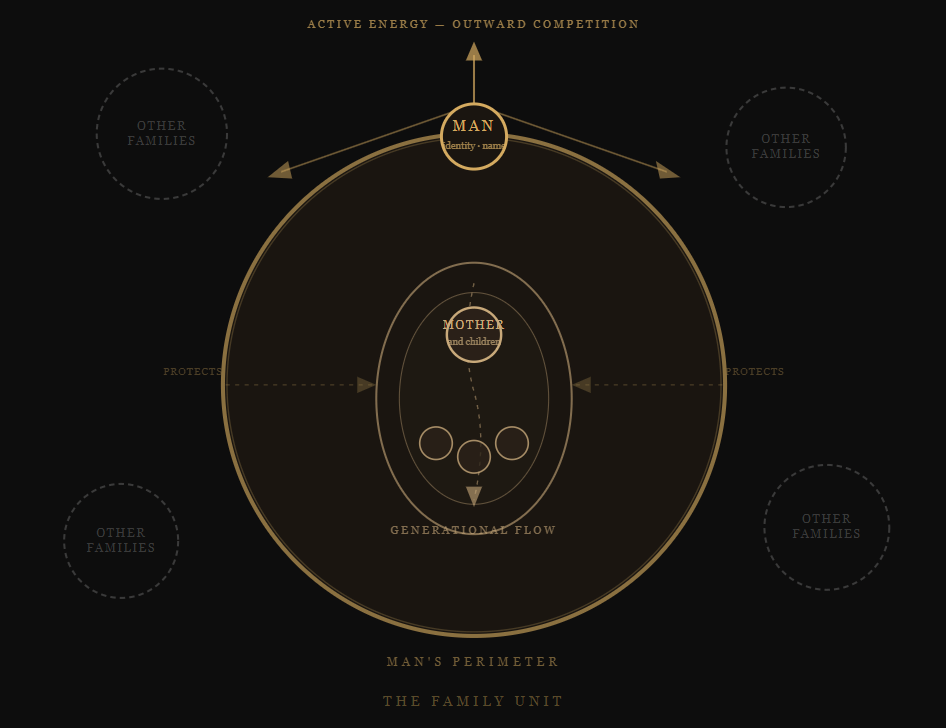
There are a few implied consequences when this arrangement is disrupted. A man who projects his active energy inwards towards the family is harming their passive emotions by cancelling them out with his active ones. An abusive household would most resemble this arrangement, but by Spengler’s account, even a man who is too critical of his family and children without a productive reason to be so falls into this category, making intelligent men particularly susceptible to this. A weak man with poor leadership qualities risks not having the ability to direct his children towards good outcomes, resulting in boys growing up without a personal role model and girls growing up without knowing what good leadership looks like; both boys and girls will look elsewhere to satisfy that need, and it is accidental whether that turns out for the better or worse.
Weak men also become prey to women who have strong identities themselves. A masculine woman in this arrangement asserts her own vision for the family in place of the man’s, which can risk tearing apart the relationship if neither side can reconcile their differences.
Spengler characterises women as incapable of understanding, or unwilling to understand, the masculine lifestyle that requires a man to focus on something other than the internal politics of his family:
“Woman is strong and wholly what she is, and she experiences the Man and the Sons only in relation to herself and her ordained role. In the masculine being, on the contrary, there is a certain contradiction; he is this man, and he is something else besides, which woman neither understands nor admits, which she feels as robbery and violence upon that which to her is holiest.”
Men have a conscience for groups and an awareness of the other in a way that women don’t because women’s emotions preoccupy them with themselves and their offspring as extensions of herself. To ensure her needs are met, her goal is always to secure a loyal provider, usually by “taming” him and trying to bring him into her world:
“Policy for Woman is eternally the conquest of the Man, through whom she can become mother of children, through whom she can become History and Destiny and Future.”
A battle ensues between the mother and father for the sons in particular. The father wants to raise his son as an extension of his identity, while the mother wants to raise him as a link in the chain of generations. Because of this, the woman looks at the man’s world of wars and treaties and competitions as fruitless compared to the real venture of embodying the line.
“What for her is a triumphant battle that annihilates the victories of a thousand childbeds? Man’s history sacrifices woman’s history to itself, and no doubt there is a female heroism too, that proudly brings the sons to the sacrifice (Catherine Sforza on the walls of Imola), but nevertheless there was and is and ever will be a secret politic of the woman — of the female of the animal world even — that seeks to draw away her male from his kind of history and to weave him body and soul into her own plantlike history of generic succession — that is, into herself.”
This does not spell a quantitatively equal arrangement for a household. The nuclear family of the West regards gender roles as a division of labour: the man works outside at a job, the woman works inside raising kids, and together their roles balance out. Spengler’s articulation strips the cultural significance of work in the West and distills it down to a qualitatively equal arrangement: women are solipsistic, self-contained, as nature is self-contained, but they are drawn to men with strong identities as markers of stability for their own needs. Men also have to keep this feminine quality to nurture the interior, while also mastering their identity to provide that stability for would-be mates. The feminine woman polarises herself to men as potential partners for her own needs; the masculine man polarises himself both to women and to other men. But if they work together, they can ensure a healthy upbringing for their children and both parties succeed in their missions.
Beyond this, it also provides the foundation for healthy internal and external politics. Family lines become the core of Spengler’s Estates, powerful Houses which, as a collective aristocracy, form the earliest content of the nation through their purposeful behaviour. A king is like a father to his nation: he seeks cohesion within the household so that the household is organised for external affairs. A king who projects his military power inwards is a tyrant, and a weak king sows the seeds for other estates and internal powers to take his throne, as well as for external powers to seize the nation for themselves. A successful king’s population and culture endures through the generations; an unsuccessful king loses himself and the nation to a foreign empire’s games. The respect a feminine woman has for a masculine man is the same respect a follower has for an effective leader with a vision for what the world ought to be. Respect has to just be there, and it must be self-evident why someone is to be followed.
But it isn’t a perfect congruency, because historically, masculine society has always produced release valves for men who aren’t capable of or willing to understand female nature. Many men use their intellect to pursue God, forming the Second Estate: the priesthood. Many pursue their own crafts, such as the arts. The strongest militaries are often trained with aggressive emotional pressure to break a man down and build him back up, the goal being to remove any feminine instinct from what should be a purely rational operation. It was self-evident to a man who he was, and whether he wished to be a peasant, a wanderer, a priest, or a knight, but some roles in society naturally implied the act of celibacy.
But the same cannot be said for the political climate of Civilisation. In each Civilisation, metaphysics dies at its beginning as the great systems for knowledge (Kant, Plato) are rounded off and finalized, and what comes after them are materialistic philosophies that steadily begin to replace metaphysics with material explanations. Life becomes the object of philosophy once it is no longer lived, and this opens up philosophy to practical pursuits such as Ethics: ‘how ought we live?’ In Greece, during and after Plato, we have the Cynics, the Stoics, and the Epicureans, and in India, there was Buddhism; all four philosophies, in one shape or another, venerate rounding oneself off from society as a source of attachment and suffering. But by contrast, the Western Ethic, beginning with Schopenhauer, and following through Marx, Proudhon, Stirner, Darwin, Spencer, Shaw, Nietzsche, and a dozen other big names of the 19th century, venerated the concept of identifying problems in society and pursuing social critique and change to improve society progressively. One such advancement for us was the explicit liberation of women as equals to men – a natural follow-on from the natural rights of man.
Jeremy Bentham (1748-1832), father to Utilitarianism, was a major proponent of women’s rights as early as the turn of the 19th century. His successor, John Stuart Mill (1806-1873), also worked with his wife to produce feminist outcomes. Bernard Shaw (1856 – 1950), in Quintessence of Ibsen, anticipates the New Woman. We associate Feminism with the Suffragettes only because they were the first independent women to radically pursue equality of the sexes, but in reality, the tradition of demanding equality goes back a century further than most would expect. Only after the men provided the foundations were there the waves of the 20th century, the Suffragettes and the Second Wave feminists in particular, who arose after World War One and during the 70s respectively, and the feminist theorists such as Simone de Beauvoir (1908 – 1986).
Western technologies also have a role to play in the context. Faustian mankind always strives to liberate itself from its condition as a means to pursue the absoluteness of Space. Within the notion of social critique and progress is the idea of breaking down old barriers to build faster and more efficient infrastructure, like a dirt path being bulldozed to build a highway. Technology has the direct effect of liberating man from previous constraints, and as a result, women are made freer in our urban society than in any other in history to pursue their own liberation. It is encoded into the spirit of our culture that this was something we would have to deal with eventually.
The liberation of women streamlines mass society. Where once men worked in the factories and women raised the children, now both are universally educated within the frame of the modern world. The education system, as we’ve noted, but also as Foucault has noted, is a place where power dynamics are clear between the teacher (the physical, emotional, and intellectual superior) and her students. Even from a young age, the above principles can be seen directly in boys and girls in these institutions. Girls are sensible, they do as they’re told, while boys are aberrants, bullying each other, fighting, not doing their work.
In a previous essay, I went through my experience within the education system. I detailed how primary/elementary school instills moral values in you that create an emotional substrate to base later political opinions on. I mentioned my Windrush lecture and my South Africa day lessons. But there’s another story I didn’t tell:
Mckenzie would oscillate between being my best friend and harassing me relentlessly on the playground from years 3 – 5. Often I would tell on him. I would go to a teacher who usually stood in the middle of the playground and tell her what was happening, by which point he would run away and hide. They would look around, not see him, and say “Well, I don’t see him, just stay away from him”. The bullying would continue.
At the end of a Tuesday in year five, the boys were changing after PE in the classroom, while the girls were changing in the locker room. Mckenzie picked up his act again. I went to the teacher and asked her to get him to stop, and she said, “In a minute”. So, a few minutes later, the girls left the locker room, and the boys went in. I must have forgotten to pack my t-shirt into my bag because while hanging my bag up, Mckenzie dangled it in my face. Having had enough of his shit after years of abuse, I spun round and launched a punch in his face. He fell backwards and was swallowed by the crowd behind him. As it turns out, I punched him so hard his glasses snapped in half. He instantly went to our teacher, and it didn’t take her nearly a minute to get up and publicly shame me in front of everyone for what I had done: “WHAT HAVE YOU DONE? WHY DID YOU PUNCH HIM?” I asked her why she didn’t do anything, and she said she would have done something in a minute.
So my teacher was mad, my mum was furious, and Mckenzie’s mum was equally furious about what happened. If that was around 3 pm that day, then 22 hours later, I found myself sitting down after lunch, and Mckenzie sat down with me and told me about a funny YouTube video he watched. We both laughed about the video and forgot about the day before. I never had a problem with him ever again. I earned his respect. I showed I wasn’t going to take shit from him. I learned something that my 50-year-old teacher and my 40-year-old mother never learned in their whole lives.
There are several lessons to draw from this. The first is that because teaching is largely a woman-dominated field, the foundations of society’s values are shaped by women as well. By extension, the society we live in is also like that classroom. The authority avoids fixing the problem until the situation deteriorates so much that good people have to fend for themselves, and only then does the authority punish the good for rejecting the reigning order. What we call “Anarcho-Tyranny” could also be equated to the girlfriend who tugs her boyfriend’s arm while he is in a fight. Women do this because, mother or not, she, in her 20s and 30s, is still in the mentality of protecting her sons from the world of her husband, even if that means maintaining a low simmer of resentment.
Men learn from these occasions that violence is unpredictable. The strong can be scared off by the weak on the implication that things might not go their way. It is out of these childhood moments that the adult world of treaties, agreements, laws, organisations, and mutually assured destruction emerges, because the threat extends to two tribes as much as two nuclear powers. But women learn that violence is very predictable, and it rarely goes their way. The world they often want is one where everyone is nice to each other to avoid that kind of distress. They are rarely instilled with the wisdom that peace comes through strength, and as a result, they expect people to get along despite wild differences and no common understanding of each other, and will subordinate themselves to the social order they inhabit with little social critique. Humanitarian orders also suppose this. The bubble of identity of one group is extended over the whole earth in hopes that everyone will lower their weapons and get along. The reality that emerges, however, is a simmer of terrible news cycles and ethnic conflict. Neither a modern liberal nor a woman knows how to handle the friction of real identities, so to avoid more violence, they choose to gossip about it in closed circles, talking instead of fixing.
The modern West also has one of the most feminine foundation narratives in all of human history. Of what use were the deaths of the 20 million men in World War One, or the 50 million deaths during World War Two? Would the world not be a better place with those men in it, having avoided these wars? Would the world therefore not be a better place without the dick-measuring contest spurred by national honour and pride? How many husbands and families were snuffed out by the terror of ideology and empire? The foundation myth of the modern world is a persistent ‘come back to bed honey’ drawing men away from any conception of something higher.
So women go to school with the boys as equals, they are often made just as active as the boys socially and physically, they navigate the institutions led by other women naturally, while boys constantly rub up against it. And then mass education becomes mass labour as they acquire their degrees and are funneled into corporate job positions. Assuming relationship quality remains the same, the fact of the matter is that now there are two parents at work when it used to be one. A woman working eight hours a day, following her boss and not a husband she respects, no longer has time to nurture children on her own, so she will defer the act of raising children to the school system, depersonalising the family and the crucial role both mother and father play in raising them. Once, it was men who refined their intellect to compete in the workforce, but now women are forced into that mould as well. You effectively have two full-time breadwinners in the household, earning half of what their ancestors did.
So whilst men and women, by the idealism of the 19th and 20th centuries, have now become equal partners in the workplace, the relationship between internal and external, private and public life, has been disrupted on multiple accounts: the attempt to force men into a woman’s role in school, the attempt to force women into a man’s role at work. What both sexes have in common is their strongly shaped intellects.
The decline in fertility rates among couples in the West is often attributed to a whole host of causes. Climate change, bad economy, lack of quality men or women in the dating pool, career paths, anti-natalism, etc., but Spengler distills the reason down to reason itself: cosmopolitan man (and woman) is all brain and no soul, all thought and zero instinct. A peasant felt the need to have children was self-evident, and had the motivation to pursue it to that end. But Civilised man begins contemplating the nature of what a relationship means for him.
“… a man’s choice of the woman who is to be, not mother of his children as amongst peasants and primitives, but his own “companion for life,” becomes a problem of mentalities.”
Reason would have both men and women pursue an equal intelligence to themselves instead of someone who is believed to be a good father or mother. The whole crisis of modern dating is underpinned by this single reality. Every man wants a beautiful, joyful woman to be the mother of his children, but since they aren’t having children until they are 30 due to societal constraints, they pursue the beautiful woman divorced from the most important qualities of motherhood. Women want a strong man who can excite them, but since they are not having children until they are 30, they pursue the strong man, divorced from the most important qualities of fatherhood. This generates a toxic culture of dating that produces more particular problems than can be discussed in this essay.
Men in particular fall victim to feeling like they are not enough as they are and substitute self-confidence for external traits such as “looks, money, and status”. Inceldom, “Looks-maxxing”, “The Redpill”, the “Manosphere” etc., are all symbols of a perfectionism that mistakes love for being an end-reward to a long journey rather than what it actually is, which is a state of being. Many behaviours displayed by women, when divorced from the focused goal of having children, appear to men as irrational, malicious, and fruitless to entertain. An action can be seen as intentionally disrespectful when she doesn’t consider you in it at all; a refusal to change can be seen as stubbornness when it’s simply her manifested identity. Often, a man today may tell himself, “A woman ought to do this, and we’d all be fine right now,” but no ancestor of his ever thought like this. Her behaviours, products of her emotions, are facts; how she ought to behave according to man’s mind is an abstract truth. The Faustian desire to change the world, when projected onto women, falls flat and leaves men feeling powerless.
But this feeling isn’t without its catalysts, and women also face their own problems. Women in the complex and abstract environments of urban areas, or simply within the force-field of culture that is projected over the landscape of the West by these cities, begin to use their intellect to suppress their own instincts.
“The primary woman, the peasant woman, is mother. The whole vocation towards which she has yearned from childhood is included in that one word. But now emerges the Ibsen woman, the comrade, the heroine of a whole megalopolitan literature from Northern drama to Parisian novel. Instead of children, she has soul-conflicts; marriage is a craft-art for the achievement of “mutual understanding.” It is all the same whether the case against children is the American lady’s who would not miss a season for anything, or the Parisienne’s who fears that her lover would leave her, or an Ibsen heroine’s who “belongs to herself” — they all belong to themselves and they are all unfruitful.”
The civilised woman sees children as a constraint upon herself and has that feeling articulated with brilliance by two centuries of the Feminist tradition. Thus, everything, her education, her career, her social circle, and her hobbies, comes before children; she will even make her whole vote focused on killing them and reducing the specialness of her future to a material clump of cells. The women who don’t think so hard about it are often still in the mode of going with the group, knowing which way violence goes for them, and so they accept the current order without a second thought. They will conform to the tradition when forced to explain their actions, but truthfully, they don’t believe in it at all. In dating, they can and will often find their emotions led around by poor quality men who have no intention of being fathers to their children simply because there are years to waste doing that now. The mass hysteria generated by third-wave feminism over r*pe culture has metastasized into a straight-up fear, not of “all men” as they say, but the idea of men they don’t know, regardless of type. This fear can paralyse any excitement over a new man in their life, or even agreeing to give out their number.
This goes without mentioning the less-than-charitable attitudes of women toward men whom they don’t want. Dating apps have made modern dating significantly worse by exacerbating superficiality and pickiness with the illusion of options that never materialise or prove good long-term options. As it turns out, the man with not one but six candid photos of himself, pretending to go about his life as though he didn’t ask his friend to take these model photos of him, has an anxious attachment style and overthinks his presentation to women he barely knows.
Men seem to understand the need for children and family as the basis for relationships more. Still, they take the basic need to provide and be an effective father in the most inorganic and materialistic sense, and direct their attention to self-improvement alone. Meanwhile, women are more likely to attack the idea of having children head-on. They come up with a thousand reasons not to have children, then, when asked why people are no longer having children, they point to contradictory explanations, such as “better living conditions” in the same sentence as “economic plight”. Both sexes are aborting children until they are “ready”, while our Medieval ancestors were producing five children in the windowless barns they lived in without a second thought.
The visceral response to becoming a mother implies that motherhood is something primary to women that must be attacked constantly to not fall back into. Meanwhile, the constant search for “the one” to woo slowly weighs one down when you feel as though only you are working to better yourself, while your options walk and talk in this horrible manner and perform next to no reciprocal self-improvement of their own. The result is a drop in relationships and sex, and correspondingly, a drop in marriage and children.
In Rome during the first century, a study by Bruce Friar estimated that maintaining a stable birthrate in the disease-ridden slums of the city would require a birthrate of around 5.82 children per woman. He noted that this obviously wasn’t taking place, and even Augustus’ Lex Iulia only incentivised the issue of 3 children per woman. The result was that Rome constantly depended upon a stream of new faces to sustain the population, burning through them like wood on a fire.
In the modern world, the disruption of a true gender dynamic in favour of mass society has resulted in the same phenomenon, the culture of the nation, which corresponds to the feminine private side of the family, rejects having children, meanwhile the state itself, which corresponds to the masculine public side of the family, variously projects its power onto its population to micromanage and tyrannise them, while also taking its eye off of the true goal of politics which is competition between other state units for the benefit of its nation. The result is an abusive household that is only permitted to exist as it does because it exists within the American Empire. To say our government “cheats” on its own people in favour of foreign peoples sounds crude, but the treachery is clear and understood because the state needs to oil the machine, treating the host nation as disposable in an order that has ceased to be organic, natural, and disposed towards producing and nurturing its own life.
The way women think, how it baffles men, is likely only going to get worse as their natural psychologies are pulled away from having children. Feminism is Cersei Lannister inviting in dangers she doesn’t understand to fix a problem that wasn’t one. The way men act, how it disturbs women, is likely also going to get worse as our natural psychologies are pulled away from providing. Male perfectionism only serves to make men more celibate as he tells himself he is not enough. The societal effects, how it terrifies us, will also get worse. Gen Z is a generation of priests, and it is only bound to continue to get worse with progressive integration into an internet dominated by cosmopolitan culture.
It doesn’t serve anyone for me to blackpill, and that is not the point of this essay. It is actually the reverse. While many men preen on Hinge, the cold approach is a forgotten art. While women fear the stranger, having a large network of diversified friends gives you many branches of social proof that will help you find a woman who likes and respects you. We don’t live in an age where sex, love, and children no longer exist; we live in one where the concepts of these things have overtaken the actual feeling in our minds and are now threatening to unravel civilisation. If you have children, ensuring they are socialised well and raised properly prevents them from inflicting their own problems on your grandchildren. It is also worth catching yourself every time you create an alibi for why you aren’t doing things. It doesn’t protect you, preserve you for something better, and it certainly doesn’t reflect your restraint and intelligence; it’s just another tension of waking consciousness that has now crystallized your brain into paralysis.
Reason is love’s enemy; having children never made any logical sense, it’s just what you do.
https://spenglarianperspective.substack.com/p/sex-and-sterility