
Donald Trump and the Alt-Right
For years Donald Trump had no more committed a MAGA supporter than Rep. Margaret Taylor Greene of Georgia.
As a private citizen, she had been fervently loyal to Trump during all the troubles and setbacks of his first term.
Greene was then elected to Congress in 2020 and upon taking office fully endorsed Trump’s claims of a stolen election and his efforts to have it overturned. Just days later, the January 6, 2021 storming of the Capitol by a mob of outraged Trump supporters prompted many to denounce him as an insurrectionist, with numerous prominent Republicans joining that chorus of condemnation.
After that incident, Trump was immediately purged from Twitter, losing direct access to his tens of millions of erstwhile followers and crippling his influence. But Greene never wavered, and her loyalty to Trump soon led to a House vote removing her from all her committee roles, effectively eliminating most of her Congressional responsibilities.
During 2023 many dozens of felony charges were filed against Trump, with the four separate criminal prosecutions taking place in fiercely anti-Trump localities, whose juries were expected to convict him. As a result, most political analysts wrote off the former president as a political has-been, much more likely to end up financially bankrupt and in a prison cell than with any chance of regaining the White House in 2024. Indeed, many of the committed right-wing activists who had constituted Trump’s base shifted their support in the 2024 race to Florida Gov. Ron DeSantis, believing that he had a much better chance of winning the presidency and enacting elements of Trump’s agenda because he lacked the latter’s heavy political baggage.
But Greene stayed loyal, and her 28,000 word Wikipedia page never even mentions DeSantis, nor Nicki Haley, the former Trump official also widely promoted as a leading candidate in the 2024 primaries.
However, all of this began to change earlier this year, as Greene became more and more openly critical of many of Trump’s current policies. The flashpoint was the complete reversal on his longstanding pledge to release all the Jeffrey Epstein documents. So about a month ago Tucker Carlson interviewed Greene for thirty minutes regarding her growing break with Trump, preceding their discussion with his own hour-long monologue on the MAGA movement and its ideological principles.
I’d always vaguely regarded MAGA—“Make America Great Again”—as merely a populist, right-wing slogan devoid of any substantive meaning, and indeed the 10,000 word Wikipedia article seems to suggest exactly that. But Carlson instead insisted that Trump’s ideological movement had clear principles, being based upon what he described as the Five Pillars of MAGA, which I’d summarize as follows:
- Putting the Interests of America First in Foreign Policy and Everything Else
- America Must Control Its Borders and Build a Wall
- No More Unnecessary Foreign Wars
- Stop Globalization and Bring Manufacturing Jobs Back to America
- Stop Censorship and Protect Free Speech
However, whether or not those fundamental pillars of the Trump MAGA movement may have existed, the actual policies implemented suggest that Trump himself was completely unaware of these.
For example, just a few weeks after Trump’s second inaugural I highlighted one of the most shocking actions taken by the new administration:
A 30-year-old Tufts doctoral student and Fulbright Scholar from Turkey was walking across her Boston-area neighborhood on the way to a holiday dinner at a friend’s house when she was suddenly seized and abducted in the early evening by six masked federal agents of the Department of Homeland Security. The terrified young woman was handcuffed and taken to a waiting car, secretly detained for the next 24 hours without access to friends, family, or lawyers, then shipped off to a holding cell in Louisiana and scheduled for immediate deportation, although a federal judge has now temporarily stayed the proceedings.
Just one of the Tweets showing a short clip of that incident has been viewed more than 4.5 million times, with a much longer YouTube video accumulating another couple of hundred thousand views.
That very disturbing scene seemed like something out of a Hollywood film chronicling the actions of a dystopian American police state, and that initial impression was only solidified once media reports explained why Rumeysa Ozturk was snatched off the streets of her home town. Her only reported transgression had been her co-authorship of an op-ed piece in the Tufts student newspaper a year earlier sharply criticizing Israel and its ongoing attacks on the civilian population of Gaza.
Apparently, one of the many powerful pro-Israel censorship organizations funded by Zionist billionaires became outraged over her sentiments and decided to make a public example of her, so its minions in the subservient Trump Administration immediately ordered her arrest.
- The Zionist Destruction of American Higher Education
Ron Unz • The Unz Review • March 31, 2025 • 7,300 Words
Snatching legal permanent American residents off our city streets because they had once been critical of the policies of a foreign government seemed to violate more than half of the alleged MAGA principles, and this pattern certainly continued during the months that followed.
Despite the intense lobbying of both Carlson and influential TPUSA leader Charlie Kirk, Trump later attacked Iran at the obvious behest of the Israel Lobby, which seemed to exercise even greater influence over his administration than it ever had over previous ones. Kirk’s strong disillusionment with the Israeli control over our government was soon followed by his extremely suspicious assassination, then by more recent claims that the FBI investigation may have been severely circumscribed while efforts by other administration figures to get at the truth of what happened were completely blocked.
So while someone like Rep. Greene had been completely committed to the MAGA agenda, the president she followed was not, and as a staunch believer in the ideals of “America First,” she began expressing her outrage that our own government had apparently fallen under the control of partisans serving a foreign nation. Tens of millions of Americans had voted for MAGA but they instead got MIGA—“Make Israel Great Again.”
This has hardly been the only example of MAGA failures or betrayals at the hands of our erratic president.
The bizarre, almost random nature of Trump’s “Liberation Day” tariffs and the rapid reversal that followed seemed very unlikely to shift substantial numbers of manufacturing jobs back to America. Major business investment decisions require confidence in long-term stability, and with Trump dramatically changing his tariff policies apparently by personal whim on a monthly, weekly, or even daily basis, none of that exists.
Over the last few weeks, Trump has regularly denounced Venezuelan President Nicolás Maduro as a notorious drug-dealer while providing no evidence to substantiate such accusations. These seemed aimed at justifying a looming American military attack against that country, with former Trump ally Col. Douglas Macgregor recently arguing that such a war will cost him his presidency. Then just a couple of days ago, Trump pardoned former Honduran President Juan Orlando Hernández, who had been convicted for drug-dealing by an American jury in 2024 and sentenced to 45 years in federal prison for flooding our country with 500 tons of cocaine over twenty years.
Soon after Greene’s appearance on Carlson’s show, Trump angrily denounced her and promised to support a Republican challenger in her district. More importantly, she began receiving numerous death-threats directed against herself and her family. Perhaps mindful of Kirk’s fate, she announced that she would resign from Congress in January.
Although all American presidents since Lyndon Johnson have been firmly pro-Israel, the Trump Administration has taken that policy to an absurd, almost cartoonish extent.
Earlier this year, Mike Huckabee, the American ambassador to Israel, had a long and friendly meeting with Jonathan Pollard, perhaps the most notorious traitor in recent American history, and neither Trump nor any of this officials seemed to take serious offense at that decision.
Meanwhile, one of the most forceful domestic policies pursued by Trump’s appointees has been their major campaign to combat antisemitism across our universities and the rest of our society, with the term usually so broadly defined as to encompass almost any criticism of Israel or Jews.
About a month ago, a political scientist named Laura K. Field published Furious Minds, a 400 page volume released by Princeton University Press analyzing the MAGA movement of President Donald Trump. Her work drew a long list of very favorable reviews and blurbs, from the New York Times on down and was even named a Financial Times Book of the Year.
But although her work was intended to be a guide to the beliefs permeating Trump’s political movement of the last few years and his current administration, she also naturally discussed the circumstances of Trump’s first presidential race. During that campaign, his candidacy was heavily associated with the Alt-Right movement, whose large and energetic presence on social media and the rest of the Internet may have helped him overcome all of Hillary Clinton’s huge traditional advantages in mainstream media support, political endorsements, and a far larger advertising budget.
Yet oddly enough, that Alt-Right movement was widely perceived as extremely critical of Jewish influence and Israel, with many of its leading figures expressing strongly antisemitic or even neo-Nazi beliefs.
The Alt-Right collapsed years ago and has no real connection with Trump’s current policies or personnel. But at the time, it had provoked an enormous amount of public attention, probably far more than any focus on MAGA. So before analyzing those latter ideas, I decided to first reexamine the very different group of activists and ideologues who had been so strongly identified with Trump’s 2016 race, a movement that I’d casually followed at the time but never investigated in any detail.
In her discussion, Field had repeatedly cited the work of George Hawley, a professor at the University of Alabama who had apparently become something of an academic expert on the Alt-Right, so I ordered and read his books, beginning with Right-Wing Critics of American Conservativism. Published by the University Press of Kansas, that 2016 volume seemed to have established his reputation as an authority on far right political movements, laying the basis for his subsequent books on the Alt-Right.
Hawley covered the origins of modern American conservativism and the many challenges it had faced over the years from the right, with his account generally following a rather conventional narrative.
After briefly discussing the Old Right of the pre-World War II era, he explained how William F. Buckley Jr. had essentially created modern American conservativism by founding National Review in 1955. Next, he recounted Buckley’s generally successful efforts to purge his mainstream conservative movement of various factions that he considered extremist or otherwise disreputable, including the highly conspiratorial John Birch Society and Ayn Rand’s libertarian Objectivists.
Following this introductory treatment, Hawley then devoted individual chapters to some of the other right-wing ideological challengers that mainstream conservatives had faced over the decades, including the “Localism” movement, libertarians, radical libertarians, and the Paleoconservatives of the 1990s. With the exception of his coverage of the “Localists”—who seemed rather unimportant to me—none of this material was new or ground-breaking, merely reflecting a traditional narrative presented in numerous other books that I had read over the years.
I noticed that no chapter was devoted to the Neocons, although the policies advocated by those former liberals and leftists were at least as divergent from the mainstream conservative movement as those groups that he had included. One of the most popular right-wing books of the 1960s was None Dare Call It Treason, with the title drawn from the famous epigram of an Elizabethan courtier pointing out that if traitors or rebels succeed in their enterprise, they inevitably rewrite history to conceal what had happened. And since the Neocons successfully seized control of the mainstream conservative movement during the 1980s and 1990s, purging any who opposed them, they were extensively discussed in Hawley’s text but unlike the other rebellious factions, no chapter was allocated to their successful coup.
Although most of his coverage seemed fine, some of Hawley’s rather blatant errors did jump out at me. For example, he repeatedly misidentified the very influential Gentile libertarian economist and Nobel Laureate Friedrich Hayek as a secular Jew. And although the author correctly explained that Buckley had based his conservatism upon Frank Meyer’s fusion of the three separate strands of free market economics, a hawkish anti-Communist foreign policy, and traditional social values, Hawley always misspelled it as “Fushionism,” a non-existent term rather than the “Fusionism” that it has always been called. These sorts of items suggested that the author lacked any deep knowledge of the ideological movement whose history he was describing.
A much more serious problem with Hawley’s account was one that he shared with nearly all previous histories of the conservative movement, which he had obviously used as his sources. These latter were almost invariably based in that ideological milieu, so much so that his discussion of the right-wing challenges that conservatism had faced was a little like using Stalinist tracts as the starting point for an analysis of Trotskyism.
This was not a major problem when author focused on libertarians or Paleoconservatives since he would then consider their own writings. But I think he seriously missed the boat with regard to earlier periods from the 1950s or the 1960s, failing to realize that later conservative chroniclers might have deliberately ignored or downplayed some important right-wingers whom they or their own earlier sources had regarded as too dangerous to discuss. After all, if conservatives had successfully thrown their early opponents down the memory-hole, the last thing they wanted was to resurrect such past ideological foes and bring them to the attention of later writers.
Consider, for example, Prof. Revilo P. Oliver, a distinguished classics scholar, who only received a single brief mention, one that casually dismissed him as a minor early conservative figure jettisoned for his antisemitism. Such a characterization was exactly how he has almost invariably been portrayed in mainstream conservative histories if they even bothered to mention him at all. But this is far from accurate, and by blindly relying upon such accounts, the author was merely repeating such severe distortions. During World War II, Oliver had headed an important American code-breaking division and then later served as one of the leading early figures in both National Review and the John Birch Society during the 1950s and 1960s, afterwards spending decades as a highly influential figure in far right circles prior to his 1994 death.
The fiercely atheistic and antisemitic Oliver had long been personally close to Buckley, having been a member of the latter’s 1950 wedding party—according to Paul Gottfried even serving as his best man—and his 1981 memoirs America’s Decline included some shocking facts about the early conservative movement. According to Oliver, National Review had originally been founded with the explicit, secret goal of combatting Jewish influence in American society. In support of that dramatic claim, we know that the largest portion of the initial funding came from Buckley’s own very wealthy father, who was notorious for his ferocious antisemitic sentiments. Oliver also claimed that the John Birch Society had been founded a few years later with exactly that same secret, antisemitic agenda. But Oliver explained that funding difficulties soon forced both those conservative organizations to desperately seek the support of major Jewish donors and therefore completely abandon those original goals, which they naturally did their best to conceal.
I summarized this remarkable first-hand account in a 2019 article, and whether or not Hawley would have credited Oliver’s stories, he certainly should have included the latter’s memoirs among his important source materials.
An even more serious omission came with regard to Prof. John Beaty’s 1951 volume The Iron Curtain Over America, which went through some 17 printings and reportedly became the second bestselling conservative book of the 1950s. Like Oliver, Beaty was a well-regarded academic scholar and during World War II he had held one of our most crucial positions in Military Intelligence, being responsible for producing the daily briefing reports provided to the White House and all our other top military and political leaders. Once again, both Beaty and his huge conservative bestseller have been totally removed from almost all our conservative histories, and Hawley seemed completely unaware of either the man or his book.
The reason for Beaty’s total purge from conservative memory is hardly mysterious. Although he himself was a strong anti-Communist and a devout Christian of rather moderate views, his central wartime role and his subsequent years of research led to his explosive account of the enormous but hidden role of Jewish organizations in our political life and our involvement in the war, and his dramatic claims were strongly endorsed by a long list of top generals and influential U.S. senators. The title of his book referred to the “iron curtain” of Jewish media control that had descended upon American society, and it seemed likely that Beaty’s analysis of that growing problem may have helped prompt the founding of National Review a few years later.
Although I found Hawley’s omissions and distortions quite serious, they were obviously unintentional and merely reflected the major gaps in the standard sources that he himself had obviously relied upon. Reading those latter works over the years, I had gradually discovered just how much of our true intellectual history of the twentieth century had been left on the cutting-room floor.
For example, the highly authoritative volume The Conservative Intellectual Movement in America was first published in 1976 by George H. Nash and then updated in 1996. But across its nearly 500 pages, there never appeared any mention of either Oliver or Beaty.
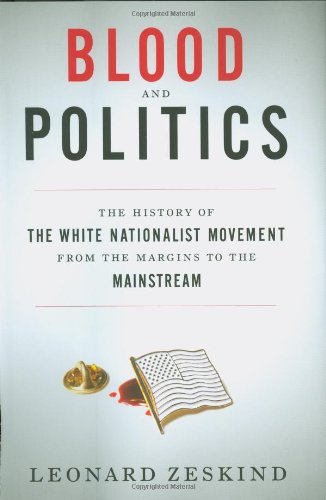
In 2009 the leftwing journalist Leonard Zeskind published Blood and Politics, a magisterial 650 page account of White Nationalism that exhaustively catalogued the racism and antisemitism of numerous right-wing and reactionary figures in America from the 1950s onward. But although the author did quite properly devote a couple of pages to Oliver, once again there was absolutely no mention of Beaty although the ADL had ferociously denounced him as a leading inspiration for such “lunatic fringe groups.” Zeskind did begin his narrative in 1955 with the founding of Liberty Lobby by Willis Carto, but given the latter’s ideological positions, it is difficult to believe that Beaty’s huge conservative bestseller earlier that decade hadn’t been a major influence in that decision.

Most recently, Matthew Continetti published The Right, a widely praised and supposedly very comprehensive 2022 history of the last one hundred years of American conservatism, rather favorably reviewed by Hawley. But Oliver only appeared in one glancing sentence across its 500 pages of text and as usual there was no mention of Beaty whatsoever, with neither Hawley nor any other reviewer ever apparently noticing that glaring omission.
All of these remarkable lacunae bring to mind how I’d reacted in 2018 when I’d first discovered some of these important but totally hidden strands of American intellectual history, including all the once towering figures who had been so completely tossed down our memory hole:
I sometimes imagined myself a little like an earnest young Soviet researcher of the 1970s who began digging into the musty files of long-forgotten Kremlin archives and made some stunning discoveries. Trotsky was apparently not the notorious Nazi spy and traitor portrayed in all the textbooks, but instead had been the right-hand man of the sainted Lenin himself during the glorious days of the great Bolshevik Revolution, and for some years afterward had remained in the topmost ranks of the Party elite. And who were these other figures—Zinoviev, Kamenev, Bukharin, Rykov—who also spent those early years at the very top of the Communist hierarchy? In history courses, they had barely rated a few mentions, as minor Capitalist agents who were quickly unmasked and paid for their treachery with their lives. How could the great Lenin, father of the Revolution, have been such an idiot to have surrounded himself almost exclusively with traitors and spies?
If Hawley’s book had merely been limited to that standard history of conservatism, I doubt it would have had much of an impact nor been remembered. But one of his last and shortest chapters was entitled “Voices of the Radical Right” and bore the descriptive subtitle “White Nationalism in the United States.” The subject obviously made Hawley quite uncomfortable, and in his opening sentence he admitted that he included this account with “some hesitation,” then went on to explain that these days many regarded “Racism…even as a psychiatric disorder, rather than the source of a logical and coherent ideology…one could justifiably argue that white nationalists have little to say that is worthy of scholarly examination.”
After several pages of such disclaimers and harsh denunciations of racism, the author finally began focusing on the topic at hand, beginning with a few paragraphs devoted to such racialist writers as Madison Grant and Lothrop Stoddard, emphasizing that during the early decades of the twentieth century they had been figures of considerable influence in American society.
But although he noted that the work of the former was idolized by Adolf Hitler, he failed to mention that many of America’s own top leaders, such as Presidents Theodore Roosevelt and Herbert Hoover, had been equally effusive in their support. And the author never indicated that after Stoddard earned his Harvard Ph.D. and then rocketed to international fame with the 1920 publication of his huge bestseller The Rising Tide of Color, he went on to spend most of the 1920s and 1930s as one of America’ most influential public intellectuals.
The historical reality is that most of the racialist assumptions of those two figures were almost ubiquitous among educated Americans and other Westerners of that era. And as I recently pointed out, extensive later research by leading mainstream scholars has indicated that the scientific underpinnings of those controversial ideas were never effectively refuted. Instead, they were dethroned and replaced by their opposites largely because their ideological opponents had powerful allies in the media, who manipulated the facts and sometimes even promoted blatant scientific fraud. Hawley seemed totally unaware of these important facts.
The author only mentioned Wilmot Robertson’s 1972 volume The Dispossessed Majority in a couple of sentences. Aside from getting its date of publication wrong, he also failed to note that despite total suppression by almost every media outlet and boycotts by almost every book store, this opus still eventually became a major bestseller with some 150,000 copies in print. The book served as the founding ur-text for modern American White Nationalism, certainly inspiring many of the later figures that Hawley discussed. Robertson’s work also attracted critical praise, with Prof. Oliver describing it as one of the most important books published in twentieth century America and Prof. Carleton Coon, the leading American physical anthropologist of his generation, praising it as “A work of vast scope and scholarship.”
Hawley spent a couple of pages on the much more recent controversy over race and IQ that was touched off by the 1994 appearance of The Bell Curve, an 845 page door-stopper that became a publishing sensation. But he failed to fully emphasize that the book in question represented the overwhelming psychometric consensus on that topic, and came in the wake of decades of previous publications by top scholars along similar lines. He also mentioned the 2009 publication of The 10,000 Year Explosion, misspelling the name of the senior author, and A Troublesome Inheritance, Nicholas Wade’s 2014 book on recent scientific discoveries connected with race, without mentioning that the award-winning Wade had been the longtime Science Editor of The New York Times.
After an obligatory discussion of the various iterations of the Ku Klux Klan and other more recent white racialist political organizations that similarly left no intellectual footprints, he did devote some coverage to Jared Taylor and Kevin MacDonald, two of the leading figures of the last few decades, presenting their ideas in reasonably fair terms.
Given the large number of factual errors, distortions, and omissions in Hawley’s two dozen pages of text, I could hardly endorse his material. But I do think that his short treatment might have been better and more even-handed than anything any other mainstream academic had published on the subject in more than a decade.
Less than 10% of Hawley’s book was devoted to his chapter on the white racialism of what he called the “Radical Right,” but despite its numerous flaws and the serious misgivings he had expressed in including it, his timing turned out to be perfect. His book was released in March 2016, providing a serious and somewhat respectful discussion of white nationalism and a couple of its current leading figures. Then later that same year, those ideological currents suddenly attracted enormous national visibility in the wake of the shocking political success of Donald Trump’s presidential campaign.
As I wrote a few weeks before Trump’s stunning 2016 victory:
In late July, Avik Roy, a Republican intellectual of South Asian ancestry, declared with anguish that he had completely misunderstood the true nature of the political party he had long and diligently served. He and his Beltway friends—the wonks and ideologues of Conservativism, Inc.—had spent years earnestly debating health care reform, targeted tax cuts, and free trade promotion, assuming that such policies and principles were similarly inspiring the voters who elected their Republican candidates to office. And then Trump, with harsh, racially charged rhetoric, diametrically opposing policy views, and a negligible advertising budget crushed all those prominent national leaders at the ballot box. According to Roy, he and all his conservative friends and patrons had been living “in a kind of bubble,” believing that their voters cared about their “philosophical, economic conservatism,” but they were entirely mistaken: “In reality, the gravitational center of the Republican Party is white nationalism.” Indeed, over the last few months, some analysts have suggested that mainstream conservative leaders have been unmasked as generals commanding a ghost army, representing an ideological movement that never really existed.
It is easy to imagine that Roy and so many other mainstream journalists and political operatives soon turned to Hawley’s recently published book in a desperate attempt to make sense of the huge ideological earthquake that had shattered all their comfortable assumptions about American politics.
Although Hawley had never once mentioned the term Alt-Right in his text, his book and especially its short chapter on white racialism encompassed the entire ideological framework of the national political movement that gained such enormous public attention in the wake of Trump’s unexpected 2016 victory. Thus, Hawley was soon regarded as one of the leading academic experts on the Alt-Right, which he correctly characterized as essentially amounting to White Nationalism. As a result, he went on to publish two rather short books in 2017 and 2019 on that topic, both released by very prestigious academic publishers.
As Hawley explained at the very beginning of Making Sense of the Alt-Right, when he began working in early 2016 on his follow-up book analyzing the politics of the Trump campaign, he hadn’t been convinced that it should even include a single chapter on the Alt-Right. But matters soon dramatically changed, and his editors at the Columbia University Press requested that he set aside the hundreds of manuscript pages that he had already written and instead focus exclusively upon that suddenly ultra-high-profile political movement. So when his book was released in 2017, it only consisted of about 200 fairly short pages, totaling perhaps 70,000 words or less.
I hadn’t been all that impressed with Hawley’s previous work, so just as I might have expected, this rather short and hastily produced volume once again came across as rather superficial, mostly focusing upon the major personalities of what was largely an online movement of provocateurs, poseurs, and agitators.
For example, Prof. Kevin MacDonald was generally considered one of the foremost ideologues of the Alt-Right, with his three academic volumes on Jews widely regarded as having provided an intellectual backbone for the movement. But he only rated a single paragraph, while dozens of pages were devoted to Richard Spencer, the young and somewhat egomaniacal impresario who had helped coin the name and then often eagerly served as its public face.
But reading Hawley’s brief text was very useful in refreshing my memory of that period of nearly a decade ago when so many of these bizarre individuals and their activities suddenly dominated the political life of the greatest superpower the world had ever known.
Many of the roots of the Alt-Right movement could be traced to various Internet imageboard websites, whose contents were typically long on crude or satirical images and short on substantive analysis. These often gave rise to the memes—generally cartoons or other images flavored with a dash of text—that became the main vehicle for Alt-Right propaganda, sometimes going viral and being viewed millions of times across various social media platforms.

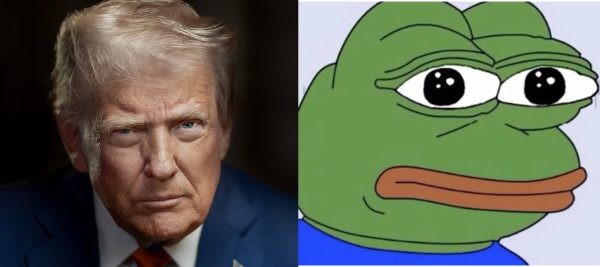
For totally obscure reasons, the main symbol and mascot of the Alt-Right soon became a crudely anthropomorphic cartoon frog called Pepe, often garnished with Nazi elements. This obviously reflected the extremely transgressive but rather juvenile ideological trolling of so many of the youthful Alt-Right activists.
Indeed, their antics often reminded me of the outrageous Yippies of the late 1960s, whose most famous exploit had been their attempt to end the Vietnam War in 1967 by levitating the Pentagon with an incantation. I’m sure that the straightlaced Birchers of that era denounced that project as terrorism, and in much the same way the ADL soon declared the cartoon frog in all its manifestations to be a symbol of hate.
The Alt-Right had no real organization nor any sort of institutional structure, so the actual size of the movement was unknown and probably ambiguous, depending upon whether we should include every teenager who had once shared a satirical Pepe meme. Much of its strength came from its successful attempt to provoke and insult journalists into taking it seriously and portraying its supposed numbers in hugely exaggerated terms.
Hawley quoted the candid editor of a small Alt-Right website in plausibly explaining how this occurred:
The Alt-Right went from a tiny, fringe thing found on Twitter & /pol/ to being a major component of the 2016 election. That’s truly impressive, and I think that’s mostly due to the unique lives of journalists. Their entire lives are lived online on sites like Twitter, and so what they see and report on tends to come to life through their articles—at times, a self-fulfilling prophecy. Normal people don’t live their existence online on places like Twitter, so most people had no idea we existed…we practically memed ourselves into existence…getting [journalists] to write about his scary, secretive, mean online group.
Hawley also explained how Alt-Right supporters sometimes tricked journalists at major media publications into reporting outrageous hoaxes as reality, with one of those successful online pranksters being a teenager still in high school. Although the author didn’t mention it, I remember that one of the most memorable of those exploits had been when Alt-Right activists managed to persuade their establishmentarian foes that the traditional OK hand gesture—traced back thousands of years to Ancient Greece and Rome—was actually meant to symbolize White Supremacy. This prompted the ADL to include it in its “Hate Database” and with the media widely declaring that the gesture had that meaning, it began being used for exactly that purpose.
I think that one of the reasons for the great success of these Alt-Right activists was that so many of the mainstream journalists and pundits whom they were trolling were Jews who had absorbed a lifetime of media-promoted paranoia regarding the deadly threat of American antisemitism and therefore sometimes reacted with hair-trigger outrage to these attacks. For generations, our news and entertainment media had almost completely banned any criticism of Jews, so their immunity levels were low when hostile trolls began using used triple parentheses “(((Echoes)))” to indicate names that concealed a Jewish identity or when they distributed gas-chamber memes. Heavily Jewish Hollywood had regularly released big-budget films that ridiculed and insulted the martyrdom of Christ, arguing that the 95% of Americans who had Christian roots must tolerate those attacks on free speech grounds, but online cartoons mocking the sacred memory of the Holocaust were bitterly denounced as being beyond the pale, leading to demands that they be suppressed.
In one of his last chapters the author also discussed the so-called “Alt-Lite,” consisting of the large number of right-wing activists who expressed considerable sympathy for the Alt-Right and many of its attacks against our political establishment but without sharing all of its harder-core racialist and antisemitic positions.

A couple of years later, Hawley published The Alt-Right: What Everyone Needs to Know with Oxford University Press. This follow-up 2019 volume ran only a little longer than his previous book and it abandoned any overall narrative for an organizational structure merely consisting of more than 100 questions and explanations, with the latter generally running a short page or two each. In his Introduction, the author explained that the very rapid pace of developing political events had required this update, given that the Alt-Right had transformed itself from a purely online movement of right-wing, white racialist trolls into something now having a physical presence, one that often provoked violence.
Hawley had considerably expanded his knowledge of the Alt-Right and its roots and predecessors in American White Nationalism. For example, he now allocated nearly two pages to Oliver, whom he correctly identified as one of the founding figures in both National Review and the John Birch Society, but a scholar whose fierce antisemitism led him to break with both those organizations, even noting Oliver’s strange, near-total absence from all standard histories of the conservative movement. But the author had still apparently never heard of Beaty.
That discussion of Oliver appeared in an early chapter on “White Nationalism 1.0” that ran nearly forty pages and did a pretty good job of providing capsule summaries of dozens of that ideological movement’s core beliefs, terminology, and major personalities. Those latter individuals included Francis Parker Yockey, George Lincoln Rockwell, Tom Metzger, William Pierce, David Duke, and Jared Taylor, though Taylor must hardly have appreciated being grouped together with so many figures widely regarded as neo-Nazis. But I found it quite odd that there was no mention anywhere of Wilmot Robertson, who arguably was the founding father of modern American White Nationalism, with his 1972 book providing the intellectual underpinnings for that movement and his monthly Instauration magazine then spending the next quarter-century as its leading publication.
Near the beginning of his discussion, Hawley made the important point that the Alt-Right movement had no real connection with Donald Trump nor his campaign, but had merely latched onto his candidacy in hopes of gaining attention and a larger audience for its ideas. Meanwhile, it had actually been Hillary Clinton and her Democratic Party allies who had deliberately promoted the Alt-Right and its connection to Trump under the mistaken assumption that it would severely damage the latter’s electoral appeal. However, Trump’s strident attacks against non-white immigrants—he had launched his campaign by denouncing Mexicans as rapists and killers—had obviously attracted the enthusiastic support of most Alt-Right leaders and their supporters.
The Alt-Right political movement was totally decentralized so that no one could point to any particular manifesto or set of principles, and those figures who sometimes tried to fill that void obviously overstepped their authority. For example, a prominent right-wing blogger calling himself “Vox Day” was often identified with the Alt-Right and he had declared the “Sixteen Points” that allegedly defined the ideological movement. But these included a total rejection of “National Socialists” and an acceptance of Christianity as a central pillar of Western civilization, claims that were anathema to the many Alt-Rightists who considered themselves neo-Nazis or who despised the latter religion.
Hawley was an untenured junior faculty member probably lacking any serious scientific expertise when he published this book, so I noticed that he sometimes tread very carefully on certain sensitive issues. For example, he explained that the Alt-Right embraced the importance of race, firmly rejecting “the now-dominant notion that race is a social construct rather than a legitimate biological category.” That latter shibboleth obviously represented exactly the sort of total absurdity spouted by so many of our leading academic and media institutions against which many of the younger generation had angrily rebelled by aligning themselves with the Alt-Right.
Similarly, he declared that “shootings of unarmed African Americans spurred new questions of racial bias…galvanized advocates for minority communities and led to the Black Lives Matter social movement.” But surely he must have been aware that nearly all the highest-profile examples of these, including the deaths of Trayvon Martin and Michael Brown, were essentially media hoaxes, constituting exactly the sort of total dishonesty that prompted the angry backlash inspiring the Alt-Right.
The author also reminded readers of one of the most clever Alt-Right stratagems that successfully illustrated the bizarre ideological extremism of the opposing political establishment and mainstream media. In 2017 activists began distributing a meme that carried the simple phrase “It’s okay to be white,” distributing it both online and in the form of printed fliers on college campuses and other public places. This provoked a huge uproar when media pundits denounced that obviously innocuous message as racist propaganda and people reported the fliers to the police, allowing Tucker Carlson to reasonably declare that this demonstrated the antiwhite agenda of the American left.
Hawley recognized that his short book only provided a cursory overview of the Alt-Right and to his credit he recommended The Rise of the Alt-Right by Prof. Thomas J. Main, published in 2018 by the Brookings Institution. So I went ahead and ordered that work, finding it much more systematic and thorough, and roughly twice the length of either Hawley book.
Main began by trying to estimate the actual size of the Alt-Right movement, comparing the traffic to the various Alt-Right websites with that of the publications in the mainstream conservative or liberal camps, finding that the former totaled a little over 1%, though it had recently been growing much more rapidly. Although that figure hardly suggested that the Alt-Right was a popular juggernaut, the author was still quite disturbed to discover that some of the most popular Alt-Right websites such as the Daily Stormer, VDARE, and American Renaissance easily matched or exceeded the readership of such mainstream and respectable publications as the Washington Monthly, Commentary, or Dissent. Furthermore, the combined total of all the Alt-Right websites was considerably larger than that of the Weekly Standard, the Neocon flagship organ, something that he found “quite striking.” However, I think those results merely demonstrated the lack of popular appeal in the contents of various influential but elite-oriented liberal and neoconservative publications rather than anything deeper.
In analyzing the ideological roots of the Alt-Right, Main devoted ten full pages to discussing Kevin MacDonald’s trilogy of scholarly books and the theories they set forth regarding the nature of Jewish influence in our society. I thought that his presentation seemed so detailed and fairly stated that although he repeatedly emphasized what he considered the fatal flaws in MacDonald’s ideas, many of his more open-minded readers may have come to the opposite conclusion.
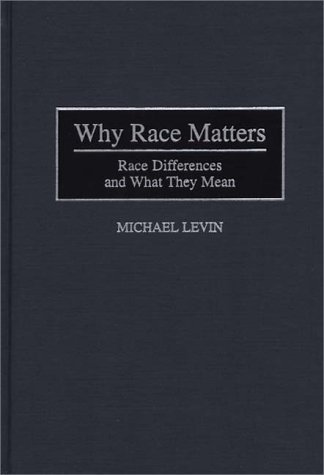
Several more pages were given to the writings of Jewish NYC philosophy professor Michael Levin, who had set out his harsh and candid views on black crime and IQ in Why Race Matters, a 400 page scholarly volume published in 1997 by a mainstream academic press. Main noted that Levin’s material had been greatly praised over the years by many of the Alt-Right’s leading thinkers, and I found his attempts to refute those racialist arguments quite unconvincing.
I was even more surprised when much later in his volume, Main approvingly quoted various supposedly authoritative academic sources who denied the very existence of race as a meaningful biological category. He seemed totally unaware of the major ideological purges over the last half-century that had eliminated or intimidated into silence so many of those academics who believed otherwise, with the name James Watson never once appearing in his text.
As might be expected of an academic with a background in political science, Main devoted one of his longest chapters, running more than 40 pages, to an exhaustive discussion of what Thomas Jefferson and some of our other Founding Fathers had really believed about racial issues and black equality, arguing that the contrary claims advanced by many in the Alt-Right were misleading. But Jefferson died nearly 200 years ago, and I have little doubt that both he and most of his contemporaries would be so horrified by so many current aspects of American society and politics that their views regarding the Alt-Right’s racial claims would be the least of their concerns.
To his considerable credit, the author personally interviewed quite a number of prominent figures in the Alt-Right ranging from its major ideologues such as MacDonald and Taylor to some of its leading promoters such as Richard Spencer, Hunter Wallace of Occidental Dissent, and Greg Johnson of Counter-Currents, and their statements about the Alt-Right and their own beliefs were sometimes illuminating. But I also discovered that the last of these individuals had responded with a long and very negative review of Main’s book, along with a much more positive appraisal of Hawley’s earlier one.
Looking back from the distance of nearly a decade, it’s difficult to see much that was accomplished by all the tremendous sound and fury of the Alt-Right movement of 2015, 2016, and 2017.
It’s possible that their online activism assisted Trump in eking out his surprising and very narrow 2016 victory. But it’s also possible that they alienated as many potential voters as they attracted. And once Trump reached the White House, he quickly threw them overboard without much hesitation, instead staffing nearly his entire administration with either mainstream Republican conservatives or else committed Neocons so that almost none of his actual policies, whether good or disastrous, could be laid at their doorstep.
Perhaps they successfully got some of their ideas far more public attention than had previously been the case, but many of their leading spokesmen were hardly the best individuals to have put forward, and the same was often true for the way that their ideas were expressed. So it’s not entirely clear to me whether they did more harm than good to the racialist cause that they espoused.
Furthermore, much of the controversy generated by the Alt-Right and the associated Alt-Lite helped provoke a massive and unprecedented Tech crackdown on dissenting voices, which soon destroyed most of the movement and began the very unfortunate trend of deplatforming and electronic censorship that has continued down to the present day.
In August 2017, I’d made some of these points in an open letter I distributed to quite a number of individuals, many of whom were prominently associated with the Alt-Right movement. After I eventually published it at the end of the following year, it provoked an enormous outpouring of responses, most of them quite hostile. The nearly 300,000 words of commentary on the resulting discussion thread is probably greater in length than the combined total of all the three books by Hawley and Main:
- An Open Letter to the “Alt-Right” and Others
Ron Unz • The Unz Review • December 24, 2018 • 2,000 Words • 2,034 Comments
A year or two later, I followed it up with another article providing another very negative appraisal of American White Nationalism that once again provoked an enormous outpouring of angry commentary, totaling nearly an additional 250,000 words.
- The Political Bankruptcy of American White Nationalism
Ron Unz • The Unz Review • July 27, 2020 • 3,400 Words • 1,507 Comments
Later that same year, I published an extremely long and comprehensive intellectual survey of the last one hundred years of white racialism in America, evaluating many of its earlier figures in a far less negative light, and although I barely mentioned the term Alt-Right, I did include a section towards the end discussing some of its leading ideologues. I think that both Hawley and Main might have greatly benefited from reading and absorbing the material that I provided.
- White Racialism in America, Then and Now
Ron Unz • The Unz Review • October 5, 2020 • 24,900 Words
Within a couple of years, almost all of those once associated with the Alt-Right had completely abandoned that term, apparently regarding it as completely discredited. Some of the major ideological figures once associated with the movement such as Kevin MacDonald, Jared Taylor, and Peter Brimelow were still writing their articles and running their websites much as before, but they had been doing so for decades, long before anyone had even coined the term Alt-Right. Meanwhile, many of the leading Alt-Right figures such as Andrew Anglin, Richard Spencer, and Mike Enoch had broken with each other and other movement activists amid sharp and bitter recriminations.
Ironically enough, I think that the one clear and substantive accomplishment of the Alt-Right movement itself was something so massively suppressed by the media that it was almost totally ignored by the books later written about the Alt-Right. Hawley’s 2019 volume only very glancingly touched upon it as discredited nonsense, while the others omitted it entirely.
In a 2019 article, I had pointed out the strong and persuasive evidence that the Pizzagate Scandal unearthed by Alt-Right activists during late 2016 was probably true, and earlier this year I returned to that same topic in a much longer article, recapitulating the very considerable evidence.
- American Pravda: John McCain, Jeffrey Epstein, and Pizzagate
The Massive Suppression of Pizzagate
Ron Unz • The Unz Review • July 29, 2019 • 6,400 Words - American Pravda: Jeffrey Epstein, the Franklin Scandal, Pedophilia, and Political Blackmail
The Suppressed Pedophilia Scandal of Pizzagate
Ron Unz • The Unz Review • July 28, 2025 • 12,300 Words
These pieces contained links to a couple of the crucial articles we’d republished in 2016 making that case, and the evidence seems just as persuasive today as it did at the time:
- Pizzagate
Aedon Cassiel • The Unz Review • December 2, 2016 • 3,100 Words - Precedents for Pizzagate
Aedon Cassiel • The Unz Review • December 23, 2016 • 6,200 Words
Related Reading:
- Bibliography
- White Racialism in America, Then and Now
- An Open Letter to the “Alt-Right” and Others
- The Political Bankruptcy of American White Nationalism
- Racial Politics in America and in California
- Immigration, Building a Wall, and Hispanic Crime
- American Pravda: John McCain, Jeffrey Epstein, and Pizzagate