
War and Peace
War is one of the fundamental conditions of humanity, and it was originally a factor of selection. The best were those who survived. However, war has developed into mass extermination, where it is often the best who are killed. During the Thirty Years’ War, what is now Germany lost more than 25% of its population. In World War I, the British lost so many capable people that it became difficult to continue administering India – in 1947, the “Crown Jewel” had to be abandoned. World War II cost so many lives that no one can put a credible figure on it. At least 27 million Soviet citizens, 2 million Germans alone during the post-war expulsion – the number of soldiers killed in German units amounts to at least 5.5 million. Added to this are British, French, Japanese, American, and other soldiers, bombing victims, especially in Germany, but also in England, victims of the siege of Leningrad (at least 1.5 million), the German policy of starvation towards Russian prisoners of war (and civilians), the partisan war in Russia, the starvation and random shootings of German or Russian prisoners of war by the Americans, the attempts to exterminate the Jews of Europe, the victims of the bombing of Tokyo, not to mention the victims of the atomic bombs. A total of 70 million in all theatres of war – and that is probably an understatement. And the vast majority of those killed were Europeans of the highest quality – at least 100 million in total in the last century – 100 million who did not have children and grandchildren, etc.
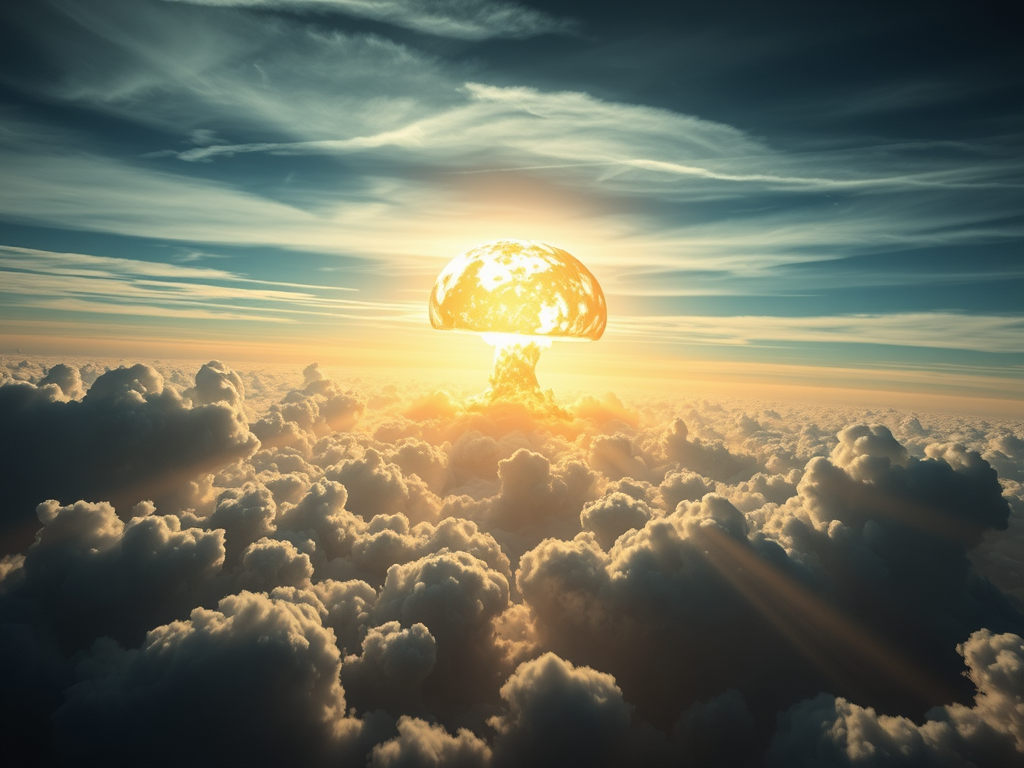
Demographically, Europe cannot afford any more wars – especially not today, when any war is almost certain to develop into a global nuclear war that will destroy all life in Europe – and on the entire planet.
Wars have almost always been a question of power, influence, and enrichment – even if they have sometimes been disguised as religious wars and crusades. With the advent of ideologies, these took the place of religion as the purpose of war. The Soviet Union, for example, had world revolution on its agenda, but it was well aware that this could not be achieved through war, but only perhaps through influence. The Soviet Union’s wars were either directly about defense or security.
With the rise of nationalism in the 19th century, the desire to unite one people in one state became a new reason for warfare. A good example is the Schleswig Wars.1 Unreasonable border demarcations after World War I were the immediate trigger for World War II. When the borders were revised after this war, the indigenous population was expelled – which is a crime against humanity. However, Germany was on its knees and could do nothing. When the Soviet Union collapsed, the indigenous populations of the individual Soviet republics were once again ignored. The borders were completely arbitrary and took no account of the nationality of the populations, but were instead an expression of the divide-and-rule principle. This was the trigger for the Ukraine conflict, the problems between Armenia and Azerbaijan, between Georgia and Abkhazia and South Ossetia – to which Adjara may eventually be added – and for the problems in the Fergana Valley, which have triggered several local conflicts and are a plague on trade and mobility between Kyrgyzstan, Uzbekistan, and Tajikistan. I often talk to people who regret the dissolution of the Soviet Union—not for political reasons, but for practical ones. In some places, life has become unnecessarily difficult.
With the possible exception of the Soviet Union, foreign policy has traditionally always been interest-based. Individual countries have looked at which policies benefit them. In Germany, the government swears upon taking office to defend Germany’s interests and avert harm from the fatherland. In connection with the Ukraine conflict, this basis for foreign policy seems to have been replaced by a “value-based” foreign policy that takes no account of the interests of the countries involved. However, it is difficult to see what values are being defended. There is talk of Ukraine’s sovereignty and its inviolable borders, but no principled position is taken on what constitutes a country. Is it a random area on the map – or is it a population that feels a connection to a particular area and shares a history, language and culture? It should be obvious that it is a population that constitutes a country. At least, that seems to have been Turkey’s motivation for invading Cyprus and dividing the island, just as it was allegedly the partly Albanian population that defined the “nation” of Kosovo and prompted the US to change the borders in Europe again and install the American protectorate of the same name. Indeed, the entire dissolution of Yugoslavia naturally led to several border changes, which were not even adjusted according to the wishes of the population. This led to the creation of the bastard state of Bosnia and Herzegovina, which is in fact also a NATO-controlled protectorate that no one really wanted and which has little future. So it is perfectly possible to change borders in Europe and detach areas at will – as long as it is the US doing it.
When Mette Frederiksen defends the war on “moral” grounds and talks about “European values” and the inviolability of borders, she therefore seems to be on very thin ice. At the start of hostilities, more than half of the population of Ukraine spoke Russian as their mother tongue, and in the five oblasts that have joined Russia through referendums, the population is Russian. These were administratively transferred from Russia to Ukraine in 1922 and 1954, respectively, without the populations being consulted. At least four other oblasts probably have a Russian majority – the two definitely do. However, the only reasonable way to determine Ukraine’s borders would be through referendums in the individual oblasts – as the Russians have already done in five oblasts. Nevertheless, there will of course still be minorities, and these must naturally be treated in accordance with “European values,” which give minorities the right to education and worship in their own languages and to use their own languages in all contexts. Added to this, of course, is the freedom to produce television programs and publish publications in their own languages. These values are self-evident – even if not all Western countries are good at complying with them. France, for example, violates the rights of linguistic minorities on a daily basis – without any consequences. The conflict should not have been difficult to resolve, had it not been for the fact that the US carried out a coup in Ukraine and the new government changed Ukraine’s constitution, depriving the majority of the population of their linguistic and cultural rights. What Mette Frederiksen supports is a thoroughly corrupt system of oppression without political freedom and without elections, which we would protest against and impose sanctions on anywhere else.
Ukraine has become a pawn in a geopolitical game in which the US insists on determining the world order according to its own ideas. Ever since the Cold War, the US has been working purposefully to encircle Russia. Would the US have accepted such encirclement? No, we know from the Cuban Missile Crisis, for example, that it would not. The US has around 800 military bases spread across the globe – why? It is an expression of a failed state’s desperate attempt to cling to world power. But Russia will no longer tolerate it. Four times in the last 300 years, Russia has been attacked through what is now Ukraine – and it will not risk a fourth time.
The West is trying to portray the current conflict as a showdown between “the good” and “the evil” – between ‘democracy’ and “dictatorship” – but this is a primitive division of the world, quite apart from the fact that Russia is not a dictatorship and that America and its vassals are not democracies. The US is a kleptocracy, where a number of oligarchs and interest groups pay politicians to promote certain causes. The most prominent are the Israel lobby, the arms lobby, and the pharmaceutical lobby – but there are, of course, others. While Putin enjoys the support of 80% of the population, Trump has to settle for half that, Starmer for 18%, Macron for 11-16% (depending on who is measuring), and Merz is historically unpopular. After a relatively short time in power, his popularity is below 25% and falling. Elections are rigged, in Germany through vote counting fraud (as in Denmark), in Moldova by de facto preventing opponents from casting their votes, in Romania by excluding unwanted candidates, in Germany by attempting to ban opposition parties, and in many other places by using so-called NGOs to pour huge sums of money into election campaigns and support certain candidates from outside. This can be seen, for example, in Georgia and Armenia, and attempts have been made in both Belarus and Russia. Any talk of “democracy” is a lie and a fraud. Within the EU, 85% of all legislation is implemented by bureaucrats who have never been elected by anyone. “No one above and no one beside the national parliament” has become an empty phrase.
Everyone has their fingers deep in the honey pot. Corruption in Ukraine is well known, but the US is at least as corrupt, and Denmark cannot claim to be free of it either – but we have decided that we do not have corruption, so we do not investigate it. But it is very telling that washed-up politicians can always find well-paid sinecures in the business world…. My guess is that all Western politicians are profiting handsomely from this war, in which the Ukrainians are merely pawns. Ukraine is no longer demographically viable, but that does not concern Mette Frederiksen and the other gang members at home and abroad. It is not their children who are dying – the fighting is not taking place in their living rooms, and it is not they who are lacking electricity, water, and heat – it is the Ukrainians, and they are not being asked if they want to go to war. As mentioned, there have been no elections in Ukraine for ages. Zelensky was elected on a peace platform. Ukraine is now a dictatorship – effectively run by a gang of gangsters who only have their own bank accounts in mind. Zelensky’s family is not in Ukraine. His wife and children are in England, his parents are in Israel – together with members of the government who have fled as a result of corruption charges.
All this talk about Ukraine defending our freedom is obviously nonsense. What on earth would Russia want with us? We have absolutely nothing that Russia needs – or wants. We only have economic and demographic problems, foreign hordes ravaging our streets, gender confusion, and pride parades. We have no raw materials, soon no industry – and a level of education that can only provoke laughter in Russia. We are not worth a drop of Russian blood! Unfortunately!
Countries that oppress large Russian minorities – i.e. Estonia, Latvia and, to a lesser extent, Lithuania – should, however, come to their senses and give these minorities back their rights. Otherwise, sooner or later, they will share the fate of Ukraine. NATO will not be able to save them; indeed, NATO will hardly survive Ukraine’s fall, and the same fate may well befall the EU. At least, that is to be hoped.
Our politicians seem to be basing their views on Francis Fukuyama’s thesis that the victory of “democracy” over communism marks the end of history, since, in Fukuyama’s opinion, “democracy” is the highest step on the ladder of historical development. Let us just note that “democracy” has only been around for about 150 years and that it is a dangerous path that will lead to the downfall of culture and humanity if it is not stopped. This does not mean that we should have a dictatorship in the classical sense, but that we must ensure that it is not the majority that decides, but the best and most highly educated of the nation. What eighteen-year-old schoolgirls think is completely irrelevant. If we are to follow Fukuyama’s and Mette Frederiksen’s line of thinking, we are back in the days of the Crusades, when power struggles were camouflaged as noble battles for the victory of good and truth. But they remain power struggles.
The US claims to be “the exceptional nation” – “the shining light on the hill.” In reality, the US is the world’s anus, from which all filth and evil emanates. After World War II, the US was the only significant country that had not suffered significant damage during the war. Its economy was intact, and it was able to take advantage of this by investing in the war-torn countries. The Soviet bloc wisely rejected this form of economic colonization. The US became the world’s policeman, respecting no form of law but only narrow American interests. Over the past 80 years, the US has thus played the role of world ruler with the right to interfere in the internal affairs of other countries and to intervene militarily at will without asking anyone – not even the UN or NATO for that matter. During this period, the US has left a trail of blood across the globe. It is time for the US to realize that those days are now over. Both Russia and China want a seat at the table. Peace cannot be achieved through military force, but only through mutual respect and mutual negotiations. This requires knowledge and understanding of other nations’ interests and security. As long as empty-headed fools like Mette Frederiksen, Emmanuel Macron, Keir Starmer, Kaja Kallas (a particularly malignant and ignorant specimen of homo erectus), and Ursula von der Leyen are directing European foreign policy, peace is impossible. Alliances caused World War I (which no one really wanted), and alliances and interference in other countries’ affairs will cause World War III. Europe’s insane and incompetent so-called leaders want World War III to cover up their incompetence, and as already mentioned, it will at least lay waste to Europe—perhaps the whole world.
Povl H. Riis-Knudsen
This article was originally published in Danish on December 5, 2025.
Translated with the help of AI
Note
- A summary of the Schleswig Wars – made with Grok
The “Schleswig Wars” refer to two connected 19th-century conflicts over the duchies of Schleswig and Holstein.1. First war (1848–51): Danish nationalists vs. German nationalists + Prussia. Denmark barely kept the duchies because the Great Powers forced Prussia to back off. - Second war (1864): Bismarck used the issue as a pretext to humiliate Denmark and later Austria. Denmark lost the duchies forever.The wars were a classic 19th-century clash of rising nationalism (Danish vs. German) combined with dynastic succession complications and great-power politics (especially Bismarck’s masterful manipulation). The modern border between Denmark and Germany (fixed in a 1920 plebiscite after World War I) still roughly follows the linguistic/ethnic line from the 1860s. ↩︎
https://www.theoccidentalobserver.net/2025/12/11/war-and-peace/