
Tolkienian Right and Lovecraftian Left
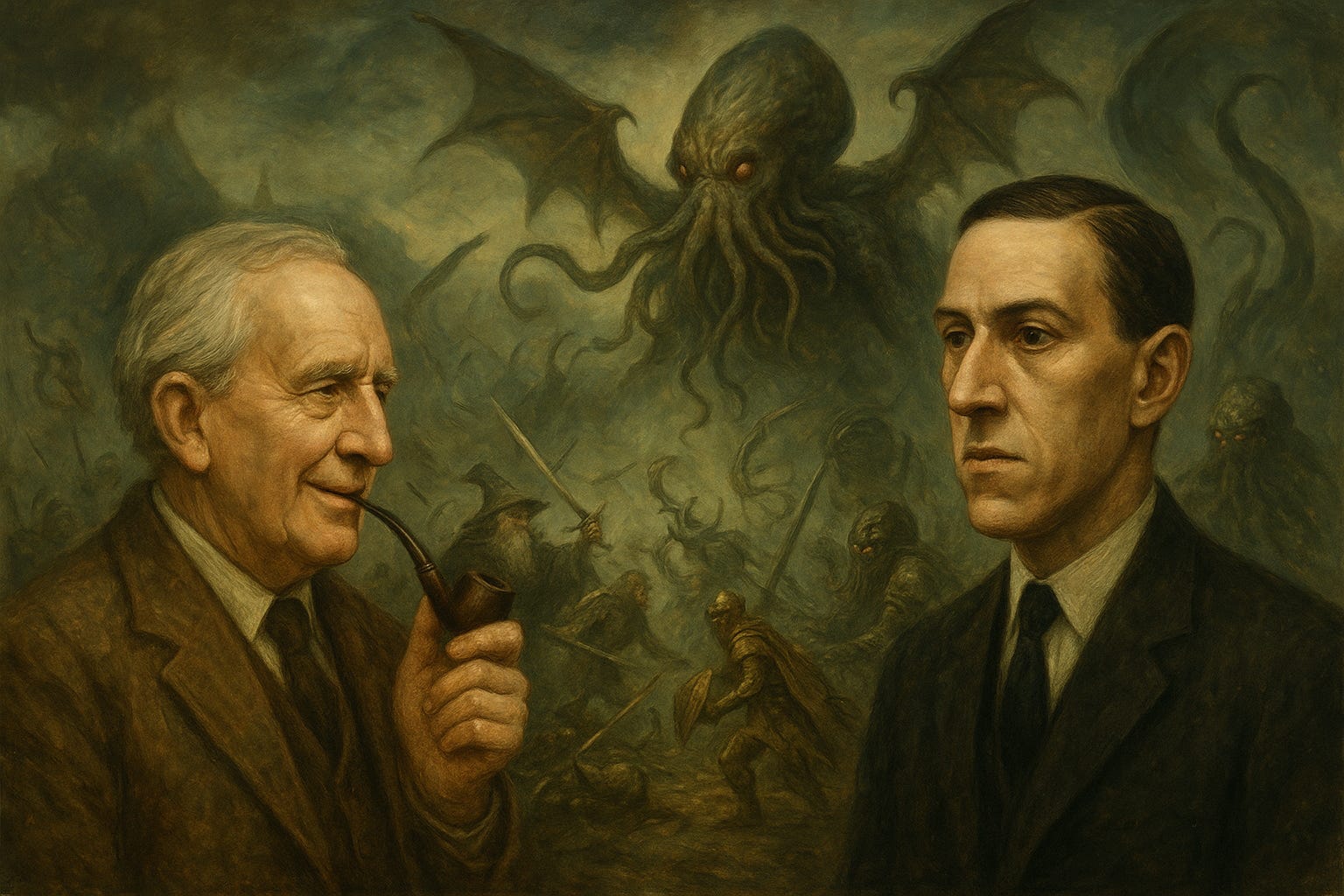
Rootedness vs. Otherness.
“The oldest and strongest emotion of mankind is fear, and the oldest and strongest kind of fear is fear of the unknown.”
— H .P. Lovecraft
“In any case if you want to write a tale of this sort you must consult your roots, and a man of the North-west of the Old World will set his heart and the action of his tale in an imaginary world of that air, and that situation: with the Shoreless Sea of his innumerable ancestors to the West, and the endless lands (out of which enemies mostly come) to the East”.
— J. R. R. Tolkien
The battle of ideas that is taking place under the surface of our age is essentially a battle of two irreconcilable principles: the preservation of the familiar and the embrace of the foreign. The first is a natural instinct that ensures a group’s survival, and the second is the negation of one’s identity. The latter was on the offensive for quite some time, but it is now forced to defend itself against the right-wing Reconquista and the Overton Window pushers that are fighting back against the liberal invaders of the Western cultural and political landscape. Tensions are rising as the struggle for the soul of our civilisation escalates.
The Left is waging a moral war by promoting white guilt, a demographic war by replacing the native stock with foreigners, and a war of censorship by terrorising and oppressing its opponents. But the resistance is growing. Will it be strong enough to grow into a proper renaissance of European identity? Or are we witnessing only the last flickering of a dying flame before it is devoured by eternal darkness? Is this the hour of wolves and shattered shields? That remains to be seen. All we can do is keep on fighting, come what may.
The man of the Right is a rooted man of home and heritage, while the leftist is an uprooted, wandering creature of individualism. He is terrified by the idea that some things are predetermined. Therefore, he runs from reality and believes in illusions about the primacy of personal choice over predetermined identity. On the other hand, the man of the Right sees his traditions not as chains but as guidelines, and his heritage not as a prison but as a foundation upon which he can build his character. He feels the undercurrent of ancient traditions beneath the new forms of his people´s expressions and achievements. In this sense, he is an archeofuturist. He knows that organic cultural development is in fact the folk-soul reasserting itself through history in various ways. His wanderlust is tempered by his rootedness.
The Freedom to Remain Rooted
The spirit of ethnocultural embeddedness in the ancestral surroundings of a given people is beautifully portrayed in the mythopoetic cycle of J. R. R. Tolkien. Frodo’s quest may save the world, but his primary motivation is to save the Shire. The Hobbits are deeply rooted in their place, and the same can be said of Elves, Dwarves or Men of Middle-earth. They unite against the common foe to defend their homelands and conserve their traditions. Upon meeting Aragorn for the first time on the plains of Rohan, Eomer says to him:
“There is trouble now on all our borders, and we are threatened; but we desire only to be free, and to live as we have lived, keeping our own, and serving no foreign lord, good or evil.”1
The desire to remain free is the main motivation for other races of Middle-earth as well, but this concept of freedom is quite removed from the liberal understanding of individual liberty as a right in itself, not necessarily conditioned by any duties or responsibilities.
In Tolkien’s world, freedom should be understood in a more traditional sense; the Rohirrim ride to war to secure not just their freedom but their way of life – the former being the chief prerequisite for the latter. As Thomas Jefferson once said: “The tree of liberty must be refreshed from time to time with the blood of patriots and tyrants.”2 The free peoples of Middle-earth fight not only for freedom as such, but for the freedom to remain who they are. For them, freedom is closely linked with rootedness in their ethnocultural identity.
Thus, freedom is not only a question of individual rights, but of being free to honour one’s ancestors, uphold native traditions, and secure the existence of one’s biocultural community. Their personal freedoms and rights do not absolve them from their duties toward their lord, folk, and land. As Tolkien once explained:
“The story is cast in terms of a good side and a bad side, beauty against ruthless ugliness, tyranny against kingship, moderated freedom with consent against compulsion that has long lost any object save mere power…”3
From this perspective, The Lord of the Rings is revealed to be a deeply conservative work. Even Tolkien himself once posited the opposing sides as conservative versus destructive.4 There are no revolutions after the war, only restoration. The king returns to his throne and re-establishes the old kingdoms of Arnor and Gondor, now united into one realm. As he prepares to take the mantle of kingship, the wise wizard offers him the following advice:
“The Third Age of the world is ended, and the new age is begun; and it is your task to order its beginning and to preserve what may be preserved”.5
Middle-earth is diverse, but it is not multicultural. Instead, it is very much ethnopluralist, and this ethnopluralism is embodied by the rootedness of its different peoples. When we think of Tolkien, we think of the woods and countryside of the Shire, the deep chambers of the Dwarves beneath the mountains, the proud white capital of Gondor, the wooden halls of the Horse-lords, and the golden forest of the Elves. The surroundings of each race are reflected in their culture and traditions, just as the Alps form an important cultural element of Central Europe and the Mediterranean Sea shaped the southern part of our continent. There are deep bonds between folk and land. Our homelands were built by our ancestors for their posterity, and rootedness is a feeling of being at home, of knowing where you belong.
Nevertheless, the current globalist agenda wants to convince us that man is essentially homeless: a citizen of the world who can be uprooted and transplanted anywhere, since we are all humans, which makes any further identities or divisions obsolete and harmful. Still, the current chaos caused by this deranged worldview proves that Dominique Venner was right when he said:
“Men exist only by what distinguishes them: clan, lineage, history, culture, tradition. There are no universal answers to the questions of existence and behaviour”.6
Those who deny such simple truths are carrying out a brutal campaign against rootedness by claiming that the natural impulse to preserve one’s homeland is evil and immoral. They are opening the gates of Europe to the Third World and flooding our lands with hostile strangers. Tolkien once described the leftist student protests and his liberal colleagues who would accuse everyone with whom they disagreed of fascism as signs of “the rising tide of Orquerie”.7 Upon seeing his beloved England today, he would most likely sound like the enraged Treebeard as he prepares to march on Isengard: “There is no curse in Elvish, Entish, or the tongues of Men bad enough for such treachery”.8
Rootedness and Wanderlust
Rootedness, however, does not mean ignorance. The Shirefolk are very much anchored in their local affairs, to the point that they become oblivious to events in the wider world. Their lack of interest in the bigger picture makes them vulnerable to unforeseen global consequences and foreign hostilities. Thus, their country is very easily subjugated by Saruman’s ruffians, and until Frodo returns with his companions, who have now become battle-hardened veterans, they are unable to successfully rebel and cast off the shackles of foreign usurpers. Even so, this is not due to rootedness but to the carefreeness that arises in times of peace and relative comfort.
On the other hand, there are some Hobbits, namely Bilbo, Frodo, and some members of the Took family, who are stirred by a strange desire for wanderlust and adventures. Such a desire could be compared to the notion of “disinstallation”, a term coined by Robert Steuckers and defined by Guillaume Faye as a “typically European penchant to abstract oneself from one’s own framework without denying one’s traditions – doing so for the sake of curiosity, conquest, and adventure”. Faye’s explanation closely correlates with the motifs behind Bilbo’s journey “there and back again”, and the adventurous spirit of the Tooks. “The bourgeois spirit is simultaneously cosmopolitan and ‘installed’”, writes Faye, “while the aristocratic spirit is both enrooted and disinstalled”9. It is a synthesis of rootedness and wanderlust; the former may hold the latter in check, but the latter may reveal many noble things to the former, thus spiritually enriching and affirming it. By visiting foreign places and gaining experience and knowledge, we may come to appreciate our roots more fully. The farther we travel, the more we long for the warmth of the home hearth. Along the way, we may also become aware of the depths of our roots and the enduring virtues that lie at their farthest reaches. This sentiment is wonderfully expressed by Merry, when he says:
“It is best to love first what you are fitted to love, I suppose: you must start somewhere and have some roots, and the soil of the Shire is deep. Still there are things deeper and higher; and not a gaffer could tend his garden in what he calls peace but for them, whether he knows about them or not. I am glad that I know about them, a little”.10
The Lovecraftian Horrors of Liberalism
Since we have established that The Lord of the Rings celebrates ethnopluralism and that its author was a champion of rootedness, it is time to turn to the darker matters of cosmic dread, summoned from the chasms of space and time by the master of horror, H. P. Lovecraft.
If Tolkien’s masterpiece reinforces the importance of rootedness, Lovecraft’s works focus on the unknown, the strange, the foreign, the unnatural, the decadent, the perverse, the unfathomable, the incestuous. Many of these adjectives would fit quite well in a description of the loathsome rabble that is the modern liberal left. The bloated many-headed beast of liberalism is drenched in spiritual and physical otherness. Multicultural progressive society has been spewing a myriad of Lovecraftian horrors out of its miserable, slimy guts, from degenerate multigendered creatures to dark entities conjured up through the desecration of blood.
The Left rebranded itself and became the torchbearer of dispossessed masses and oppressed minorities of the world. Former adversaries of capitalism made an unholy alliance with liberals and big business. Together they began to import the global Other into our homes, thus realising the hellish project known as the great replacement. Spurred by undermen’s hatred, the primitive masses of lesser men, envious foreigners, mentally deranged freaks, and frustrated women are following the supposed agents of progress and tolerance, who have made it their life’s mission to tear down the founding pillars of our civilisation.
By introducing the Other into our societies and initiating large-scale cultural and demographic changes, the blasphemous architects of multiculturalism have turned once familiar places into unrecognizable concrete jungles, where the stench of cheap dishes made by recipes that were written in strange tongues mingles in the polluted air with the cacophony of vulgar voices speaking and yelling in foreign languages. As the pandemonium of harsh, unfamiliar speech and stink blends among the mishmash crowds of the modern cities, it forms a truly nightmarish assault on the auditory and olfactory senses of any decent person.
The Onslaught of Shoggoths and Orcs
Loathsome legions scream hysterically of tolerance and equality as they tear down civilisation. Swarms from pits of misery and hatred have answered the calls of their false gods and prophets. We have seen them burn and pillage like orcish bands unleashed from the bowels of a decaying society. Their inferiority generates a mockery of all that is high and noble. They deface old walls with crude signs and tear down the statues proudly erected by men who respected their history and ancestry instead of rejecting it. Emboldened by the vile corruptors of civilisation and under the spell of liberal sorcerers, hateful strangers and local undesirables destroy and mock our cultural legacy. Let us not forget that it was the terrible primitive race of Shoggoths who tore down the advanced society of the more aristocratic Elder Things, and demonstrated their triumph by vandalizing the art of their former superiors. In a similar manner, the Orcs desecrated the statue of the king of Gondor as a sign of their conquest, crushing off its head and daubing the sign of the eye upon it.
The march of the Left is not a valiant rebellion against injustice but the revolt of perversion against decency, chaos against order, the foreign against the familiar, uncontrolled lust against self-restraint. Is Cthulhu stirring in his tomb of stone in the dark depths of the ocean? It was prophesied that his return would be preceded by mankind becoming “free and wild and beyond good and evil, with laws and morals thrown aside and all men shouting and killing and reveling in joy”.11 Were it a true prophecy, and not just the brilliant writing of a great wordsmith of dread, the Great Old One would already have risen from the waters to announce his reign, as the hosts of rootless masses would welcome him with a nauseating ecstatic dance of death on the ruins of the Western World.
From Red Hook to Innsmouth
As the doom approaches, heralded by the worshipers of Cthulhu and the useful idiots of Mordor Inc., many Western cities are turning into Red Hook–like slums of multiracial inferno. The Horror at Red Hook was inspired by Lovecraft’s time in New York, but today his vivid description of the neighbourhood, which was taken over by migrants, reflects the reality of numerous American and European cities:
“From this tangle of material and spiritual putrescence the blasphemies of an hundred dialects assail the sky. Hordes of prowlers reel shouting and singing along the lanes and thoroughfares, occasional furtive hands suddenly extinguish lights and pull down curtains, and swarthy, sin-pitted faces disappear from windows when visitors pick their way through”.12
When an old dabbler in the occult appears and summons spirits from the ancient, primitive past that preceded the dawn of civilisation, all hell breaks loose in the underbelly of the wretched neighbourhood. However, the plethora of abnormalities roaming underground simply mirrors the diverse demographics of the surface above. Underneath the multiethnic ghetto, “The root of a contagion destined to sicken and swallow cities and engulf nations” is revealed. Thus, we are presented with a surreal vision of multiculturalism projected into the realm of the supernatural, where Semitic demons, Middle-Eastern apparitions, mythological beings of Ancient Greece, and Walpurgian wraiths march through the corridors of terror in bewildering disarray. It is a gruesome spectacle before which the world and Nature stand helpless.13
It would seem that, for Lovecraft, the decaying surface and the hellish underground of Red Hook differ only in the scale of horror: the area itself is repulsive to anyone with healthy racial instincts and morals, while the demonic chaos beneath seems impossible and incomprehensible to any rational mind. But it is only the scale of otherness that separates mere disgust from terror and insanity upon witnessing something that one’s eyes cannot believe and mind cannot explain.
Presently, the liberals are summoning dark forces that are rising on our shores and spreading throughout our lands, whilst they poison the minds of our people and corrupt them into malevolent beings, just as the first Dark Lord of Middle-earth, Morgoth, created Orcs by perverting Elves. Instead of occultists with forbidden knowledge, we have mad scientists of liberalism, who have unleashed upon us the multicultural experiment that is threatening to swallow our cities and engulf our nations.
But let us leave the sinister alleys of Red Hook and travel to another decaying place, one cursed by nature itself. By the coast of Essex County in Massachusetts, a once-prosperous town was turned into an ominous place of otherness after a greedy captain decided to put gold above blood. In the wake of economic crisis, a local wealthy master of ships found a new source of income: gold received from ancient, bizarre beings, the Deep Ones, who live in the darkness of the sea. Nevertheless, as time passed, the sea dwellers were no longer satisfied with providing fish and exchanging their valuables for mere trinkets. They migrated to the waters around the coasts of the accursed Innsmouth and demanded different kinds of pleasures. Hence, one of the greatest sins against nature was wrought; the sin of miscegenation. The locals tainted their blood with an alien substance and gradually degenerated into a different breed. Their lust for gold has sent them on a ruinous path. They ceased to be who they were by corrupting their genes, and their abominable sacrifice did not save their city in the long term. Innsmouth becomes a deppressing half empty settlement where strange eyes lurk from the dark windows of crumbling houses.
The captains of the festering liberal order are still convincing us that we can save our economy and stop the consequences of low birth rates only by inviting foreigners into our homes. They offer pestilence as a cure and present a path to extinction as the road of redemption. The Left indulges the growing appetite of the foreigners and treats victims of their bestial desires, cruel claws, and sharp knives as necessary offerings on the altar of diversity. The appalling acts of blood corruption and violations of natural laws are exhibited as progress. The shadow that once hung over Innsmouth is now stretching across the lands of the West.
Inner and Outer Fountains of Horror
There are two main fountains of fear and horror that Lovecraft tapped into. The first stems from the ultimate unknown, the greatest otherness — the vastness and crushing infinity of space. But the second often comes from within ourselves, from the revelation or the prospect of a polluted bloodline and contaminated genes. What is more terrifying: The cosmic dread of the realisation of human smallness and insignificance in the horrific boundlessness of space and time, and the maddening recognition that the universe is completely indifferent, or even hostile, to our existence? The overwhelming despair of discovering that there are creatures mightier and billions of years older than us, traveling among the stars, or sleeping under the oceans, beneath the Arctic ice, and in the forgotten crevices of the Earth, and that all we can do is hope we do not gain their attention or awaken them from their slumber – or the revelation that alien blood runs through our veins, and the prospect of not knowing who we truly are?
The exposure of the incestuous past of others, or the fact that some people will willingly seek pleasure in the defilement of their own blood, is almost equally nerve-wracking and abominable. Another type of dread is stirred by the witnessing of the complete abandonment of all decency and morals among our fellow-men who look, talk, and walk like us but are revealed to be entirely different creatures. This is the revulsion for the beast within, the defilers of their own biological heritage, the willing executioners of their bloodlines; those who sentence their ethnocultural communities to extinction in exchange for the pleasures of the flesh and wealth, those who find satisfaction in forever desecrating the sacred blood of their ancestors. Today, such vile practices and life choices are applauded by the Left and encouraged by the soulless liberal ideology that is foreign to the authentic European virtues and represents a spiritual strangenness that must be cast away if we are to find our roots and reclaim the physical and intellectual realms of our lands once again.
Lovecraft observed with horror the emergence of multicultural cosmopolitan societies. He considered his age decadent, and was, like Tolkien, hostile to mechanisation and consumerism. As he once commented, the coming age was the age of “standardisation and mechanical invention”, in which “the racial-cultural stamina” that “shines more brightly in art, war, and prideful magnificence« would fade under “the arid intellectualism, engulfing commercialism, and pointless material luxury”.14
Even if Tolkien’s views differed in many respects, he too was very weary of “American cosmopolitanism”.15 Moreover, the miscegenation that comes from multiculturalism was for Lovecraft almost as heinous as intermingling with alien creatures from space or other nonhuman entities. The disgust and terror that his characters feel upon learning of such monstrosities echoed his own racial views and attitudes toward multiethnic populations. Out of this repulsion at biocultural decadence, some of the most magnificent horror and science fiction tales emerged under his pen. If the esteemed reader is interested in further analysis of Lovecraft’s works from an identitarian point of view, I would like to invite him to also read my three-part essay on the subject, published here.
Tolkienian Left and Lovecraftian Right?
Of course, the main premise of this essay could be inverted. We can easily imagine a Tolkienian Left led by the supreme totalitarian globalist Sauron, who wants to destroy the ethnocultural particularism of Middle-earth by establishing a universalist, materialist society of cold industrial logic, in which different peoples are endlessly exploited for labour while natural resources are completely drained until all the lands are turned into a polluted wasteland. The enforcers of order in this empire of sameness and serfdom would be crude Orcs and the dark peoples imported from the East and South. Rootedness would disappear, as the earth would become too dry and hard for anything to grow in it, while gangs of Orcs, Goblins, and Easterlings would terrorise the native populations. In fact, such brute conditions already appeared in the First Age of Middle-earth after the great victory of Morgoth, who granted Dor-lómin, a land of fair, bright-eyed, golden-haired men of the House of Hador, to the dark Easterlings. The migrants from the East oppress, torture, and exploit the native population.
The Morgothian, and later Sauronian, globalism could thus be envisioned with the Orcs and the Swarthings as useful idiots, mirroring the big corporations, international liberal class, and their antifascist leftist street dogs.
Conversely, Lovecraft was a true man of the Right as we understand it, even more so than Tolkien, who was also a conservative and a traditionalist. His protagonists are predominantly well-educated men of culture, professors or researchers, often driven by a somewhat »Faustian« thirst for knowledge, which can, in a tragic turn of events, result in their mental or even physical demise. They are mostly men of good morals that reflect conservative virtues. Furthermore, such qualities are sometimes shared by some of the alien species that built civilisations on our planet before the birth of humanity. The Great Race of Yith or the Elder Things may seem terrifying to us and to Lovecraft’s heroes at first, but they are in fact great builders of civilisation, appreciators of high culture and art, and vigilant keepers of their traditions and mores. Their societies are quite removed from current egalitarianism and are described as an amalgamation of socialism and fascism.
The Great Race of Yith is led by a cultivated governing class, while the Elder Things are a race of explorers that could be a good example of the synthesis of rootedness and wanderlust, or Faye’s disinstallation; they travel across the universe and create settlements on faraway planets, but also attach great importance to the preservation of their history and culture. In a tragic turn, their downfall is caused by exhaustion from constant wars, environmental changes, and chiefly by the rebellion of their former slaves, the primitive Shoggoths. Unlike the modern liberal, who would cheer for the Shoggoths as they tear down the supreme civilisation of their former masters, Lovecraft’s sympathies, and those of the main protagonist, are completely with the Elder Things. In these examples, we could recognise essentially right-wing principles and an image of a Lovecraftian Right.
Men of Rootedness
Tolkien and Lovecraft were both men of rootedness. The Saxon bard was very attached to his country and especially to the West Midlands, where he grew up. He was very aware of the deep connections between land and blood, which, as he claimed, also affected his life choices:
“I am indeed in English terms a West-midlander at home only in the counties upon the Welsh Marches; and it is, I believe, as much due to descent as to opportunity that Anglo-Saxon and Western Middle English and alliterative verse have been both a childhood attraction and my main professional sphere”.16
In a similar fashion, Lovecraft once said:
I discovered that the cosmic and cosmopolitan element in me is the thinnest of veneers, and that I am actually – so far as all the deeper emotions and springs of action are concerned – an extremely localised New Englander of the most pronounced type.17
These words echo his simpler, yet stronger, proclamation of rootedness: “I am Providence”18 — which is also engraved on his tombstone.
Nevertheless, the rootedness of the two great authors invoked different forces of inspiration in their imagination. Tolkien’s tales emphasise the feeling of rootedness, of place, of belonging. Even being far away from home and seeing new things reinforces the bond with one’s folk and home. On the other hand, Lovecraft focuses on otherness, on the most unimaginable forms of life that are incomprehensible to his heroes, and on the things so vile and disgusting that they send shivers down our spine and give us eternal nightmares. If Tolkien presents us with the strength of the familiar, Lovecraft shows us the justified fear of the unknown, as well as the legitimate rejection and disgust for hideous abnormalities, such as inbreeding or the contamination of one’s blood through miscegenation.
By reading Tolkien, we learn about the things that are worth fighting for. There are many moral truths and pieces of advice hidden in the pages of his works, whether we share his deep Catholic faith or find ourselves more at home among the fragments of older traditions. But Lovecraft teaches us a hard and unpopular truth: that many times prejudices are well-founded. When confronted with otherness, be it far-removed peoples from completely different biocultural environments or unnatural and deviant life choices, we should listen to our gut, not the liberal Wormtongues of the world.
The feeling that we get when witnessing the crazed pink-haired obese feminists screaming about abolishing patriarchy or the evil-eyed migrants demanding more rights and more mosques is not a »phobia« but an instinct of self-preservation. When we see the parades of perversion, our disgust is as natural as that of the man who answers the door only to find the Thing on the doorstep. Our wrath when we learn of another violent act of foreign invaders posing as refugees is as natural as the wrath of Treebeard when he learns of trees being cut down, or the anger of Éomer as he chases a pack of Uruk-hai across his land.
Therefore, the question upon which the future of our towns, regions, lands, and civilisation depends arises before us: Will we stand as the Men of the West and drive back the Lovecraftian spawns of liberalism, or will our cities continue to rot amid the foul stench of death and extinction until the Occident becomes a global Innsmouth, where degenerate shapes walk among decaying buildings, freakish cults worship false idols, and infinite numbers of alien creatures keep coming to our shores?
Whatever destiny lies before us, the old masters of letters can provide us with the inspiration and insight in the struggle for our ethnocultural survival and civilisational rebirth. And we must never forget that deep roots are not touched by the frost.
1. J.R.R. Tolkien, The Lord of the Rings, Book 2, The Two Towers (London: HarperCollins Publishers, 2014), p. 443.
2. From a letter to William Stephens Smith, 1787
3. Humphrey Carpenter, ed., The Letters of J. R. R. Tolkien: Revised and Expanded Edition (London: HarperCollins Publishers, 2023), letter no. 144.
4. Ibid.
5. J.R.R. Tolkien, The Lord of the Rings, Book 3, The Return of the King (London: HarperCollins Publishers, 2014), p. 996.
6. Dominique Venner, The Shock of History (London: Arktos, 2015), p. 80.
7. Humphrey Carpenter, ed., The Letters of J. R. R. Tolkien: Revised and Expanded Edition (London: HarperCollins Publishers, 2023), letter no. 194a.
8. J.R.R. Tolkien, The Lord of the Rings, Book 2, The Two Towers (London: HarperCollins Publishers, 2014), p. 497.
9. Guillaume Faye, Why We Fight (United Kingdom: Arktos, 2011), p. 119.
10. J.R.R. Tolkien, The Lord of the Rings, Book 3, The Return of the King (London: HarperCollins Publishers, 2014), p. 892.
11. H. P. Lovecraft, »The Call of Cthulhu«, The H. P. Lovecraft Archive, 1926, accessed December 16, 2025, https://www.hplovecraft.com/writings/texts/fiction/cc.aspx
12. H. P. Lovecraft, »The Horror at Red Hook«, The H. P. Lovecraft Archive, 1925, accessed December 16, 2025, https://www.hplovecraft.com/writings/texts/fiction/hrh.aspx
13. Ibid.
14. H. P. Lovecraft, Selected Letters II, ed. August Derleth and Donald Wandrei (Sauk City, WI: Arkham House, 1968), p. 249, accessed December 16, 2025, https://archive.org/details/LovecraftH.P.SelectedLettersIIArkhamHouse1968
15. Humphrey Carpenter, ed., The Letters of J. R. R. Tolkien: Revised and Expanded Edition (London: HarperCollins Publishers, 2023), letter no. 53.
16. Ibid., letter no. 165.
17. H. P. Lovecraft, Selected Letters II, ed. August Derleth and Donald Wandrei (Sauk City, WI: Arkham House, 1968), p. 196, accessed December 16, 2025, https://archive.org/details/LovecraftH.P.SelectedLettersIIArkhamHouse1968
18. Ibid., p. 14.
https://www.arktosjournal.com/p/tolkienian-right-and-lovecraftian