
Virtue-Maxxing in 2026
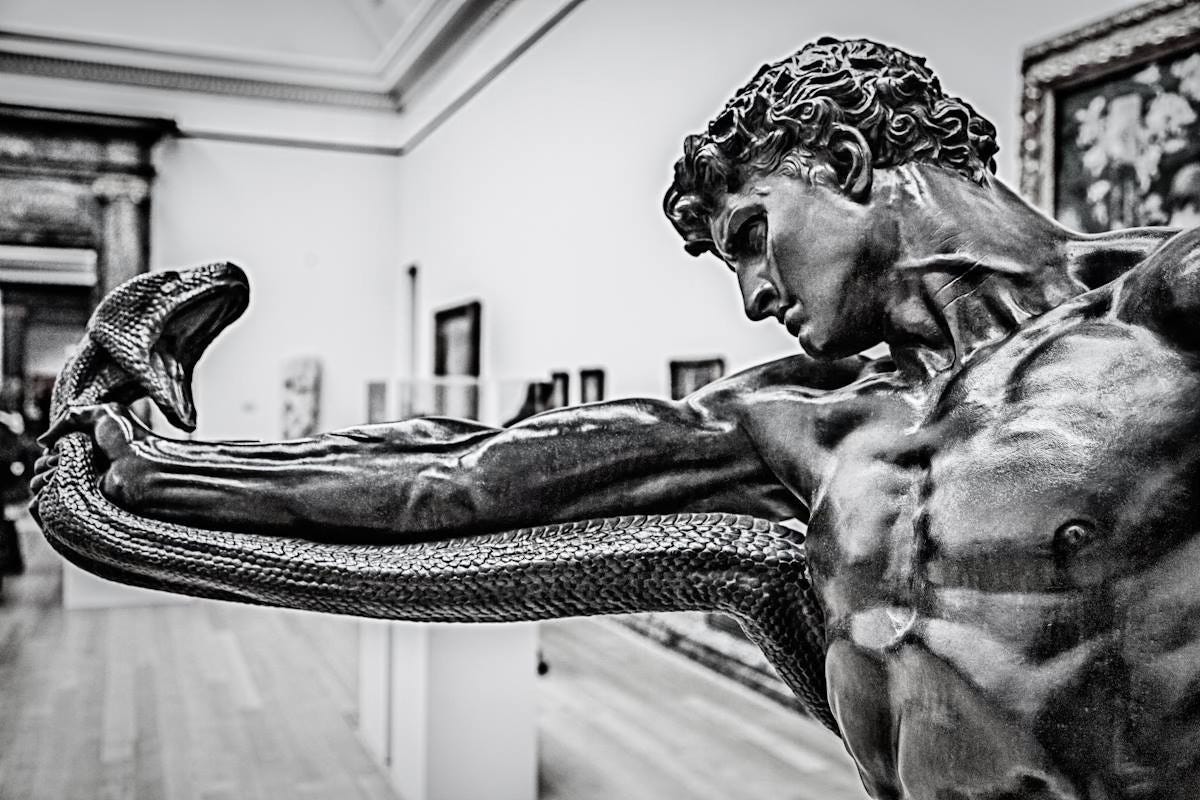
The clock is ticking. It has always been ticking, but for the longest time it was easy enough to ignore. No longer, though. All indications suggest that things are about to get wild out there. 2026 must be approached as a now-or-never year, with everything at stake. We will either prove worthy, or we will suffer the consequences. With that in mind, my aim in 2026 is to grow in virtue. The old and obvious answers are the best ones: the solution to almost every problem involves becoming better. Whatever is on the way, the cultivation of excellence is how a man makes ready.
Here are some notes on the path ahead and the virtues I aim to focus on: the theological, cardinal, and chivalric ones.
The Theological Virtues: Faith, Hope, Love
First things first: I need to get right with the Lord and live accordingly. Too often I approach the demands of the spiritual life as items on a checklist. Not to go too hard on obligations and duties—because there is obvious value in discharging them like a man—but mere obligations and duties tend to give rise to mechanical resentment and lifelessness.
The Lord’s line about the vine and branch (John 15:4-5) is the theme for the year:
Remain in me, as I remain in you. Just as a branch cannot bear fruit on its own unless it remains on the vine, so neither can you unless you remain in me.
I am the vine, you are the branches. Whoever remains in me and I in him will bear much fruit, because without me you can do nothing.
In other words, there is no flourishing apart from the source of all flourishing. If you sever yourself, you falter.
Faith
- Really attend Mass. Of course I already do attend Mass, but I don’t always really attend Mass. My resolution is to really be there, to put aside all other concerns and distractions and be attentive to what’s happening in the readings, prayers, and the Sacrament.
- Read the daily Mass readings every day—slowly, carefully, and maybe twice.
- Pray as though you are actually talking to a real person! I fall into a bad habit of merely mouthing the words, prayers to no one. No more!
- Listen to Archbishop Sheen’s Life Is Worth Living series.
Hope
- Don’t ever doom. Always remember Gandalf’s line: “Despair is for those who see the end beyond all doubt. We do not.” Things can—and do—turn in the most unexpected ways. Your job is to stay in the game and not freak out when things may be looking bleak.
- Walk. This is a great exercise in hope. In his meditations on the virtue, Josef Pieper notes that it is essentially the interaction of humility and magnanimity, and walks (especially silent ones) teach and train you in these. Humility: you confront realities about yourself when you cut the distractions and move through the world like the pilgrim you are. Magnanimity: you build resolve to aim higher when you’re in motion.
- Re-commit to studying heroes and saints. Learn about and be inspired by the possibilities.
- Never lie to yourself and never presume. Strive to see yourself as you really are, as God sees you. This gets back to the note about humility being a component of hope. The truth is I have not done nearly enough with the time and opportunities I’ve been given. So I have no ground for presumption. That is the essential fact which needs to inform all of my actions moving forward, and there’s something strangely invigorating about being honest with oneself.
Love
- Simply do your best for those who need help. Give what aid you can to the hungry, the lonely, the imprisoned (literally and figuratively). For me this includes volunteering at our homeless shelter, which is run by a very impressive and hard-nosed local lady. It is the least I can do.
Cardinal Virtues (Prudence, Justice, Courage, Temperance)
The cardinal virtues are the virtues on which the good life “hinges.” A man must know the good, do the good, conquer the fears that threaten your ability to do the good, moderate the attachments that threaten your ability to do the good. These follow directly from the theological virtues: the man who believes, hopes, and loves will want to do his utmost to live accordingly and make good things happen in this world.
Prudence
- Cultivate quiet. Noise, distraction, flashing lights, meaningless dopamine bursts—all of these threaten your ability to experience and know reality. The Lord speaks to you most clearly in the silence and does not wish to talk over or compete with all the noise you allow into your life.
- Pay attention. The way forward is less about formulating grand strategic plans and more about noticing opportunities as they arise. You cannot possibly account for all the details and variables that arise even in the near future, but you can be intensely present and focused on what is happening now and what chances are taking shape. The problem is that life is all about taking you out of this mode of attentiveness, so you must actively reclaim the power.
- Tap into a deeper wisdom. Prudence is ultimately not your own; it goes far beyond personal cleverness and cunning. It is about connecting to the ultimate source of wisdom. Making yourself more receptive to this is the first step.
- Study harder. Prudence is not first and foremost a virtue for scholars; it is a virtue for men of action. That said, good study will aid action. Read so as to know the truth about how things work, and read about people who have faced peril and intrigue and emerged triumphant.
Justice
- Always give others what they are owed. Understand how grave a failure it is to fall short in this. (Justice follows directly on the heels of prudence, as the extension or execution of it. To give others what they are owed requires that we first know what they are owed.)
Courage
- Believe in the Lord. Courage, like all virtues, is a gift from Heaven. On the simplest level, faith can put all the dangers of the world into perspective, showing them to be less fearsome than they might seem. He whose soul is ready can fight more aggressively.
- Build and invest in friendship. Courage is usually a social virtue. Guys who have your back—and who will ruthlessly make fun of you if you do something cowardly—are crucial.
- Train. You will be more ready to face the dangers before you if you have cultivated your talents and abilities.
- Face discomfort. When a man regularly confronts discomfort and difficulty, he often finds that those things weren’t quite as bad as we often build them up to be in our minds. This too is an aid to courage.
Temperance
- Fast more regularly. I’ve come to suspect that I might be a glutton. It’s less obvious because I’m in shape and because I do a few long fasts every year. But still I feast a little too regularly. Newman had a great line about how the only man who can truly feast is one who has fasted first. The key for me will be to do short fasts more frequently. Master your appetite.
- Be more careful on social media. This one is tricky because my project brings me to X and Substack and I even make a little money off of it. But one of the subtle consequences of too much time online is that my brain deteriorates and the quality of my posting declines. So I must establish better discipline. Must say a prayer before logging on, establish a hard stop at night, spend the morning hours well (not online), strive to do good in the digital realm, but always choose real life.
Chivalric Virtues: Prowess, Courtesy, Honor, Generosity, Loyalty
The chivalric virtues have a lot of overlap with the theological and cardinal virtues, and are more specifically the virtues which distinguish the Christian protector and noble.
Prowess
- Train for a fight. One of my goals is to win an amateur kickboxing match, which means I need to be ready in every way for the fire. This readiness will carry over to the rest of my life.
Courtesy
- Cultivate the composure and warmth of heart that naturally tend toward good manners and social graces. Strive to bring out the best in others with your conduct.
- Approach every conversation like it matters and like there is nothing else more important at that moment. Give your full attention to others. Listen to what they’re saying, as well as what they’re not saying.
Honor
- Prove worthy of an excellent reputation. (Honor is something like a meta-virtue in this regard.) Desire great things. And not just to have them, but to deserve them.
Generosity
- Transcend the transactional. Give without concern for repayment. Remember the line from Sr Fernandez de Castro’s biography of St Fernando III: “God will not allow himself to be outdone in generosity.” Money, time, and talents take on extraordinary power when they are given away.
Loyalty
- Build your fire team, your mesnie.1 Remember the line from Bronze Age Mindset: “Every great thing in the past was done through strong friendships between two men, or brotherhoods of men, and this includes all great political things, all acts of political freedom and power. The modern zoo wants you instead to be a weak and isolated ‘individual.’”
- Be near your people. I am in the process—thanks be to God—of pulling off a great coup which would put me not just in the same small city as my closest friends, but even in the same neighborhood as a few of them. So much of modern life is about encouraging and establishing physical distance, breaking apart those bonds of solidarity. This makes isolated, atomized individuals of us all, and makes us weaker.
[Normally I include faith as the final chivalric virtue, in order to convey that the code is a deeply Christian one. But because it was already mentioned above, I’m not going to repeat myself.]
I love this description from Asbridge’s biography of William the Marshal: “The mesnie was the retinue of knights who gathered around a lord—the tightknit group of warriors serving as elite troops and trusted bodyguards. In many cases the knights in a noble’s mesnie became like members of his extended family—steadfast supporters and valued advisors. The sense of an intimate community was conveyed by the word mesnie because it derived from the Latin term mansio (household) and could be used interchangeably with another Latin word familia (military household). Crucially, the concept of the mesnie imposed a degree of obligation on both parties involved. Knights served their lord, fighting in the field, showing allegiance and fidelity, but in return a noble was expected to shelter his warriors, protecting their status and advancing their careers. In real terms, this meant not only paying for a knight’s living costs and funding the upkeep of their equipment, arms, and horses; it could also involve rewards of land and title, even the arrangement of an advantageous marriage.” Obviously our mesnies will not have feudal hierarchy to them. But the bonds of mutual loyalties provide a model nonetheless.
https://thechivalryguild.substack.com/p/virtue-maxxing-in-2026