
Controlled Dissent: The Hidden System That Broke Charlie Kirk
Newly obtained group messages, and a posthumous admission from a close ally, show that in the 48 hours before he died Charlie Kirk was openly severing the ties that had for years tethered him to the pro-Israel donor class. Those private revelations, when read against the public record and history of targeted removals, transform an already serious line of inquiry into a matter that requires immediate, independent forensic and legal scrutiny. Update (October 7, 2025): Andrew Kolvet of The Charlie Kirk Show has confirmed the authenticity of the leaked texts.
Forty-eight hours before the shot that felled him, Charlie Kirk told eight close friends—by his own hand—that he had just lost a “huge Jewish donor” worth $2 million a year because he refused to “cancel Tucker.” In the same thread he wrote, bluntly: “Jewish donors play into all the stereotypes. I cannot and will not be bullied like this. Leaving me no choice but to leave the pro-Israel cause.” Two days later he was dead.
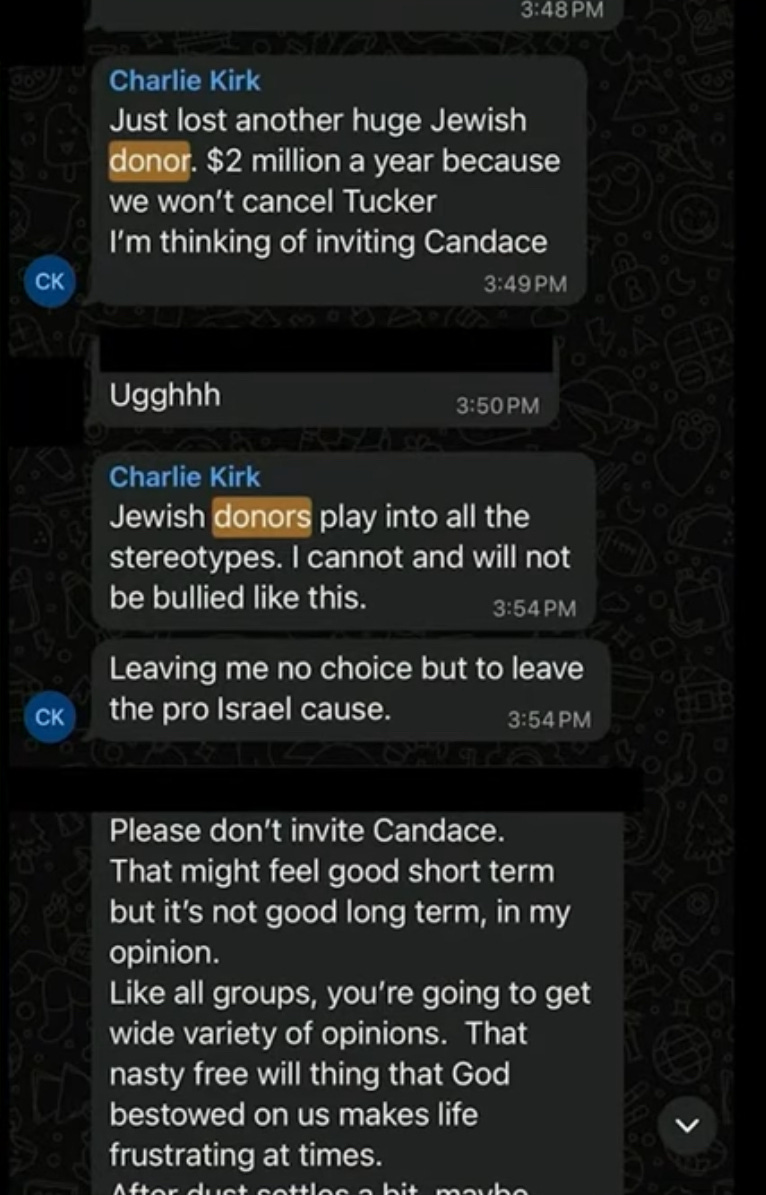
These newly surfaced messages mark the clearest proof yet that Charlie Kirk’s break from the pro-Israel donor and media machine was not a private dispute — it was a public rupture that stripped him of protection inside a system where loyalty equals survival. (read more)
As outlined in our previous investigation tracing Israel’s long record of eliminating figures deemed “existential threats,” the state’s real wars were never with groups like Hαmαs or ISIS — factions it has alternately cultivated, tolerated, or fought when convenient. The true danger has always been ideological: voices capable of undermining the legitimacy of the project itself.
And that is precisely what Charlie Kirk became.
Not a soldier. Not a spy. But a leader of America’s conservative youth, the very generation now turning away from Israel. Through TPUSA, he stood at the breach between Israel and the last pillar of its American shield — the right-wing base that guarantees vetoes, funding, and silence. To lose him was to risk the collapse of that shield entirely.
“Verbal antisemitism is much stronger these days than physical antisemitism.” — said early in the interview.
“If this guy will risk our existence, we will take him out.” — said later in the same interview.
— Yossi Cohen, former Mossad chief.
Quotes taken from the following interview:
Placed beside Kirk’s private confession — “Leaving me no choice but to leave the pro-Israel cause” — these statements fuse into a single, chilling logic:
When influence threatens Israel’s political lifeline, it becomes a matter of national security.Subscribe
The Enforcement Logic: When Power Polices Its Own
The newly revealed messages don’t just confirm tension—they reveal a system of ideological enforcement operating through financial control. Kirk’s message about losing a $2 million donor isn’t a stray complaint; it’s a window into the machinery that governs American political loyalty. Money doesn’t just sustain influence—it disciplines it.
What first appeared to be a private donor dispute now aligns with a broader architecture of control. The earlier episode I described—billionaire Robert Shillman’s public announcement that he would cut Kirk off—now reads not as a singular act of anger but as a staged ritual of punishment. The performance element matters: it wasn’t merely about withdrawing funds, but about signaling to every other dependent figure the cost of deviation.
“What killed Charlie Kirk wasn’t a bullet—it was the moment he stopped obeying.”
The structure that elevated him required total submission to its narrative hierarchy. Once he challenged it, protection was revoked.
Structural Exposure
Kirk’s exposure wasn’t accidental—it was engineered by the role he played. As the face of youth conservatism, he sat at the intersection where ideology, finance, and generational influence converged. That position made him invaluable, but also impossible to defy without consequence.
The danger began the moment Kirk granted visibility to conversations the donor bloc deemed forbidden—figures like Tucker Carlson, or subjects like the Epstein–intelligence web, or giving Candace Owens a stage. These weren’t random provocations; they represented a shift from obedience to inquiry. Each act cracked the illusion of unanimity the system relied upon to sustain legitimacy.
Charlie Kirk’s private stance—refusing to cancel friends or hosts for donor comfort—marked a direct breach of the unspoken contract that binds institutional influence: loyalty above truth.Subscribe
Turning Point USA, IHRA, and the ADL’s Extremist Label
Charlie Kirk’s Turning Point USA (TPUSA) became a lightning rod for scrutiny under the International Holocaust Remembrance Alliance (IHRA) working definition of antisemitism, which explicitly flags as antisemitic “claiming that the State of Israel, by its policies, is guilty of a crime against humanity,” and broadly, targeting those who question Israel’s military or political actions. Kirk’s public resistance to Israel dragging the United States toward a war with Iran put him directly in this crosshairs. TPUSA’s leadership and its campus activists were repeatedly flagged by the Anti-Defamation League (ADL) for “racist or bigoted comments” in its Glossary of Extremism, and TPUSA was labeled as “extremist.”
The ADL’s historical role underscores the weight of this designation. During the 1980s and 1990s, it maintained secret surveillance files on American political groups, often prompting legal challenges and financial settlements. In 1996, for instance, the ADL paid $200,000 to settle a lawsuit alleging unlawful spying on U.S. citizens. That legacy illustrates how labeling—financial, political, or moral—can be weaponized in domestic contexts.
The Jewish Defense League (JDL), founded by Meir Kahane, complements this historical pattern. Classified as a terrorist group by the FBI since 2001, its members engaged in violent acts, some of which resulted in targeted assassinations on U.S. soil. Remarkably, one former member, Yechiel Leiter, now serves as Israel’s Ambassador to the United States, exemplifying the complex and enduring links between militant activism, political surveillance, and formal diplomatic roles.
Placed in this context, Charlie Kirk’s trajectory becomes clearer: his refusal to cancel allies or align unquestioningly with Israel’s political imperatives rendered him structurally vulnerable. TPUSA was not just a youth movement—it was the last significant ideological bulwark capable of channeling conservative American support in ways favorable to Israel. By granting platforms to Tucker Carlson, scrutinizing the Epstein–Israel intelligence nexus, and resisting donor orthodoxy, Kirk broke the tacit contract that historically guaranteed influence, financial security, and survival.
This intersection of IHRA-defined antisemitism, ADL surveillance practices, and historical patterns of targeted silencing demonstrates that Kirk’s marginalization was not merely rhetorical—it was embedded within an infrastructure historically willing to enforce compliance, sometimes violently. The message is unmistakable: influence that challenges the established coalition protecting Israel is treated as an existential threat, even within America’s political heartlands.
The Panic Code
In the days following Charlie Kirk’s assassination, Turning Point USA held an event—hosted not by its founder, but by Megyn Kelly. Her remark on stage, “Israel has lost the left and independents; only the right remains,” was more than commentary—it was confession. It served as a decoding cipher for the panic coursing through the donor network Kirk had disrupted.
Read against the backdrop of Charlie Kirk’s leaked communications and the ADL–IHRA framework that redefined dissent as antisemitism, Kelly’s remark exposes the scale of the rupture. Kirk wasn’t simply testing boundaries—he was rewriting allegiance inside the last demographic still considered safely loyal. Charlie’s stance risked birthing a generation of conservatives untethered from donor orthodoxy and unafraid to question Israel’s political sanctity. For those whose power relies on that sanctity, such independence wasn’t disagreement—it was infection.
Charlie Kirk refusal to accept the IHRA’s politicized definition of antisemitism, particularly its clause equating criticism of Israel with hate speech, positioned him as a threat to the structure that governed conservative obedience. The ADL’s historical surveillance practices, the JDL’s violent legacy, and the quiet rehabilitation of figures like former JDL member and current Israeli Ambassador Yechiel Leiter all frame this panic as more than ideological. It was systemic—a security breach inside an ecosystem built on narrative control.
The Internal Undoing
The true meaning of Kirk’s rupture is systemic, not personal. His downfall illustrates how empire disciplines its intermediaries: by coding financial obedience into ideological survival. Once he broke formation, the same apparatus that had amplified him became the weapon that erased him.
Charlie Kirk wasn’t silenced by external enemies but by the very infrastructure that once celebrated him as its prodigy. His rebellion—measured, principled, and internally sourced—revealed a deeper crisis: that even within the right’s fortress, the consensus on Israel’s untouchable status was beginning to fracture.
Charlie wasn’t just punished for disloyalty—he was neutralized for being contagious. The movement didn’t fear his opinions; it feared his influence.
And that, ultimately, is the quiet revelation beneath every leaked message and every vanished ally: that the line between loyalty and liability is drawn not by conviction, but by who controls the purse.
The Final Obedience
The arc of this story ends not in mystery, but in pattern. What happened to Charlie Kirk mirrors a logic older than the headlines: systems protect themselves by erasing what exposes their dependence. Power sustains itself through selective silence, not random tragedy.
This isn’t to claim certainty about who pulled the trigger—only to acknowledge that the operation bears the unmistakable fingerprints of professional intelligence. When mapped against the political stakes, the timing, and the cascading financial pressure preceding his death, the most probable axis of motive points toward Israeli interests—unless future evidence shifts that conclusion.
In the end, Kirk’s death reads as the logical punctuation to a script he dared to revise. He tested the boundaries of loyalty in a system that permits dissent only as spectacle. What followed was not chaos, but order—an order restored by the quiet hand of those who cannot afford contagion.
https://phantompain1984.substack.com/p/controlled-dissent-the-hidden-system