
The Reckoning Few See Coming
A moral-social reckoning is baked into the soaring inequality and artifice that characterizes the present era globally.
I highly recommend reading my colleague Simon Pearce’s succinct yet comprehensive explanation of historian Peter Turchin’s key driver of historical cycles, Elite Overproduction: Democracy’s Edge: Elite Overproduction: Part 1: How surplus, status, and aspiration turn stability into instability.
Simon explains how the same forces that generated prosperity end up fueling a “wealth pump” that concentrates wealth and power in the hands of the few. His takeaway (as I understand it) is it’s important to understand that these dynamics are morally neutral, as they are systemic in nature.
This is an important point about systems dynamics: they operate independently of what we see as the drivers of history: ideology, religion, etc.
This engages our rational mind, which makes sense of the world in a scientific-observational manner. But as a thought experiment, imagine telling those who have been immiserated and impoverished by these dynamics: “It’s nothing personal, you’re poor and precarious now because that’s the way these dynamics play out.”
The abstract rationality of systems analysis isn’t the only way humans make sense of the world; our emotional and social intelligence makes sense of the world as a moral universe of obligations and fairness that isn’t erased by a rationalist method of making sense of the world; the two ways of making sense are fundamental to our nature and co-exist.
In other words, we understand systems dynamics rationally as abstractions, but we experience the consequences of these dynamics in a completely different way: we sense the unfairness of most of the gains going to a minority while we worked hard and contributed to the gains, and our blood boils at the injustice of this unfair distribution of the gains of our efforts and sacrifices.
In terms of power, we feel the injustice of a system that claims to give us all a voice in decisions that affect us all, yet the power is concentrated in an unelected technocrat elite and a handful of moguls.
This emotional and social intelligence is our core selective advantage, for this is what enables cooperative efforts and the collection and distribution of knowledge.
In summary: our experience of the consequences of impersonal systems dynamics is innately emotional and social, and these are experienced in an innately moral universe of obligations fulfilled or shirked and fairness fulfilled or violated by exploitation, coercion, trickery (now called narrative control) or fraud / free-riding.
As I explain in my book Investing in Revolution, the foundation of civilization is social, and so a moral-social reckoning is baked into the soaring inequality and artifice that characterizes the present era globally. The grievances of unfairness and exploitation lead to either retribution or redress.
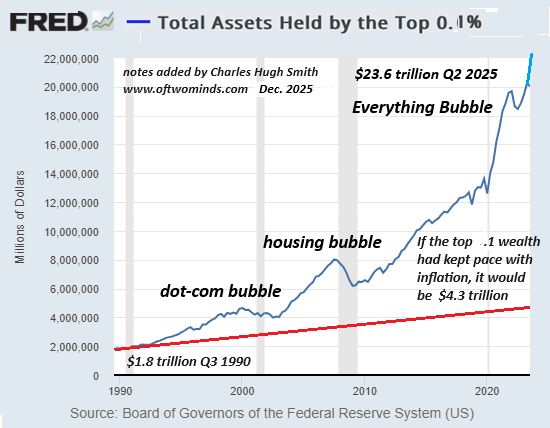
Financially, this extreme of inequality follows a power law: those few at the top collect the vast majority of the gains of the economy.
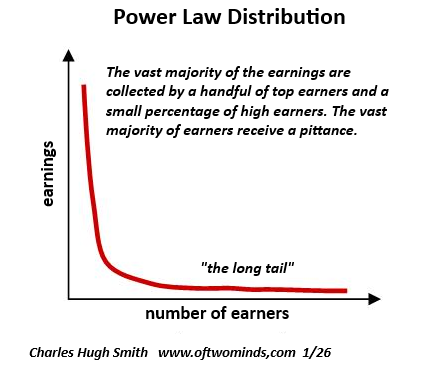
Retribution can be formal, moderated by a social consensus / accord, or it can be extremely chaotic and messy. Redress, by its very nature, is formalized into a forum where the facts are publicly exposed and redress is administered, accompanied by apologies and forgiveness–the essential role of emotional intelligence in the process.
Few seem to understand that this reckoning of extremes of exploitation and unfairness will manifest regardless of political machinations, ideology or rationalist policy formulations. How it plays out depends on the strength of the repression applied to suppress it / maintain the status quo inequality and the extremes of immiseration experienced by the bottom 60%–and just as importantly, the unanticipated immiseration experienced by those who assumed themselves protected from precarity, those in the 61% to 89% income/wealth bracket, “the middle class” of elite aspirants (i.e. those credentialed by higher education) who have been over-produced without fully grasping the system was incapable of expanding the economic slots they took as their birthright.
The larger point here is making sense of novel complex circumstances with narrowly focused conventional tools generates a higher order delusion of comprehension.
https://charleshughsmith.substack.com/p/the-reckoning-few-see-coming