
The Irreversible Split of the West
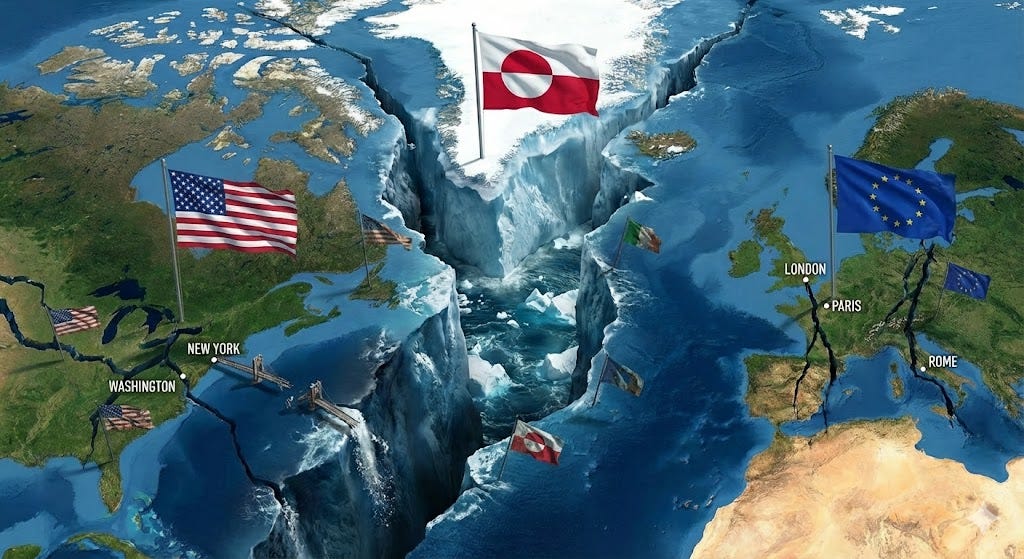
A fundamental transformation of the entire global architecture.
Alexander Dugin on the irreversible fracture of the West, Trump’s imperial gambits, and the emergence of five competing Western poles.
Conversation with Alexander Dugin on the Sputnik TV program Escalation.
Host: The holidays at the beginning of 2026 brought news that inevitably recalls the great deals of the past. The press is actively discussing Donald Trump’s initiative regarding Greenland, comparing it to the purchase of Alaska. They say that if Trump manages to acquire the island, his name will stand alongside that of the greatest U.S. presidents. In your view, is the acquisition of Greenland one of Trump’s main goals for the United States, a way for him to enter history?
Alexander Dugin: I think Trump certainly has such a goal, but it is not his primary one. Before our eyes, a fundamental transformation of the entire global architecture is taking place. In U.S. history, alongside the purchase of Alaska, there was also the Louisiana Purchase, which had belonged to a completely different regime, as well as the war with Mexico, after which the United States annexed two-thirds of its territory. The expansion of a sphere of influence is a constant of American policy.
Today Trump has proclaimed a “Monroe Doctrine” with his own “corollary,” meaning the assertion of the United States as the sole hegemon in the Western Hemisphere. We saw this in the case of Venezuela: the abduction of Maduro and the forcing of the country to its knees virtually without a single shot. Now American politicians run things there as if it were their own backyard, and Trump does not accidentally write on social media that he is the “acting president of Argentina.” In this logic, Greenland is a natural geographic extension of the North American continent.
However, Trump will not stop there. Canada’s current prime minister is already, in effect, preparing for war with the United States—Canada should brace itself as the next target. I think Trump will get his way both with Greenland and with Canada. While problems may still arise with South America, the absorption of Canada will simply be “swallowed” by the world. Some will say we were unlucky to get such a president; others will say that he truly made America great again.
The situation around Greenland exposes a crucial fact: the complete split of the West. The unified West no longer exists. It can fight us, Iran, or Venezuela, but now it is ready to fight within itself as well. We saw the pitiful attempts by the European Union to send a few troops to Greenland to “protect” it from a fictitious threat from Russia and China. But as soon as Trump issued an ultimatum on tariffs, Friedrich Merz immediately withdrew his group.
Trump openly tells Europeans: “You are my vassals, do what I order.” Told to make peace with the Russians—make peace. Told to hand over Greenland—hand it over. Told to support Netanyahu—support him. For decades, the globalist leadership of the United States created the illusion that Europe was a partner with a voice. Now those illusions have shattered. Trump tells them directly: “You are nobody, just hired hands, pizza delivery boys or migrant workers. If I take Greenland, you must respond: ‘Oh dear Daddy Trump, take it quickly, save us from the evil Russians and Chinese with their submarines.’” That is the world we are in: Trump pounds his fist on the table, and Europe—having briefly tried to claim it would defend Greenland from America—quickly capitulates.
Trump is prepared to dismantle NATO, since the alliance already consists of 95 percent U.S. resources anyway. What is happening today is not just a colossal humiliation of Europe (emotions will pass), it is the end of the former collective West. The Greenland episode has become a litmus test, revealing a unique picture: a once-united monolith, with which we were still fighting just a year ago, has broken apart into five different poles.
The first West is Trump himself. He declares: “I am the West, and everyone else is just scenery.” He behaves like a cowboy ready to “bomb” everyone—enemies and allies alike—recognizing no one else as a sovereign subject. For him, only the U.S. president exists; everyone else is nobody.
The second West is the European Union. It suddenly discovered that it is no longer even a “junior partner.” The EU has been stripped of subjectivity, effectively castrated politically. For European elites accustomed to at least formal admission into the “men’s club,” this was an absolute shock. They were told outright: your opinion on Ukraine or Greenland is of no interest to anyone.
The third is England. It has found itself in a strange position: seemingly close to the United States, yet hit by Trump’s tariffs because of its criticism of the Greenland deal. Britain is no longer the conductor of the EU (after Brexit), but it is not a U.S. puppet either. It is a separate, autonomous player.
The fourth consists of the globalist remnants. This is the “deep state” in the United States, the Democrats, who watch Trump with horror, realizing that they are next in line for a purge. Their representatives are still strong within EU and British structures, and they continue to speak of global domination even as the ground slips out from under their feet. Even Macron is already talking about leaving NATO, and Merz is considering rapprochement with Russia, having grasped the scale of the losses.
Finally, the fifth West is Israel: a small country that behaves as if it were the center of the world. In a messianic frenzy, Netanyahu is building a “Greater Israel,” using extremely brutal methods and forcing everyone to assist him. It turns out that Israel is not a Western outpost, but a force that in many ways itself manages America through pro-Israeli networks.
In the end, instead of one enemy, we face five different “Western poles.” Our eyes dart around: whom should we make deals with? Who here is truly sovereign, and who is merely pretending? The stratification of the West into these five parts is the main outcome of the current crisis.
Host: A question from a listener: “Alexander Gelyevich [Dugin], what is the reason that Trump changed tactics so sharply after the New Year? Venezuela, Greenland, tanker seizures—why do we see such a rapid intensification of actions by the American president?”
Alexander Dugin: First, I think Trump has run into extremely powerful domestic opposition within the United States itself, and he vitally needs to consolidate his position through successes on the international stage. He was elected to restore order at home, but that has proven extraordinarily difficult. It turned out that virtually the entire judicial system in America is under Soros’s control: so-called “activist judges,” instead of law and justice, are guided by liberal ideology and always rule against Trump.
This has begun to stall all internal processes. Protests against federal border enforcement agencies erupted, escalating into clashes with casualties. Many governors effectively sabotage his directives. Trump has begun to bog down domestically: the Epstein list has still not been published, and many legitimate grievances have accumulated against him. He realized that he could spend three years fighting these corrupt liberals and get nowhere, while the 2026 midterm elections loom ahead—elections he has every chance of losing.
I believe pollsters and PR advisers told him plainly: domestic resources are exhausted, a new argument is needed. Something must be annexed, someone kidnapped, defeated, frightened, or humiliated. Then he will gain leverage for domestic politics. Trump understands that time is vanishing rapidly—both biological time and presidential time. He decided that 2026 is the line beyond which delay is no longer possible.
The annexation of Greenland, the effective start of a war with Canada, the dissolution of NATO, and the dismantling of the UN—all of this forms part of an agenda for a global redivision of the world. Against this backdrop, Trump’s domestic enemies fade into the background: it is far harder to remove a president who has acquired colossal territories for the United States and restored its status as a frightening power. After Biden, America began to be treated with mockery, but Trump reminded the world that he is a “rabid despot,” capable of striking anywhere at any moment.
Humanity shuddered. We, of course, are no fools either and are ready for challenges, but it is important to understand: this is no longer the old, dying globalist system; it is something else. Trump uses any means: utterly immoral and unlawful ones. He openly declares that international law no longer exists, and that he himself will decide what is moral and what is not.
The cowboy said it—the cowboy did it. He burst into world politics like a saloon in the Wild West, shot the opponents, and declared himself sheriff. Trump is the embodiment of this “Wild West,” with all its repulsive and, for some, charming traits. If Europe today is an old, senile “nursing home,” reminiscent of Thomas Mann’s The Magic Mountain, where degenerates live out their days at the expense of migrant labor, then Trump is a young, aggressive, predatory force. His shift to an active foreign policy is entirely rational.
Host: Important forecasts are already being voiced at the official level. The president’s special representative Kirill Dmitriev noted that amid Trump’s tougher actions, Europe may begin to pivot towards dialogue with Russia. How realistic is such a scenario under the current governments of that “fifth of the West” you mentioned? After all, for both geopolitical and geographic reasons, it is objectively more advantageous for Europe now to begin such a turn.
Alexander Dugin: You know, if a year or a year and a half ago—indeed, even a couple of months ago—we had begun talking about the United States seriously raising the issue of annexing Greenland, it would have seemed so unrealistic that even people with the most avant-garde geopolitical thinking would have called it impossible.
To imagine that Europe would first prepare to fight America over Greenland, and then that this resolve would not last even a week, ending in a retreat—last autumn this would have seemed inconceivable. We still dreamed that Europe possessed at least some degree of sovereignty.
Today Europeans find themselves in entirely new, shock conditions. Before, they could quarrel with Trump over trifles, such as the scale of support for Kiev. For Trump himself, this is not especially important: his image as a “peacemaker” was merely a smokescreen, a fog. It is no accident that he effectively restored the Pentagon’s status as a Ministry of War—this alone says everything. He does not care about real peace, nor about a ceasefire in Ukraine. He is solving his own, purely American tasks.
Trump told the Europeans outright: “Quickly conclude a ceasefire with the Russians on the terms I myself agreed to in Anchorage.” Europe initially responded arrogantly: “We are a coalition of the willing, we will support Ukraine and manage without you.” Trump shot back: “Manage, then put Greenland on the table and survive however you can.” Europe stumbled into this situation suddenly, without preparation. Panic now reigns there.
The fact that Macron began, in the heat of the moment, to speak of leaving NATO, and that Friedrich Merz oscillates between acknowledging the collapse of the German economy due to the break with Russia and attempts to ingratiate himself with Washington—this is classic hysteria. The European Union is in panic. Today’s European leaders are relics of the old system: people of Soros, of the Davos Forum, adherents of Fukuyama’s model, which has finally gone under.
In this agony, they may propose any scenario, even the most fantastic ones. Including: “Why not lean on Russia? Why not reconsider relations with Putin?” How serious this is remains a big question. For now, such a turn seems unlikely, but under the conditions of the global redivision of the world that Trump has set in motion, absolutely nothing can be ruled out.
Host: Let us not stray far from the topic of Donald Trump. This time, let us discuss his initiative to create a Board of Peace to govern the Gaza Strip. News has just crossed the wires: the Russian president’s press secretary confirmed that Donald Trump invited Vladimir Putin to join this board. What exactly will this body do, and how effective can it be under current conditions?
Alexander Dugin: I think Trump, having rolled up his sleeves, has truly embarked on a radical redrawing of the world’s political map. International law, embodied in the UN, reflected a balance of power nearly a century old—a bipolar world in which two superpowers conducted a dialogue while all other countries served merely as extras. When the Soviet Union committed geopolitical suicide, this system effectively outlived itself. Americans have repeatedly raised the question of dissolving the UN and replacing it with some sort of “League of Democracies,” where instead of dialogue there would be a U.S. monologue accompanied by approving silence from the audience.
Today the collective West has split into the five blocs we discussed. Each has its own program, but the Trump–Netanyahu tandem stands out in particular. The latter increasingly openly proclaims himself the “King of the Jews,” implementing the messianic project of a “Greater Israel.” Ideas of exterminating Palestinians and expanding borders from sea to sea, set out in radical texts like The King’s Torah, are no longer mere conspiracy theories—they are reflected in the symbolism of the IDF itself.
Trump, as a specific kind of Christian Zionist, is burdened by old institutions. He needs something new, and he begins to fashion alternative structures—such as the “Board of Peace”—around the region that is central in his eschatological geopolitics. That region is Israel and Gaza. Trump wants to create an institution without globalist activists like Greta Thunberg and her flotillas, consisting only of those who will not contradict his friend Netanyahu. This is also a unipolar model, but in a new, “mystical” configuration.
As for the invitation to Vladimir Putin to join this board: the information requires verification. If Trump truly made such a move, then he mistakenly assumes that our position on Israel is softer than that of Western globalists. In reality, we categorically condemn the genocide in Gaza and consider Netanyahu’s methods absolutely unacceptable. Trump hopes to surround himself with those he trusts, but on the Palestinian tragedy our views are unlikely to coincide with his vision of a “new order.”
Host: This has just been confirmed by Dmitry Peskov, the presidential press secretary. It is official information, confirmed by the Kremlin: the invitation to Vladimir Putin has indeed been extended.
Alexander Dugin: Then it is quite obvious that Trump is confident in us and in the assumption that we will support his initiative. He is equally confident that those he deliberately did not invite to this “Board of Peace” will oppose it. This event—the invitation to Vladimir Putin—lies in the same vein as the Greenland story. We are, of course, not thrilled by the deal to purchase the island, but by and large Greenland concerns us far less than Venezuela, Iran, and certainly Ukraine. Europeans themselves understand perfectly well: if Trump absorbs Greenland, Ukraine will be instantly forgotten—there will simply be no time for it.
Trump’s image as an opponent of interventions turned out to be nothing more than political fog. He promised to be a “president of peace,” but in practice he calmly intervenes wherever he wishes, threatens everyone with war, and effectively turns the defense department into a “Ministry of Offense” or a Ministry of War. Peacemaking for him is merely a signboard. He does not truly believe in it. His real goal is to strengthen American hegemony at everyone’s expense—at ours, at China’s, and, as it turns out, at Europe’s.
Trump views Europe as an annoying misunderstanding, like a rebellious branch of his own retail chain that decided to push its own merchandise in his shop. Their disobedience irritates him far more than our calm, sovereign, and distanced position. We do not provoke; we behave consistently: everything we declare, we carry out, and everything we do, we articulate in terms he understands. This does not make Trump our friend—he is a friend only to himself. I am not sure he is even a friend to the American people, since his policy could end in catastrophe. He risks everything, like a hussar who has staked on cards his estates, his family, and his future. Such players sometimes get lucky, but more often they lose everything at once.
Trump is a risk-taking bully who has put everything on the line. The stakes in this Great Game are raised to the limit. His moves are unexpected: the invitation of Russia to the Gaza board was likely made to spite the European Union, to show them, “Look what I can do.” For globalists who, during Trump’s first term, branded him a “Kremlin agent,” this invitation looks like a nightmare come to life. “Putin-friend” invited his “friend”—for them, this is the end of the familiar world.
However, it is difficult to expect real peace in Palestine: the fate of the long-suffering people lies in the hands of those who can be called executioners and maniacs. Russia currently lacks the ability to dictate its terms forcefully in this region without risking angering Trump as he angered Europe. This invitation is an offer that our president will examine with the utmost responsibility. We do not need handouts. We will see whether China and other BRICS countries join this board—this is precisely our multipolar understanding of order: an alternative one, neither UN-based nor globalist.
The world today is not a black-and-white picture, but a “philosophy of complexity,” which the president spoke about at Valdai. We are in a situation of quantum mechanics in international politics. Classical mechanics, with its inertia and calculable trajectories of falling nuclear warheads, belongs to the past. Now wave laws apply. Extremely complex processes of superposition are underway, which suddenly “collapse” into the nation-state: one moment the prime minister speaks on behalf of the country, the next everything turns again into network waves where it is unclear where one begins and another ends.
I study daily the briefings of leading global analytical centers, and I get the impression that no one has a clear understanding of what is happening. Everyone describes his own universe with its own gravitational constants. We need an entirely new thought in international politics.
An invitation to a “Board of Peace” from a country with which we are effectively at war in Ukraine, while we condemn the aggression of its ally Israel, is a paradox that must be placed in the correct context.
Old maps with red lines no longer work. As Sergey Karaganov notes, even nuclear weapons are ceasing to be a deterrent in the usual sense—the question of their direct use now arises. We are in a state of phase transition: the water in the pot has either already boiled or is about to boil. This stochastic transition, described by the Navier–Stokes equations and fractal theory, is now fully transferring into world politics. Our analysts need to abandon old humanitarian templates and turn to new physics and the theory of superstructures.
Host: You mentioned the Ukrainian track, and its place in the current context is extremely intriguing. Now, judging by Western media publications, European politicians are literally rewriting their plans for Ukraine on the fly: the theses they were going to take to the Davos forum are being thrown into the trash, and all attention is shifting to Greenland. Do you think it is possible that now not only the United States, but Europe as well, will begin to gradually distance itself from Ukrainian events, allowing us, in effect, to end this conflict one-on-one with Kiev?
Alexander Dugin: That would be the optimal option, but I fear that no one will grant us such a luxury. Although I am convinced that Zelensky’s days are numbered. He will certainly be “canceled.” It is not a given that Zaluzhny will replace him—someone else may be installed instead. However, we should harbor no illusions: Trump himself is not ready to hand Ukraine over to us. Moreover, the existence of such a conflict hotspot on our own territory benefits him: it is classic leverage, a tool for managing us.
Trump will not give up Ukraine voluntarily. The plan he proposes, supposedly on our terms, is merely an attempt to freeze the conflict. They intend to regroup and create a deterrent center against us “just in case.” I do not think Trump considers us existential enemies, but he certainly does not want our strengthening. He understands that Russia cannot be defeated, but helping our growth is not part of his plans. On the contrary, his goal is to weaken us. Therefore, we should not count on his benevolence.
On the contrary, Trump will continue to apply pressure through sanctions, and it may even come to military provocations. Trump is no friend of ours. And although his opponents call him a “friend of Putin,” in reality that is not the case. He stands alone, for his own interests. In his strategy—even in its boldest versions—there is no idea of transferring Ukraine to Russia. A decisive Russian victory is not part of his plans, which means he will oppose us.
Unfortunately, we must rely exclusively on our own strength. We must use any favorable moment: the fluctuations accompanying a change of presidency in the United States, disagreements in Europe, corruption scandals shaking Ukraine, and the West’s shift of attention to Greenland. All of these are factors that must be taken into account. We have no choice but to act sovereignly, in our own interests and according to our own strategy.
We need a far bolder strategy than we have now: sovereign, active, fast, and effective. If you like, it must be Russian-style “mad,” because right now we are too rational and too kind.
(Translated from the Russian)
https://www.multipolarpress.com/p/the-irreversible-split-of-the-west