
Against the Boomer-Manichaean Heresy
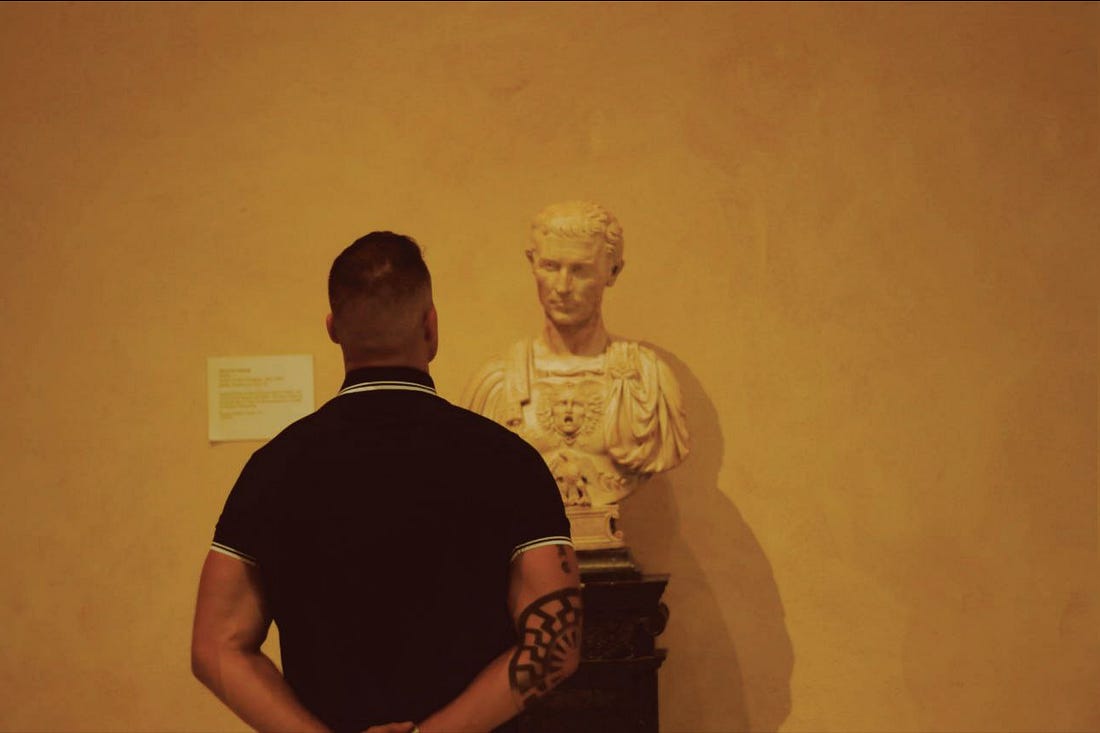
“It’s what’s on the inside that counts” was probably the supreme educational maxim of my formative years, drilled into our brains so religiously by teachers, pastors, gurus, and sloganeers that it challenged the Golden Rule as the great expression of moral wisdom for our times. Beneath the hokey sentimentality, the claim is a little radical. People who say it’s what’s on the inside that counts seem eager to revive a dualistic Manichaean understanding of the human person, as though we were co-created by rival deities: an evil one who makes physical things and a good one who makes spiritual things. So “outside” and “inside” are separate planes of being which not only have nothing to do with each other, but are at war. You’re a warzone.
I call this revived teaching the Boomer-Manichaean Heresy.1 It’s vaguer than what Mani taught long ago and is perfectly adapted for the moral tone of postwar America, capturing the sentimentalism, slackness, and decline. Why, for example, should you dress sharp (except for a truly special occasion)? People shouldn’t judge you based upon the effort you put (or didn’t put) into your appearance. They should care instead about what’s in your heart—and make maximally generous interpretations based on scant evidence. Or so we were told. Everyone was encouraged to just assume the best. What could go wrong?
Implied in this moralism is that appearances deceive, almost necessarily. Handsome, athletic, muscular men probably lack the inner goodness that portly and slovenly ones possess—because the handsome man cares about unimportant things and the slovenly one doesn’t. Vices are worked into virtues.
Prowess and Humility
Of course, the “inside” definitely does count. A man’s values and intentions matter. This obvious fact makes the heresy seem plausible, so long as one thinks about it only briefly and superficially. The problem is the assumption that the interior is the only thing that counts, and that it’s necessarily disassociated from appearances, exteriors, and physical realities. You are less a warzone than a largely unified whole—because what’s on the inside makes itself manifest in action and even in form, and external things can also shape and reinforce the interior. Case in point: the slovenly man who suddenly starts bathing, combing his hair, standing up straight, and wearing a collared-shirt tends to feel a transformative surge of self-respect.
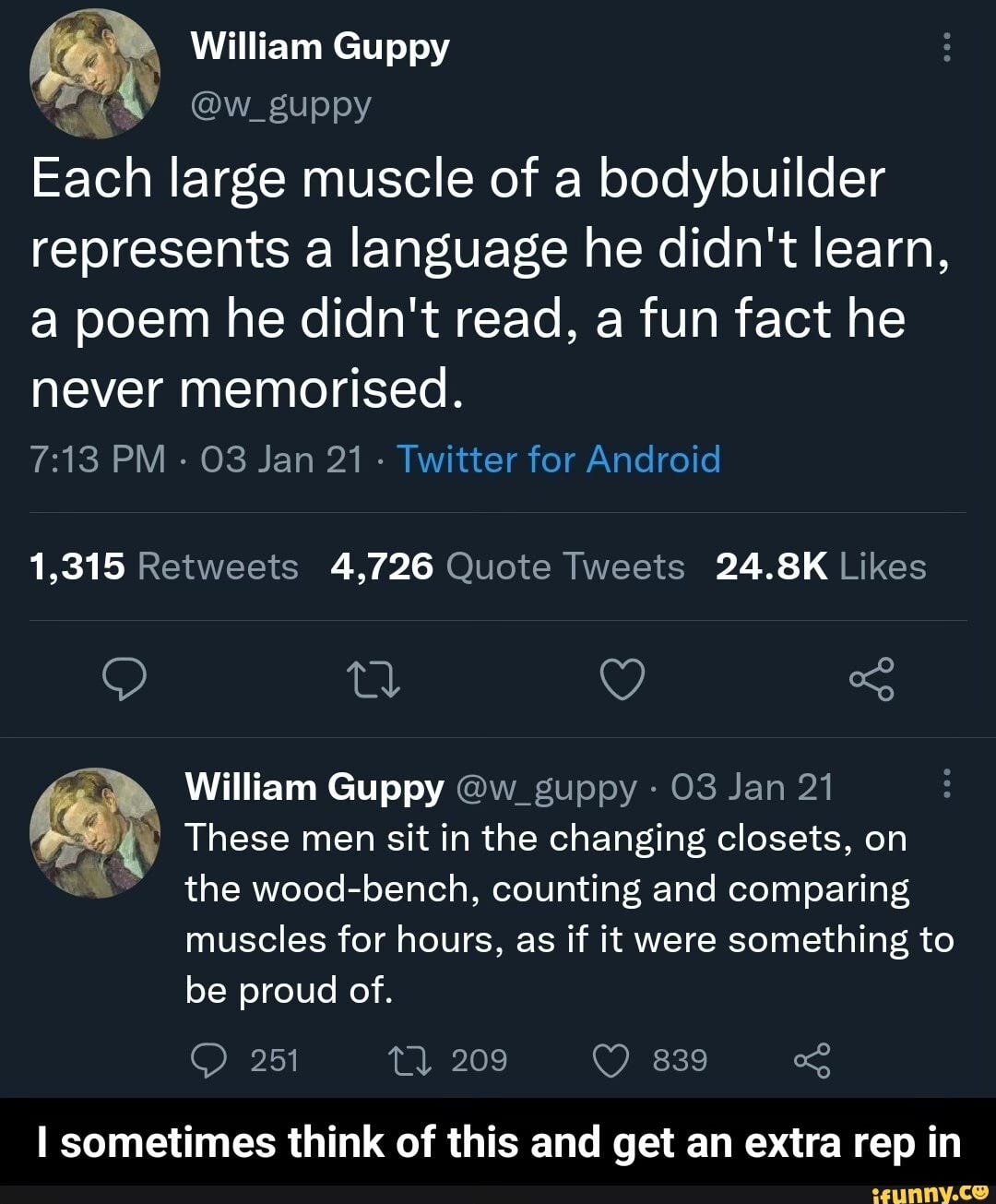
The gym is an almost perfect testing ground. Thanks to the teachings of the heretics, the normie mind is often inclined to dismiss physical training and prowess as a vain pursuit, a dismissal satirized by the famous tweet from William Guppy. People with substance, he asserts on behalf of the heretics, are more interested in memorizing poems and “fun facts” than getting stronger and looking the part.
But anyone who has ever sweated and exerted knows that moral virtues are trained along with the physical ones. Those who aren’t naturally eager to volunteer themselves for physical difficulty must make a prudential decision that something good will come out of the struggle and then must exercise the willpower to make it happen. Wholesome suffering cultivates courage and perseverance. Discipline is exercised also, as good choices are made into habit—and pretty soon the difficulties become a lot less difficult. Aristotle 101. Such developments have obvious connection to things beyond the gym: training is basically a literal metaphor for the rest of life, and the experience puts an end to the lie of strict separation between inside and outside.
The most interesting tie is between prowess and humility.
It’s important to get definitions right. Humility correctly understood has almost nothing to do with the performative lowliness, stooped shoulders, and renounced aspiration. “I’m too impressed with my own unimportance even to think of aiming for anything high” is a form of wicked fake humility, which Augustine labels as “grievous pride.” True humility instead has everything to do with self-knowledge—and the first thing that a man with self-knowledge must admit is that he’s not God. Everything else follows from this admission. Josef Pieper writes in Faith Hope Love that “Humility is not primarily an attitude that pertains to the relationship of man to man: it is the attitude of man before the face of God. Humility is the knowledge and acceptance of the inexpressible distance between Creator and creature.”
In other words, being a mere mortal means you have limits, and humility is accurate knowledge of your own limits. Physical training teaches your limits concretely: you can only lift so much, punch so hard, run so fast, endure so long. Anyone who enters the gym implicitly acknowledges that he’s not as strong as he’d like to be, and the purpose of his visit is to address that weakness and improve himself, if only just a little. A little today, a little tomorrow, a little the day after (thus exercising the virtue of patience in addition to the others).
So the claim that lifting and training is “vain” has it quite backwards. As the infamous poster William wheelwright once noted, it’s truer to say that vain delusions meet their demise in the gym, where a man constantly learns and relearns the limits of his strength. There’s nothing necessarily modest or humble about avoiding these challenges—especially when others are counting on you to be physically strong enough to protect them.2
That’s not to say there aren’t pitfalls to be avoided. Though most lifters are good guys, their pursuit most certainly can lead to problems. All the best things can become “problematic”: food and sex, for instance, which are so important that human life would come to halt without them, but which also can occasion attachment, gluttony, obesity, lust, infidelity, and so on. It’s hardly unique to physical training—or a convincing indictment of it—that some people take it to dark and strange places.
But the vanity of a few weight-lifters is far less disastrous than the pitfalls of Boomer-Manichaeism—like a massive epidemic of rotundity (73.6% of Americans are overweight or obese, last time I checked). In fancying themselves crusaders against shallowness, the heretics fail to realize that those who disregard appearances are as shallow as those who fixate on them. They’re just nicer in their shallowness. The heresy ultimately underwrites the deterioration of the human form by celebrating those with bad habits and lauding their shortcomings as signs of higher sensibilities. Rather than tough love, heretics offer weaponized reverse-judgmentalism and “Body Positivity.”
We don’t need to assign a direct correlation between max pull-ups and moral virtue, but fitness obviously matters. And the decline of bodily vitality is not merely a physical problem. The mass corpulence of our society indicates legions of scientific, economic, and ethical errors—a failure to understand human flourishing and create conditions which make it possible. It also invites political tyranny. Rotund men who cannot climb two flights of stairs without needing medical attention afterward pose little challenge to the will of petty tyrants or globalist tycoons. They are much better suited for a life of consuming, obeying, sleeping, and repeating. If your men are all fat and weak, your society is garbage.3
On a more personal level the deterioration of the physical body brings a decline in courtesy, warm-heartedness, and social grace—as low-energy, low vitality fellows tend to be tired, moody, and anxious. Everything is worse.
One of the things I love about chivalry is its rejection of the false dichotomies which tell us that moral and physical excellence are somehow mutually exclusive. The aspiring knight strives to be just, honorable, courteous while also cultivating the martial ferocity needed to put bad men down. We’re going to need a revival of both kinds of excellence if we’re going to have a chance. This is why chivalry is an ideal whose time has come again.
https://thechivalryguild.substack.com/p/against-the-boomer-manichaean-heresy